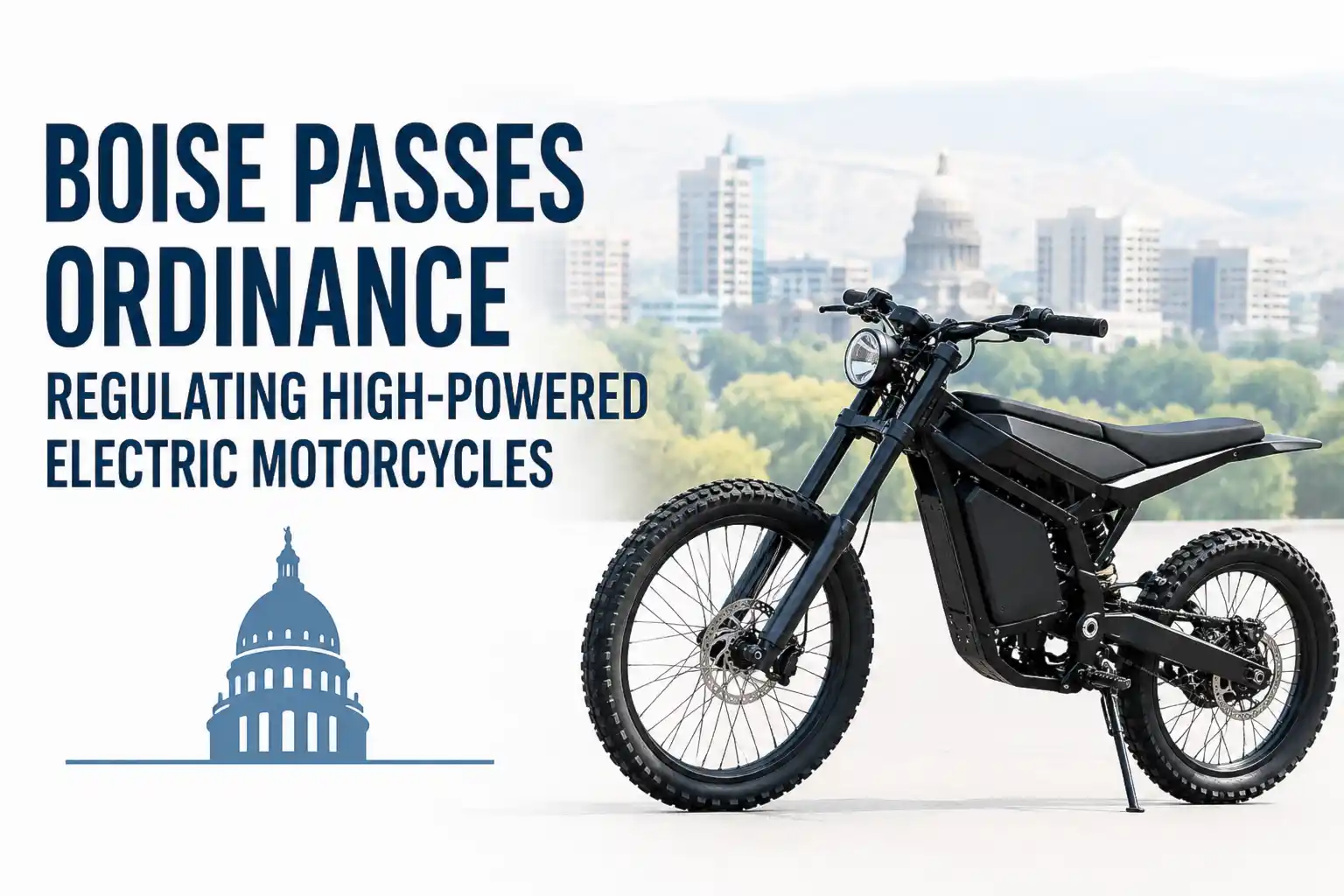
Boise,Idaho Passes Emergency Ordinance Targeting High-Powered Electric Motorcycles
Last Updated on July 3, 2026 by Kristina
The City of Boise, Idaho has approved a new emergency ordinance aimed at improving safety by clarifying how high-powered electric motorcycles – often called e-motos – are regulated within city limits.
While some headlines describe the move as an “e-bike ordinance,” the new law is actually focused on electric motorcycles that exceed Idaho’s legal definition of an electric bicycle. Rather than creating an entirely new category of vehicle, the ordinance reinforces that these higher-powered machines are already considered motor vehicles under existing Idaho law. The city’s goal is to improve education, enforcement, and public safety by making those requirements clearer.
If you’re unsure what legally qualifies as an e-bike, my guide on Understanding E-Bike Classes: Class 1, 2 & 3 Explained explains the differences and why they matter.
Want to understand how this fits with the rest of Idaho’s e-bike rules? Read our full Idaho E-Bike Laws Guide to see how Class 1, Class 2, and Class 3 e-bikes are treated across the state.
Why Boise Took Action
City officials say the ordinance comes in response to growing concerns from parents, residents, and law enforcement about high-powered electric motorcycles being ridden throughout Boise.
Officials cited several reasons for taking action, including:
- An increase in crashes and serious injuries involving electric-powered vehicles.
- Complaints about unsafe riding on sidewalks, parks, and shared-use paths.
- Confusion over which vehicles qualify as e-bikes and which are legally motorcycles.
- The growing popularity of powerful off-road style electric motorcycles marketed toward children and teenagers.
What Counts as an Electric Motorcycle?
Under the ordinance, an electric motorcycle (e-moto) is generally defined as a two- or three-wheeled vehicle that:
- Has an electric motor over 750 watts, or
- Is capable of traveling faster than 28 mph.
For a broader look at how e-bike laws vary across the country, see my State-by-State E-Bike Laws Guide.
Vehicles meeting either of those criteria fall outside Idaho’s three-class e-bike system. Instead, they are treated as motor vehicles under state law.
What Riders Must Do
Because these vehicles are classified as motorcycles rather than bicycles, riders must meet the same legal requirements as other motorcycle operators.
That includes:
- Titling the vehicle.
- Registering it through the Idaho Department of Motor Vehicles.
- Carrying insurance.
- Holding a valid driver’s license with a motorcycle endorsement.
- Operating the vehicle only where motor vehicles are legally permitted.
This Does Not Affect Most E-Bikes
For riders of traditional electric bicycles, very little changes.
Idaho continues to recognize the standard three-class e-bike system:
| Class | Maximum Assisted Speed | Motor Limit |
|---|---|---|
| Class 1 | 20 mph (pedal assist) | 750 watts or less |
| Class 2 | 20 mph (throttle) | 750 watts or less |
| Class 3 | 28 mph (pedal assist) | 750 watts or less |
These bicycles remain legal under Idaho’s e-bike laws. However, riders should still follow any local operating restrictions. For example, Boise already has rules limiting where Class 3 e-bikes may be ridden, including restrictions on certain bike lanes, sidewalks, and the Greenbelt.
If you’re shopping for your first electric bike, my Complete E-Bike Buying Guide can help you choose a model that complies with your state’s laws.
Why This Matters
Over the past several years, many cities have struggled with vehicles that look similar to bicycles but perform much more like lightweight motorcycles.
Some of these machines:
- Exceed legal e-bike power limits.
- Can reach 40 mph or more, with some models capable of considerably higher speeds.
- Lack functional pedals or include pedals only to resemble an e-bike.
- Are frequently marketed toward teenagers despite operating more like motorcycles.
Because they often resemble electric bicycles, many buyers mistakenly assume the same rules apply. In reality, many of these vehicles legally qualify as motorcycles and must meet additional licensing and registration requirements.
Boise officials say the ordinance is intended to reduce that confusion while improving safety for pedestrians, cyclists, and motorists.
Could Other Cities Follow?
Boise is far from the only community dealing with the rapid growth of high-powered electric motorcycles.
Across the United States, cities are trying to determine how to regulate vehicles that blur the line between bicycles and motorcycles. Rather than restricting traditional Class 1, 2, and 3 e-bikes, many communities are focusing specifically on higher-powered electric motorcycles that exceed established e-bike classifications.
As these vehicles become more common, it’s likely other cities will consider similar ordinances aimed at improving safety while preserving access for riders using legal electric bicycles.
My Take
I actually think Boise is targeting the right problem.
As someone who follows the e-bike industry closely, I’ve become increasingly concerned that true electric bicycles are being lumped together with machines that are essentially electric dirt bikes or lightweight motorcycles.
There’s a huge difference between:
- A 500W or 750W commuter e-bike being ridden responsibly at 20 mph.
- A 5,000W or 6,000W electric motorcycle capable of 40 mph or more being ridden on a bike path.
Those are completely different vehicles with very different safety risks.
One thing I appreciate about Boise’s approach is that it isn’t banning traditional e-bikes. Instead, it’s clarifying that vehicles exceeding Idaho’s legal e-bike limits are already considered motorcycles under state law and should be operated accordingly.
I also think education is just as important as enforcement. Many parents may genuinely believe they’re buying an oversized e-bike for their child when they’re actually purchasing a vehicle that’s legally treated as a motorcycle. Better education can help families make informed decisions before they buy.
I also believe manufacturers share some responsibility. Many high-powered machines are advertised using terms like “e-bike” even though they exceed legal e-bike limits in many states. That can create confusion for buyers who may not realize they’re purchasing a vehicle that may require registration, insurance, and even a motorcycle endorsement.
As high-powered electric motorcycles continue to grow in popularity, I expect we’ll see more cities adopt similar ordinances. The important thing will be making sure lawmakers continue to distinguish between legal Class 1, 2, and 3 e-bikes and high-powered electric motorcycles. Treating them as the same thing would be unfair to the millions of riders who use traditional e-bikes safely and responsibly every day.
For more news on electric bikes click here

Kristina is not just an enthusiast but a true authority on electric bikes. Nestled in the coastal beauty of Virginia, Kristina has found the perfect backdrop for her passion for electric biking. As a dedicated wife and homeschooling mom, her life revolves around family, faith, and the thrill of adventure.
Originally hailing from Ohio, Kristina's journey with electric bikes began as a curiosity and quickly evolved into a deep expertise. Her blog is a testament to her love for electric biking, combining her fascination for eco-friendly transportation with her coastal lifestyle.
When she's not cruising the beach on her electric bike, you'll find Kristina indulging in her other loves: long walks along the shore, getting lost in a good book, and cherishing moments with her loved ones. With a heart as big as her love for animals, especially cats, Kristina brings a unique perspective to the electric bike world, grounded in her strong faith in God and her dedication to a sustainable lifestyle.
Through her blog, Kristina shares her extensive knowledge of electric bikes, offering valuable insights, tips, and recommendations to fellow enthusiasts. Whether you're a seasoned rider or a newcomer to the electric bike scene, Kristina's blog is your go-to source for all things electric biking, fueled by her passion, expertise, and the scenic beauty of coastal Virginia.