Florida Gov. DeSantis Vetoes E-Bike Speed Limit Bill: What Riders Should Know
Last Updated on July 6, 2026 by Kristina
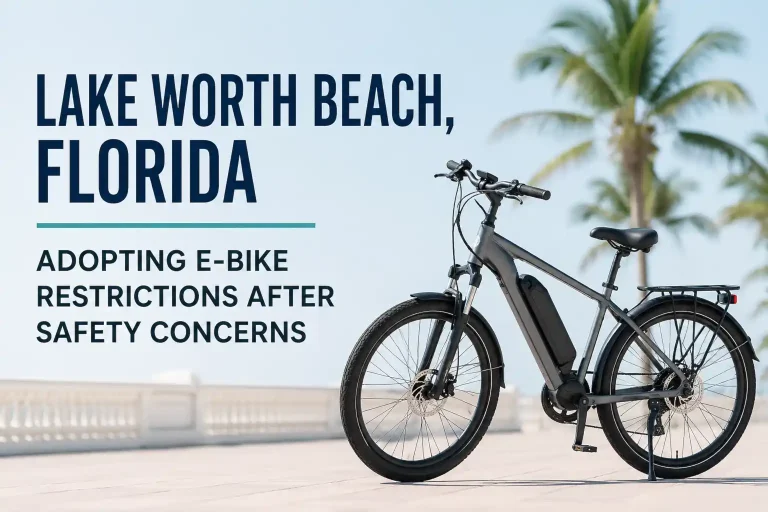
Florida e-bike laws were almost changed in a pretty big way, but Gov. Ron DeSantis has now vetoed the bill that would have added new statewide rules for electric bicycles and other micromobility devices.
The bill, known as CS/SB 382, passed the Florida Senate 37-0 and the Florida House 112-0 before being vetoed by the governor on June 25, 2026. Even though it had strong support from lawmakers, the bill did not become law.
For Florida riders, this is an important update because the proposed speed rule does not apply. Florida’s existing e-bike laws are still in place, along with any local rules from cities, counties, parks, trails, beach areas, or other local authorities.
If you ride in Florida or plan to travel there with your electric bike, be sure to also check my Florida State E-Bike Law Guide and my State-by-State E-Bike Law Guide so you can compare Florida’s rules with other states.
Did Florida Pass a New 10 MPH E-Bike Speed Limit?
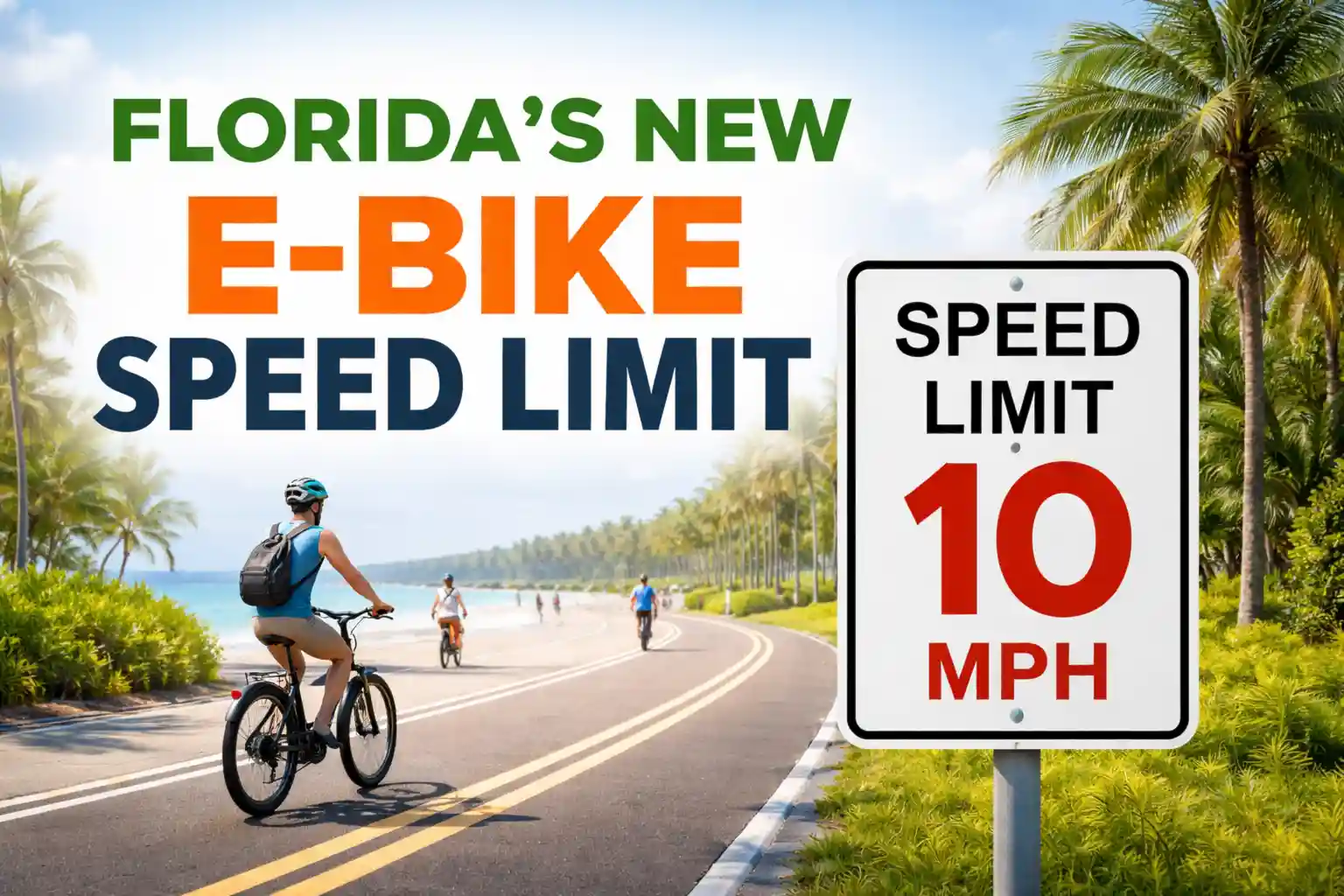
No. Florida did not pass the proposed 10 mph e-bike speed limit because Gov. DeSantis vetoed CS/SB 382.
It is also important to understand that this would not have been a blanket 10 mph speed limit for every e-bike ride in Florida. The vetoed bill would have limited e-bikes to 10 mph on sidewalks or other pedestrian-designated areas when a pedestrian was within 50 feet.
Since the bill was vetoed, that proposed statewide rule did not take effect.
What the Florida E-Bike Bill Would Have Done
CS/SB 382 focused on micromobility devices, including electric bicycles. One of the biggest parts of the bill was the proposed rule that an e-bike rider could not go faster than 10 mph on a sidewalk or other pedestrian-designated area if a pedestrian was within 50 feet.
The bill also would have required e-bike riders on certain shared pathways not located next to a roadway, including shared paths in parks and recreational areas, to yield to pedestrians and give an audible signal before overtaking and passing them.
Violations would have been treated as noncriminal traffic infractions and punished as nonmoving violations.
The bill also would have created a Micromobility Device Safety Task Force adjunct to the Florida Department of Highway Safety and Motor Vehicles. That task force would have studied micromobility safety and submitted recommendations to state leaders.
Another part of the bill would have required law enforcement agencies to collect certain crash data involving micromobility devices. The Florida Department of Highway Safety and Motor Vehicles would then have been required to submit a summary report to state leaders by October 31, 2026.
Why Gov. DeSantis Vetoed the E-Bike Speed Limit Bill
In his veto letter, Gov. DeSantis said the 10 mph rule within 50 feet of a pedestrian would be difficult for a bicyclist to measure while safely riding.
He also raised concerns that enforcing the rule could lead to more speed detection or surveillance devices being used by local governments. According to ClickOrlando’s report, DeSantis also noted that violators could face fines surpassing $100.
Another issue he raised was the task force. DeSantis objected to the bill creating a task force while also making rule changes before that task force had the chance to study the issue and make recommendations.
That is the main reason this bill failed, even though it passed unanimously in both chambers of the Florida Legislature.
What Florida E-Bike Riders Should Know Now
Because the bill was vetoed, Florida’s current e-bike law still applies.
Under current Florida law, electric bicycles are generally treated like bicycles. Florida Statute 316.20655 says an electric bicycle rider has the rights and duties of a bicycle rider, and e-bikes are not subject to driver’s license, motor vehicle registration, title, or financial responsibility requirements.
Florida law also says e-bike riders may ride where bicycles are allowed, including streets, highways, roadways, shoulders, bike lanes, bicycle paths, and multiuse paths.
However, local governments can still adopt ordinances for e-bike operation on streets, sidewalks, sidewalk areas, bicycle paths, multiuse paths, trail networks, beaches, and dunes.
That local-rule part is very important. Even though Florida did not pass this statewide 10 mph rule, a city, county, park, beach, or trail authority may still have its own e-bike restrictions.
For a full breakdown of Florida’s current rules, see my Florida State E-Bike Law Guide.
Florida’s Current E-Bike Classes
Florida defines an electric bicycle as a bicycle or tricycle with fully operable pedals, a seat or saddle, and an electric motor of less than 750 watts.
Florida recognizes three e-bike classes:
Class 1 e-bike: The motor provides assistance only while the rider is pedaling and stops assisting when the bike reaches 20 mph.
Class 2 e-bike: The motor can propel the bike without pedaling and stops assisting when the bike reaches 20 mph.
Class 3 e-bike: The motor provides assistance only while the rider is pedaling and stops assisting when the bike reaches 28 mph.
That means high-powered electric dirt bikes, modified bikes, or throttle-only machines that exceed Florida’s e-bike definition may not be treated the same as legal electric bicycles.
Does This Mean Florida Riders Can Ride Fast Around Pedestrians?
No, and this is where riders need to be careful.
Just because the proposed 10 mph rule was vetoed does not mean riders should speed around people walking, jogging, walking dogs, pushing strollers, or using mobility devices.
E-bikes are heavier and faster than regular bicycles, and a crash with a pedestrian can be serious. Even without this new state law, riders should slow down near pedestrians, announce when passing, use a bell or voice, and ride at a speed that fits the area.
A good rule of thumb is simple: if you are near people walking, slow way down and ride like you expect someone to step sideways at any moment.
Why This Matters Beyond Florida
This Florida veto also matters because states across the country are still trying to figure out how to handle e-bikes, high-powered electric motorcycles, and other micromobility devices.
Some states are focusing on speed limits. Others are looking at age rules, helmets, registration, school safety, trail restrictions, beach access, or the difference between legal e-bikes and off-road electric motorcycles.
That is why I always recommend checking the rules before you ride in a new state. You can compare Florida with other states in my State-by-State E-Bike Law Guide.
My Take
I understand both sides of this one.
On one hand, I do think pedestrian safety matters. Sidewalks, parks, shared paths, and beach areas can get crowded, and an e-bike going too fast around walkers is a real problem. Riders should not be flying past people at high speed, especially when kids, seniors, pets, and families are nearby.
But I can also see why the 50-foot rule could be hard to follow in real life. When you are riding, judging exactly 50 feet from every pedestrian is not always simple. It could also become difficult to enforce fairly unless there were speed detection tools or surveillance, which is something Gov. DeSantis raised in his veto explanation.
My personal take is that Florida still needs clear e-bike safety guidance, but it should be practical. Instead of a rule that is hard for riders to measure, I would rather see simple, common-sense standards that riders can understand right away: slow down near pedestrians, yield on shared paths, use a bell or voice before passing, and keep high-powered electric motorcycles off sidewalks and pedestrian paths.
For now, Florida riders should not take this veto as a free pass to ride recklessly. The proposed law did not pass, but local rules still matter, and safe riding still matters even more.
For more news on electric bikes click here
External Sources
Florida Senate CS/SB 382 bill page: https://www.flsenate.gov/Session/Bill/2026/382
Florida Senate CS/SB 382 enrolled bill text: https://www.flsenate.gov/Session/Bill/2026/382/BillText/er/HTML
Florida Statute 316.20655 – Electric bicycle regulations: https://www.leg.state.fl.us/statutes/index.cfm?App_mode=Display_Statute&URL=0300-0399/0316/Sections/0316.20655.html
Florida Statute 316.003 – E-bike definitions: https://www.leg.state.fl.us/STATUTES/index.cfm?App_mode=Display_Statute&URL=0300-0399/0316/Sections/0316.003.html

Kristina is not just an enthusiast but a true authority on electric bikes. Nestled in the coastal beauty of Virginia, Kristina has found the perfect backdrop for her passion for electric biking. As a dedicated wife and homeschooling mom, her life revolves around family, faith, and the thrill of adventure.
Originally hailing from Ohio, Kristina's journey with electric bikes began as a curiosity and quickly evolved into a deep expertise. Her blog is a testament to her love for electric biking, combining her fascination for eco-friendly transportation with her coastal lifestyle.
When she's not cruising the beach on her electric bike, you'll find Kristina indulging in her other loves: long walks along the shore, getting lost in a good book, and cherishing moments with her loved ones. With a heart as big as her love for animals, especially cats, Kristina brings a unique perspective to the electric bike world, grounded in her strong faith in God and her dedication to a sustainable lifestyle.
Through her blog, Kristina shares her extensive knowledge of electric bikes, offering valuable insights, tips, and recommendations to fellow enthusiasts. Whether you're a seasoned rider or a newcomer to the electric bike scene, Kristina's blog is your go-to source for all things electric biking, fueled by her passion, expertise, and the scenic beauty of coastal Virginia.