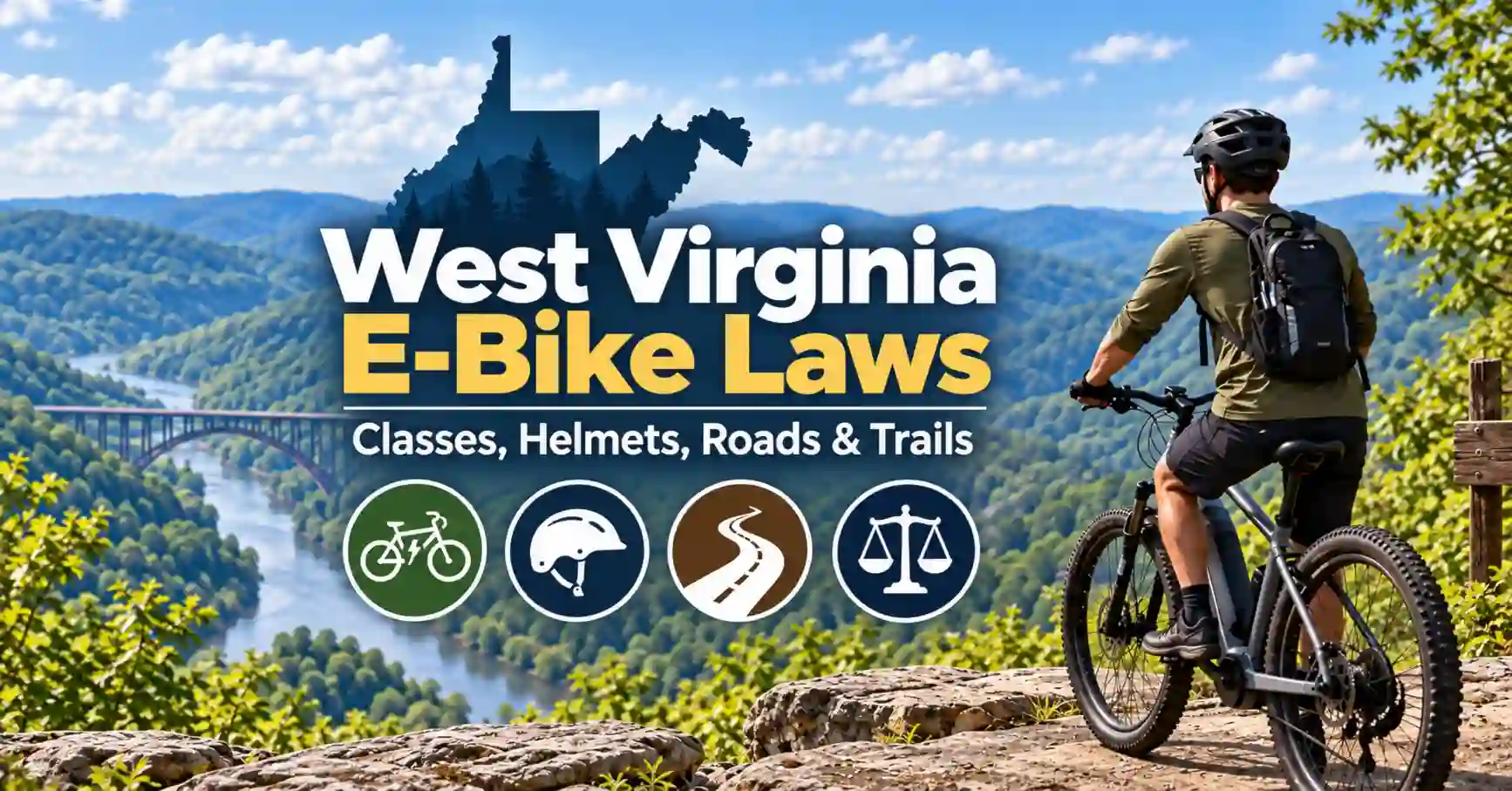
West Virginia E-Bike Laws: Classes, Helmets, Age Rules, Roads, Trails, and Local Restrictions
Last Updated on September 14, 2026 by Kristina
Last researched and verified: September 14, 2026.
West Virginia recognizes Class 1, Class 2, and Class 3 electric bicycles, but its law has several details riders should know before getting on the road or trail. A qualifying electric bicycle must have fully operable pedals and an electric motor of fewer than 750 watts. Class 1 and Class 2 motor assistance is limited to 20 mph, while Class 3 pedal assistance is limited to 28 mph.
For a qualifying electric bicycle, West Virginia does not require motor-vehicle registration, a title, a driver’s license, or the state’s motor-vehicle financial-responsibility requirements. The current e-bike statute also does not state a general statewide minimum riding age. Operators and passengers under age 15 must wear a properly fitted and fastened bicycle helmet.
Where you may ride depends heavily on your e-bike class and who manages the property. Class 1 and Class 2 e-bikes generally receive the same access as traditional bicycles on roads and trails where traditional bicycles are allowed. Class 3 e-bikes face an important statewide trail restriction and generally cannot use bicycle paths, multi-use trails, or single-use trails unless the route is within a highway or roadway or the government authority with jurisdiction expressly permits Class 3 use.
If you are comparing West Virginia with another state, start with the State-by-State E-Bike Laws Guide. If you are unsure which class your bike fits, see the Class 1, Class 2, and Class 3 e-bike guide. West Virginia’s actual statutes control when you ride in West Virginia.
Why You Can Trust Electric Bike Explorer
I checked the important legal claims in this guide against the current West Virginia Code, official West Virginia Legislature bill records, state agencies, municipal codes, federal land-management rules, trail-management sources, and current university policies. Local, campus, park, and federal rules are separated from statewide law so they are not presented as rules that apply everywhere in West Virginia.
Learn more about how Electric Bike Explorer researches and reviews information.
Like these law guides? You can add Electric Bike Explorer as a preferred source on Google.
West Virginia E-Bike Laws at a Glance
| Rule | West Virginia requirement |
|---|---|
| Legal e-bike definition | 2 or 3 wheels, fully operable pedals, and an electric motor of fewer than 750 watts |
| Class 1 | Pedal assist only; assistance ends at 20 mph |
| Class 2 | Motor may propel the bicycle without pedaling; assistance is limited at 20 mph |
| Class 3 | Pedal assist only; assistance ends at 28 mph |
| Throttle | Expressly permitted for Class 2 |
| Operable pedals | Required |
| Driver’s license | Not required for a qualifying e-bike |
| Registration and title | Not required under the state e-bike exemption |
| Motor-vehicle financial responsibility | Not required under the state e-bike exemption |
| General statewide minimum age | No general minimum age appears in the current state e-bike statute |
| Helmet | Required for an e-bike operator or passenger under age 15 |
| Class 3 speedometer | Required and must display speed in mph |
| Class 3 path and trail access | Generally restricted unless the route is within a highway or roadway or the responsible government authority expressly permits it |
| Speed or throttle modification | State law prohibits tampering that changes motor-powered speed capability or changes engagement between pedal-assist and throttle-assist operation |
| Alcohol or controlled substances | A person under the influence may not operate a Class 1, Class 2, or Class 3 e-bike |
| Local and property rules | Cities, agencies, federal land managers, campuses, trail systems, and private property owners may impose additional rules within their authority |
How West Virginia Defines Class 1, Class 2, and Class 3 E-Bikes
West Virginia Code §17C-1-70 defines an electric bicycle as a 2- or 3-wheeled vehicle with fully operable pedals and an electric motor of fewer than 750 watts.
| Class | Motor operation | Maximum assisted speed | Throttle |
|---|---|---|---|
| Class 1 | Motor assists only while the rider is pedaling | 20 mph | Throttle-only propulsion does not fit the Class 1 definition |
| Class 2 | Motor may be used exclusively to propel the bicycle | 20 mph | Yes – expressly permitted |
| Class 3 | Motor assists only while the rider is pedaling | 28 mph | Throttle-only propulsion does not fit the Class 3 definition |
West Virginia separately defines a throttle as a device controlling power to the electric motor for the purpose of propelling the bicycle. §17C-11-8 expressly says Class 2 e-bikes may use a throttle.
The same section also contains general motor-disengagement language involving pedaling and braking. Because the statute separately defines Class 2 as capable of motor-only propulsion and expressly authorizes a Class 2 throttle, those provisions should be read together rather than treating the general disengagement wording as eliminating Class 2 throttle operation.
What Type of Electric Vehicle Do You Actually Have?
Before applying the Class 1, 2, or 3 rules, check whether your vehicle fits West Virginia’s definition at all.
| Question | If yes | If no |
|---|---|---|
| Does it have fully operable pedals? | Continue checking | It does not satisfy West Virginia’s e-bike definition |
| Is the electric motor below 750 watts? | Continue checking | It falls outside the literal e-bike definition |
| Does assistance stop at the applicable 20 mph or 28 mph class limit? | It may fit Class 1, 2, or 3 | It may be outside the e-bike definition |
| Can the motor propel without pedaling? | It may fit Class 2 if it otherwise meets the limits | It may fit Class 1 or Class 3 depending on assisted speed |
| Has the speed capability or pedal/throttle engagement been modified? | Check the modification rule carefully | Apply the bike’s original legal configuration |
A vehicle that falls outside the e-bike definition does not automatically become a legal moped simply because it has 2 wheels. Another vehicle definition, licensing rule, registration requirement, or equipment rule may apply. See the E-Bike vs. Moped vs. Scooter Law Guide before assuming an out-of-class vehicle can be ridden like an ordinary e-bike.
Are West Virginia E-Bikes Bicycles or Motor Vehicles?
The most accurate answer is that West Virginia gives qualifying e-bikes specific treatment rather than simply saying they are ordinary bicycles for every purpose.
Class 1 and Class 2 e-bikes receive the same rights, privileges, and duties as traditional bicycles on roads and trails where traditional bicycles are allowed. Qualifying e-bikes are also expressly exempt from motor-vehicle title, registration, driver’s-license, and financial-responsibility requirements. West Virginia’s moped definition separately excludes an electric bicycle that meets §17C-1-70.
Because different chapters of the West Virginia Code use their own definitions, it is safer to rely on the specific e-bike provisions than to make the broader statement that an e-bike is never a motor vehicle for any legal purpose.
License, Registration, Title, and Insurance Requirements
Under §17C-11-8, a person owning or operating a qualifying electric bicycle is not subject to the West Virginia motor-vehicle provisions concerning registration, title, driver’s licenses, or financial responsibility.
That means a qualifying e-bike does not need ordinary state motor-vehicle registration or title, and the rider does not need a driver’s license merely to operate that e-bike.
The financial-responsibility exemption concerns the state’s motor-vehicle requirements. It does not guarantee that a rental company, event, employer, property owner, or other private organization could never have its own insurance or liability conditions.
For a broader explanation of how licensing changes when a vehicle falls outside an e-bike definition, see the E-Bike Licensing Guide.
West Virginia E-Bike Age and Helmet Requirements
The current version of §17C-11-8 does not state a general statewide minimum age to operate a Class 1, Class 2, or Class 3 e-bike. This matters because older summaries may still repeat age language that is not present in the current state section.
The current statewide e-bike helmet rule says an operator or passenger under age 15 must wear a properly fitted and fastened bicycle helmet. The Child Bicycle Safety Act similarly requires a properly fitted, securely fastened helmet for a person under 15 operating or riding as a passenger on a bicycle on a public roadway, public bicycle path, or other public right-of-way.
A city, trail system, rental operator, school, campus, or property manager may have stricter youth or helmet rules. Hatfield-McCoy Trails is a good example: its trail rules require approved helmets for everyone and impose separate rules for riders under 16.
Equipment and Speedometer Requirements
West Virginia requires an electric bicycle to comply with the bicycle equipment and manufacturing requirements adopted by the U.S. Consumer Product Safety Commission in 16 C.F.R. Part 1512.
Class 3 e-bikes must also have a speedometer showing the bike’s speed in miles per hour.
West Virginia’s general bicycle-equipment section requires a bicycle used at night to have a white front lamp visible from at least 500 feet and a rear red reflector meeting the statutory visibility requirement. It also requires a brake capable of meeting the state’s braking standard. Class 1 and Class 2 e-bikes expressly receive the duties of traditional bicycles where traditional bicycles are allowed.
Does West Virginia require a Class 1, 2, or 3 manufacturer label?
I did not find a separate statewide class-sticker requirement in the current West Virginia e-bike sections. That is different from saying labeling never matters.
A particular land manager can require proof of class. New River Gorge National Park and Preserve, for example, requires a rider using Stone Cliff Trail to establish that the e-bike is Class 1 or Class 2 through a manufacturer label on the frame or manufacturer documentation.
Where Can You Ride an E-Bike in West Virginia?
| Location | Statewide starting point | Important exception |
|---|---|---|
| Ordinary public roads | Qualifying e-bikes may operate subject to applicable traffic laws | Controlled-access roads and posted restrictions can differ |
| On-road bicycle lanes | Class 1 and Class 2 receive traditional-bicycle rights where bicycle use is allowed | Check local signs and rules, particularly for Class 3 |
| Sidewalks | No blanket statewide e-bike sidewalk permission was found | Municipal ordinances can be stricter |
| Public bicycle and multi-use paths | Class 1 and Class 2 generally follow traditional-bicycle access | Land-manager rules and signs can restrict access |
| Natural-surface bicycle trails | Class 1 and Class 2 generally follow traditional-bicycle access | Actual trail designation and land-manager rules still control |
| Class 3 on paths or trails | Generally prohibited | Allowed if within a highway/roadway or expressly permitted by the responsible government authority |
| Private trails or property | No automatic public access | Owner may allow or restrict e-bikes |
| State parks, forests, and WMAs | State law is only the starting point | Agency designations, signs, and individual trail rules matter |
| Federal land | Federal rules control access | NPS and U.S. Forest Service rules can differ substantially |
Road and Bicycle-Lane Rules
West Virginia’s general bicycle road-position rule says a rider traveling slower than the normal speed of traffic should use a marked bicycle lane when one is provided. If there is no marked bicycle lane, the rider generally stays as close as practicable to the right side of the roadway, subject to exceptions for passing, left turns, hazards, unsafe conditions, and lanes too narrow to share safely.
On a one-way roadway with 2 or more marked traffic lanes, a bicyclist may ride near the left edge. Bicyclists generally may not ride more than 2 abreast on a roadway except on areas set aside exclusively for bicycles.
Class 1 and Class 2 e-bikes expressly receive the same rights and duties as traditional bicycles on roads where traditional bicycles are permitted. The Class 3 provisions focus primarily on prohibiting Class 3 use on certain paths and trails rather than creating a separate statewide prohibition on ordinary roadway use. Riders should still obey local signs and traffic controls.
For general riding-location guidance, see the E-Bike Rules of the Road Guide.
Controlled-access highways can be different
West Virginia Code §17C-7-13 allows the state or a local authority to prohibit bicycles and certain other traffic from controlled-access roadways under its jurisdiction. When such restrictions are established, official signs must give notice.
Are E-Bikes Allowed on Sidewalks in West Virginia?
West Virginia’s e-bike statute does not create blanket statewide permission to ride an electric bicycle on every sidewalk. Local ordinances therefore matter.
Parkersburg expressly prohibits an electric-assisted bicycle from being operated on a sidewalk. Wheeling has separate general bicycle sidewalk restrictions based on location and rider age.
See the E-Bike Sidewalk Laws Guide for the broader state-by-state issue.
Who Makes the Rule?
| Authority | What it may control | Example |
|---|---|---|
| West Virginia Legislature | E-bike definition, classes, statewide equipment rules, license/title exemptions, helmet baseline, trail baseline | §17C-1-70 and §17C-11-8 |
| City or local authority | Local bicycle operation, sidewalks, traffic, parking, park speeds, and other authorized local controls | Parkersburg sidewalk rule |
| State agency or park | Individual roads, trails, rental programs, and facility rules | Kanawha State Forest and Pipestem |
| National Park Service | NPS roads, trails, and park-specific e-bike access | New River Gorge |
| U.S. Forest Service | National Forest motorized travel and trail designations | Monongahela National Forest |
| Independent trail authority | Permits, equipment, youth rules, access, and operating conditions | Hatfield-McCoy Trails |
| College or university | Campus riding, parking, residence-hall storage, and charging | WVU and Marshall |
| Private property owner | Whether an e-bike may be used on the property | Private trail, campground, apartment property, or shopping center |
State Parks, State Forests, and State-Managed Land
The West Virginia Division of Natural Resources and West Virginia State Parks can manage access on property under their control. Do not assume every state trail has the same e-bike rule.
Wildlife management areas and state forests
The West Virginia Division of Natural Resources’ current hunting and trapping regulations state that bicycles, including e-bikes, are permitted on roads open to public vehicular travel and on roads designated by signs for bicycle use on wildlife management areas. The same guidance says bicycles, including e-bikes, are permitted on all roads on state forests unless signs prohibit them.
That rule concerns roads. It should not be converted into a claim that every hiking or natural-surface trail on a WMA or state forest is open to e-bikes.
Kanawha State Forest
The official Kanawha State Forest trail page identifies 9 trails as permitted for mountain biking. Under the statewide Class 1 and Class 2 bicycle-parity rule, those classes generally start with the same access as traditional bicycles, subject to current signs and agency restrictions.
Class 3 is different. The statewide rule requires express permission for Class 3 use on a bicycle path, multi-use trail, or single-use trail outside a highway or roadway. I did not find blanket Class 3 permission on the Kanawha trail page, so Class 3 riders should verify before riding those trails.
Pipestem Resort State Park
Pipestem Resort State Park operates an e-bike rental program. The current program lists a minimum rental age of 8, requires riders ages 8 through 12 to be accompanied by an adult, and requires a parent or guardian signature on the waiver for participants under 17.
Those are Pipestem rental-program rules. They are not West Virginia’s statewide minimum e-bike riding age.
Hatfield-McCoy Trails
The official Hatfield-McCoy information for Tornado Single Trax says that trail system is open to dirt bikes and e-bikes.
Hatfield-McCoy also has its own trail rules. A trail-user permit is required for drivers and passengers, everyone must wear a DOT- or Snell-approved helmet and eye protection, riders must meet manufacturer minimum age and size requirements, no one under 6 may use the trails, and an operator or passenger under 16 must remain under direct parental or guardian supervision and within eyesight.
The Tornado page I reviewed says “e-bikes” without dividing that access into Class 1, 2, and 3. Riders should confirm current equipment or class restrictions with Hatfield-McCoy rather than assuming that wording applies identically to every trail system it manages.
Popular West Virginia Riding Areas Compared
| Area | Manager | Class 1 / 2 | Class 3 | Important note |
|---|---|---|---|---|
| Stone Cliff Trail, New River Gorge | National Park Service | Expressly permitted | Not permitted on the trail | Proof of Class 1 or 2 required by label or manufacturer documentation |
| Other New River Gorge park trails | National Park Service | Not open to e-bikes under the current Compendium | Not permitted | Stone Cliff is the only park trail open to e-bikes |
| New River Gorge roads open to public motor vehicles | National Park Service | Check applicable state and park rules | Permitted under the current Compendium | Road rules differ from trail rules |
| Monongahela National Forest | U.S. Forest Service | Follow current motorized-travel designations | Follow current motorized-travel designations | Forest Service treats e-bikes as motor vehicles; ordinary bicycle trail access does not automatically mean e-bike access |
| Kanawha State Forest designated mountain-bike trails | West Virginia State Parks / DNR | Generally follows traditional-bicycle access, subject to signs | Verify express permission | 9 trails are currently identified for mountain biking |
| Pipestem e-bike rental program | West Virginia State Parks | E-bike rentals offered | Confirm rental-bike class and permitted route | Rental-program age and waiver rules apply |
| Tornado Single Trax | Hatfield-McCoy Trails | E-bikes expressly allowed; class not differentiated on the page reviewed | Confirm current class/equipment rule | Permit, helmet, eye protection, and youth supervision rules apply |
Federal Lands and New River Gorge
New River Gorge National Park and Preserve
The current New River Gorge National Park and Preserve Superintendent’s Compendium provides a much narrower trail rule than West Virginia’s general Class 1 and Class 2 access provision.
Stone Cliff Trail is the only park trail open to e-bikes. Only Class 1 and Class 2 e-bikes may use it. Riders must be able to prove the bike’s class through manufacturer labeling on the frame or manufacturer documentation.
Class 3 e-bikes are prohibited on all park trails and administrative roads. They may be used on park roads open to public motor-vehicle traffic.
The Compendium also says an e-bike for this federal park rule has a motor of less than 750 watts, and a device with a motor rated at 750 watts or more is not considered an e-bike under that park regulation.
Monongahela National Forest
The U.S. Forest Service manages e-bikes as motor vehicles for travel-management purposes. Monongahela National Forest also has forest orders regulating motorized vehicle use on National Forest System roads, trails, and land.
The important practical point is that a trail being open to ordinary mountain bikes does not by itself mean an e-bike may use that trail. Riders should consult the current Motor Vehicle Use Map for the ranger district, current forest orders, and any posted closures before riding.
The current Cheat Ranger District Motor Vehicle Use Map explains that the map identifies roads and motorized travel designations and that operating a motor vehicle outside applicable designations is prohibited. Because e-bikes are managed as motor vehicles by the Forest Service, use the current motorized-travel designation rather than West Virginia’s ordinary bicycle-access rule to decide where an e-bike can be ridden in the National Forest.
West Virginia City E-Bike Rules Compared
| City | E-bike-specific provision found? | Sidewalk / path issue | Rider takeaway |
|---|---|---|---|
| Charleston | No separate citywide e-bike operating provision located in the current online code reviewed | General bicycle, traffic, park, and posted-property rules may still apply | Use state law as the starting point and check the specific facility |
| Huntington | No separate citywide e-bike operating provision located in the current online code reviewed | General local bicycle, traffic, park, and property rules may still apply | Verify the route or facility rather than assuming statewide access settles the issue |
| Morgantown | Electric bicycles expressly appear in the city’s shared/mixed-use-path definition | The definition alone is not blanket permission on every path or sidewalk | Check the operating rule and posted facility restrictions |
| Wheeling | Yes | General bicycle sidewalk restrictions apply in the current online code; city e-bike section also still displays an under-16 Class 3 restriction | Current city and state age wording do not match – verify before a rider under 16 uses Class 3 |
| Parkersburg | Yes | Electric-assisted bicycles are expressly prohibited on sidewalks | Do not assume West Virginia’s lack of a blanket statewide sidewalk ban means Parkersburg allows it |
Important City and Local Rules
Charleston
I reviewed Charleston’s current online municipal code and did not locate a separate e-bike-specific citywide operating provision that should be presented as an additional Charleston e-bike rule. The code does separately regulate motorized scooters, but that is a different vehicle category and should not be substituted for an e-bike rule.
State law therefore provides the starting point, while Charleston bicycle, traffic, park, sidewalk, and posted-property rules can still apply. Check the current Charleston Code of Ordinances and the rules for the specific park, greenway, sidewalk, or facility you plan to use.
Huntington
I also did not locate a clearly e-bike-specific citywide operating restriction in the current Huntington online traffic code that should be added as a separate e-bike rule here.
That does not eliminate general bicycle, traffic, sidewalk, park, or property restrictions. Check the current Huntington Code of Ordinances and posted rules for the location where you plan to ride.
Morgantown
Morgantown’s code expressly includes electric bicycles in its definition of a public shared-use or mixed-use path. The definition describes a path designed for pedestrians, bicycles, other nonmotorized transportation, electric bicycles, electric scooters, or combinations of those uses.
That definition is useful, but it should not be treated as blanket permission to ride an e-bike on every sidewalk, trail, or path in Morgantown. The specific operating provision, path designation, and posted rule still matter. See the current Morgantown Code of Ordinances.
Wheeling
Wheeling deserves special attention because its current online municipal e-bike section still states that a person under 16 may not operate a Class 3 e-bike. The current statewide version of §17C-11-8 no longer contains that under-16 Class 3 restriction.
Because the current city and state wording do not match, I would not tell a rider that either provision can simply be ignored. A person under 16 considering a Class 3 e-bike in Wheeling should verify the current official ordinance and the city’s enforcement position before riding.
Wheeling’s general bicycle sidewalk ordinance also says bicycles may not be ridden on sidewalks in the city’s C-3 Central Business Zone. A person age 15 or older may not ride a bicycle on any city sidewalk. Younger riders outside the business district must yield to pedestrians and provide an audible signal before overtaking.
See Wheeling’s current electric-bicycle section and bicycle sidewalk ordinance.
Parkersburg
Parkersburg has one of the clearest local e-bike sidewalk provisions I found. Its code expressly states that a bicyclist may not operate an electric-assisted bicycle on a sidewalk.
The same section prohibits bicycle riding on sidewalks in the central downtown business district and generally prohibits a person age 12 or older from riding a bicycle on a sidewalk. The city provides an exception to those general bicycle sidewalk restrictions for sidewalks it has designated as multi-use paths, but the section separately states that an electric-assisted bicycle may not be operated on a sidewalk.
See the current Parkersburg bicycle and sidewalk ordinance.
College and University E-Bike Policies Compared
| Institution | Bicycle / e-bike storage | Charging | Important takeaway |
|---|---|---|---|
| West Virginia University | Indoor storage of e-mobility devices including e-bikes is prohibited in residence halls | Indoor charging is prohibited in residence halls | The WVU policy expressly names e-bikes |
| Marshall University | Ordinary bicycles may be stored in many resident rooms, except First Year Residence Halls require outdoor racks; public-area storage is prohibited | Housing prohibits use, charging, and battery-installed storage of hoverboards, e-scooters, E-Riders, and similar devices | The battery-device clause does not expressly say “e-bike,” so e-bike owners should confirm Housing’s interpretation before bringing one inside |
| K-12 schools | Varies by district and campus | Varies by district and campus | Check the specific county school district and school policy |
College, University, and School Policies
West Virginia University
West Virginia University’s current Housing community standards expressly state that indoor storage or charging of e-mobility devices such as e-bikes, e-scooters, and hoverboards is not permitted in residence halls.
Students living on campus should review the current WVU Community Standards of Conduct before bringing an e-bike or battery into university housing.
Marshall University
Marshall University’s current 2026-27 Residence Hall Guide says ordinary bicycles may be stored in resident rooms except in First Year Residence Halls, where residents must use outdoor bicycle racks. Bicycles may not be stored in lobbies, walkways, stairwells, laundry rooms, or other public areas, and bicycle riding is prohibited inside the residence halls.
The guide separately prohibits the use, charging, and battery-installed storage of hoverboards, e-scooters, E-Riders, and “similar devices.” It permits such a device to be stored in a room with the battery removed.
Because that battery provision does not expressly use the term “e-bike,” I would not automatically tell students that every e-bike is covered without confirmation. E-bike owners should ask Housing and Residence Life how the rule applies before bringing an e-bike or its battery into a residence hall.
See Marshall’s current Residence Hall Guide.
K-12 schools
I did not find one statewide K-12 e-bike parking, storage, or charging policy that can safely be presented as applying to every West Virginia school. Families should check the specific county school district and individual campus policy before a student rides an e-bike to school or brings a lithium-ion battery inside.
Modified, Unlocked, and Out-of-Class E-Bikes
West Virginia specifically prohibits tampering with or modifying an e-bike in a way that changes its motor-powered speed capability or changes motor engagement between pedal-assist and throttle-assist types of operation.
If the motor is modified so that a limit established in §17C-1-70 is exceeded, the vehicle is no longer an electric bicycle under the statute.
The modification subsection contains an exception when the modified electric bicycle is operated solely and exclusively on the person’s own property. That should not be read as permission to use the modified bike on public roads or trails while continuing to claim Class 1, Class 2, or Class 3 treatment.
Once a vehicle is outside the e-bike definition, another vehicle classification may apply. Do not assume it automatically becomes a legal moped, motorcycle, or motor-driven cycle without checking the separate requirements.
Alcohol and Controlled Substances
West Virginia’s e-bike statute expressly states that a person under the influence of alcohol or controlled substances may not operate a Class 1, Class 2, or Class 3 electric bicycle.
The fact that a driver’s license is not required for a qualifying e-bike does not eliminate this prohibition.
Can You Be Fined for Violating West Virginia E-Bike Rules?
Yes. West Virginia Code §17C-11-1 says it is a misdemeanor to perform an act forbidden by Article 11 or fail to perform an act required by that article. That article contains the state’s principal e-bike operating section.
When Chapter 17C does not provide another specific penalty, the general misdemeanor provision in §17C-18-1 provides a first-conviction penalty of a fine up to $100 or imprisonment up to 10 days. A second conviction within 1 year can carry a fine up to $200, imprisonment up to 20 days, or both. A third or subsequent conviction can carry a fine up to $500, imprisonment up to 6 months, or both.
Not every bicycle-related rule uses that general penalty. The Child Bicycle Safety Act has its own penalty structure for a parent or legal guardian who violates the under-15 helmet requirement: a $10 fine, 2 hours of community service related to child-injury prevention, or both. For a first violation, the court may waive the fine when satisfactory proof is provided that a helmet was obtained.
Local ordinances, federal lands, campuses, and trail systems can have separate enforcement provisions. The actual penalty depends on the rule violated and the circumstances.
What Happened to West Virginia Senate Bill 485?
SB 485 did not become law
Senate Bill 485 was introduced January 19, 2026 as the proposed “West Virginia Behavior-Based E-Bike and Multi-Use Trail Mobility Act.”
The proposal covered bicycles, e-bikes, adaptive mobility devices, and other personal mobility devices on public multi-use trails, shared-use paths, greenways, rail-trails, park trails, municipal trails, and other publicly accessible trail corridors.
Instead of relying solely on the existing Class 1, Class 2, and Class 3 framework for trail behavior, SB 485 proposed behavior-based trail categories. It also proposed passing, yielding, speed, safety, enforcement, and rulemaking provisions.
The bill included a proposed July 1, 2026 effective date. That date never took effect because the bill never became law.
The Legislature’s complete official history for SB 485 gives the last action as “S To Transportation and Infrastructure 01/19/26.” The action history shows introduction and referral to Transportation and Infrastructure and then Finance, but no passage by the Senate.
SB 485 did not pass the Senate, did not pass the House, was not sent to the governor, was not signed, and no portion of it became current West Virginia law.
SB 487 also did not become law
Senate Bill 487, the proposed West Virginia Trails, Access, and Stewardship Act, also contained substantive e-bike provisions.
For proposed State Trail Corridors, it would have permitted Class 1 and Class 2 e-bikes on State Bicycle Trails and Multi-Use Non-Motorized Trails unless restricted by a corridor-specific management plan. It proposed treating Class 3 e-bikes as motorized vehicles and generally prohibiting them on nonmotorized trails except in specified circumstances. It also expressly preserved federal rules on federally managed land.
The official history lists its last action as referral to the Senate Committee on Natural Resources on January 19, 2026. It did not pass either chamber and did not become law.
I also checked 2025 legislation for material changes to West Virginia’s e-bike framework. I did not find an enacted 2025 measure changing the core e-bike class definitions, helmet requirement, age rule, trail-access rule, motor limit, or modification provision. The current West Virginia Code identifies 2023 House Bill 2062 as the latest signed legislation affecting §§17C-1-70 and 17C-11-8.
Real-World West Virginia E-Bike Scenarios
I have a Class 2 throttle e-bike and want to commute on city streets
If the bike meets West Virginia’s definition, Class 2 throttle use is expressly permitted. You do not need motor-vehicle registration, a title, or a driver’s license merely because it is a qualifying Class 2 e-bike. Follow applicable traffic rules and check local restrictions for sidewalks, parks, and specific paths.
My 14-year-old wants to ride an e-bike
The current statewide e-bike statute does not state a general minimum operating age, but an operator or passenger under 15 must wear a properly fitted and fastened helmet. A city, rental program, trail system, or school may have stricter rules.
My 15-year-old wants to ride a Class 3 e-bike in Wheeling
This is one of the situations where checking locally matters. Current statewide law does not contain a general under-16 Class 3 prohibition, but Wheeling’s current online e-bike section still displays one. Verify the current official city rule and enforcement position before riding.
I have a Class 1 e-bike and want to ride New River Gorge trails
Being Class 1 does not open every bicycle trail. Under the current National Park Service rule, Stone Cliff Trail is the only New River Gorge park trail open to e-bikes. Class 1 and Class 2 are permitted there with proof of classification.
I want to ride a mountain-bike trail in Monongahela National Forest
Do not rely on the fact that ordinary mountain bikes are allowed. The Forest Service treats e-bikes as motor vehicles. Check the current Motor Vehicle Use Map, current forest orders, and posted designations for your ranger district.
My e-bike is marketed as a 750W bike
West Virginia’s literal statutory definition says the motor must be fewer than 750 watts. Do not automatically substitute another state’s “750W or less” rule. If the bike is rated at exactly 750W, verify its West Virginia classification before relying on e-bike exemptions.
I unlocked my e-bike so the motor assists beyond its legal class speed
West Virginia prohibits modifying an e-bike’s motor-powered speed capability. If the modification causes the vehicle to exceed a statutory limit, it is no longer an electric bicycle under §17C-11-8. The own-property exception does not turn a modified bike into a legal public-road e-bike.
Practical Checklist Before Riding
- Confirm that your bike has fully operable pedals.
- Check the motor rating – West Virginia says fewer than 750 watts.
- Know whether the bike is Class 1, Class 2, or Class 3.
- Know whether it has throttle-only propulsion and how that throttle operates.
- Do not assume an unlocked or modified bike still qualifies as an e-bike.
- Make sure a Class 3 bike has the required mph speedometer.
- If the operator or passenger is under 15, use a properly fitted and fastened helmet.
- Check required lighting and brakes before riding, especially at night.
- Check the city before riding on a sidewalk.
- For a trail, identify the actual land manager rather than relying only on state law.
- For federal property, check current NPS or Forest Service rules.
- For a campus or school, check parking, storage, and battery-charging rules separately.
- Watch for posted closures and trail-specific conditions that can change faster than statutes.
Nearby State Law Guides
Traveling outside West Virginia? Laws change quickly. Check other states:
Virginia e-bike laws
Pennsylvania e-bike laws
Ohio e-bike laws
Kentucky e-bike laws
👉 Compare all states in the state-by-state e-bike law guide
Frequently Asked Questions About West Virginia E-Bike Laws
Do I need a driver’s license to ride an e-bike in West Virginia?
No. A person operating an electric bicycle that meets West Virginia’s definition is exempt from the state’s driver’s-license requirement for motor vehicles.
Does an e-bike need registration or a title?
No. Qualifying e-bikes are exempt from West Virginia motor-vehicle registration and title requirements.
Does West Virginia require e-bike insurance?
The e-bike statute exempts qualifying e-bike owners and operators from the state’s motor-vehicle financial-responsibility requirements. Private insurance can still be useful, and a private organization can have separate contractual requirements.
What is the minimum age to ride an e-bike in West Virginia?
The current state e-bike section does not state a general minimum operator age. Local governments, trail systems, rentals, schools, and other property managers may impose additional rules.
Do children have to wear helmets?
Yes. An e-bike operator or passenger under age 15 must wear a properly fitted and fastened bicycle helmet.
Can a Class 2 e-bike have a throttle?
Yes. West Virginia expressly allows Class 2 e-bikes to use a throttle for propulsion.
Can a Class 3 e-bike use a throttle?
West Virginia defines Class 3 as pedal-assist operation in which motor assistance ends at 28 mph. Throttle-only propulsion does not fit that Class 3 definition.
Is a 750W e-bike covered by West Virginia’s definition?
The statute says fewer than 750 watts. Because exactly 750 watts is not fewer than 750 watts, riders with a bike rated at exactly 750W should verify classification rather than relying on the more common “750W or less” wording used elsewhere.
Can I ride an e-bike on a sidewalk?
Do not assume so. West Virginia’s e-bike section does not grant blanket statewide sidewalk access, and local ordinances can be stricter. Parkersburg expressly prohibits electric-assisted bicycles on sidewalks.
Can a Class 3 e-bike use a bike path or trail?
Generally not under the statewide rule unless the path or trail is within a highway or roadway or the municipality, local authority, or responsible state agency expressly permits Class 3 operation.
Can I ride an e-bike at New River Gorge?
Yes, but only where the National Park Service permits it. Stone Cliff Trail is currently the only park trail open to e-bikes and is limited to Class 1 and Class 2. Class 3 e-bikes may use park roads open to public motor-vehicle traffic but are prohibited on park trails and administrative roads.
Can I ride an e-bike on Monongahela National Forest mountain-bike trails?
Do not assume ordinary mountain-bike access applies. The Forest Service treats e-bikes as motor vehicles. Use the current Motor Vehicle Use Map, forest orders, and posted motorized-travel designations.
Can I modify or speed-unlock an e-bike?
West Virginia prohibits tampering with or modifying an e-bike to change its motor-powered speed capability or engagement between pedal-assist and throttle-assist operation. A vehicle modified beyond the statutory limit is no longer an electric bicycle under that section.
Did Senate Bill 485 change West Virginia e-bike trail law?
No. SB 485 remained in Senate committee. It did not pass either chamber, was not signed, and none of its proposed trail rules became law.
Final Takeaway
West Virginia’s statewide rules start with the bike itself. A qualifying e-bike must have fully operable pedals and a motor of fewer than 750 watts. Class 1 and Class 2 assistance is limited at 20 mph, while Class 3 pedal assistance ends at 28 mph. Class 2 throttle propulsion is expressly permitted.
A qualifying e-bike does not require ordinary motor-vehicle registration, title, a driver’s license, or state motor-vehicle financial responsibility. The current statewide e-bike statute contains no general minimum rider age, but operators and passengers under 15 must wear helmets.
The harder question is usually where the bike can be ridden. Class 1 and Class 2 generally follow traditional-bicycle access under West Virginia law, while Class 3 has much tighter path and trail restrictions. Cities, state parks, trail authorities, federal agencies, universities, and private property owners can add another layer of rules.
Before riding somewhere new, check both the statewide law and the agency or property owner that actually controls the road, sidewalk, path, trail, park, campus, or property.
Official Sources
- West Virginia Code §17C-1-70 – Electric bicycle definitions
- West Virginia Code §17C-11-8 – Electric bicycle requirements and exclusions
- West Virginia Code §17C-11-5 – Bicycle roadway and bicycle-lane rules
- West Virginia Code §17C-11-7 – Bicycle lighting and brake requirements
- West Virginia Code §17C-11A-4 – Child bicycle helmet requirements
- West Virginia Code §17C-11A-7 – Child Bicycle Safety Act penalties
- West Virginia Code §17C-11-1 – Violations of bicycle article
- West Virginia Code §17C-18-1 – General misdemeanor penalties
- West Virginia Code §17C-2-8 – Powers of local authorities
- West Virginia Code §17C-7-13 – Controlled-access roadway restrictions
- West Virginia Legislature – SB 485 introduced text
- West Virginia Legislature – SB 485 complete history
- West Virginia Legislature – SB 487 introduced text
- West Virginia State Parks – Kanawha State Forest trails
- West Virginia State Parks – Pipestem biking and e-bike rentals
- Hatfield-McCoy Trails – Trail rules and regulations
- National Park Service – New River Gorge Superintendent’s Compendium
- U.S. Forest Service – Monongahela National Forest Cheat Ranger District Motor Vehicle Use Map
- City of Parkersburg – Bicycle and sidewalk ordinance
- City of Wheeling – Electric bicycle ordinance
- City of Wheeling – Bicycle sidewalk ordinance
- City of Morgantown – Code of Ordinances
- West Virginia University Housing – Community Standards of Conduct
- Marshall University – Residence Hall Guide
Legal information last verified: September 14, 2026.
This guide is for general informational purposes and is not legal advice. State, city, campus, park, trail, federal-land, and property rules can change or differ. Confirm current requirements with the agency or authority responsible for the place where you plan to ride.

Kristina is not just an enthusiast but a true authority on electric bikes. Nestled in the coastal beauty of Virginia, Kristina has found the perfect backdrop for her passion for electric biking. As a dedicated wife and homeschooling mom, her life revolves around family, faith, and the thrill of adventure.
Originally hailing from Ohio, Kristina's journey with electric bikes began as a curiosity and quickly evolved into a deep expertise. Her blog is a testament to her love for electric biking, combining her fascination for eco-friendly transportation with her coastal lifestyle.
When she's not cruising the beach on her electric bike, you'll find Kristina indulging in her other loves: long walks along the shore, getting lost in a good book, and cherishing moments with her loved ones. With a heart as big as her love for animals, especially cats, Kristina brings a unique perspective to the electric bike world, grounded in her strong faith in God and her dedication to a sustainable lifestyle.
Through her blog, Kristina shares her extensive knowledge of electric bikes, offering valuable insights, tips, and recommendations to fellow enthusiasts. Whether you're a seasoned rider or a newcomer to the electric bike scene, Kristina's blog is your go-to source for all things electric biking, fueled by her passion, expertise, and the scenic beauty of coastal Virginia.