How to Tell if Your E-Bike Wheel Bearings Are Bad: Symptoms, Checks & When to Stop Riding
Last Updated on September 15, 2026 by Kristina
Roughness, grinding, excessive side-to-side play, or a wheel that does not rotate normally can point to an e-bike wheel-bearing problem. But those symptoms do not confirm a failed bearing by themselves. Brake rub, loose spokes, an improperly seated wheel, axle or fastener problems, tire or fender contact, drivetrain noise, and internal motor problems can feel or sound very similar.
The safest approach is to rule out the simple external causes first, then decide whether the hub or bearings need closer inspection. If you are troubleshooting more than one symptom, start with the E-Bike Troubleshooting & Maintenance Guide. If the sound seems to come from a hub motor, also see E-Bike Motor Makes Grinding Noise? Causes & Fixes.
How to Tell if Your E-Bike Wheel Bearings May Be Bad
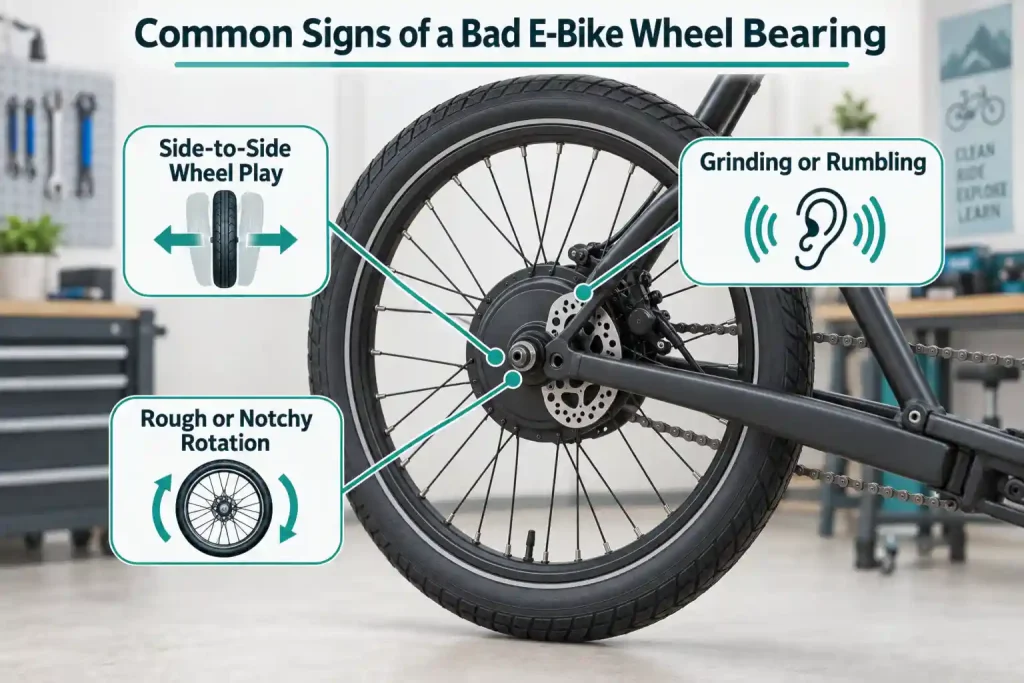
Bad e-bike wheel bearings may cause grinding or growling, rough or notchy rotation, abnormal side-to-side play, clicking or knocking, or a wheel that binds instead of turning smoothly. The safest first check is to turn the bike off, make sure the wheel is correctly secured, gently check for abnormal play, and rotate the wheel by hand while ruling out brake, tire, fender, spoke, and drivetrain contact.
Do not diagnose a bearing problem from one symptom alone. Bearing designs vary by bike and component, and hub-motor wheels can behave differently from conventional bicycle wheels.
60-Second Bearing Check
- Turn the e-bike off.
- Confirm the wheel appears fully seated and securely retained according to the bike manufacturer.
- Check for obvious rim or axle movement without forcing the wheel.
- Rotate the wheel by hand and listen and feel for grinding, roughness, notches, or binding.
- Look for brake-rotor rub, tire or fender contact, loose spokes, or another external source of resistance.
If the wheel feels loose, unstable, or poorly retained, stop there and do not ride until the cause is identified.
Safety First – When to Stop Riding
Do not continue riding if there is substantial wheel or axle looseness, severe wobbling, binding, obvious axle or dropout damage, a wheel that is not securely retained, severe grinding accompanied by instability, or damaged hub-motor wiring near the axle. Those conditions can affect wheel retention, steering, braking, or control.
A tiny amount of movement does not automatically prove the bearings are dangerous. Hub, axle, and wheel-retention systems vary. What matters is whether the wheel is properly installed and retained, whether the movement is abnormal for that design, and whether control or structural integrity may be affected.
Stop riding: meaningful wheel or axle looseness, an unstable wheel, questionable wheel retention, binding, damaged dropout or axle parts, or damaged motor wiring near the axle.
Inspect before riding again: new grinding, roughness, clicking, unexplained play, or a change in how the wheel rotates.
Check another cause first: the noise clearly changes with brake application, visible tire or fender contact is present, spokes are loose, or the sound occurs only under motor power.
E-Bike Wheel-Bearing Symptoms and What They Can Also Mean
| Symptom | What It Could Mean | What to Check First |
|---|---|---|
| Grinding or growling while the wheel rotates | Worn or contaminated bearings, brake rub, internal motor noise, or drivetrain noise | Spin by hand with the motor off and listen for whether the sound follows wheel rotation, brake contact, or drivetrain movement |
| Rough or notchy rotation | Bearing damage, bearing adjustment issue on some hubs, brake drag, seal drag, or hub-motor resistance | Rule out external rubbing and compare the feel with the bike or hub manufacturer’s expected behavior |
| Side-to-side wheel play | Bearing play, loose axle hardware, improper wheel seating, loose hub components, spoke or rim problems | Confirm wheel retention first, then determine whether movement is at the hub/axle or elsewhere in the wheel |
| Clicking or knocking | Bearing or hub play, loose spokes, freehub/drivetrain noise, brake hardware, or motor-related noise | Check spokes, axle retention, brakes, and when the click occurs |
| Wheel wobble | Rim or tire problem, loose or broken spokes, poor wheel seating, axle issue, or hub play | Watch the rim and tire separately as the wheel rotates and inspect the wheel-retention system |
| Wheel slows unusually quickly when spun | Brake rub, tire/fender contact, seals, drivetrain drag, hub-motor drag, or bearing trouble | Look for contact first and do not use spin time alone as a bearing test |
| Noise changes when the brake is applied | Brake rotor/pad contact or brake-related movement may be more likely | Inspect rotor alignment, wheel seating, and caliper/pad contact |
| Noise only under motor power | Motor, controller, gearing, internal motor parts, or electrical drive load may be involved | Compare powered operation with an unpowered hand-spin test |
| Vibration through the frame or handlebars | Wheel/tire issue, loose hardware, spokes, bearings, brakes, or motor operation | Use the E-Bike Shaking or Vibrating guide to narrow the source |
Before Blaming the Bearings – Rule Out These Problems First
Brake Rotor or Pad Rubbing
Disc-brake rub can create scraping, grinding, or resistance that feels like a rough hub. A wheel that is not fully seated can also change rotor alignment. Before assuming the bearings are bad, look through the caliper while the wheel turns and check whether the rotor is contacting a pad.
Do not spray lubricant around a rotor or caliper while troubleshooting. Oil or other contamination can reduce braking performance and may require pad or rotor service.
Tire or Fender Contact
A tire touching a fender, frame member, cable, rack part, or other accessory can slow the wheel and create a repeating rub. Check for visible contact throughout a full wheel rotation.
Loose or Damaged Spokes
Loose or broken spokes can create clicking, wheel movement, rim deviation, and vibration that riders sometimes mistake for hub play. If the rim itself moves or the spokes do not have consistent support, use the guide to loose or breaking e-bike spokes before assuming the bearings are the root cause.
Wheel Not Seated Correctly
A wheel that is not fully seated in the fork or frame can cause brake rub, abnormal tracking, and unsafe retention. Check the bike manufacturer’s wheel-installation instructions. Do not compensate by blindly tightening hardware beyond the specified procedure.
Loose Axle Hardware or Thru-Axle
Loose wheel-retention hardware can produce movement that resembles bearing play. The correct retention method and torque depend on the bike, hub, axle, and motor design. Use the manufacturer’s specification for your exact model.
Visible Rim, Tire, or Wheel Damage
A bent rim, damaged tire, impact-damaged wheel, or distorted component can create wobble even when the bearings are not the cause. If the bike recently struck a curb, pothole, rock, or other obstacle, inspect the wheel and axle area carefully before riding.
Rear-Wheel Drivetrain Noise
On a conventional rear hub, cassette, freehub, chain, derailleur, or other drivetrain noise can be mistaken for bearing noise. Notice whether the sound changes when you pedal, coast, or shift.
Hub-Motor Noise Only Under Electrical Power
If the wheel feels reasonably normal when rotated by hand with the system off but grinds, knocks, or vibrates primarily under motor power, the issue may be motor-related rather than an ordinary wheel bearing. See the motor grinding-noise troubleshooting guide before replacing wheel bearings or an entire motor.
How to Check an E-Bike Wheel for Bearing Problems
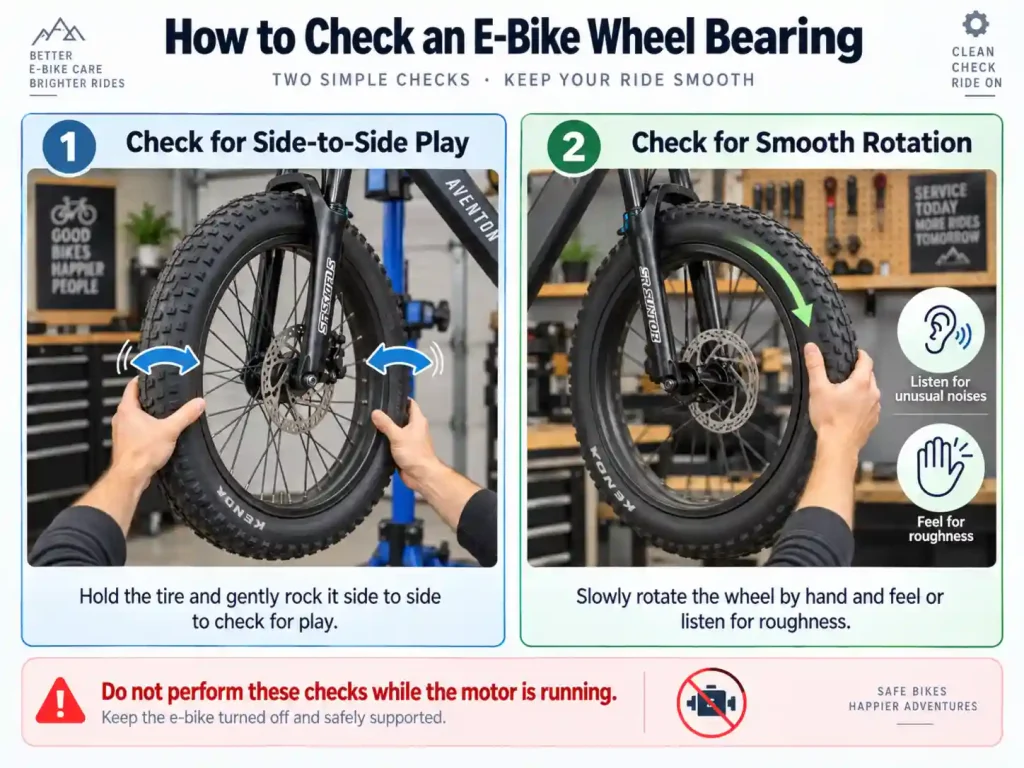
- Turn the bike off. Prevent unexpected motor assistance while you inspect the wheel.
- Stabilize the bike safely. A repair stand can make the check easier if it is rated for the bike’s weight and used according to its instructions. Otherwise use a safe method recommended by the bike manufacturer.
- Inspect the wheel and axle area. Look for damaged axle parts, distorted dropouts, loose hardware, broken spokes, a bent rim, or damaged hub-motor wiring.
- Confirm the wheel is properly secured. Check the bike manufacturer’s installation procedure for quick-release, thru-axle, axle-nut, torque-arm, or hub-motor hardware. Do not invent a torque value.
- Check for side-to-side play. Gently hold the rim and try to move it laterally. Do not force it. Obvious knocking or movement can point to bearing, axle, retention, or hub problems, but it does not identify the exact failed part.
- Rotate the wheel by hand. Feel and listen for grinding, roughness, distinct notches, or binding. Try to identify whether the sensation repeats with each rotation.
- Rule out external drag. Watch for rotor/pad contact, tire or fender rub, cable contact, and anything else touching the rotating wheel.
- Compare with the other wheel only when meaningful. A conventional front hub and a rear hub motor may naturally feel very different. Comparison is most useful when the hubs are similar in design.
- Stop before manufacturer-specific internal work. Do not dismantle a hub motor or sealed bearing system unless the manufacturer documents owner service and you have the skills and tools required.
Where Are You Actually Feeling the Play?
If the rim seems to move, try to determine whether the movement originates at the hub/axle interface or from the rim and spoke system. Repeating rim deviation can come from spoke tension, wheel damage, or tire seating. A distinct knock between the hub and axle area points the diagnosis in a different direction.
This is a localization check, not a reason to force the wheel. If retention is questionable or the source is not clear, a qualified shop can inspect the hub, axle, spokes, rim, and dropouts together.
Do Not Judge Bearings by Spin Time Alone
A wheel that stops sooner than expected does not automatically have bad bearings. Brake drag, bearing seals, drivetrain parts, tire or fender contact, and hub design can all affect free-spinning behavior.
Hub motors add another complication. Direct-drive hub motors can produce noticeable magnetic or cogging drag when turned, while many geared hub motors use an internal freewheel that changes how the wheel coasts. The exact behavior depends on the motor. Use spin time as one clue, not a pass/fail bearing test.
Front Wheel vs Rear Wheel vs Hub-Motor Bearings
Conventional Front Hub
A conventional front hub is usually the simplest wheel in the system, but its bearing design still matters. Some hubs use adjustable cup-and-cone bearings while others use cartridge bearings. The correct service method depends on the specific hub.
Conventional Rear Bicycle Hub
A non-motor rear hub adds freehub or freewheel and drivetrain components. Noise or roughness may come from the wheel bearings, but it may also come from the freehub, cassette, chain, or related parts. Separating wheel-rotation noise from pedaling/coasting noise helps narrow the problem.
Rear Hub Motor
A rear hub motor combines wheel, axle, electrical cable, motor internals, and drivetrain hardware in one area. Accessing internal bearings may require motor-specific disassembly, special tools, wiring precautions, and service information. Do not assume a conventional bicycle-hub procedure applies.
Front Hub Motor
A front hub motor has fewer drivetrain variables, but axle retention and motor-cable protection are still critical. If there is meaningful axle movement, dropout damage, cable damage, or uncertain wheel retention, stop riding until the system is inspected.
What Does Normal Bearing Play Feel Like?
There is no universal numerical amount of acceptable wheel-bearing play that applies to every e-bike. Hub and axle systems vary. Some adjustable bicycle hubs are set according to the specific hub design, while cartridge-bearing hubs generally do not use the same adjustment method.
Obvious knocking or movement at the rim warrants further inspection, especially if it remains when the wheel is correctly installed and retained. But do not assume every detectable movement means a bearing must be replaced. The correct interpretation comes from the hub or bike manufacturer’s service information.
🎬 Watch: How to Check and Adjust Cup-and-Cone Hub Bearings
This Park Tool video shows how cup-and-cone bicycle hub bearings are checked and adjusted. Not every e-bike uses this type of hub, and hub-motor bearings may require a different, manufacturer-specific service procedure.
Bad Bearing or Brake Rub?
Brake rub often produces a scrape or resistance that is tied to rotor position. The sound may change after braking or may be visible where the rotor passes through the caliper. Bearing roughness is more likely to be felt through the hub as the wheel turns, but this distinction is not definitive.
Park Tool’s brake service guidance specifically includes checking wheel seating and hub play when diagnosing rotor rub. That is a good reminder that the two problems can interact, so check both instead of assuming one symptom proves one cause.
Bad Bearing or Loose Spokes?
Loose spokes can create clicking, rim movement, vibration, and a wheel that does not track correctly. Bearing trouble is centered in the hub, while spoke problems affect how the rim is supported by the hub. If you find loose, broken, or repeatedly detensioning spokes, use the loose-spoke and wheel troubleshooting guide and avoid riding an unstable wheel.
Bad Bearing or Hub-Motor Problem?
Pay attention to when the symptom occurs. Roughness that is present while the unpowered wheel is turned by hand can point toward mechanical drag or a hub/bearing issue. A noise that appears mainly under electrical power can point toward motor internals, gearing, or another drive-system problem.
This still is not a definitive test. Some hub motors have normal drag characteristics, and internal failures can produce symptoms in more than one operating condition. Use the E-Bike Motor Makes Grinding Noise guide for the motor-specific branch of the diagnosis.
Possible Fixes
Start with the simplest verified cause and move toward more specialized service:
- Correct an improperly seated wheel using the bike manufacturer’s installation procedure.
- Correct confirmed brake rub using the brake and bike manufacturer’s service guidance.
- Correct loose wheel-retention hardware only to the manufacturer’s specification.
- Have an adjustable bicycle hub correctly serviced when that design supports adjustment.
- Replace a worn cartridge bearing when the hub manufacturer specifies replacement rather than adjustment.
- Replace damaged hub, axle, freehub, wheel, or related components when inspection shows they are the actual cause.
- Use professional e-bike service for internal hub-motor bearing or motor problems when manufacturer-specific disassembly is required.
Do not assume every bearing can be tightened. Do not pry open sealed cartridge bearings as a general repair method, and do not replace an expensive motor or complete wheel before simpler causes are reasonably ruled out.
When Professional E-Bike Service Is Appropriate
Professional service is the safer choice when:
- wheel play cannot be identified or corrected safely;
- wheel retention, axle integrity, torque arms, or dropouts are questionable;
- grinding or binding is severe;
- a hub motor needs internal disassembly;
- motor wiring near the axle is damaged;
- the bearing system is unfamiliar or manufacturer-specific;
- specialized bearing extraction or installation tools are required;
- you cannot confidently distinguish bearings from brakes, spokes, drivetrain, or motor problems; or
- bearing damage may have affected the axle, hub shell, motor, or dropout.
Help the Shop Diagnose It Faster
Before taking the bike in, note when the symptom occurs. Does it happen while coasting, pedaling, braking, turning, or only under motor power? Which wheel seems to produce it? Did the bike recently hit a curb or pothole? Is any axle hardware or motor cable visibly damaged?
If the symptom is intermittent, a short phone video or audio recording can help a technician understand what you experienced, provided you can make the recording safely without riding distracted.
Can You Ride an E-Bike With Bad Wheel Bearings?
Confirmed bearing damage can worsen with continued use and may damage the hub, axle, or surrounding components. When bearing problems create meaningful looseness, instability, binding, axle problems, or uncertain wheel retention, stop riding until the bike is inspected.
Not every small noise or tiny amount of movement means the bike is immediately unsafe. The decision depends on the hub design and whether wheel retention or control is affected. If you are unsure, err on the side of inspection rather than continuing to ride an unstable wheel.
What Not to Do
- Do not keep riding with serious wheel looseness, instability, or questionable retention.
- Do not blindly tighten axle, cone, hub, or motor hardware without the correct specification and procedure.
- Do not spray lubricant where it can reach brake rotors or pads.
- Do not contaminate brake components while checking a hub.
- Do not force or pry sealed components open.
- Do not pull, twist, pinch, or support a hub-motor wheel by its cable.
- Do not open a hub motor without appropriate manufacturer documentation, tools, and skills.
- Do not replace an expensive motor or wheel until simpler causes have been reasonably ruled out.
Preventing Wheel-Bearing Problems
There is no universal e-bike wheel-bearing replacement schedule. Instead, include the wheel and hub in routine inspections. Check for developing play, new noise, changes in rotation, damaged axle hardware, and correct wheel installation.
Rain, dirt, impacts, heavy loads, frequent rough-surface riding, and poor storage conditions can justify more frequent inspection, but the correct maintenance schedule comes from the bike and component manufacturers. Use the E-Bike Maintenance Checklist and the complete e-bike maintenance schedule as practical starting points.
Practical Tool Tip
A stable bicycle repair stand can make wheel-spin, brake-rub, and play checks easier because it keeps the wheel off the ground. Use a stand rated for your e-bike’s weight and follow the stand and bike manufacturer’s lifting and clamping instructions. A basic hex-key set and a torque wrench can also be useful when your bike manufacturer provides the correct fastener specifications.
🔎 Why You Can Trust This Guide
This troubleshooting guide is based on manufacturer and component documentation, established bicycle diagnostic principles, professional service references, and safety guidance. Symptoms are treated as clues rather than proof, and manufacturer-specific procedures are left to the documentation for the exact bike, hub, axle, or motor.
Learn more about the site’s research, review, and editorial process.
Related E-Bike Troubleshooting Resources
- E-Bike Troubleshooting & Maintenance Guide
- E-Bike Tools Hub
- E-Bike Motor Makes Grinding Noise? Causes & Fixes
- Why Is My E-Bike Shaking or Vibrating?
- Why Does My E-Bike Make Clicking Noises?
- Why Do E-Bike Spokes Keep Coming Loose or Breaking?
Frequently Asked Questions
How do I know if my e-bike wheel bearings are bad?
Grinding, rough or notchy rotation, abnormal side-to-side play, or binding can point to bearing trouble. They do not confirm it. First rule out brake rub, poor wheel seating, loose axle hardware, spoke problems, tire or fender contact, drivetrain noise, and hub-motor issues.
Should an e-bike wheel have any side-to-side play?
There is no universal allowable-play number for every e-bike hub. Obvious knocking or movement deserves inspection, but hub and axle designs vary. Confirm the wheel is correctly installed and use the component manufacturer’s guidance before deciding whether adjustment or replacement is required.
Why does my e-bike wheel feel rough when I spin it?
Possible causes include bearing wear, an adjustment issue on some hub types, brake drag, tire or fender contact, seals, drivetrain resistance, or the normal resistance characteristics of some hub motors. Check the external causes before concluding that the bearings have failed.
Can brake rub feel like a bad wheel bearing?
Yes. Rotor/pad contact can create scraping and resistance that feels like a rough wheel. A poorly seated wheel can also change rotor alignment. Inspect the brake and wheel seating before replacing bearings.
Can loose spokes cause clicking or wheel movement?
Yes. Loose or broken spokes can cause clicking, vibration, rim movement, and wheel wobble. That is why spoke and rim condition should be checked before assuming movement comes from the hub bearings.
Can hub-motor bearings be replaced?
Some hub-motor bearings can be replaced, but the procedure is motor-specific. Access may require special tools, wiring precautions, correct replacement parts, and manufacturer service information. Do not assume a conventional bicycle-hub procedure applies, and do not open a motor when the manufacturer restricts service to qualified personnel.
Can I ride an e-bike with a bad wheel bearing?
Do not ride if there is meaningful looseness, instability, binding, axle or dropout damage, damaged motor wiring, or uncertain wheel retention. A minor symptom without those conditions still deserves diagnosis, because continued riding on confirmed bearing damage can worsen other hub or axle parts.
How much does e-bike wheel-bearing repair usually involve?
It depends heavily on the hub. A conventional adjustable hub, a cartridge-bearing hub, a rear freehub, and a hub motor can require very different labor, parts, and tools. Damage to the axle, hub shell, motor, or dropout can also change the repair substantially, so there is no responsible universal price or repair scope without identifying the exact system.
My Take
With wheel-bearing problems, I would focus first on whether the wheel is secure and stable rather than trying to diagnose the exact bearing immediately. Grinding, roughness, or play can point toward bearing trouble, but brake rub, spokes, axle hardware, wheel seating, and hub-motor issues can create similar symptoms.
If the wheel has meaningful looseness, binding, or questionable axle retention, I would stop riding and have it inspected. If the wheel is secure and the symptom is minor, working through the simple checks first can help avoid replacing an expensive hub motor or wheel unnecessarily.
Like Electric Bike Explorer?
Add Electric Bike Explorer as a Preferred Source on Google to make it easier to see more of our e-bike news, guides, reviews, and troubleshooting content in Google Search.
Technical and Safety Sources
- Park Tool – Hub Overhaul and Adjustment: Cup and Cone Style
- Park Tool – Hydraulic Disc Brake Alignment
- Bafang H730 Dealer Manual
- Ride1Up – Rear Hub Motor Wheel Removal Guidance
- Grin Technologies – Hub Motor Technical Overview

Kristina is not just an enthusiast but a true authority on electric bikes. Nestled in the coastal beauty of Virginia, Kristina has found the perfect backdrop for her passion for electric biking. As a dedicated wife and homeschooling mom, her life revolves around family, faith, and the thrill of adventure.
Originally hailing from Ohio, Kristina's journey with electric bikes began as a curiosity and quickly evolved into a deep expertise. Her blog is a testament to her love for electric biking, combining her fascination for eco-friendly transportation with her coastal lifestyle.
When she's not cruising the beach on her electric bike, you'll find Kristina indulging in her other loves: long walks along the shore, getting lost in a good book, and cherishing moments with her loved ones. With a heart as big as her love for animals, especially cats, Kristina brings a unique perspective to the electric bike world, grounded in her strong faith in God and her dedication to a sustainable lifestyle.
Through her blog, Kristina shares her extensive knowledge of electric bikes, offering valuable insights, tips, and recommendations to fellow enthusiasts. Whether you're a seasoned rider or a newcomer to the electric bike scene, Kristina's blog is your go-to source for all things electric biking, fueled by her passion, expertise, and the scenic beauty of coastal Virginia.