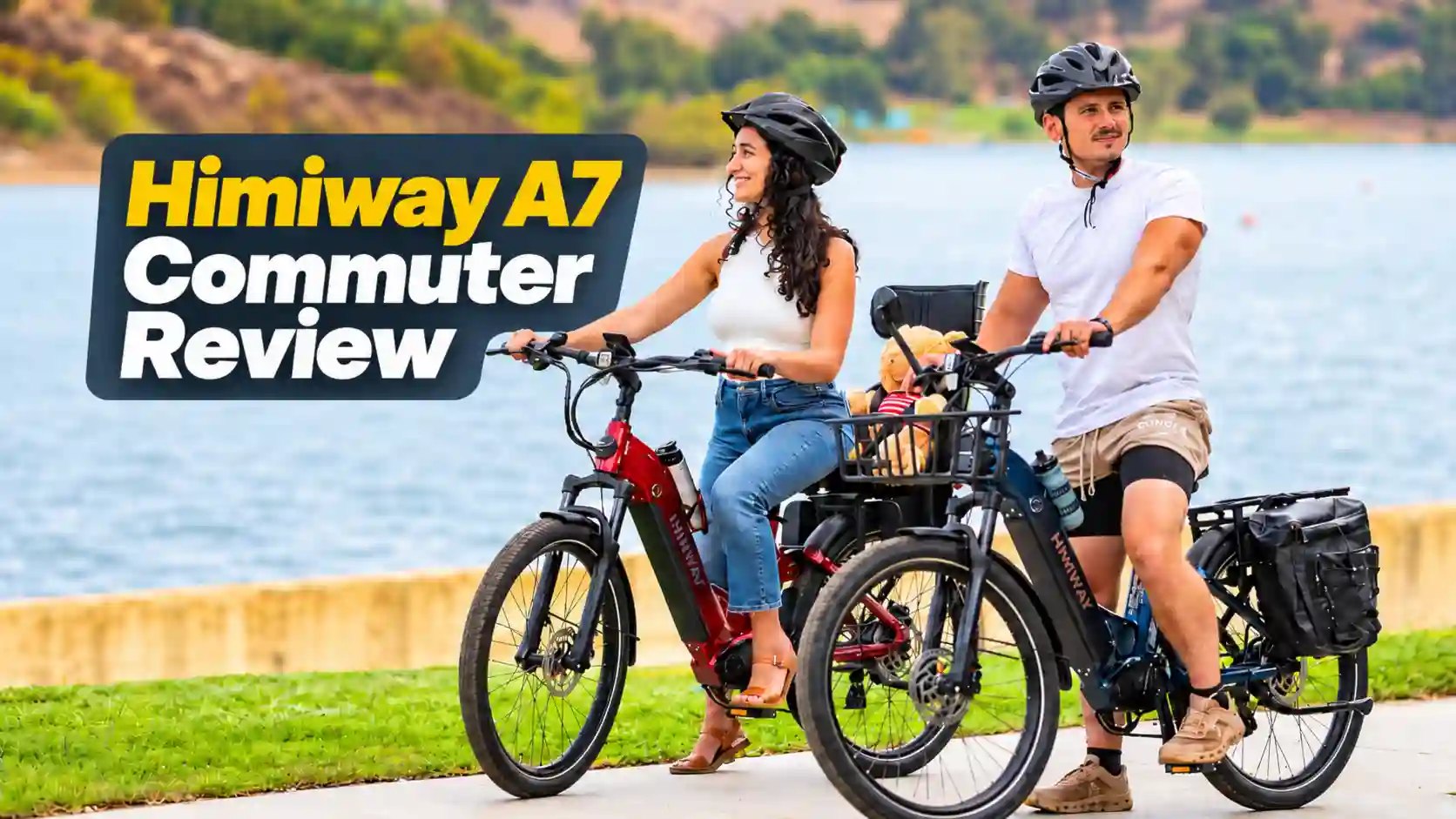
Himiway A7 Commuter Review: Full-Suspension Comfort With an 84-Lb Tradeoff
Last Updated on October 4, 2026 by Kristina
📚 Research-Based Review – Built from independent sources, specs, and user reports
Introduction
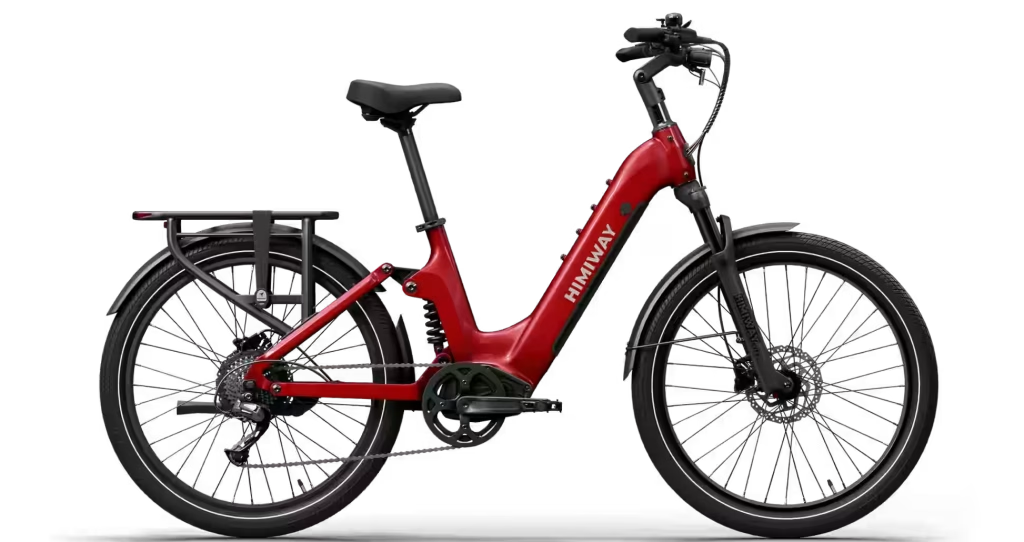
The regular Himiway A7 is a step-through, full-suspension commuter built around comfort rather than minimum weight. It combines a 720Wh removable battery, hydraulic disc brakes, 27.5-inch commuter tires, a rear rack, fenders, integrated lights, and switchable torque- or cadence-sensor assistance.
The question I would ask before buying it is simple: does the extra comfort and equipment justify owning an 84-lb commuter?
For riders dealing with rough pavement, longer recreational rides, or joint sensitivity, the suspension and upright setup are appealing. For anyone who needs to carry a bike upstairs or regularly lift it onto a rack, 84 lb can be a deal breaker.
This review covers the regular hub-motor Himiway A7 sold in the United States. It is not the Himiway A7 Pro, which uses a completely different mid-drive system.
If you are still comparing motor types, Electric Bike Explorer’s e-bike motor guide explains the practical differences between hub motors and mid-drives. The E-Bike Buying Guide is also worth reading before deciding how much battery, suspension, weight, and carrying capacity you actually need.
Quick Verdict
Overall Rating: 8.1 out of 10 – Very Good
Best for: Comfort-focused commuters and recreational riders who want a low step-through frame, full suspension, a torque sensor, integrated commuting equipment, and relatively high advertised carrying capacity.
Strongest advantage: Front and rear suspension give the A7 an unusually comfort-focused setup for an everyday commuter.
Biggest drawback: The current A7 weighs 84 lb, making stairs, vehicle loading, and many hitch-rack setups considerably harder.
Current price: $1,999, checked October 2, 2026.
Review type: Research-Based Review
Evidence confidence: Moderate
Rating Breakdown
| Area | Score |
|---|---|
| Motor and performance | 8.2/10 |
| Battery and range | 8.1/10 |
| Comfort and ride quality | 9.1/10 |
| Brakes and safety | 8.2/10 |
| Fit and accessibility | 8.5/10 |
| Features and usability | 8.6/10 |
| Portability and weight | 5.8/10 |
| Warranty, service and ownership | 7.2/10 |
| Price and value | 8.2/10 |
🔎 Why You Can Trust This Review
I researched Himiway’s current U.S. product information, current A7/A7 2.0 owner resources and manual, warranty, return policy, electrical-certification information, replacement-parts listings, financing information, independent performance testing, and available rider feedback.
I separate Himiway’s claims from independently reported results, and I disclose specification conflicts rather than quietly choosing the most favorable number. Affiliate relationships do not influence the rating or conclusion. Electric Bike Explorer’s review methodology explains how bikes are researched and rated.
Who the Himiway A7 Is Good For – and Who Should Skip It
I think the A7 makes the most sense for riders who put comfort and everyday equipment ahead of low weight.
It is especially interesting for commuters who ride cracked pavement, recreational riders who want a softer ride, adults who prefer an upright position, and anyone who finds a low step-through easier to mount.
The 20.2-inch listed standover, adjustable stem, wide saddle, 2.4-inch tires, and front-and-rear suspension all point toward accessibility and comfort rather than aggressive handling.
I would also consider it if you want torque-sensor assistance. A torque sensor responds to how hard you pedal, which generally feels more natural than a basic cadence sensor. Himiway lets the rider switch between torque and cadence modes, giving you more choice than many commuters.
I would skip the A7 if you regularly carry your bike upstairs, need to lift it into an SUV by yourself, or already own a vehicle rack with a modest per-bike weight limit. At 84 lb, this is a very heavy commuter.
It is also not a substitute for a true mountain bike. Full suspension can make potholes, broken pavement, gravel, and recreational paths more comfortable, but that does not turn a heavy urban commuter into a performance trail bike.
Finally, riders who regularly climb very steep or sustained hills may prefer the A7 Pro’s mid-drive motor, provided its higher price and different ownership tradeoffs make sense.
Himiway A7 Specifications
| Specification | Current U.S. Himiway A7 |
|---|---|
| Price checked | $1,999 on October 2, 2026 |
| Frame | Aluminum-alloy step-through |
| Colors | Red, Midnight Blue, White |
| Regular rider-height range | 5 ft. 1 in. to 6 ft. 3 in. |
| Large rider-height range | 5 ft. 3 in. to 6 ft. 1 in. |
| Regular minimum saddle height | 31.5 in. |
| Large minimum saddle height | 32.6 in. |
| Step-over/standover height | 20.2 in. |
| Bike weight | 84 lb |
| Published replacement-battery weight | 8.4 lb for Himiway’s compatible 48V 15Ah replacement pack |
| Payload | Official conflict: current product page advertises 400 lb; current Regular/A7 2.0 manual lists 330 lb |
| Motor location | Rear hub |
| Regular motor | Himiway currently lists 48V, 750W, 70Nm |
| Large motor | Himiway currently lists 48V, 500W, 60Nm |
| Peak motor output | Not verified – Himiway does not clearly distinguish a separate peak figure |
| Battery | Samsung/LG 48V 15Ah |
| Battery capacity | 720Wh |
| Claimed throttle range | Up to 40 miles |
| Claimed pedal-assist range | Main specifications say up to 70 miles; other Himiway copy has listed up to 65 miles |
| Independently reported current-model range | Not verified for the present 750W Regular version |
| Default maximum assist speed | 20 mph |
| Adjustable maximum assist speed | Up to 28 mph |
| Throttle | Thumb throttle |
| Class settings | Himiway lists Class 1, 2 and 3 configurations |
| Sensor | Switchable torque/cadence |
| Front suspension | Himiway product page: 120mm “hydraulic suspension” fork with lockout and rebound adjustment; current manual describes a 120mm coil-spring fork |
| Rear suspension | Four-link design, 90mm published travel |
| Brakes | Shimano MT200 hydraulic discs |
| Rotor size | 180mm front and rear |
| Drivetrain | Shimano 8-speed, 13-32T freewheel |
| Tires – Regular | Innova 27.5 x 2.4 in. with reflective strip |
| Front light | Integrated 120-lux LED |
| Rear light | Integrated, with brake indication and steady/flash modes |
| Fenders | Full-coverage aluminum front and rear |
| Rear rack | MIK-compatible; official limits conflict: 120 lb in the current specifications, 60 lb in Himiway FAQ copy, and 55 lb in the current manual |
| Display | 3.5-in. color display, Bluetooth, adjustable angle |
| App/connectivity | Bluetooth is listed; broader current app functions were not sufficiently verified |
| Walk mode | 1.0-3.7 mph |
| Battery water resistance | IPX6 |
| Complete-bike water rating | Not verified |
| Charging | 48V 2A charger |
| Published charging time | Not published for the current A7 configuration |
| Certification | Himiway lists A7 as UL 2849 and UL 2271 certified |
| Warranty | 2-year manufacturer warranty; battery coverage is prorated under Himiway’s policy |
| Returns | 15-day standard window with important mileage, condition, shipping and restocking conditions |
| Financing | Affirm, PayPal Credit and Klarna |
| Replacement battery | $499 listed for compatible 48V 15Ah pack when checked; A7 15Ah variant showed sold out or unavailable |
✅ Pros
- 120mm published front travel and 90mm rear travel
- Low step-through frame
- Switchable torque and cadence sensors
- Smart Auto plus five manual assist levels
- Current Regular version lists a 750W/70Nm rear-hub motor
- 720Wh Samsung/LG battery
- Shimano MT200 hydraulic disc brakes
- 180mm rotors front and rear
- Integrated 120-lux headlight
- Brake-indicating rear light
- Full fenders included
- MIK-compatible rear rack included
- Shimano 8-speed drivetrain
- Adjustable stem
- High advertised payload, although the current manual lists a lower figure
- Up to 28 mph configurable assist where legal
- Himiway lists the A7 under UL 2849 and UL 2271 certification
- Replacement battery is an official catalog item
- 2-year manufacturer warranty
❌ Cons
- Very heavy at 84 lb
- Difficult choice for stairs or frequent vehicle loading
- Current motor specification differs by A7 size
- Himiway does not clearly publish a separate peak motor figure
- Official pedal-assist range information is not completely consistent
- Product page and current manual conflict on total payload
- Rear-rack limits conflict substantially across current official Himiway sources
- Child-seat compatibility should be confirmed rather than assumed
- Current 750W Regular model lacks strong quantified independent performance testing
- 2A charger is modest for a 720Wh battery
- Current model-specific charging time is not clearly published
- A7-compatible 15Ah replacement battery was unavailable when checked
- Non-defect returns can be expensive
- Used returns can incur a 30% restocking fee
- Warranty labor is not universally covered
- 84-lb weight narrows compatible vehicle-rack choices
Important Payload and Rack Conflict
The payload and rack numbers deserve more than a footnote.
Himiway’s current product page advertises a 400-lb payload, but the current A7 Regular/A7 2.0 manual lists a 330-lb structural capacity.
The rack numbers conflict even more. Himiway’s current specification table lists 120 lb, FAQ copy has listed 60 lb, and the current manual specifies 55 lb.
Because these are conflicting current official sources, I would not assume the highest number is safe. Until Himiway clarifies which limit governs the exact current bike, I would treat the manual’s more conservative limits as the safer reference when planning heavy loads.
The same care is needed with motor specifications. Himiway’s current Regular and Large A7 configurations do not use the same published motor rating, so confirm your selected size before ordering.
Design, Frame and Build Quality
The A7 uses an aluminum step-through frame with the battery integrated into the downtube area. The 20.2-inch listed standover is considerably friendlier than a high-step commuter frame for riders who dislike swinging a leg over a rear rack.
I also like the adjustable stem on paper. Himiway lists a 0-60-degree adjustment range, which gives riders some ability to raise and shorten the effective cockpit for a more upright position.
Cable routing appears relatively tidy in current product imagery, and Himiway equips the bike with a thru-axle front end rather than a basic quick-release fork. That is a useful structural choice on a heavy, full-suspension e-bike.
I would be careful about calling the build quality “proven,” however. Current long-term independent evidence on the latest 750W Regular version is still limited.
Included equipment is strong for commuting: front and rear lights, full fenders, a rear rack, kickstand, and an 8-speed drivetrain are already on the bike rather than being immediate accessory purchases.
Ride Quality and Comfort
Comfort is the strongest reason I see to choose the A7.
Himiway publishes 120mm of front travel and 90mm of rear travel. Its current product page describes the front fork as hydraulic suspension with lockout and rebound adjustment, while the current manual describes a coil-spring fork. Those descriptions may refer to different aspects of the fork, but I would not try to infer internal construction beyond what Himiway documents.
Add the 27.5 x 2.4-inch tires, wide memory-foam saddle, ergonomic grips, and adjustable stem, and the A7 is clearly designed to soften rough urban surfaces.
For riders with sensitive knees, hips, backs, or wrists, that combination may be more useful than having a lighter, racier bike. Suspension cannot guarantee comfort for any individual rider, but it can reduce some of the road shock reaching the rider.
The downside to soft suspension is that movement can consume some pedaling energy. Himiway gives the front fork a lockout, which is useful on smooth pavement. I did not find sufficiently detailed current independent testing to quantify how much the rear end moves under hard pedaling on the latest bike.
The 84-lb mass should also make the A7 feel substantial once moving, but weight that can contribute to a planted feel can make slow-speed maneuvering, garage handling, backing up, and parking more cumbersome.
Earlier independent testing of the previous A7 praised its overall comfort after a seatpost-fit problem was corrected. Himiway’s current Regular/A7 2.0 documentation specifies a different seatpost arrangement, so I would not assume that early seatpost problem applies to today’s bike.
Motor, Sensor and Hill Performance
This is the section where model identity matters most.
The current Regular A7 specification lists a 48V, 750W rear-hub motor with 70Nm of torque.
The current Large A7 specification lists a 48V, 500W rear-hub motor with 60Nm.
That means buyers should not assume every A7 has the same motor simply because both sizes appear under the same product name.
Himiway does not clearly identify a separate peak-watt figure on the current A7 specifications, so I am not going to describe the 750W or 500W figures as peak power.
The A7 can switch between torque and cadence sensing. In torque mode, assistance responds to pedal pressure. That generally creates a more proportional feeling than a basic cadence sensor.
Cadence mode instead responds primarily to whether the cranks are turning, which can provide easier assistance with less pedal force.
Himiway also includes Smart Auto assistance plus five manual assist levels.
The thumb throttle adds another option for starts or short periods when you do not want to pedal. Himiway lists a default maximum speed of 20 mph and an adjustable maximum up to 28 mph, with Class 1, 2 and 3 configurations.
That does not mean every setting is legal everywhere. Class definitions, throttle access and path rules vary by state and locality, so check Electric Bike Explorer’s state e-bike law guides before changing speed or class settings.
What About Hills?
A 750W/70Nm hub motor should have more published output than the previous 500W A7, but I do not have a trustworthy quantified hill test for the exact current 750W Regular configuration.
The strongest instrumented performance data available comes from an earlier 500W, 60Nm A7 weighing about 72.7 lb. That is not the same specification as today’s 84-lb Regular model.
Because the motor, overall weight, tires and some other equipment differ, I do not think it is responsible to use the earlier hill or acceleration numbers as proof of current performance.
If your commute includes repeated steep grades, a mid-drive such as the A7 Pro has a mechanical advantage because it sends motor power through the bike’s gearing. That lets the motor take better advantage of lower gears when climbing.
Battery, Charging and Realistic Range
The A7 uses a 48V 15Ah Samsung/LG battery.
That equals 720Wh, which is a healthy capacity for an urban commuter. It is not exceptionally large when you remember that the bike weighs 84 lb and the Regular version can use a 750W rear-hub motor.
Himiway’s main specification table claims up to 70 miles of pedal-assist range and up to 40 miles using the throttle. Other Himiway copy associated with the A7 has listed up to 65 miles of pedal-assist range.
That conflict is a good reminder not to treat maximum-range marketing as an everyday guarantee.
Real range depends on rider and cargo weight, hills, wind, temperature, tire pressure, stop-and-go riding, assist level, speed, throttle use, and whether the Regular or Large motor configuration is being ridden.
I found useful range testing on the previous 500W A7. BikeRide reported 45.77 miles in PAS 3 and 39.17 miles at maximum pedal assistance.
Those are legitimate measurements for the earlier 500W bike under BikeRide’s test conditions. They are not range tests of the present 750W Regular A7 and should not be used to predict an exact range for today’s model.
The current bike comes with a 48V 2A charger. Himiway does not publish a clear current model-specific charging time in the A7 specification table, so I am leaving charging time as not published rather than transferring the older bike’s 7-plus-hour independent result.
Replacement Battery
Himiway’s official replacement-battery store currently lists an A7-compatible 48V 15Ah replacement pack for $499 and gives that pack a weight of 8.4 lb.
When I checked, the A7-compatible 48V 15Ah variant was shown as sold out or unavailable.
That may change, but it is worth checking immediately before buying if assured replacement-battery availability is an important part of your long-term ownership plan.
Brakes and Safety
The A7 uses Shimano MT200 hydraulic disc brakes with 180mm rotors at both ends.
MT200s are widely used hydraulic brakes and are a reasonable component level for a commuter. Himiway also lists brake motor-cutoff switches.
The bike’s weight makes brake setup particularly important. At 84 lb before rider and cargo, the complete moving system can become very heavy.
BikeRide’s earlier 500W A7 stopped from 20 mph in 23 feet during its independent test. The tester considered that longer than the comparison bikes in that testing.
I would not use 23 feet as the expected stopping distance of today’s A7. The tested bike was the previous roughly 72.7-lb, 500W/60Nm configuration and used different tires. The current Regular bike is substantially heavier and has changed specifications.
The older result is useful only as historical context and reinforces the importance of properly bedding the brake pads, checking rotor alignment, maintaining tire pressure, and confirming strong lever feel before riding a newly assembled heavy e-bike.
The integrated 120-lux headlight and brake-indicating rear light are useful commuting equipment. Reflective tire details add another visibility feature on the Regular configuration.
Electrical Certification
Himiway’s current UL-certified model list includes the A7 and A7 2.0 under both UL 2849 and UL 2271 and says representative samples of the listed models were independently tested and certified.
UL 2849 concerns the e-bike electrical system, while UL 2271 concerns the lithium-ion battery.
That is more specific than vague language such as “built to UL standards.” Still, if certification is a condition of an apartment building, workplace, rebate program, insurer, or local rule, check the label on the exact bike and battery or request the current certification documentation before relying on it.
Display, Controls and Technology
The current A7 has a 3.5-inch full-color display with adjustable viewing angle and Bluetooth.
The control system offers five manual pedal-assist levels, Smart Auto assistance, torque/cadence sensor switching, a thumb throttle, and walk mode.
That flexibility is one of the A7’s stronger usability features because riders can decide whether they want effort-based assistance or easier cadence-based power delivery.
I would not buy it primarily for app technology, though. Himiway clearly advertises Bluetooth, but I did not find enough current model-specific documentation to make firm claims about every app function, remote-security feature, subscription service or phone-based control.
I also did not verify a USB charging port for the current regular A7, so I am not listing one.
Cargo and Everyday Practicality
A rear rack, full fenders and integrated lights come standard. That gives the A7 a substantial head start as a commuter or grocery bike.
Himiway describes the rack as MIK HD compatible, which can make it easier to fit compatible bags, baskets and accessories.
The capacity is where I would be cautious.
Himiway’s current specification table lists a 120-lb rear-rack capacity. Other current Himiway FAQ copy lists 60 lb, while the current Regular/A7 2.0 manual lists 55 lb.
The current product page also advertises 400 lb total payload, while the current manual lists 330 lb structural capacity.
Those are material conflicts.
For normal commuting loads such as a work bag or modest groceries, the rack can still be useful. But I would not plan around either the 120-lb rack figure or the 400-lb payload figure without written confirmation from Himiway for the exact bike you receive.
What About a Child Seat?
Himiway’s product material associates the MIK rack with child-seat use, but the current manual adds an important qualification.
The manual warns that added load-bearing accessories such as child seats have not necessarily been tested for compatibility, reliability or safety and recommends consulting Himiway or a dealer before installation.
Because of that warning – combined with the conflicting rack-capacity figures – I would not describe the current A7 as having verified child-seat compatibility.
If you intend to carry a child, confirm the exact seat model, adapter, mounting method, rack rating, child weight and total load directly with Himiway and the child-seat manufacturer before purchase.
I also did not find model-specific official documentation supporting trailer towing, so I would not infer trailer compatibility from the bike’s overall payload claim.
Weight, Storage and Transportation
This section may decide the purchase.
The current A7 weighs 84 lb.
That is manageable in a garage or ground-floor storage area, but it is a serious amount of bike to carry up a staircase.
An elevator solves the lifting problem, but you still need enough room to turn and maneuver a long, heavy bicycle in hallways and doors.
Vehicle transportation also needs planning. Many lightweight tray racks are not designed for an 84-lb bike. Check the rack’s per-bike tray limit, not merely its combined capacity.
Removing the battery can reduce the lifting weight by roughly 8.4 lb if the current replacement-battery weight matches the battery supplied with your bike, but the remaining bicycle would still be heavy.
The A7 does not fold.
If easy lifting is a priority, Electric Bike Explorer’s lightweight e-bike guide is a better place to shop.
Assembly
Himiway provides current A7/A7 2.0 owner resources with the manual and assembly guidance.
The documentation covers front-wheel installation using the thru-axle and calls for common hex tools. A torque wrench is useful wherever the manual provides tightening specifications.
Himiway does not publish a reliable universal assembly time for the current A7, and I would rather leave that number out than repeat a single owner’s experience as though everyone will have the same result.
After assembly, check:
- front and rear brake alignment
- wheel and thru-axle security
- handlebar and stem torque
- pedal installation
- derailleur shifting
- tire pressure
- suspension setup
- lighting
- battery security
- motor cutoffs
- throttle behavior
- rack and fender fasteners
If the brakes rub badly, a rotor appears bent, shifting is not properly indexed, or you are uncertain about torque specifications, professional assembly or a post-assembly inspection is worthwhile.
🎬 Watch the Himiway A7 in action: This video gives you a closer look at the bike’s design, features, and everyday riding setup so you can see how it compares with the details covered in this review.
Independent Testing
This is the weakest part of the evidence base for the current 750W Regular A7.
The detailed instrumented tests I found were performed on an earlier A7 with a 500W, 60Nm rear-hub motor and an independently measured weight of about 72.7 lb.
BikeRide reported:
- 45.77 miles in its PAS 3 range test
- 39.17 miles in its highest-assist range test
- a 23-foot stop from 20 mph
- an 8-second 0-20 mph acceleration result at the tested stock settings
- generally positive comfort impressions after correcting a seatpost-fit problem
- measurable hill-test results for that earlier motor system
Those are useful historical data points for the A7 platform.
They are not independent test results for today’s 84-lb, 750W/70Nm Regular A7.
Because the motor, weight, tires and other components differ, I do not use the older acceleration, hill, braking or range figures as proof of current-model performance.
I would like to see a new instrumented test of the exact current 750W Regular configuration before rating its performance more aggressively.
What Owners Are Saying
Himiway’s own verified-buyer section contains positive comments about comfort, suspension and torque-sensor riding.
Some newer buyer comments also distinguish the current higher-output Regular configuration from the older 500W version.
Those comments are useful, but they have limits. They are hosted by the manufacturer, the latest configuration has had less time to accumulate long-term reliability evidence, and a handful of reviews cannot establish how common a particular problem is.
I therefore give owner feedback less weight than current specifications, manuals, policies and independent tests.
The ownership issues I would continue watching include:
- long-term suspension wear
- brake adjustment on such a heavy bike
- replacement-battery availability
- availability of model-specific electronic parts
- customer-service turnaround
- the unresolved payload and rack-capacity conflicts
Warranty, Returns, Service and Replacement Parts
Himiway’s current warranty states that its bikes are covered by a 2-year manufacturer’s warranty against covered manufacturing defects.
The frame has 2-year replacement coverage, while the battery is described under a 2-year prorated warranty.
Wear items such as tires, tubes, brake pads and brake rotors have much more limited coverage and are generally addressed only for qualifying shipping-related problems reported shortly after delivery.
Labor is another detail to understand. Himiway’s warranty specifically says labor associated with transferring parts to a replacement frame is not included, and service or installation costs are not automatically covered in every warranty situation.
I would read the complete current warranty immediately before buying rather than assuming “2-year warranty” means every repair expense is covered.
Return Policy
The current direct-purchase return policy is stricter than the phrase “15-day return” may suggest.
For a new and unused bike returned for personal reasons within the eligible period, Himiway lists a $300 bike shipping charge.
For a used bike within the allowed mileage and return period, Himiway’s policy can add significant deductions, including a 30% restocking fee under the applicable conditions.
Condition, mileage, packaging and the reason for the return all matter.
That makes fit and model verification especially important before putting meaningful mileage on the bike.
Replacement Parts
Himiway sells replacement batteries and other bike components through its parts catalog.
The A7/A7 Pro/D5 2.0-compatible 48V 15Ah replacement battery was listed at $499 when checked, with a published weight of 8.4 lb.
The A7-compatible 15Ah variant was shown as sold out or unavailable when researched.
That does not mean it will remain unavailable, but it is a practical reason to check replacement-battery stock before buying if long-term parts support is one of your priorities.
Financing
Himiway currently lists financing options including Affirm, PayPal Credit and Klarna.
Approval, interest rate and total financing cost depend on the provider and the customer’s approved terms.
Price and Value
At $1,999, the A7 competes in a crowded part of the commuter market.
Its value argument is not that it is the lightest or simplest bike for the money. It is that relatively few $2,000 commuters combine rear suspension, 120mm of published front travel, a 720Wh battery, hydraulic brakes, torque sensing, throttle capability, a rack, fenders, lights and a low step-through frame.
If rough-road comfort is your priority, that is a strong equipment package.
The weaker side of the value equation is ownership friction. Eighty-four pounds is a lot of bike, replacement-battery availability was uncertain when checked, Himiway’s current payload and rack figures conflict, and the return policy makes a wrong fit potentially expensive.
Compared with lighter commuters near the same price, the A7 asks you to accept substantially more mass in exchange for suspension comfort and included equipment.
Himiway A7 vs. Himiway A7 Pro
These are not the same bike with different trim.
| Feature | Himiway A7 | Himiway A7 Pro |
|---|---|---|
| Drive system | Rear hub | Mid-drive |
| Current motor | Regular: 750W/70Nm; Large: 500W/60Nm | Ananda M100 500W mid-drive |
| Torque | 70Nm Regular; 60Nm Large | Up to 130Nm claimed |
| Battery | 720Wh | 720Wh |
| Claimed PAS range | Main A7 specs say 70 miles, with conflicting lower Himiway copy elsewhere | Up to 50 miles |
| Sensor | Switchable torque/cadence | Torque sensor |
| Drivetrain | Shimano 8-speed | Shimano 9-speed |
| Front suspension | 120mm published travel | 120mm published travel |
| Rear suspension | 90mm published travel | Full suspension |
| Brakes | Shimano MT200, 180mm | Shimano MT200, 180mm |
| Weight | 84 lb | About 77 lb listed |
| Payload | 400 lb advertised; current manual lists 330 lb structural capacity | 300 lb |
| Current price checked | $1,999 | $2,899 |
| Best use | Comfort-focused commuting and riders who prefer a hub motor | Steeper routes and riders specifically wanting a mid-drive |
| Main ownership tradeoff | Heavy bike plus unresolved load-limit documentation | Higher purchase price and lower published payload |
The A7 Pro’s biggest functional difference is not simply its 500W number. It is the location of the motor.
A mid-drive sends power through the bicycle’s drivetrain. On a climb, selecting a lower gear allows the motor to benefit from the bike’s gearing, which can make a mid-drive more effective on steep or sustained hills than a hub motor with a higher wattage number.
The standard A7 is the simpler choice if you value its lower purchase price, rear-hub drive, and comfort-focused equipment more than maximum climbing capability.
Should You Buy the Himiway A7?
I think the Himiway A7 earns its place as a comfort-first commuter, but I would buy it for a very specific reason: you genuinely want front-and-rear suspension on an everyday step-through bike.
The suspension, wide saddle, adjustable cockpit, 2.4-inch tires, torque sensor and low frame address real concerns for riders who find traditional commuter bikes harsh or awkward to mount.
The biggest reason I would hesitate is not motor power or battery size. It is the 84-lb weight.
That weight affects storage, stairs, car racks, maintenance, maneuvering and what happens if you ever have to lift a disabled bike. A feature can be excellent on the road and still create problems in the garage.
My second concern is Himiway’s documentation.
The current product page advertises a 400-lb payload while the current manual lists 330 lb. The rack is listed at 120 lb in one current specification area, 60 lb in FAQ material, and 55 lb in the current manual.
Those are not trivial differences.
Until Himiway reconciles them, I would use conservative loading practices and get written confirmation before planning heavy cargo or a child-seat installation.
And although the current 750W Regular motor looks more capable on paper than the previous 500W A7, there is not yet enough instrumented independent testing for me to claim proven current-model hill, acceleration, range or braking performance.
That evidence limitation is why I am comfortable at 8.1 out of 10, rather than pushing the score higher based on specifications alone.
You should buy this bike if your top priorities are an easy-to-mount frame, full-suspension comfort, upright commuting, torque-sensor assistance, a 720Wh battery, hydraulic brakes and included commuter equipment – and you have ground-floor or garage storage where the 84-lb weight will not be a daily problem.
You should skip this bike if you need to carry your e-bike upstairs, frequently load it into a vehicle, own a rack that cannot safely carry an 84-lb bike, need clearly documented heavy-cargo limits, want extensively independently validated current-model performance, or simply do not need rear suspension.
Choose the A7 Pro instead if you regularly climb steep hills and specifically want a mid-drive motor that can use the bike’s gearing.
Consider another commuter if lower weight, simpler transportation, clearer load documentation, or more mature independent testing matters more to you than rear-suspension comfort.
Final Electric Bike Explorer score: 8.1 out of 10 – Very Good.
Before buying, confirm the exact Regular or Large configuration, motor specification, rider fit, current price, payload and rear-rack limits, replacement-battery availability, and certification labeling. If you plan to use a child seat, get compatibility confirmation for the exact seat and mounting setup. Also check your local e-bike class rules before enabling a 28-mph setting.
Meaningful Alternatives
Himiway A7 Pro
Choose the A7 Pro instead if your routes include serious hills and you specifically want a mid-drive.
Himiway currently lists the A7 Pro at $2,899. Its Ananda M100 system is rated at 500W with up to 130Nm claimed torque, paired with a torque sensor and Shimano 9-speed drivetrain.
It keeps the full-suspension commuter concept but sends motor power through the drivetrain rather than directly through a hub motor.
The tradeoffs are the higher price, lower published payload and the additional drivetrain involvement that comes with a mid-drive.
Aventon Level 4 REC
The Aventon Level 4 REC is a strong alternative if you want a commuter at roughly the A7’s price but do not need rear suspension.
Aventon lists it at about 68.5 lb, substantially lighter than the A7, with a 733Wh battery, rear-hub motor, front suspension, and modern security and connectivity features.
I would favor the Level 4 REC over the A7 when easier handling, vehicle transport and integrated technology matter more than rear-suspension comfort.
I would lean toward the A7 when broken pavement and ride cushioning are the higher priorities. You can also compare more options in Electric Bike Explorer’s commuter e-bike guide.
Read my full review of the Aventon Level 4 REC
Velotric Discover M
The Velotric Discover M is worth considering if you want a substantially lighter premium commuter with a mid-drive.
Velotric currently lists a battery of roughly 801.6Wh, higher published motor torque than the A7, and a bike weight around 60 lb before certain accessories, depending on configuration. It uses front suspension and a suspension seatpost rather than the A7’s true rear suspension.
At roughly $2,499 when checked, it costs more than the regular A7.
The tradeoff is straightforward: the Discover M emphasizes lower weight, mid-drive performance and battery capacity, while the A7 emphasizes front-and-rear suspension comfort at a lower purchase price.
Read my full review of the Velotric Discover M
Sources
- Himiway – current U.S. A7 Commuter product page and technical specifications
- Himiway – A7 and A7 2.0 Owner Resources and manual
- Himiway – UL-certified e-bike model list and electrical-safety information
- Himiway – current warranty policy
- Himiway – current return and refund policy
- Himiway – financing information
- Himiway – official replacement-battery listing
- Himiway – current A7 Pro specifications
- BikeRide – independent testing of the earlier 500W/60Nm A7
- Aventon – current Level 4 REC specifications
- Velotric – current Discover M specifications

Kristina is not just an enthusiast but a true authority on electric bikes. Nestled in the coastal beauty of Virginia, Kristina has found the perfect backdrop for her passion for electric biking. As a dedicated wife and homeschooling mom, her life revolves around family, faith, and the thrill of adventure.
Originally hailing from Ohio, Kristina's journey with electric bikes began as a curiosity and quickly evolved into a deep expertise. Her blog is a testament to her love for electric biking, combining her fascination for eco-friendly transportation with her coastal lifestyle.
When she's not cruising the beach on her electric bike, you'll find Kristina indulging in her other loves: long walks along the shore, getting lost in a good book, and cherishing moments with her loved ones. With a heart as big as her love for animals, especially cats, Kristina brings a unique perspective to the electric bike world, grounded in her strong faith in God and her dedication to a sustainable lifestyle.
Through her blog, Kristina shares her extensive knowledge of electric bikes, offering valuable insights, tips, and recommendations to fellow enthusiasts. Whether you're a seasoned rider or a newcomer to the electric bike scene, Kristina's blog is your go-to source for all things electric biking, fueled by her passion, expertise, and the scenic beauty of coastal Virginia.