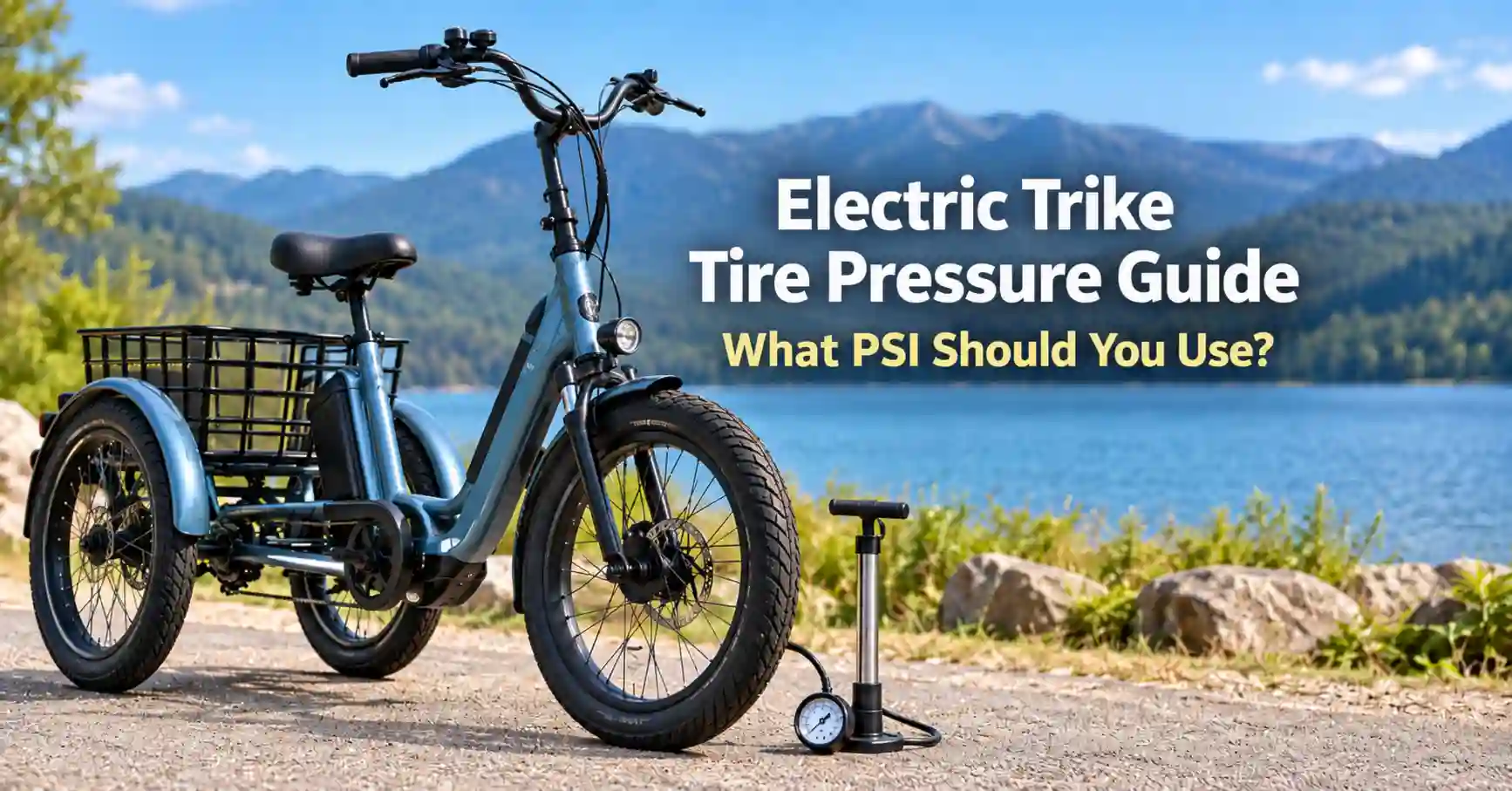
Electric Trike Tire Pressure: What PSI Should You Use?
Last Updated on October 24, 2026 by Kristina

Getting the tire pressure right on an electric trike matters more than you might realize. It can affect how your trike steers, handles bumps, carries weight, and rolls down the road.
But what PSI should you actually use?
Unlike a traditional bicycle, an electric trike has three wheels, and the correct pressure can vary significantly depending on the tires, rims, rider weight, and manufacturer.
Some electric trikes use relatively low pressures, while others require considerably more air.
The safest approach is to follow the tire-pressure recommendations for your specific electric trike and its installed tires and wheels, rather than relying on a generic PSI chart.
This guide explains how to find those recommendations, whether all three tires should use the same pressure, how to check and inflate the tires, and what to do when replacing tires or dealing with changing temperatures.
If you’re new to three-wheel riding, my electric trike beginner’s guide also explains how steering, turning, and stopping differ from riding a regular bicycle.
What PSI Should Electric Trike Tires Have?
There isn’t one recommended PSI that works for every electric trike.
Here are two examples from published manufacturer documentation:
| Electric trike | Manufacturer tire-pressure guidance | Important details |
|---|---|---|
| EVELO Compass | 20–35 PSI, depending on rider weight | EVELO warns that the tire-sidewall pressure marking on the documented original setup is incorrect |
| Sun Bicycles E350 | 40–65 PSI | Listed for its original 24 × 1.75-inch tires in the E350 assembly and user guide |
These figures illustrate how different the recommendations can be.
Don’t use either range for another trike unless its manufacturer confirms that it’s appropriate.
A trike fitted with replacement tires, different rims, or an updated wheel assembly may require different pressure settings.
How to Find the Correct PSI for Your Electric Trike
Before inflating your tires, you need to establish which pressure recommendations actually apply to your model.
Here’s where I’d check.
| Where to look | What to check |
|---|---|
| Owner’s manual | Recommended pressure range and any instructions for different loads |
| Manufacturer support website | Updated specifications or model-specific service guidance |
| Tire sidewall | Tire size, model, and pressure markings |
| Rim or wheel documentation | Tire compatibility and maximum permitted pressure |
| Manufacturer customer support | Clarification when specifications are incomplete or conflicting |
Step 1: Identify your exact model
Start with the manufacturer’s name and complete trike model.
If there are multiple generations or versions, make sure you’re looking at documentation for the correct one.
A newer model may use different tires or wheels even when its name looks similar.
Step 2: Check the owner’s manual
Look under tire maintenance, wheel specifications, inflation, or the pre-ride checklist.
Some manuals provide a pressure range, while others specify different pressures based on rider weight or load.
Step 3: Check the tire and rim information
Look for tire size, pressure markings, and any rim restrictions.
The tire’s maximum pressure is not necessarily the pressure you should use for everyday riding.
The tire, rim, and complete trike setup must all be suitable for the chosen pressure.
Step 4: Check whether the wheels or tires have been replaced
If you’ve purchased a used trike, or its tires have been changed, don’t assume the original manufacturer’s recommendations automatically apply without checking compatibility.
Step 5: Contact the manufacturer if anything conflicts
This is particularly important when a tire-sidewall marking differs from the trike manufacturer’s instructions.
Don’t simply pick the higher number or split the difference.
Ask the manufacturer or a qualified mechanic to confirm the correct pressure for the installed combination.
Once you’ve verified your trike’s pressure requirements, record them somewhere convenient so you don’t have to search for the information every time you inflate your tires.
Why Electric Trike Tire Pressure Matters
Proper tire inflation helps a trike perform the way its manufacturer intended.
Both underinflation and overinflation can create problems.
When tire pressure is too low
Underinflated tires may cause:
- Increased rolling resistance.
- Excessive tire deformation under load.
- Greater susceptibility to pinch flats on some tire setups.
- Premature tire wear.
- Potential rim damage when riding over bumps.
- Changes in handling or steering response.
Low pressure can also make the trike feel sluggish when pedaling without assistance.
When tire pressure is too high
Excessive pressure can make the ride harsher and reduce the tire’s ability to absorb uneven surfaces.
Inflating beyond the permitted pressure for the tire-and-rim combination can also create a serious safety risk.
Schwalbe explains that tire pressure affects comfort, rolling resistance, grip, and wear, but the appropriate setting depends on the tire and the load it carries.
The goal isn’t to use the highest possible PSI. It’s to use an appropriate, manufacturer-approved pressure.
Real Manufacturer Examples: Electric Trike Tire Pressure
One useful way to understand the differences is to look at actual manufacturer instructions.
EVELO Compass tire pressure
EVELO’s Compass tire-pressure support document gives the following recommendations based on rider weight:
| Rider weight | Recommended pressure |
|---|---|
| 100–150 lb | 20 PSI |
| 150–200 lb | 25 PSI |
| 200–250 lb | 30 PSI |
| 250–350 lb | 35 PSI |
EVELO also provides an important warning.
According to its published guidance, the pressure marking on the Compass tire sidewall is incorrect for the documented tire-and-wide-rim setup.
EVELO specifically instructs owners not to inflate those tires above 40 PSI because doing so places excessive stress on the rims.
That is a good example of why blindly inflating a tire to its printed maximum can be a mistake.
These values are specific to the configuration addressed by EVELO’s instructions. They shouldn’t be applied to other models or assumed correct after a wheel or tire replacement.
Sun Bicycles E350 tire pressure
The Sun E350 electric trike uses a different wheel and tire setup.
Its assembly and user guide, revised November 26, 2025, lists:
- Tire size: 24 × 1.75 inches.
- Recommended pressure range: 40–65 PSI.
The manual also instructs owners to inspect all three wheels and maintain proper tire pressure using an accurate gauge.
These figures differ substantially from the EVELO Compass recommendations.
That’s not a contradiction. They’re different trikes with different requirements.
What about the Mooncool TK2?
According to Mooncool’s published specifications, the standard TK2 uses CHAOYANG 20 × 3.0-inch tires.
However, tire size alone doesn’t establish the correct pressure for the complete wheel setup.
I couldn’t substantiate a specific TK2 target PSI from the model’s official specifications during this research.
For that reason, I’d consult the supplied owner’s manual or Mooncool customer support rather than borrowing another trike’s pressure recommendation.
My Mooncool TK2 hands-on review covers the trike’s features and riding experience, but it shouldn’t be used as a substitute for its tire-pressure specifications.
Should Front and Rear Electric Trike Tires Have the Same Pressure?
Not necessarily.
This is one reason electric trike inflation advice needs to be more specific than general bicycle recommendations.
A traditional upright electric trike usually has one front wheel and two rear wheels.
That means the rear load is distributed between two tires, although the actual loading depends on the frame, rider position, and cargo.
Does the front tire need more pressure?
Not automatically.
Some trikes have different tire sizes or manufacturer recommendations for the front and rear wheels.
Follow any position-specific instructions provided for your model.
Should both rear tires use the same PSI?
On trikes with matching rear tires and wheels, keeping both rear tires at the same approved target is generally a sensible starting practice unless the manufacturer directs otherwise.
Unequal inflation can affect how the trike feels and responds.
However, equal pressure won’t fix damaged tires, misaligned wheels, or other mechanical problems.
What about EBE’s tire-pressure calculator?
EBE has an E-Bike Tire Pressure Calculator that provides general estimates based on rider weight, tire type, cargo, and riding conditions.
It’s helpful for understanding the factors involved in tire pressure.
However, I wouldn’t use its two-wheel front-and-rear estimates as the final inflation instructions for an electric trike.
The trike manufacturer’s recommendations should take priority.
How Rider Weight and Cargo Affect Tire Pressure
A heavier rider or additional cargo changes how much weight the tires must support.
But that doesn’t mean you should automatically add a fixed number of PSI for every additional 10 or 20 pounds.
The appropriate setting depends on the manufacturer’s instructions, the permitted load, and the tire-and-wheel combination.
Example: A loaded grocery basket
Imagine using an electric trike to pick up groceries.
On the way to the store, the rear basket might be empty.
On the way home, the basket could be carrying several bags of groceries.
That additional weight can affect tire loading and handling.
What I’d recommend:
- Check the manufacturer’s maximum rider, cargo, and combined weight limits.
- Confirm its approved tire-pressure recommendations.
- Check whether the manual provides pressure adjustments for different loads.
- Keep the tires within all applicable limits.
- Ask the manufacturer if the correct setting for regular heavy loads isn’t clear.
Adding more air doesn’t make an overloaded trike safe.
Does Tire Width Determine Electric Trike PSI?
Tire width matters, but it isn’t enough to determine the correct pressure.
Electric trikes can use relatively narrow city tires, wider comfort tires, or fat tires.
Wider tires generally operate at lower pressures than narrower tires, depending on construction and load requirements.
However, a 3-inch tire on one electric trike doesn’t automatically need the same pressure as a 3-inch tire on another.
The rim design and approved wheel configuration also matter.
Don’t choose your electric trike’s PSI based only on tire width.
What Happens if You Replace Your Electric Trike’s Tires?
This is worth paying attention to, particularly if you’re replacing worn tires or switching to a different tread pattern.
A replacement tire may have a different construction, load rating, width, or permitted inflation pressure.
Even if the size looks similar, that doesn’t guarantee it’s suitable for the rim and intended load.
Check tire and rim compatibility first
Before buying a replacement tire, confirm:
- The required tire diameter and compatible bead-seat dimensions.
- The tire width permitted by the rim and trike.
- The tire’s suitability for the intended load.
- Frame, fender, brake, and component clearances.
- The tire’s approved inflation range.
- The rim manufacturer’s pressure limitations.
Continental’s tire-and-rim guidance explains that the tire and rim can have different maximum permitted pressures.
When they do, the lower applicable maximum must be respected.
That doesn’t mean the lower maximum is automatically the recommended riding pressure.
Can you keep using the same PSI after changing tires?
Possibly, but don’t assume that without checking.
A new tire may have a different approved range or behave differently on the original rim.
If the replacement specifications conflict with the trike manufacturer’s instructions, seek clarification before inflating or riding.
What about changing to wider tires?
A wider tire won’t automatically improve comfort or grip.
It must fit the rim, frame, fenders, and other components correctly.
Changing tire dimensions may also affect clearance and handling.
For additional tire information, see my guide to choosing e-bike tires.
For unusual trike wheel arrangements, I’d recommend professional help with tire selection rather than choosing a replacement based only on diameter and width.
How to Check Electric Trike Tire Pressure: Step by Step
You don’t need extensive mechanical experience to check your tires.
A reliable pressure gauge and compatible pump are usually enough.
Step 1: Park on level ground
Before applying the parking brake, position the trike so the valves can be accessed safely if practical.
Switch off the motor assistance, park securely, and apply the parking brake according to the manufacturer’s instructions.
Avoid reaching near moving wheels or lifting a heavy electric trike unnecessarily.
Step 2: Check when the tires are cool
For consistent measurements, check pressure before riding, when the tires haven’t warmed from use or direct heat.
Step 3: Identify the valve type
Many electric trikes use Schrader valves, similar to those on automobile tires.
Others may have Presta valves, particularly if the wheels or tubes have been replaced.
Use a compatible pump and gauge.
Step 4: Remove the valve cap
Inspect the valve stem for visible damage or an unusual angle.
A crooked or damaged valve can indicate a problem that needs attention.
Step 5: Attach the pressure gauge
Connect the gauge according to its instructions and read the pressure.
Avoid excessive force or unnecessary air loss.
Step 6: Adjust the pressure
Compare the reading with your verified manufacturer-approved setting.
If pressure is low, add air gradually.
If pressure is too high, release small amounts and recheck.
Step 7: Repeat for all three tires
Check the front, left rear, and right rear tires separately.
Don’t assume that the rear tires have matching pressure just because they look alike.
Step 8: Inspect the tire condition
Check for cuts, bulges, cracking, exposed material, unusual wear, or signs that the tire bead isn’t seated correctly.
If you notice significant damage, don’t ride until the problem has been resolved.
Step 9: Reinstall the valve caps
Once the pressure and tire condition have been checked, replace the caps.
What if the Rear Tire Valves Are Difficult to Reach?
This is a practical problem some electric trike owners may encounter.
Rear baskets, fenders, wheel positions, and frame components can make accessing the valve awkward.
A pump that works perfectly on a regular bicycle may not be convenient for your trike.
Try positioning the valve first
Before securing the trike, you may be able to roll it a short distance on level ground until the valve is in an accessible position.
The Sun E350 manual, for example, instructs users to position the valve at approximately the 6 o’clock position for inflation.
This won’t necessarily be the best arrangement for every trike, but it’s a useful example.
Once the valve is accessible, park and secure the trike before attaching the pump.
Consider a flexible pump hose
A pump with a flexible hose may be easier to attach when the valve is close to a basket support, fender, or other component.
Some pumps use angled heads or adapters that can also improve access.
Make sure any adapter is compatible with the valve and doesn’t cause leakage or place excessive force on the valve stem.
Don’t force the connection
If you have to bend the valve stem substantially to attach the pump, stop.
Forcing the connection can damage the valve or tube.
If the valve cannot be reached safely, a qualified bike shop may be able to recommend an appropriate pump connection or inspect the wheel setup.
How Often Should You Check Electric Trike Tire Pressure?
I’d recommend a quick visual tire inspection before every ride and regular pressure checks with a proper gauge.
Checking pressure approximately once a week is a reasonable practical routine for frequently used trikes, although the manufacturer’s instructions should take priority.
Mooncool recommends weekly pressure checks in its general electric trike tire-pressure guidance.
Check sooner if:
- The trike hasn’t been ridden for an extended period.
- Temperatures have changed significantly.
- One tire looks softer than the others.
- The trike feels different while steering.
- You’re planning to carry additional cargo.
- You’ve recently repaired or replaced a tire or tube.
Some tire-and-tube combinations lose pressure more quickly than others, so your maintenance routine may need adjusting.
How Hot and Cold Weather Affect Electric Trike Tire Pressure
Temperature can change tire pressure even when the tire doesn’t have a puncture.
When temperatures fall, pressure generally decreases.
When temperatures rise, pressure generally increases.
Cold-weather riding
If your trike is stored in a cold garage or shed, you may find that the pressure is lower than it was during warmer weather.
Check the tires with a gauge and adjust them according to the manufacturer’s approved range.
Don’t automatically add a fixed number of PSI for every temperature change.
Hot-weather riding
Warmer temperatures can increase pressure.
Continental warns that pressure changes caused by temperature differences need to be considered, especially when a tire is already close to its permitted maximum.
Avoid inflating a cold tire to its maximum allowed pressure without considering the conditions in which it will be ridden or stored.
What if you keep your trike indoors?
A tire inflated in a warm indoor environment may show a different pressure after the trike has spent time outdoors in cold weather.
For more consistent checks, consider the storage and riding temperatures and follow the manufacturer’s instructions.
Temperature changes don’t explain every pressure loss. If a tire continues losing air beyond normal changes, investigate for a leak.
Can Incorrect Tire Pressure Affect Electric Trike Stability?
Yes, tire pressure can influence handling, but it isn’t the only factor.
Unlike a regular bicycle, an upright electric trike doesn’t lean and balance in the same way while turning.
Changes in tire pressure can affect tire deformation, steering feel, comfort, and traction.
Uneven rear tire inflation may contribute to an unusual riding sensation.
However, an electric trike that feels unstable could also have:
- Wheel or bearing problems.
- Steering or alignment issues.
- Tire damage.
- Uneven cargo loading.
- Loose or damaged components.
- Handling characteristics the rider isn’t accustomed to.
What if your trike feels lopsided?
Stop in a safe location.
Inspect all three tires and check their pressure.
If restoring the correct pressure doesn’t resolve the problem, don’t keep adding more air.
Have the trike inspected before continuing if it still feels unstable or unpredictable.
For additional help, see my beginner’s guide to riding an electric trike.
Why Does One Electric Trike Tire Keep Losing Air?
If you’re constantly refilling one tire, investigate the cause rather than treating it as normal.
| Possible cause | What to look for | Recommended action |
|---|---|---|
| Small puncture | Gradual air loss or embedded debris | Inspect and repair or replace as appropriate |
| Leaking valve | Air escaping near the valve | Inspect and repair the valve or tube |
| Damaged tire | Cuts, cracking, bulges, or exposed material | Stop riding if damage is significant |
| Temperature changes | Pressure changes with weather or storage conditions | Recheck with a gauge |
| Incorrect installation | Crooked valve or uneven tire seating | Have the wheel assembly inspected |
A tire that becomes completely flat or loses air rapidly shouldn’t be ridden.
You could damage the wheel or compromise the trike’s handling.
My guide to why e-bike tires keep losing air covers punctures, valve problems, and other causes in more detail.
What Kind of Tire Pump Is Best for an Electric Trike?
For many owners, a floor pump with a reliable pressure gauge is a practical starting point.
A portable electric pump can also be convenient, particularly if manual pumping is difficult.
Features worth considering
- A gauge that reads accurately at your trike’s recommended pressure.
- Compatibility with the valve type.
- A flexible hose or accessible pump head.
- A secure connection that minimizes air loss.
- Simple inflation and pressure-release controls.
- Automatic shutoff, if using a compatible powered inflator.
A pump’s maximum PSI rating doesn’t tell you how accurately it measures the relatively low pressures used by some trikes.
Be careful with powerful air compressors
Automobile tire inflators and gas-station compressors can deliver air quickly.
That makes it easier to overshoot a bicycle tire’s permitted pressure.
Use a suitable pressure gauge and monitor inflation carefully.
For specific equipment ideas, see my best portable air pumps for e-bikes guide.
My Electric Trike Tire Pressure Record
Once you’ve confirmed the correct pressure for your electric trike, it’s useful to keep a record.
You can save or print this worksheet and update it whenever you check your tires.
| Information | My trike |
|---|---|
| Brand and model | __________________ |
| Model year or version | __________________ |
| Front tire size | __________________ |
| Rear tire size | __________________ |
| Approved front PSI | __________________ |
| Approved left rear PSI | __________________ |
| Approved right rear PSI | __________________ |
| Tire and rim pressure restrictions | __________________ |
| Source of pressure information | __________________ |
| Last pressure check | __________________ |
Important: Enter only values verified for your trike’s installed tire-and-wheel setup. This worksheet records recommendations; it does not calculate them.
A simple record can also help you notice when one tire is repeatedly losing air.
Electric Trike Tire Pressure Mistakes to Avoid
Using one PSI for every trike: Different models can require very different pressures.
Inflating to the tire’s maximum without checking the trike: A tire-sidewall maximum may not be the correct operating pressure for the full wheel setup.
Ignoring rim limitations: A tire may be rated for more pressure than a particular rim can safely tolerate.
Using a general two-wheel e-bike calculator as the final answer: A trike’s weight distribution may require different considerations.
Assuming all three tires must have different pressures: Follow model-specific instructions rather than making unsupported adjustments.
Adding air automatically because you’re carrying more weight: Never exceed the approved limits or the trike’s load capacity.
Reusing the same PSI after replacing tires: Verify compatibility and permitted pressures first.
Guessing based on appearance: Use a gauge.
Forcing a pump onto a difficult rear valve: Choose a compatible connection that doesn’t damage the valve.
Ignoring temperature changes: Cold and hot conditions can change pressure readings.
Riding on damaged tires: Bulges, serious sidewall damage, and improperly seated beads need attention before riding.
Quick Electric Trike Tire Pressure Checklist
Before heading out:
- ☐ I know the recommended pressure for my particular trike.
- ☐ I have checked the applicable tire and rim restrictions.
- ☐ The front tire is properly inflated.
- ☐ The left rear tire is properly inflated.
- ☐ The right rear tire is properly inflated.
- ☐ The tires show no serious cuts, bulges, or unusual damage.
- ☐ The valve stems look intact.
- ☐ Any cargo is within the manufacturer’s weight limits.
- ☐ The trike feels normal during a cautious initial riding check.
If anything seems unsafe, stop and investigate.
Frequently Asked Questions
What is the best tire pressure for an electric trike?
It depends on the specific trike, tire-and-rim combination, rider weight, and manufacturer instructions. There isn’t one universal PSI recommendation.
Should all three electric trike tires have the same PSI?
Not necessarily. Follow any front-and-rear or position-specific recommendations in the manual.
Is 30 PSI good for an electric trike?
It may be appropriate for some models but not others. EVELO specifies 30 PSI for a particular rider-weight group on its documented Compass configuration, while the Sun E350 requires a higher pressure range.
Should I use the maximum PSI printed on the tire?
Not automatically. The tire’s maximum is not necessarily the recommended riding pressure. Check all applicable manufacturer and rim limitations.
Does lower tire pressure make an electric trike more stable?
Not necessarily. Lower pressure can change tire grip and comfort, but excessive underinflation can create handling and safety problems.
How do I know when my trike tires need air?
Use an accurate, compatible pressure gauge. Visual appearance alone isn’t reliable.
Can I use a car tire pump?
A suitable inflator may work if it matches the valve and provides controlled inflation. Avoid high-speed inflation that could overshoot the permitted pressure.
Should I change PSI when carrying groceries?
Additional cargo can affect tire loading. Follow the manufacturer’s instructions for different loads and stay within the trike’s total weight and tire-pressure limits.
Can I use the same pressure after replacing the tires?
Only after confirming that the new tires, rims, and trike remain compatible with that setting.
What if my rear tire valves are hard to reach?
Try safely positioning the trike so the valves are accessible before applying the parking brake. A compatible flexible pump hose may help. Never force the valve stem.
What should I do if the owner’s manual conflicts with the tire sidewall?
Don’t guess. Confirm the installed tire and rim combination, then contact the trike manufacturer or a qualified mechanic for clarification.
Why You Can Trust Electric Bike Explorer
Electric Bike Explorer provides practical, independent guidance for people researching, buying, riding, and maintaining electric bikes and trikes.
This guide draws on published manufacturer specifications and established bicycle tire-maintenance guidance. Model-specific PSI figures are identified separately from general maintenance recommendations.
I haven’t independently pressure-tested every trike mentioned. Always use the verified instructions for your particular model and installed wheels.
You can learn more about how Electric Bike Explorer researches and evaluates e-bikes.
My Take
I think checking tire pressure is one of the simplest electric trike maintenance habits worth developing.
Three wheels may make a trike feel reassuring when you’re stopped, but they don’t eliminate the importance of properly inflated tires.
What stands out to me is just how different the manufacturer recommendations can be.
That’s why I wouldn’t recommend one universal electric trike PSI chart or tell readers to automatically add air based on their weight.
The first thing I’d do is find the manufacturer’s actual recommendation. After that, use a reliable gauge and check all three tires regularly.
I also think keeping a written pressure record is worthwhile, especially if you own a trike with different wheel specifications or regularly carry groceries.
And if your trike starts handling differently, don’t automatically assume it needs more air. Tire pressure is only one possible cause, and mechanical problems deserve proper attention.
A few minutes spent checking the tires can help prevent unnecessary wear, frustrating flats, and potentially unsafe riding conditions.
If you find Electric Bike Explorer helpful, consider adding EBE as a preferred source in Google Search for more independent e-bike and trike guidance.
Sources and Further Reading
- EVELO – Compass Tricycle Tire Pressure
- Sun Bicycles – E350 Assembly and User Guide
- Continental – Tire and Rim Compatibility and Pressure Limits
- Schwalbe – Bicycle Tire Pressure Guidance
- Mooncool – Understanding Electric Trike Tire Pressure

Kristina is not just an enthusiast but a true authority on electric bikes. Nestled in the coastal beauty of Virginia, Kristina has found the perfect backdrop for her passion for electric biking. As a dedicated wife and homeschooling mom, her life revolves around family, faith, and the thrill of adventure.
Originally hailing from Ohio, Kristina's journey with electric bikes began as a curiosity and quickly evolved into a deep expertise. Her blog is a testament to her love for electric biking, combining her fascination for eco-friendly transportation with her coastal lifestyle.
When she's not cruising the beach on her electric bike, you'll find Kristina indulging in her other loves: long walks along the shore, getting lost in a good book, and cherishing moments with her loved ones. With a heart as big as her love for animals, especially cats, Kristina brings a unique perspective to the electric bike world, grounded in her strong faith in God and her dedication to a sustainable lifestyle.
Through her blog, Kristina shares her extensive knowledge of electric bikes, offering valuable insights, tips, and recommendations to fellow enthusiasts. Whether you're a seasoned rider or a newcomer to the electric bike scene, Kristina's blog is your go-to source for all things electric biking, fueled by her passion, expertise, and the scenic beauty of coastal Virginia.