Are E-Bikes Allowed for Hunting on Public Land? BLM, National Forest, Wildlife Refuge & WMA Rules
Last Updated on September 30, 2026 by Kristina
Last researched and verified: September 28, 2026.
Can you use an e-bike for hunting on public land? Sometimes – but there is no single rule that applies to every public hunting area.
The answer depends on who manages the land, which road or trail you want to use, your e-bike’s classification, seasonal closures, and whether you plan to ride only to your hunting area or use the bike to help retrieve game.
This distinction matters because an e-bike can be legal under state law but still be prohibited on a particular National Forest trail, BLM route, National Wildlife Refuge, or Wildlife Management Area.
If you are shopping specifically for a backcountry setup, my guide to the best hunting e-bikes explains the bikes and features that make sense for hunters. Before riding, I also recommend checking the e-bike laws for your state, because state rules still matter even when the hunt takes place on federal land.
Quick Answer: Where Can You Use an E-Bike for Hunting?
| Public Land | General E-Bike Rule | What Hunters Need to Check |
|---|---|---|
| BLM land | E-bikes are allowed on roads and trails open to OHV use and in areas designated open to OHVs. Certain non-motorized routes may also be opened to qualifying e-bikes through a site-specific decision. | Route designation, e-bike class, seasonal restrictions, cross-country travel, and game-retrieval rules. |
| National Forest | Current Forest Service guidance allows Class 1, 2, and 3 e-bikes on motorized roads and trails. Additional non-motorized trails can be specifically designated for e-bike use. | Current Motor Vehicle Use Map, local e-bike designations, seasonal restrictions, forest orders, and off-route game retrieval. |
| National Wildlife Refuge | E-bike access depends on the individual refuge. A refuge manager may allow e-bikes on roads and trails where traditional bicycles are allowed when the use is compatible with the refuge’s purposes. | Refuge-specific rules, permitted roads and trails, hunt-unit restrictions, permits, and seasonal access. |
| State WMA | There is no nationwide WMA rule. Regulations are established by the state or other agency managing the property. | WMA regulations, motorized-access rules, seasonal gates, permits, game retrieval, and any overlapping federal rules. |
The safest rule is simple: never assume that a road, two-track, bicycle trail, or hunting access route is open to your e-bike just because you can physically ride it.
Check Your Exact Hunting Route Before You Go
If you already know where you plan to hunt, you can use the Electric Bike Explorer Trail Access Checker as a starting point for identifying possible e-bike restrictions.
The tool can help you look at factors such as the trail, state, e-bike class, land manager, and throttle use. It is not a substitute for the current land-manager rule, permit, map, or posted closure.
Before relying on any route, verify these five things:
- Who manages the land? BLM, Forest Service, Fish & Wildlife Service, a state wildlife agency, county, tribe, or another entity?
- What is the exact road or trail? Look for a route name or number rather than checking only the general area.
- Is your specific e-bike allowed? Check the class, motor rating, throttle configuration, and any modifications.
- Is the route open on your hunting dates? Seasonal restrictions and emergency closures can change access.
- If you harvest an animal, can you leave the designated route? Never assume game retrieval creates an exception to motorized travel restrictions.
⚖️ Law Research Note
I reviewed current federal agency guidance and current Electric Bike Explorer legal resources when updating this guide. Public-land rules can change, and local offices, refuges, wildlife areas, seasonal orders, individual hunt permits, and temporary closures may impose additional restrictions.
Confirm the current route map, posted regulations, hunting rules, permit conditions, and temporary closures before riding.
Two Different Questions Matter: Can You Ride There, and Can You Hunt From There?
This is the part I think causes the most confusion.
Being legally allowed to hunt an area does not automatically mean you can ride an e-bike anywhere within that area. Being allowed to ride an e-bike on a particular road also does not necessarily mean you can leave that road to retrieve an animal.
I would treat these as separate questions:
- Is hunting legal in the area during my season?
- Does my bike meet the applicable e-bike definition?
- Is this exact road or trail open to my e-bike?
- Are there seasonal motorized-access restrictions?
- Can I leave the designated route?
- Can I use an e-bike or another motorized vehicle for game retrieval?
- Are there separate rules for transporting firearms, bows, or other hunting equipment?
You may get a different answer to each one.
Can I Ride This Route? A Simple Decision Tree
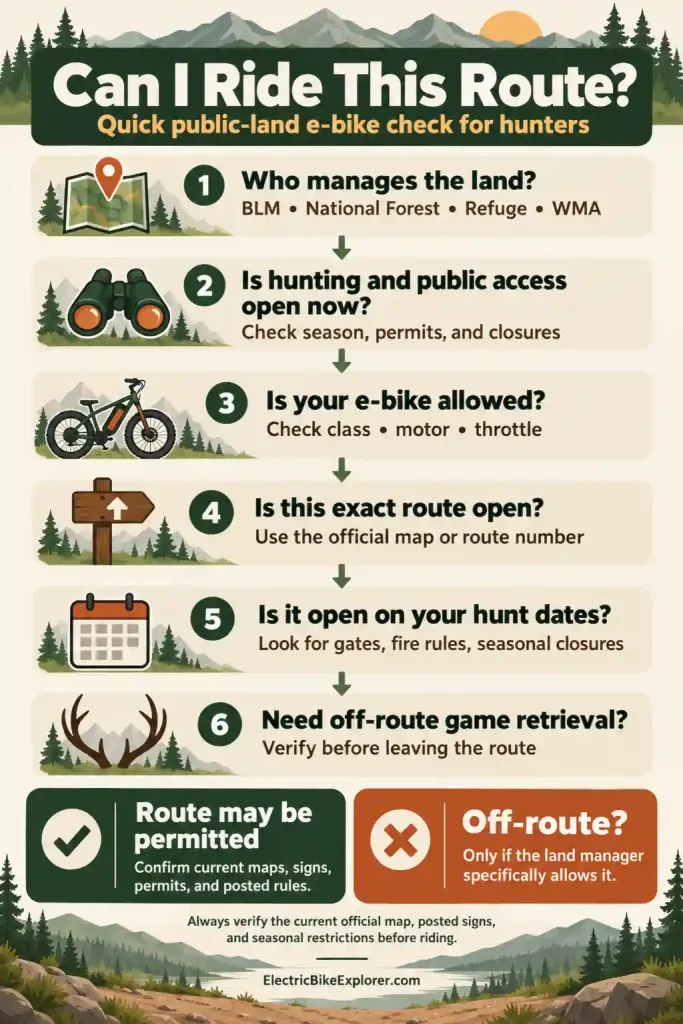
- Is hunting currently allowed in the area?
If no, stop. If yes, continue. - Does your bike qualify for the e-bike access you are relying on?
If you cannot confirm the classification or legal definition, verify it before continuing. - Is the exact road or trail open to your e-bike?
If no, do not ride it. If yes, continue. - Is it open on the dates you plan to hunt?
Check seasonal tables, emergency closures, fire restrictions, and special orders. - Will you remain on the designated route?
If yes, continue following the applicable route rules. - Do you plan to leave the route to retrieve game?
If yes, verify that off-route motorized game retrieval is specifically allowed. Do not assume it is.
If you cannot get a clear answer at any step, I would treat the route as unverified until the land manager confirms it.
Are E-Bikes Allowed for Hunting on BLM Land?
BLM-managed public land can offer excellent hunting access, but e-bike access is route-specific.
The Bureau of Land Management’s current e-bike rule covers qualifying Class 1, Class 2, and Class 3 e-bikes with fully operable pedals and an electric motor of no more than 750 watts.
According to the Bureau of Land Management e-bike guidance, e-bikes are allowed on roads and trails open to OHV use and in areas designated open to OHVs.
That does not mean every non-motorized mountain bike trail on BLM land is automatically open to e-bikes.
BLM managers can authorize qualifying e-bikes on certain roads and trails otherwise limited to bicycles or non-motorized travel through site-specific land-use planning or implementation decisions.
Can You Ride Cross-Country on BLM Land?
Do not assume that you can.
BLM guidance states that, unless specifically authorized, cross-country e-bike travel is allowed only in areas designated open to OHVs. In other situations, e-bikes must remain on marked and designated routes and comply with applicable trail restrictions.
Seeing a deer or elk away from the road does not by itself authorize you to ride across the landscape to reach it.
What About Retrieving Game on BLM Land?
Game retrieval still has to comply with the travel-management rules and any special conditions for that location.
Some BLM planning areas can have specific game-retrieval provisions, but those provisions are not universal.
Before a hunt, I would ask the local BLM office a very specific question rather than simply asking whether e-bikes are allowed.
What to Ask the Land Manager
You can adapt this question for a BLM office, ranger district, refuge, or state wildlife agency:
I have a Class 2 e-bike with a 750W motor. I am hunting [property or unit] on [dates] and plan to use [road or trail name/number]. Is that route open to this e-bike during those dates? If I harvest an animal, can the e-bike be used off the designated route for game retrieval, or must I bring the animal back to the open route first?
If your bike has a different class, motor configuration, or throttle setup, describe it accurately.
This is much more useful than asking only, “Are e-bikes allowed?”
Are E-Bikes Allowed for Hunting in National Forests?
National Forest rules are different from BLM rules, and this is one of the most important differences for hunters to understand.
Under current Forest Service guidance, e-bikes are managed within the agency’s motorized travel system. Class 1, Class 2, and Class 3 e-bikes are currently allowed on motorized roads and trails on National Forest System lands.
Local Forest Service officials can also designate additional non-motorized trails for particular e-bike use after the required decision-making process.
You can review the current federal position on the Forest Service Electric Bicycle Use page.
If you are not sure which category your bike falls into, see my explanation of Class 1, Class 2, and Class 3 e-bikes.
Important: A Forest Service Rule Change Has Been Proposed
On August 24, 2026, the Forest Service began a rulemaking process that includes a proposal to change how Class 1 e-bikes could be treated on certain National Forest System trails where traditional bicycles are allowed.
As of September 28, 2026, that is still a proposal – not the current rule.
The public comment period closed September 23, 2026. Until a final rule is issued and becomes effective, hunters should continue following the current Forest Service e-bike guidance, local designations, Motor Vehicle Use Maps, seasonal restrictions, and forest orders.
This is also a good reason to recheck Forest Service rules shortly before your hunt instead of relying on an article or map saved months earlier.
How to Read a National Forest Motor Vehicle Use Map
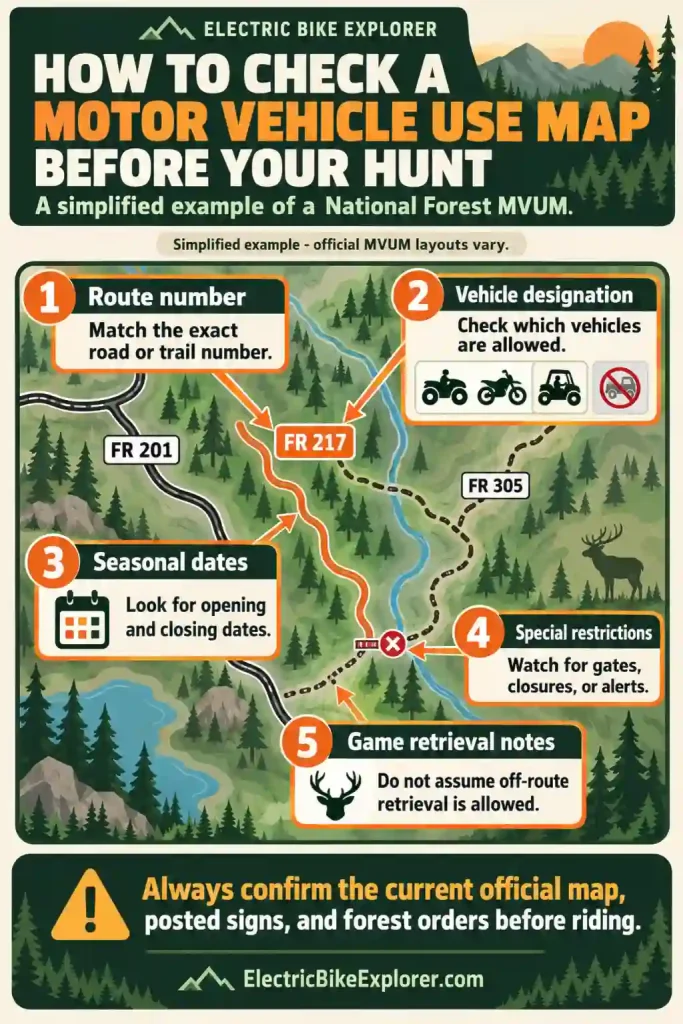
Before hunting from an e-bike in a National Forest, get the current Motor Vehicle Use Map, usually called an MVUM.
The Forest Service maps guidance explains that MVUMs identify roads, trails, and areas designated for public motor-vehicle travel. They can also show vehicle categories, seasonal restrictions, distance allowances, and other travel rules.
The most important thing to understand is that a route that looks open on the ground is not necessarily legally open to motorized travel.
When reading the MVUM, check:
- Route number: Match the number on the map to the road or trail you intend to use.
- Vehicle designation: Check which types of vehicles are authorized.
- Seasonal dates: Some routes are open only during specific periods.
- Special designations: Look for separate tables or notes affecting particular roads or uses.
- Game-retrieval designations: Some maps or local rules identify limited motorized game-retrieval allowances. Never assume one exists.
- Current version: Forest Service maps are updated as needed, so use the latest version available.
The Forest Service specifically warns that a route or area not listed on the applicable motor vehicle use map is not open to public motorized travel simply because it looks usable.
I would use the MVUM together with a topographic or navigation map because an MVUM is primarily a legal travel map, not a detailed backcountry navigation map.
Seasonal Closures Can Change the Answer
A route may be open during summer and closed during part of hunting season. Wildlife restrictions, wet-weather closures, wildfire conditions, maintenance, resource-protection orders, and other temporary restrictions can also affect access.
I would download or print a fresh map shortly before the hunt rather than relying on one saved several years ago.
Do Not Assume You Can Ride Off-Route to Retrieve an Animal
Game-retrieval rules can vary by National Forest and route.
Some Forest Service maps include specific motorized game-retrieval designations. Other forests or areas prohibit cross-country motorized travel for game retrieval.
If you harvest an animal half a mile from an open road, the fact that your e-bike has a trailer does not automatically make it legal to ride across the forest floor to reach it.
You may need to pack the animal back to an open route before loading it onto the bike or trailer.
Can Hunters Use E-Bikes on National Wildlife Refuges?
National Wildlife Refuges require another layer of checking because access is managed refuge by refuge.
U.S. Fish & Wildlife Service guidance says e-bikes may be used on refuge roads and trails where traditional bicycle use is allowed when the refuge manager determines that the use is consistent with the refuge’s statutory purpose and is a compatible use.
You can review the national framework on the U.S. Fish & Wildlife Service e-bike page.
That does not mean every National Wildlife Refuge allows hunters to ride an e-bike to every hunt unit.
Individual refuges may have:
- Designated bicycle or e-bike routes
- Areas closed to bicycles or motorized travel
- Special hunter-access routes
- Limited-entry hunt units
- Permit-specific transportation rules
- Seasonal closures
- Separate accessibility provisions
For a refuge hunt, read both the normal refuge rules and the current hunting permit, hunt brochure, or hunt-unit regulations. A general recreation page may not contain every restriction that applies to a particular hunt.
Are E-Bikes Allowed on Wildlife Management Areas?
Wildlife Management Areas, commonly called WMAs, are where a nationwide answer becomes impossible.
WMAs are generally governed by state wildlife agencies or other state and local land managers. Motorized access can vary substantially between states and even between two WMAs within the same state.
One property may allow e-bikes on designated roads. Another may restrict motorized access during hunting season. A third may permit bikes only on roads open to regular vehicle traffic.
There is another complication: some Wildlife Management Areas overlap National Forest or other federal land.
When that happens, hunters may need to comply with both the hunting regulations issued by the state wildlife agency and the travel-management rules issued by the federal land manager.
What to Check Before Riding an E-Bike on a WMA
- Whether the WMA allows e-bikes
- How the property classifies an e-bike
- Which roads and trails are open
- Whether gates are closed seasonally
- Whether different rules apply during hunting season
- Whether e-bike classes are treated differently
- Whether motorized game retrieval is permitted
- Whether off-route travel is prohibited
- Whether a permit, registration, decal, or authorization is required
- Whether firearm or bow-transport rules apply while using the bike
Start with the state wildlife agency’s current WMA regulations rather than relying on a forum post, old hunting video, or what another hunter was doing last season.
Your Hunting E-Bike May Not Legally Count as an E-Bike Everywhere
This is a major issue in the hunting e-bike market.
Many hunting bikes are advertised around power, torque, hill climbing, and heavy-load capability. Those can be useful backcountry features, but land-access rules depend on the applicable legal definition and agency designation rather than the marketing category.
If a bike exceeds the motor, speed, pedal, or operating limits used by the applicable agency or state, it may not qualify for the access given to a Class 1, Class 2, or Class 3 e-bike.
Also be careful with specifications such as “peak power.” A manufacturer’s peak-power claim is not necessarily the same thing as the motor rating used in a particular legal definition. Check the actual bike documentation and applicable rule rather than relying on one advertising number.
Modified bikes create another complication. Increasing assisted speed, changing the controller, altering throttle operation, or otherwise changing the bike may affect how it is classified.
What About Class 1 vs Class 2 Hunting E-Bikes?
Hunters often like Class 2 bikes because a throttle can help with starts, balancing a loaded bike, or moving through difficult terrain without immediately pedaling.
But class and throttle configuration can affect trail access.
One land manager may permit several e-bike classes, while another route may be designated only for a particular class or motorized use.
This is why I would never choose a hunting bike based only on motor power or range. Where you plan to hunt matters just as much.
If most of your hunts take place on public land, research your regular hunting areas before buying the bike.
Can You Use an E-Bike to Haul a Deer or Elk?
From a practical standpoint, a hunting e-bike and properly matched trailer can be useful for hauling equipment or helping move packed meat along a legal route.
The legal question is still whether the route and activity are permitted.
A rule allowing you to ride to a hunting area does not necessarily authorize off-route game retrieval. Likewise, a motorized route open to your bike does not automatically give you permission to travel beyond that route after an animal is down.
If you are planning to tow a trailer, my hunting e-bike accessories guide covers trailers and other backcountry gear. Remember that equipment capability and legal access are two different questions.
Do Not Forget the Return Trip
Legal access is only useful if the bike has enough usable range to get you back out.
Cold temperatures, climbing, mud, soft tires, a heavy rider, hunting gear, high assist levels, and a loaded trailer can all reduce range. The return trip can also be much harder if you are carrying meat or other additional weight.
My hunting e-bike range guide explains how to estimate trip distance, terrain, load, battery use, and a reserve for the ride back to the truck.
I would plan range from the most difficult likely return trip, not from the manufacturer’s best-case mileage claim.
What About Wilderness Areas?
Be especially cautious when a hunting route approaches designated Wilderness.
Federal Wilderness restrictions generally prohibit motorized equipment and mechanical transport, including bicycles, subject to narrow legal exceptions.
Do not assume that an e-bike – or even a conventional bicycle – can continue into designated Wilderness simply because the approach road was open.
Check the actual Wilderness boundary on the current land-manager map before your hunt. In remote country, that boundary may not be obvious on the ground.
Hunters With Disabilities May Have Different Access Options
A standard hunting e-bike does not automatically become legal on a closed route because the rider has a disability.
However, federal and state agencies can have disability-access rules, mobility-device provisions, reasonable-modification procedures, or special hunting-access programs that are separate from the ordinary e-bike rules.
If this applies to you, contact the responsible land manager before the hunt. Explain the device you use, the route you want to access, and the dates involved, and ask what accessibility or authorization process applies.
Do not assume that a disability parking placard by itself authorizes an e-bike on every closed road or non-motorized trail.
Save This Before You Lose Cell Service
Public-land hunts frequently take place where mobile coverage is poor or nonexistent.
Before leaving the truck, I would save offline copies of:
- The current MVUM, BLM travel map, refuge map, or WMA map
- Your hunting regulations and permit conditions
- Any applicable seasonal-use table
- Current closure or emergency-order information
- The land manager’s office phone number
- Your route and return route
- The applicable e-bike rule or agency guidance
- Any written response you received from the land manager about your route
I would also keep a screenshot or PDF rather than depending entirely on a website loading in the field.
For remote hunts, the navigation and repair equipment in my hunting e-bike gear guide can help you build a more complete backcountry setup.
A 10-Minute Public-Land E-Bike Check Before Your Hunt
- Identify the land manager. Is it BLM, National Forest, National Wildlife Refuge, state WMA, county property, tribal land, private timberland, or a mixture?
- Confirm your bike’s classification. Do not rely only on the product name.
- Check applicable state rules. Federal land access does not erase state operating or hunting laws.
- Find the official route map. Use the current MVUM, BLM travel map, refuge map, WMA map, or other official access document.
- Match the route number. Confirm the exact road or trail rather than the general area.
- Check dates. Look for seasonal gates, wildlife closures, fire restrictions, emergency closures, and hunt-specific access periods.
- Verify game retrieval separately. Ask specifically whether you may leave the designated route after harvesting an animal.
- Check weapon-transport rules. State hunting law may regulate firearms, bows, crossbows, or other hunting equipment on vehicles.
- Plan your battery reserve. Account for the loaded return trip, not just the ride in.
- Save everything offline. Do not assume you will have cell service when you need the rule or map.
If the official map and a sign on the ground appear to conflict, I would stop and get clarification rather than assuming the less restrictive interpretation is correct.
Common Public-Land E-Bike Mistakes Hunters Should Avoid
Assuming a regular bicycle trail is automatically open to an e-bike.
That is not necessarily true, particularly on federal land.
Assuming Class 1 is legal everywhere.
A Class 1 designation by itself does not open every bicycle trail under current federal rules.
Following tire tracks instead of the official map.
An old road or trail can look heavily used and still be closed to motorized travel.
Using an outdated screenshot.
Seasonal designations, closures, and agency rules can change.
Assuming game retrieval is automatically allowed.
A legal ride can become an off-route motorized-travel violation if you leave the designated route where retrieval is not authorized.
Assuming your hunting bike legally qualifies as an e-bike.
High-powered, modified, unusually fast, or pedal-less machines can fall into a different regulatory category.
Checking only state law.
State e-bike legality does not automatically open a federally managed trail.
Planning range only for the ride in.
Cold weather, climbing, mud, and a heavier return load can make the trip out much harder.
For a broader explanation of how e-bike access works, see my e-bike rules of the road guide.
My Take
I think e-bikes can be one of the most useful access tools a hunter can own, especially when the alternative is driving a larger vehicle or hiking several miles with heavy equipment.
But public-land access is not an area where I would rely on assumptions.
The biggest mistake is asking only, “Are e-bikes legal here?” The better question is, “Is my specific e-bike allowed on this exact route, on these dates, for what I plan to do?”
I would add one more question for hunters: “What happens after an animal is down?”
If you can answer all of those questions before the hunt, an e-bike can be a practical way to reach a stand, scout farther from the truck, conserve energy, and carry equipment while staying within the access rules.
If you cannot verify the route, leave the bike parked until you can.
Frequently Asked Questions
Are e-bikes legal on all BLM roads?
No. Access depends on the designation of the road, trail, or area. E-bikes are allowed on routes open to OHV use, while otherwise non-motorized routes require specific authorization before qualifying e-bikes can use them.
Can I use an e-bike on a closed National Forest road?
Do not assume that you can. Check the current MVUM, local e-bike designations, seasonal rules, and forest orders for that exact route.
Can I ride a Class 1 e-bike on a non-motorized National Forest trail?
Under the current rules verified September 28, 2026, traditional bicycle access alone does not automatically establish Class 1 e-bike access. The Forest Service has proposed changing this policy, but that proposal is not yet a final rule.
Can I use an e-bike to retrieve a deer or elk?
Sometimes, but only within the applicable travel and game-retrieval rules. Some areas provide limited motorized game-retrieval access, while others prohibit leaving designated routes.
Are e-bikes allowed on Wildlife Management Areas?
It depends on the WMA. Check the current regulations issued by the state wildlife agency or other managing authority for that specific property.
Are hunting e-bikes with motors over 750W legal on federal public land?
Do not assume they receive the same access as qualifying Class 1, Class 2, or Class 3 e-bikes. BLM’s e-bike rule, for example, applies to qualifying bikes with motors of no more than 750 watts. Other agencies and state laws may use their own definitions and classifications.
Does turning the motor off make an e-bike a regular bicycle?
Do not rely on that assumption. Access rules generally depend on how the device is legally classified and how the land manager has designated the route, not simply whether the motor happens to be switched off at that moment.
What if the Trail Access Checker and an official agency page disagree?
Follow the current official rule, map, posted sign, order, or direct guidance from the responsible land manager. The Electric Bike Explorer Trail Access Checker is a planning tool, not the controlling legal authority.
Legal Disclaimer
This guide is for general informational purposes and is not legal advice. Public-land access rules, hunting regulations, seasonal closures, trail designations, WMA regulations, and e-bike classifications can change. State, federal, tribal, county, refuge, forest, and local land managers may impose additional restrictions. Confirm the current rules with the agency responsible for the exact location where you plan to hunt.
Official Sources
- Bureau of Land Management – E-Bikes on BLM-Managed Public Lands
- USDA Forest Service – Electric Bicycle Use
- USDA Forest Service – Motor Vehicle Use Maps and mapping guidance
- U.S. Fish & Wildlife Service – E-Bikes on Refuges
- Federal Register, August 24, 2026 – proposed Forest Service Travel Management rulemaking concerning Class 1 e-bikes

Kristina is not just an enthusiast but a true authority on electric bikes. Nestled in the coastal beauty of Virginia, Kristina has found the perfect backdrop for her passion for electric biking. As a dedicated wife and homeschooling mom, her life revolves around family, faith, and the thrill of adventure.
Originally hailing from Ohio, Kristina's journey with electric bikes began as a curiosity and quickly evolved into a deep expertise. Her blog is a testament to her love for electric biking, combining her fascination for eco-friendly transportation with her coastal lifestyle.
When she's not cruising the beach on her electric bike, you'll find Kristina indulging in her other loves: long walks along the shore, getting lost in a good book, and cherishing moments with her loved ones. With a heart as big as her love for animals, especially cats, Kristina brings a unique perspective to the electric bike world, grounded in her strong faith in God and her dedication to a sustainable lifestyle.
Through her blog, Kristina shares her extensive knowledge of electric bikes, offering valuable insights, tips, and recommendations to fellow enthusiasts. Whether you're a seasoned rider or a newcomer to the electric bike scene, Kristina's blog is your go-to source for all things electric biking, fueled by her passion, expertise, and the scenic beauty of coastal Virginia.