Federal Railroad Administration Warns of E-Bike Battery Fire Risks on Passenger Trains
Last Updated on November 12, 2026 by Kristina
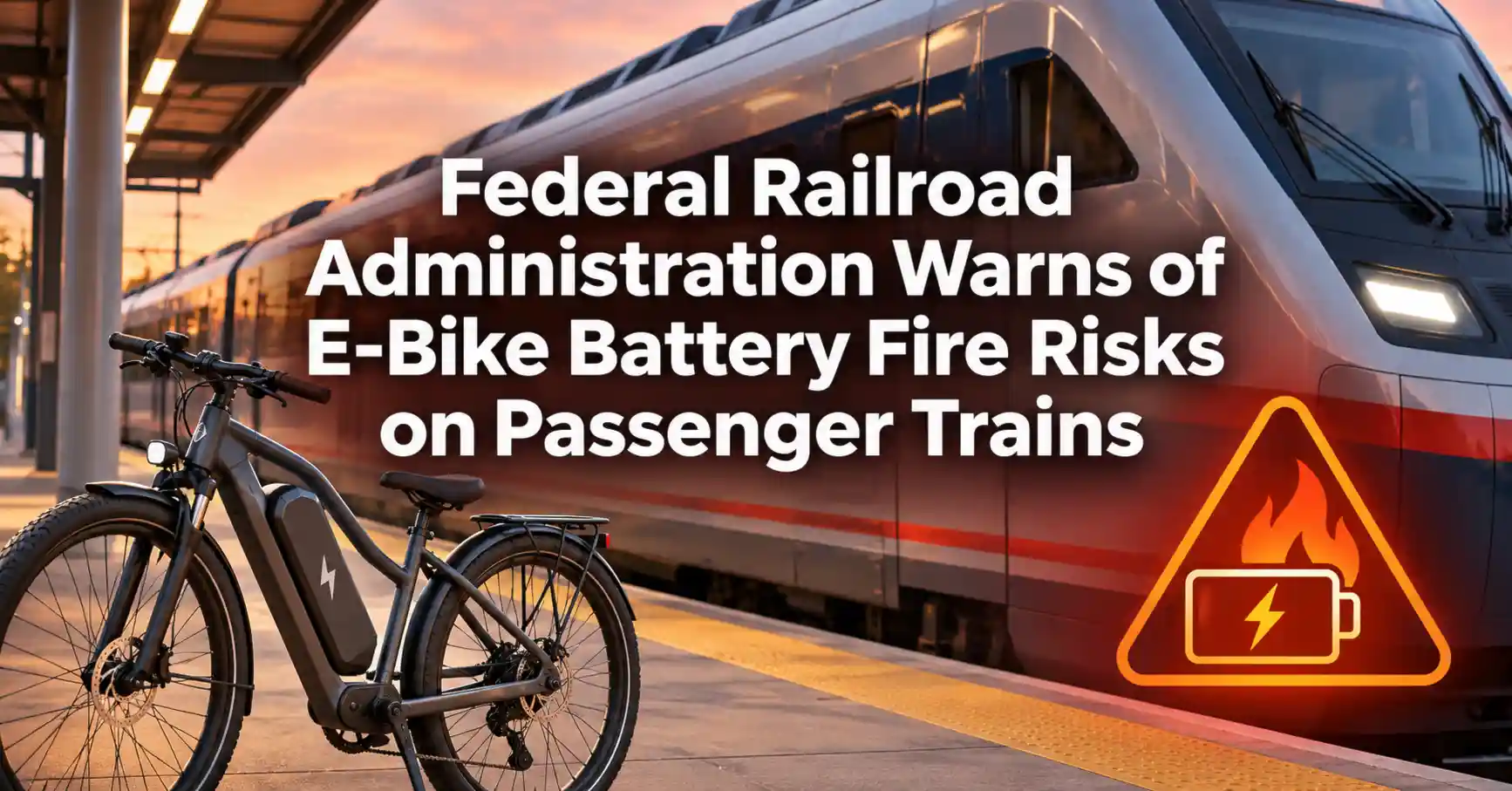
November 12, 2026: The Federal Railroad Administration (FRA) has issued a new safety advisory warning passenger rail operators about the potential dangers of lithium-ion battery fires involving e-bikes, e-scooters, and other electric micromobility devices carried aboard trains. The agency recommends changes to where devices are stored, whether batteries can be charged on board, and how rail crews prepare for emergencies.
Does this mean e-bikes are now banned on passenger trains? No. The November 12 advisory is guidance directed at passenger rail operators, not a new nationwide prohibition on taking an electric bike aboard a train. Riders should still check the rules of the specific rail service they plan to use. Battery condition matters, too: our guide to e-bike battery overheating warning signs explains symptoms that should not be ignored before any trip.
Why Is the FRA Warning About E-Bike Batteries?
Many electric bicycles use lithium-ion batteries, which offer useful energy capacity in a relatively compact package. A damaged, defective, overheated, or improperly charged battery can sometimes enter thermal runaway—an uncontrolled heating reaction that can produce intense heat, flammable gases, smoke, and fire. For everyday prevention steps, see our e-bike battery fire prevention guide.
The risks can be particularly serious inside an enclosed passenger railcar, where smoke can spread quickly and people may have limited paths to exit. The advisory is not limited to e-bikes; it covers electric micromobility vehicles including e-scooters, e-unicycles, and hoverboards. For background on battery protections, see our explanation of how an e-bike battery management system works.
What Did the Passenger Train Fire Tests Find?
The warning draws on full-scale tests reported by the UL Fire Safety Research Institute’s passenger-railcar fire study. Researchers deliberately triggered battery failures involving several types of electric micromobility devices inside an 85-foot passenger railcar.
According to the FRA’s summary of those controlled tests:
- Life-threatening heat conditions within roughly 10 feet of a failing device developed in as little as 20 to 60 seconds.
- Hot smoke moved the length of the railcar in approximately 19 to 34 seconds.
- Complete loss of visibility occurred between approximately 1 minute 48 seconds and 4 minutes 6 seconds.
- Depending on the scenario, toxic-gas exposure across the railcar reached potentially incapacitating levels within approximately 3 minutes 37 seconds to 7 minutes 8 seconds.
These results show how quickly conditions could deteriorate if a battery enters thermal runaway. The tests were intentionally designed to produce failures; they do not establish how frequently e-bike batteries catch fire during normal train travel.
Six Safety Measures the FRA Recommends
In Safety Advisory 2026-02, the FRA asks passenger railroads to review the research and consider the following measures:
- Review the fire research. Rail operators should evaluate the full-scale testing and what it means for their own passenger cars.
- Update fire safety analyses. Operators that permit lithium-ion-powered micromobility devices should reassess onboard fire risks and adopt appropriate mitigations.
- Keep devices away from passenger seats. The FRA recommends prohibiting storage at seats or underneath seats, where fires could spread to nearby materials and be harder to monitor.
- Improve emergency plans and training. Crew procedures should address overheating, thermal runaway, passenger evacuation, and incidents in tunnels or on elevated structures. The FRA specifically recommends that employees prioritize moving passengers away from the threat over trying to extinguish or fight a battery thermal event.
- Restrict devices from the first and last cars. A battery fire in an end car could obstruct critical evacuation routes.
- Prohibit charging aboard passenger trains. The FRA recommends that operators ban onboard charging of these devices to reduce one possible source of battery failure.
Important distinction: These are recommendations in a safety advisory. They are not, by themselves, new nationwide passenger rules. Existing federal railroad fire-safety and emergency-preparedness requirements continue to apply, and individual rail operators can maintain or change their own carriage policies.
What Does This Mean if You Commute With an E-Bike and a Train?
For many riders, combining an e-bike with a train makes commuting easier. The advisory does not change that basic benefit, but it does make checking your rail operator’s battery and bike policies more important.
Before traveling:
- Check the rail operator’s current rules. Confirm whether e-bikes are accepted, which cars or storage areas are allowed, whether reservations are required, and whether there are restrictions on battery size or charging.
- Inspect your battery and charger. Do not travel with a battery that is unusually hot, swollen, visibly damaged, leaking, smoking, or giving off a strange odor. Stop using a suspect battery and seek qualified assistance. For a fuller checklist, see how to tell if an e-bike battery is dangerous.
- Do not assume you can charge on board. Even before an operator changes its written policy, it’s best to charge using the manufacturer’s approved equipment in a permitted, supervised location before your trip.
- Follow crew directions. Keep aisles and exits clear, use designated storage areas, and immediately notify rail staff if you notice smoke, hissing, unusual heat, or another sign of a serious battery problem. Do not try to handle a smoking or burning battery yourself.
For other transportation methods, our guide to shipping an e-bike and its battery safely explains why the rules for sending a complete e-bike through a shipping carrier are different from the rules for carrying one aboard a passenger train.
Is This a New Federal E-Bike Battery Law?
No. The FRA document is a safety advisory, not a federal ban on e-bikes or a new mandatory consumer battery standard. It addresses how passenger railroads can reduce risks from devices they allow on board. Separately, the Consumer Product Safety Commission has been considering nationwide battery safety standards; read our coverage of the proposed federal e-bike battery safety standard for that distinct issue.
As of November 12, 2026, riders should not assume that every train service has adopted all six FRA recommendations. The practical step is to check the policies of the operator you will actually ride.
The Bottom Line
The FRA’s new advisory highlights a real, high-consequence hazard: if a lithium-ion battery fails inside a crowded railcar, heat and smoke can spread very quickly. But the announcement is not a blanket ban on e-bikes aboard U.S. passenger trains. It calls on passenger rail operators to assess risks, strengthen emergency preparation, and consider restrictions on charging and storage.
🎬 Watch: E-Bike Fire on a Train — New Data Shows How Little Time You Have
This video explains how quickly smoke, heat, and dangerous conditions can develop during an e-bike battery fire aboard a passenger train, highlighting important findings from recent fire-safety research.
My Take
I think this advisory raises an important issue, especially for riders who depend on both their e-bike and public transportation.
E-bikes make commuting more convenient and affordable, and I wouldn’t want to see unnecessary restrictions make that harder. At the same time, the research shows just how quickly a battery fire can become dangerous inside an enclosed passenger train.
To me, the answer isn’t automatically banning e-bikes from trains. It’s encouraging safer batteries, clear transportation policies, proper storage, and better emergency preparedness.
Riders also have a responsibility to inspect their batteries, use compatible chargers, and take warning signs seriously. A little prevention can go a long way toward protecting both riders and fellow passengers.
Official source: Federal Railroad Administration Safety Advisory 2026-02, published November 12, 2026. Research background: UL Fire Safety Research Institute’s passenger-railcar fire study.
Stay informed: Read more Electric Bike Explorer news and updates for new safety advisories, e-bike laws, recalls, and industry developments.

Kristina is not just an enthusiast but a true authority on electric bikes. Nestled in the coastal beauty of Virginia, Kristina has found the perfect backdrop for her passion for electric biking. As a dedicated wife and homeschooling mom, her life revolves around family, faith, and the thrill of adventure.
Originally hailing from Ohio, Kristina's journey with electric bikes began as a curiosity and quickly evolved into a deep expertise. Her blog is a testament to her love for electric biking, combining her fascination for eco-friendly transportation with her coastal lifestyle.
When she's not cruising the beach on her electric bike, you'll find Kristina indulging in her other loves: long walks along the shore, getting lost in a good book, and cherishing moments with her loved ones. With a heart as big as her love for animals, especially cats, Kristina brings a unique perspective to the electric bike world, grounded in her strong faith in God and her dedication to a sustainable lifestyle.
Through her blog, Kristina shares her extensive knowledge of electric bikes, offering valuable insights, tips, and recommendations to fellow enthusiasts. Whether you're a seasoned rider or a newcomer to the electric bike scene, Kristina's blog is your go-to source for all things electric biking, fueled by her passion, expertise, and the scenic beauty of coastal Virginia.