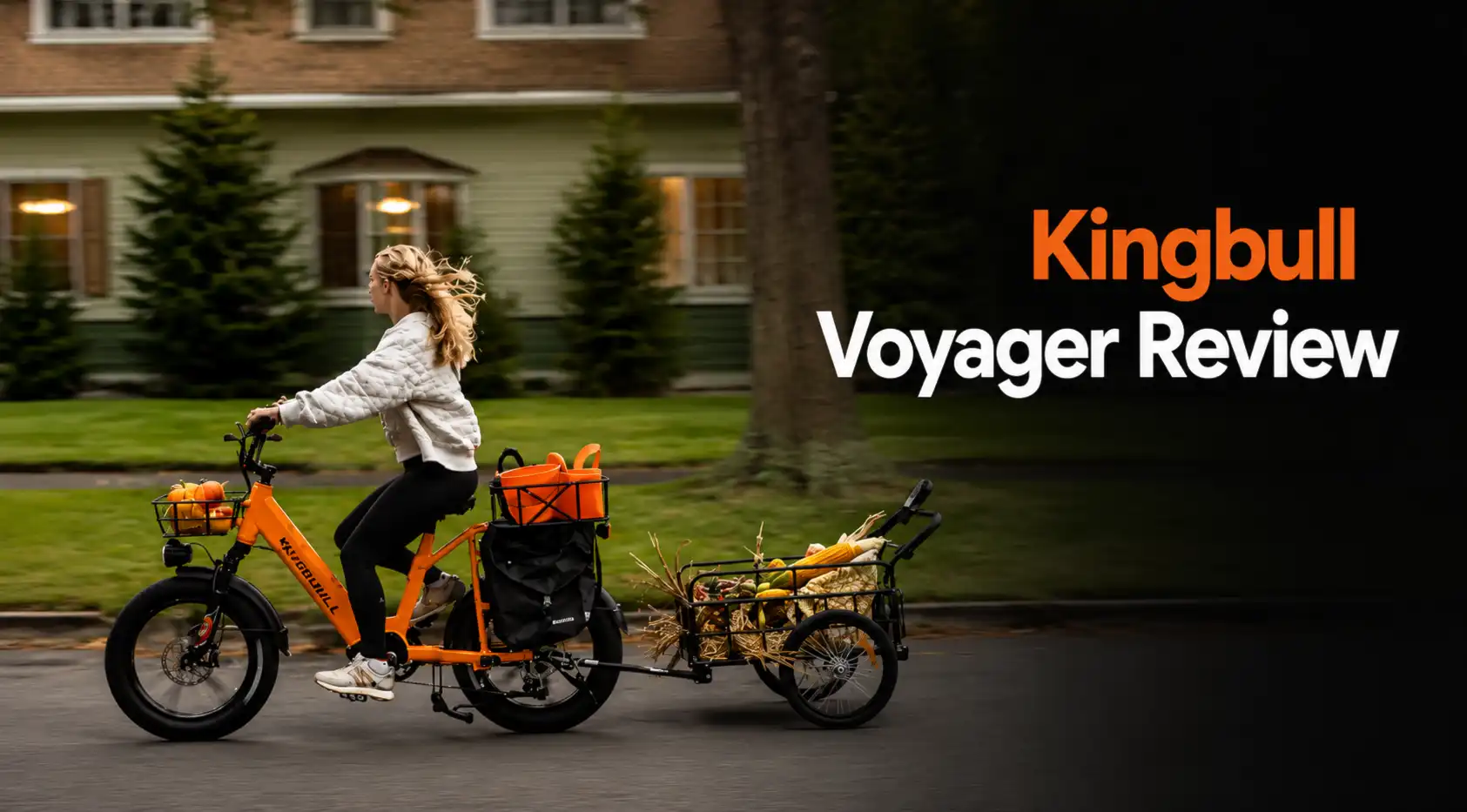
Kingbull Voyager 2.0 Review: Is This Fat-Tire Cargo E-Bike Worth Buying?
Last Updated on July 21, 2026 by Kristina
📚 Research-Based Review – Built from independent sources, specs, and user reports
The Kingbull Voyager 2.0 is a powerful fat-tire electric cargo bike designed for riders who want to carry groceries, equipment, a child seat, or other everyday cargo without paying the higher price of many premium cargo e-bikes.
With a 750W Bafang rear hub motor, torque-sensing pedal assist, a 720Wh Samsung-cell battery, hydraulic disc brakes, front suspension, and a claimed 450-pound maximum load rating, the Voyager 2.0 offers a lot of utility for its current price.
However, there are also several important details buyers should understand. The Kingbull Voyager is heavy, its seven-speed gearing may feel limited at higher speeds, and Kingbull publishes conflicting cargo-rack and maximum-load information on its website and in the owner’s manual.
In this Kingbull Voyager 2.0 review, I will take a detailed look at its motor performance, battery range, cargo capacity, ride quality, rider fit, display, technology, reported testing, and feedback from people who have purchased or reviewed the bike.
If you are still comparing different styles of utility e-bikes, my best cargo e-bikes for families guide and electric bike buying guide can help you compare the Voyager with other options.
Model note: This review covers the current Kingbull Voyager 2.0. Older Voyager listings found online may show different batteries, sensors, suspension components, weight ratings, displays, and cargo specifications. Make sure you are comparing the same Voyager generation.
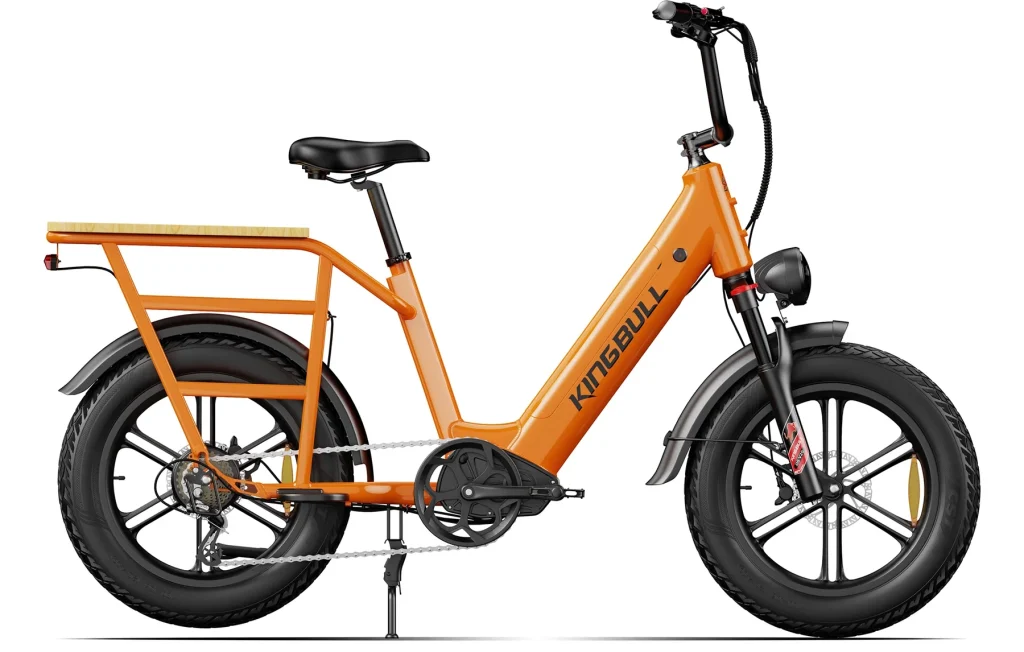
Kingbull Voyager 2.0 Quick Verdict
Electric Bike Explorer Rating: 8.5 out of 10 – Very Good
The Kingbull Voyager 2.0 earns an 8.5 out of 10 in my Electric Bike Explorer rating system. This places it in the Very Good category.
I think it is a strong value for someone who wants an affordable electric cargo bike with fat tires, a comfortable step-through frame, useful hill-climbing power, and enough carrying capacity for groceries, equipment, or an approved child-seat setup.
The 750W Bafang motor, torque sensor, 720Wh battery, hydraulic brakes, and integrated cargo rack are impressive at its current sale price.
The Voyager loses points because of Kingbull’s conflicting rear-rack and maximum-load information, its heavy 76-pound weight, limited high-speed gearing, lack of built-in GPS tracking, and restrictive return conditions.
Best for
- Grocery runs and everyday errands
- Riders who want a powerful utility e-bike
- Riders who prefer a compact cargo e-bike
- Riders who prefer a step-through frame
- Heavier riders who need more carrying capacity
- Recreational riders who want fat tires and front suspension
- Parents using a properly approved child-seat or passenger system
- Value-focused shoppers who do not need advanced smart technology
Consider another e-bike if
- You need to carry the bike upstairs
- You want a lightweight commuter e-bike
- You regularly pedal at 25 to 28 mph
- You want built-in GPS tracking or app connectivity
- You need a longtail cargo bike specifically designed for two children
- You depend heavily on local dealer support
- You plan to ride technical mountain-bike trails
Key Features at a Glance
The Kingbull Voyager 2.0 includes:
- Custom 750W Bafang rear hub motor
- Torque-sensing pedal assist
- Five pedal-assist levels
- Thumb throttle
- Up to 28 mph pedal-assist speed
- Up to 20 mph throttle speed
- Removable 48V, 15Ah battery
- 720Wh battery capacity
- Samsung battery cells
- Up to 60 miles of manufacturer-claimed range
- Optional second-battery compatibility
- Four-inch color display
- Shimano seven-speed drivetrain
- Hydraulic disc brakes
- 180mm brake rotors
- 20 x 4-inch CST fat tires
- 60mm front suspension fork
- Step-through aluminum frame
- Integrated welded rear cargo rack
- Integrated headlight, brake light, and horn
- Fenders, mirrors, lock, pump, and foot pegs included
- UL 2849-listed electrical system
- UL 2271-listed battery
- IPX6 water-resistance rating
These features and specifications are based on Kingbull’s current Voyager 2.0 product information.
🔍 Why You Can Trust Electric Bike Explorer
Electric Bike Explorer is dedicated to providing honest, well-researched, and easy-to-understand information for e-bike riders. Whenever possible, I personally test the e-bikes, accessories, and products I review. When I can’t test something directly, I rely on careful research, manufacturer specifications, real-world rider feedback, official sources, and trusted industry information.
For law guides, I review state statutes, local ordinances, transportation agencies, park rules, and official government resources whenever possible. For e-bike news, I review the original reporting along with available town documents, meeting agendas, proposed ordinances, police statements, government notices, and other primary sources. I also make a clear distinction between a proposal, an approved rule, and a law that has already taken effect.
For troubleshooting and safety guides, I focus on practical explanations, common rider experiences, manufacturer guidance, and safe maintenance practices.
My goal is to help you make informed decisions, understand the rules where you ride, solve common e-bike problems, and get the most out of your electric bike safely.
Want to know how I score bikes and research my guides? Read my full review and ranking process
Want to See More Electric Bike Explorer in Google Search?
Add Electric Bike Explorer as a preferred source to see more of our e-bike law guides, safety updates, reviews, buying guides, and troubleshooting posts when they are relevant to your searches.
Kingbull Voyager 2.0 Specifications
| Specification | Kingbull Voyager 2.0 |
|---|---|
| E-bike type | Fat-tire electric cargo bike |
| Frame style | One-size step-through frame |
| Frame material | Aluminum |
| Available colors | Orange and gray |
| Motor | Custom Bafang rear hub motor |
| Rated motor power | 750W |
| Claimed motor torque | Approximately 80–85Nm, depending on the published source |
| Controller | 48V, 25A |
| Maximum pedal-assist speed | Up to 28 mph |
| Maximum throttle speed | Up to 20 mph |
| E-bike class | Class 3 by default; configurable as Class 2 |
| Pedal-assist sensor | TROG-1B torque sensor |
| Pedal-assist levels | Five |
| Throttle | Left-side thumb throttle |
| Battery | 48V, 15Ah |
| Battery capacity | 720Wh |
| Battery cells | Samsung INR21700-50G cells |
| Battery location | Integrated, removable battery |
| Claimed maximum range | Up to 60 miles with the standard battery |
| Optional battery setup | Compatible with an additional battery |
| Charger | 54.6V, 3A smart charger |
| Approximate charging time | Five to six hours |
| Display | Four-inch full-color multifunction display |
| Drivetrain | Shimano seven-speed |
| Rear derailleur | Shimano RD-M310 |
| Shifter | Shimano SL-M315 |
| Rear gear range | 14–28T |
| Chainring | 48T |
| Brakes | ZOOM HB-875-E hydraulic disc brakes |
| Brake calipers | Two-piston |
| Brake rotor size | 180mm front and rear |
| Motor cutoff sensors | Yes |
| Front suspension | Coil suspension fork |
| Suspension travel | 60mm |
| Fork adjustments | Preload and lockout |
| Wheels | 20-inch one-piece magnesium-alloy wheels |
| Tires | CST 20 x 4-inch fat tires |
| Recommended tire pressure | 10–30 PSI |
| Bike weight | Approximately 76 pounds |
| Advertised maximum load | 450 pounds, but Kingbull’s definition is inconsistent |
| Separate rider-weight limit | Not clearly published |
| Published rear-rack capacity | 150, 180, or 200 pounds, depending on the section of Kingbull’s website |
| Recommended rider height | Approximately 5 feet 2 inches to 6 feet 6 inches |
| Minimum seat height | Approximately 32.7 inches |
| Maximum seat height | Approximately 39.3 inches |
| Overall length | Approximately 69 inches |
| Overall height | Approximately 46.9 inches |
| Handlebar width | Approximately 28.3 inches |
| Water resistance | IPX6 |
| Headlight | Integrated 48V LED headlight |
| Rear light | Integrated taillight with brake-light function |
| Horn | Integrated electric horn |
| Fenders | Front and rear included |
| Kickstand | Center-style loading stand |
| Electrical-system certification | Kingbull lists the bike as UL 2849 certified |
| Battery certification | Kingbull lists the battery as UL 2271 certified |
| Battery-cell certification | Samsung cells listed as UL 2580 certified |
| Warranty | Two years on the frame and eligible electrical components |
| Assembly | Approximately 85% assembled |
Kingbull lists a 450-pound maximum payload in its technical specifications, but the owner’s manual defines maximum load as the combined weight of the rider, the e-bike, riding gear, and cargo. Because the bike itself weighs approximately 76 pounds, these two descriptions do not mean the same thing. I would confirm the usable rider-and-cargo capacity directly with Kingbull before approaching the claimed maximum.
✅ Pros
- Strong 750W Bafang rear hub motor
- Claimed 80–85Nm of motor torque
- Smoother torque-sensing pedal assistance
- Useful 720Wh battery capacity
- More than 33 miles reported during independent higher-speed testing
- Up to 28 mph pedal-assist speed
- 20 mph thumb throttle
- Comfortable step-through frame
- Wide 20 x 4-inch fat tires
- Front suspension with preload and lockout
- Hydraulic disc brakes
- 180mm brake rotors
- Motor cutoff sensors
- Integrated welded cargo rack
- One-piece magnesium-alloy wheels
- Four-inch color display
- Integrated headlight, brake light, and horn
- Fenders and several accessories included
- UL-listed electrical system and battery
- Strong feature package for its sale price
❌ Cons
- Heavy at approximately 76 pounds
- Published maximum-load definition is unclear
- Rear-rack capacity is listed as 150, 180, and 200 pounds
- Separate rider-weight limit is not clearly published
- Shimano gearing can cause ghost pedaling above 20 mph
- Minimum seat height may be too tall for some shorter riders
- No built-in GPS tracking listed
- No smartphone app listed
- No USB charging port
- No integrated turn signals listed
- No bottle-cage mounts reported
- Center stand may scrape on uneven surfaces
- Foot pegs should not be treated as a complete passenger system
- Restrictive return conditions
- Direct-to-consumer service may require remote troubleshooting
- Not intended for technical mountain-bike trails
Kingbull Voyager 2.0 Price and Package Options
At the time I checked, the Kingbull Voyager 2.0 was listed at approximately $1,119, compared with a stated regular price of $1,899. Kingbull frequently runs promotions, so the actual price may be higher or lower when you check.
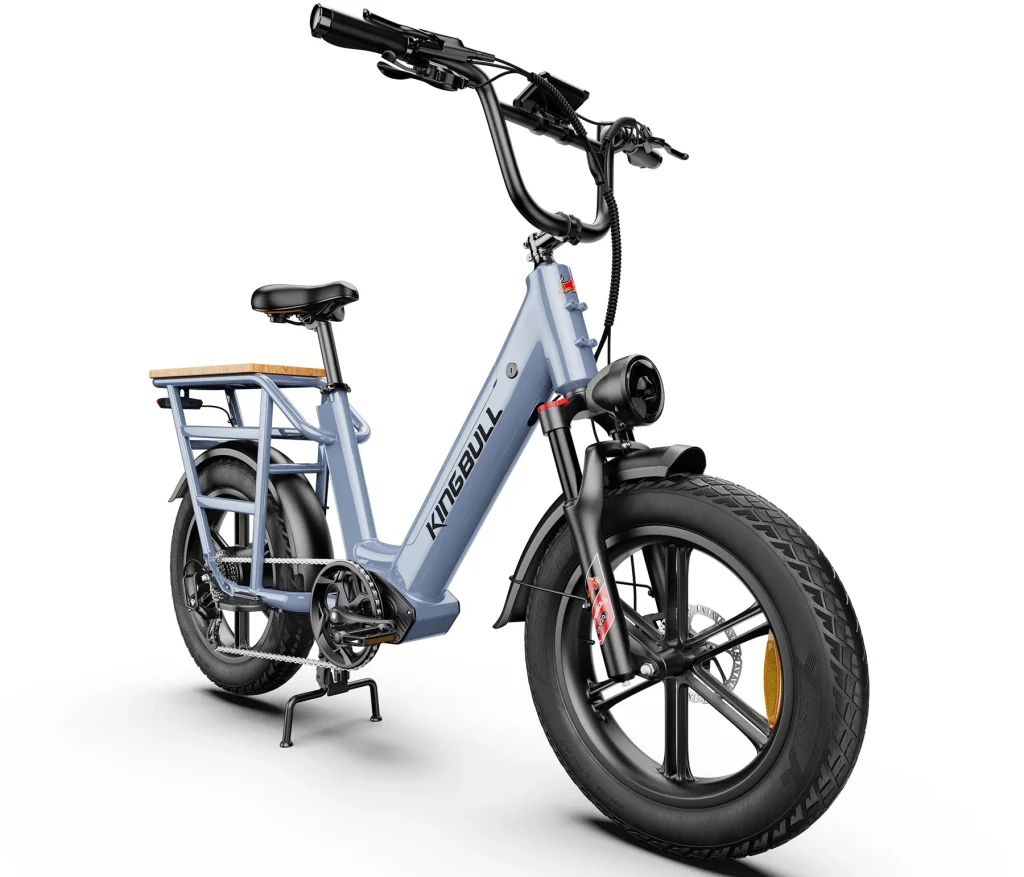
The current Kingbull Voyager 2.0 is offered in orange and gray, with the following package options:
- E-bike only
- E-bike with a front basket
- E-bike with a cargo trailer
Kingbull also sells or promotes an optional second-battery setup for riders who need more range. The standard Voyager 2.0 reviewed here comes with one 720Wh battery unless a different battery package is specifically selected.
The standard package is listed as including several useful accessories:
- Mirrors
- Cable lock
- Compact air pump
- Bungee cord
- Folding footrest pegs
- Battery charger
- Basic assembly toolkit
- Owner documentation
These included accessories add value, although the supplied lock and pump should be viewed as basic starter accessories rather than replacements for a high-security e-bike lock or full-size floor pump.
Kingbull Voyager 2.0 Motor Power
The Kingbull Voyager 2.0 uses a custom 750W Bafang rear hub motor paired with a 48V, 25-amp controller.
There is a small discrepancy in the published torque rating. Kingbull’s current FAQ lists up to 85Nm of peak torque, while Kingbull’s own Voyager launch article and BikeRide list approximately 80Nm. I would describe the motor as producing a claimed 80 to 85Nm of torque, rather than treating either figure as independently verified.
The motor supports pedal-assist speeds of up to 28 mph. The thumb throttle is limited to approximately 20 mph.
Kingbull describes the Voyager 2.0 as a Class 3 e-bike by default, but the display settings allow it to be configured for Class 2 operation. Riders should check their state and local e-bike laws before changing the speed settings or using the Voyager on trails and shared-use paths.
How the torque sensor changes the ride
One of the most important upgrades on the Voyager 2.0 is its torque sensor.
A torque sensor measures how much pressure the rider puts into the pedals. The motor then increases or decreases assistance based on that effort.
This normally creates a smoother and more natural ride than a basic cadence sensor, which may turn the motor on as soon as it detects crank movement.
The torque sensor should be especially helpful when:
- Starting with cargo on the rack
- Riding slowly around pedestrians
- Climbing hills
- Maneuvering in parking lots
- Carrying a child in an approved seat
- Riding on loose or uneven surfaces
It should also give the rider more control over how much assistance the motor provides instead of delivering the same surge of power every time the pedals begin turning.
Can the Kingbull Voyager 2.0 Climb Hills?
Based on its motor, controller, smaller 20-inch wheels, and reported testing, the Kingbull Voyager 2.0 should be a capable hill-climbing cargo e-bike.
The smaller wheel diameter gives the hub motor a mechanical advantage compared with the same motor installed in a larger wheel. That can help during loaded starts and steeper climbs.
Independent reviewers summarized by BikeRide were impressed by the Voyager 2.0’s hill-climbing performance and reported that its motor could continue carrying heavy loads up steep hills.
However, motor wattage and torque do not tell the entire story. Hill performance will also depend on:
- Rider weight
- Cargo weight
- Hill steepness
- Hill length
- Battery charge
- Tire pressure
- Pedal-assist setting
- How much effort the rider contributes
The Voyager should handle most paved neighborhood and commuting hills well, but very long or extremely steep climbs may still require lower gearing and meaningful rider effort.
Kingbull Voyager Battery and Range
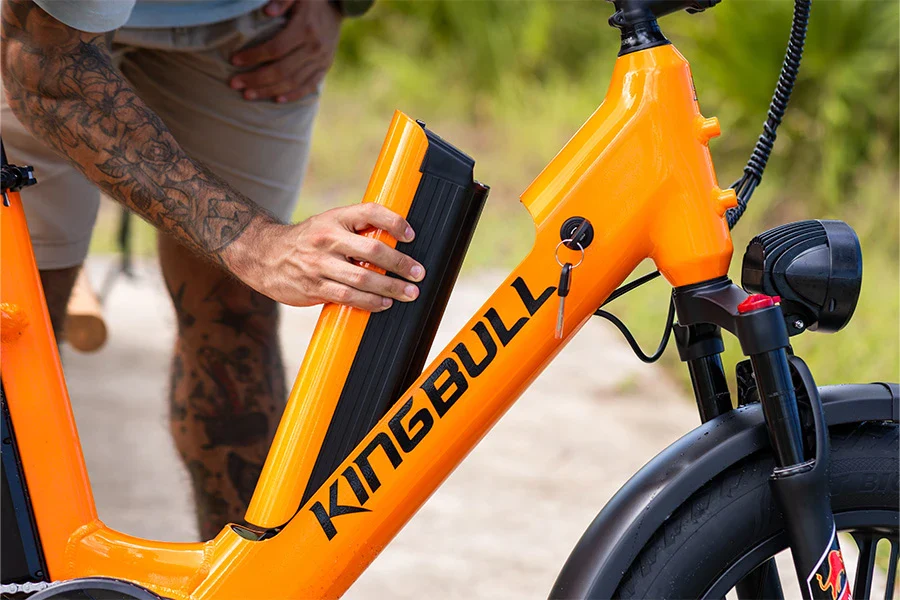
The standard Kingbull Voyager 2.0 has a removable 48V, 15Ah battery with approximately 720Wh of capacity.
Kingbull says the battery uses Samsung INR21700-50G cells and advertises a maximum range of up to 60 miles under ideal riding conditions. The battery is integrated into the frame but can be removed for charging or storage.
A 720Wh battery is a useful size for an electric cargo bike in this price range. It is larger than many batteries found on inexpensive commuter and folding e-bikes, although it is smaller than the single or dual batteries used on some long-range cargo models.
The included 3-amp charger is expected to recharge the battery in approximately five to six hours.
How far can the Kingbull Voyager 2.0 really travel?
I would not assume that every rider will receive 60 miles from one charge.
Manufacturer range tests are normally performed under favorable conditions, such as:
- Lower pedal-assist settings
- Flat terrain
- Moderate speed
- A lighter rider
- Minimal cargo
- Properly inflated tires
- Warm weather
- Meaningful rider pedaling
BikeRide reports that a tester weighing approximately 215 pounds traveled more than 33 miles with the single-battery Voyager 2.0. The test reportedly used the bike’s higher-speed settings, making the result more useful than the maximum manufacturer claim alone.
That does not guarantee that every rider will travel 33 miles. A heavier rider, large cargo load, cold weather, steep hills, headwind, low tire pressure, or frequent throttle use can substantially reduce electric bike range.
You can enter the Voyager’s 720Wh battery, rider weight, cargo, terrain, and assist level into my E-Bike Range Calculator for a more personalized estimate.
Optional second battery
Kingbull promotes an optional second battery for the Voyager 2.0. Adding another 720Wh battery would bring total capacity to approximately 1,440Wh.
Kingbull claims up to 100 miles with the dual-battery setup, although actual range will still vary. Buyers should also remember that a second battery adds cost and weight.
Kingbull Voyager Ride Quality
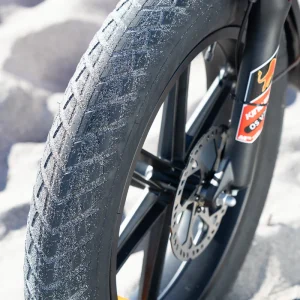
The Kingbull Voyager 2.0 appears to prioritize comfort, traction, and loaded stability rather than lightweight or sporty handling.
Its 20 x 4-inch CST fat tires create a wide contact patch and add cushioning over cracked pavement, packed gravel, grass, and uneven paths.
The 60mm suspension fork helps reduce impact through the handlebars. It also includes preload adjustment and a lockout, allowing riders to make the fork firmer on smoother roads.
Independent reviewers praised the comfort and traction of the four-inch tires and described the hydraulic brakes as powerful and responsive. They also found the compact cargo bike reasonably manageable despite its weight.
Stability with cargo
The 20-inch wheels help keep the bike and rear load closer to the ground than they would be on a cargo bike with 26-inch wheels.
A lower center of gravity can make it easier to:
- Start from a stop
- Balance with cargo
- Load the rear rack
- Maneuver at lower speeds
- Put a foot down when stopping
The torque sensor should also make the bike easier to control because motor assistance responds to pedal pressure instead of turning on abruptly.
Fat-tire tradeoffs
The fat tires provide comfort and traction, but they also have disadvantages.
Compared with narrower commuter tires, four-inch fat tires generally:
- Create more rolling resistance
- Add weight
- Require more battery power at higher speeds
- Make steering feel slower
- Cost more to replace
The Voyager is likely to appeal more to riders who prioritize comfort and stability than riders who want quick, agile handling.
High-speed pedaling
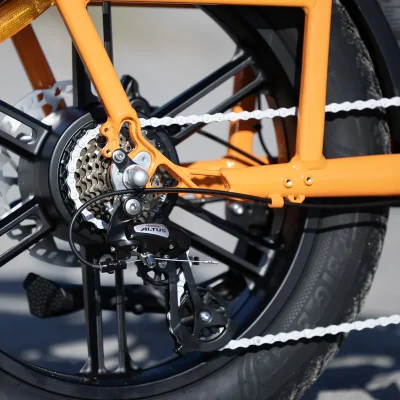
One reported weakness is the Shimano seven-speed drivetrain.
The bike uses a 48-tooth front chainring and a 14-tooth smallest rear cog. Reviewers reported ghost pedaling above approximately 20 mph, meaning the pedals begin spinning quickly without providing much additional propulsion.
Riders who usually travel between 12 and 20 mph may not see this as a serious problem. Someone who wants to pedal comfortably near the full 28 mph assisted speed may find the gearing limiting.
Frame Style, Rider Height, and Fit
The Kingbull Voyager 2.0 is offered in a one-size aluminum step-through frame.
Kingbull recommends it for riders approximately 5 feet 2 inches to 6 feet 6 inches tall. The seat height adjusts from approximately 32.7 to 39.3 inches.
The open frame should make the Voyager easier to mount than a cargo bike with a high top tube. That can be especially useful when:
- The rear rack is loaded
- A child seat is installed
- The rider has limited hip mobility
- The rider has difficulty swinging a leg over a rear rack
- The rider frequently stops during errands
However, the 32.7-inch minimum seat height is not especially low.
As someone who is approximately 5 feet 1 inch tall, I would want to test the Voyager before buying it. A person’s inseam is more important than overall height, but some shorter riders may not be able to place both feet securely on the ground while seated.
My E-Bike Size and Fit Calculator can provide a general fit estimate, but it does not replace checking the bike’s actual measurements or taking a test ride.
Is the Kingbull Voyager easy to move without power?
At approximately 76 pounds before adding accessories or cargo, the Voyager is a heavy e-bike.
The motor should make it manageable while riding, but its weight may become noticeable when:
- Lifting it onto a vehicle rack
- Moving it through a narrow doorway
- Carrying it up stairs
- Turning it around inside a garage
- Loading it into a truck or SUV
- Walking it with a depleted battery
The included walk-assist mode may help when pushing the bike, but it will not make the bike easier to lift.
Kingbull Voyager Cargo Capacity
Cargo capacity is one of the Voyager 2.0’s most important features, but it is also where Kingbull’s published information becomes confusing.
Kingbull’s technical table advertises a 450-pound maximum payload. However, the Voyager 2.0 manual says maximum load includes:
- The rider
- The e-bike itself
- Riding equipment
- Cargo
Because the Voyager weighs approximately 76 pounds, a 450-pound total including the bike would leave about 374 pounds for the rider, accessories, and cargo combined.
That is very different from a 450-pound payload rating that excludes the bike.
Kingbull’s website repeatedly markets 450 pounds as the bike’s payload or carrying capacity, while its manual uses a different definition. Because of that conflict, I would not assume that a rider can add 450 pounds to the 76-pound bike.
Before purchasing the Voyager for a heavier rider or very heavy cargo, I recommend asking Kingbull to confirm in writing:
- The maximum rider weight
- Whether the bike’s weight is included in the 450-pound limit
- The maximum combined rider-and-cargo weight
- The capacity of the rack installed on the specific bike being shipped
You can also read my guide explaining how much weight an e-bike can carry before comparing cargo-bike weight limits.
Conflicting Kingbull Voyager Rear-Rack Capacity
Kingbull currently publishes three different rear-rack capacities for the Voyager 2.0:
- 150 pounds in the product-feature section
- 180 pounds in the technical specifications
- 200 pounds in the FAQ
Independent reviewers also noticed and criticized this inconsistency.
The 180-pound figure appears in the detailed technical table, but I would not treat it as a guaranteed limit when the same manufacturer publishes two other numbers on the same page.
The safest approach is to follow the lowest published figure unless Kingbull confirms otherwise. Buyers should also check for a capacity label or warning printed on the rack supplied with their individual bike.
This matters especially when carrying:
- A child seat
- An adult passenger
- Large grocery loads
- Delivery equipment
- Camping supplies
- A heavy rear basket
- Multiple panniers
The capacity of a child seat, basket, pannier, rack extension, or passenger accessory may also be lower than the capacity of the bike rack itself.
Can the Kingbull Voyager Carry a Child?
The Voyager 2.0 may be able to carry a child when equipped with an approved and compatible child carrier.
However, the included folding foot pegs alone do not make the rear rack a safe passenger system.
The owner’s manual says the rear rack is intended primarily for luggage and should not carry a passenger unless an approved child carrier is used. It also directs riders to remain within the rack limit, use a helmet, and never leave a child unattended on the bike.
A proper child-passenger setup should include:
- A compatible child seat or passenger enclosure
- Secure footrests
- Wheel and drivetrain guards
- A correctly fitted helmet
- Something safe for the child to hold
- Appropriate back and side support
- Weight within every component limit
- Compliance with state and local passenger laws
One independent tester also questioned whether the supplied foot pegs felt sturdy enough for heavier passenger use.
I would not carry a child directly on a rack cushion with only the included pegs. The bike needs a complete passenger system designed for the child’s age, size, and weight.
Essential E-Bike Gear (Quick Picks)
Before you choose your e-bike, these are the accessories most riders end up needing for safety and everyday use:
Kingbull Voyager Display and Technology
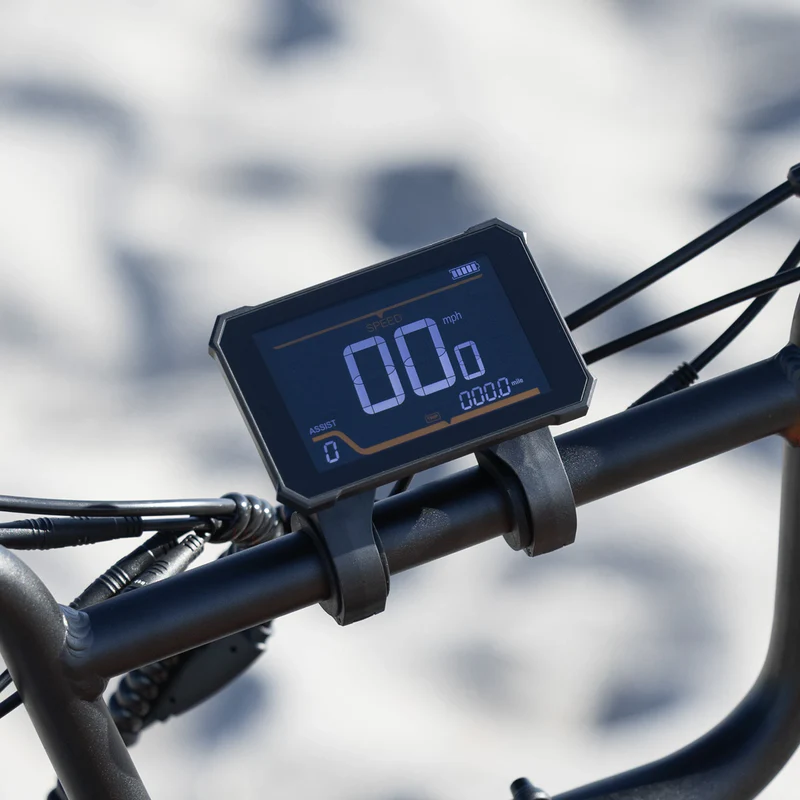
The Kingbull Voyager 2.0 includes a four-inch full-color multifunction display.
The display and system can provide information such as:
- Current speed
- Average speed
- Maximum speed
- Battery level
- Pedal-assist level
- Odometer
- Trip distance
- Riding time
- Voltage
- Brake status
- System faults
The display menu also allows certain settings to be adjusted, including the maximum assisted speed and whether the bike operates with pedal assistance, throttle assistance, or both. Riders should avoid changing unfamiliar settings because incorrect programming may affect the bike’s performance or legal classification.
Technology the Voyager does not appear to include
The Voyager’s current specifications do not list:
- Built-in GPS tracking
- Cellular theft alerts
- Companion smartphone app
- Geofencing
- Remote motor shutdown
- Integrated electronic wheel lock
- USB charging port
- Integrated turn signals
Independent reviewers also reported that the display does not include a USB charging port and that the frame lacks bottle-cage mounts.
The Voyager provides the basic ride information most people need, but it is not a highly connected smart e-bike.
Riders who consider built-in security a priority may want to compare the Voyager with the models in my best e-bikes with GPS tracking guide or add a hidden aftermarket GPS tracker.
Brakes and Stopping Power
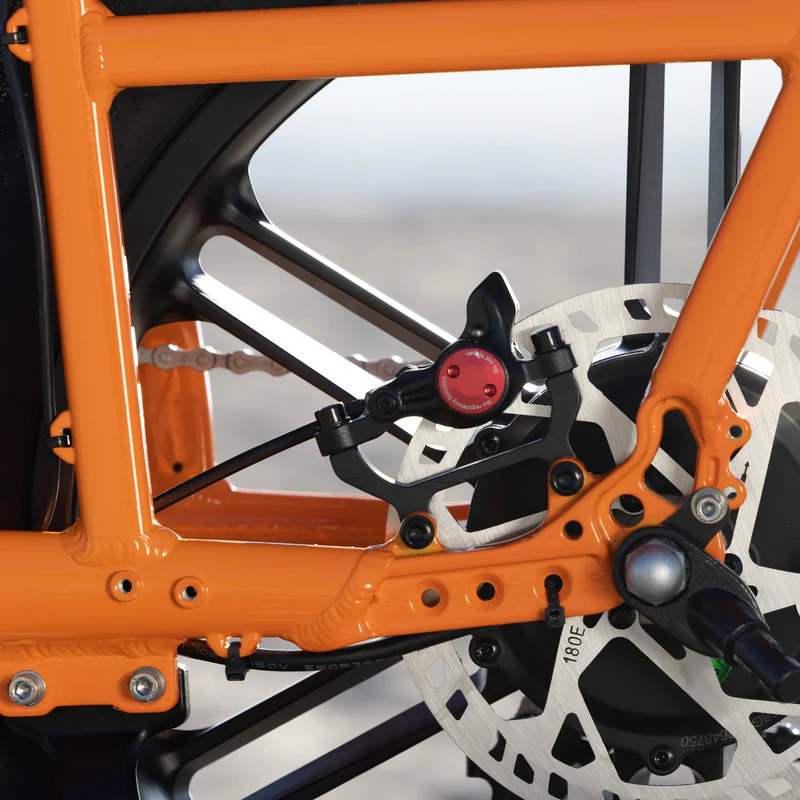
The Kingbull Voyager 2.0 uses ZOOM HB-875-E hydraulic disc brakes with two-piston calipers and 180mm rotors on both wheels.
Hydraulic brakes are an important feature on an electric cargo bike because the braking system may need to stop the rider, bike, accessories, and cargo at the same time.
The brake levers also contain motor cutoff sensors. Applying either brake interrupts motor assistance, reducing the chance that the motor will continue pushing while the rider is trying to stop.
Independent reviewers described the Voyager’s hydraulic brakes as powerful and responsive.
Even with good brakes, a loaded cargo e-bike requires more stopping distance. Riders carrying heavier loads should:
- Inspect brake pads frequently
- Keep rotors clean
- Test both brakes before each loaded ride
- Reduce speed on wet or loose surfaces
- Brake earlier before intersections
- Avoid exceeding component weight limits
Brake performance may decrease in rain, mud, loose gravel, or during long downhill descents.
Tires, Wheels, and Suspension
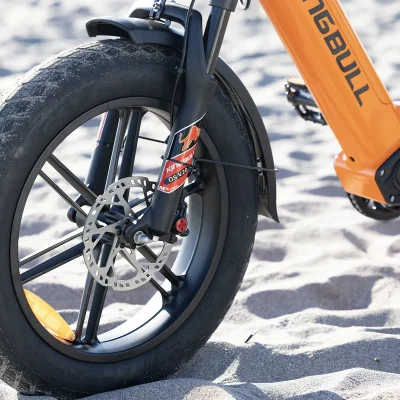
The Voyager rides on 20 x 4-inch CST fat tires mounted to one-piece magnesium-alloy wheels.
The solid-style wheels do not have conventional spokes that can loosen or break. Independent reviewers considered this a useful feature on a cargo e-bike that may be exposed to heavier loads.
Kingbull describes the tires as puncture resistant, but no pneumatic tire is completely puncture proof. Riders should still carry appropriate flat-repair supplies.
The owner information gives a broad recommended pressure range of approximately 10 to 30 PSI. The best pressure will depend on:
- Rider weight
- Cargo weight
- Surface
- Weather
- Desired comfort
- Desired rolling efficiency
My E-Bike Tire Pressure Calculator can provide a practical starting range based on your riding conditions.
The 60mm front suspension fork should be enough for potholes, cracked pavement, packed gravel, and maintained recreational paths. It is not intended to turn the Voyager into a technical mountain bike.
Kingbull’s manual advises using the cargo bike for its intended purpose and avoiding extreme off-road or downhill riding.
🎥 Watch the Kingbull Voyager 2.0 in Action
This video provides a closer look at the Kingbull Voyager 2.0, including its design, cargo setup, controls, and riding performance.
Reported Kingbull Voyager 2.0 Testing
BikeRide summarized three expert reviews of the Kingbull Voyager 2.0. These tests provide useful information beyond Kingbull’s advertised specifications, although they were not all performed under identical controlled conditions.
Reported range testing
A tester weighing approximately 215 pounds reportedly traveled more than 33 miles using the standard single-battery Voyager 2.0.
The tester reportedly used higher-speed settings, which normally consume more battery than low-assist riding.
Reported hill-climbing performance
Reviewers were impressed by the bike’s ability to climb hills and maintain assistance while carrying weight.
The combination of a 750W hub motor, high-current controller, torque sensor, and smaller 20-inch wheels appears to provide useful climbing power.
Reported braking performance
Testers found the hydraulic disc brakes powerful and responsive.
This is especially important on a 76-pound cargo e-bike that may be carrying a substantial rider-and-cargo load.
Reported comfort and traction
Reviewers praised the comfort and grip provided by the four-inch CST tires.
The combination of fat tires, front suspension, upright seating, and compact wheels appears to create a stable ride on pavement and light unpaved surfaces.
Reported high-speed gearing
Reviewers reported ghost pedaling above approximately 20 mph.
The motor may continue assisting toward 28 mph, but the rider may struggle to contribute meaningful pedal power because of the limited top gear.
Reported kickstand clearance
The center loading stand provides a stable platform while placing cargo on the bike.
However, reviewers reported that the stand sits low enough to scrape on bumps and uneven terrain.
Reported foot-peg concern
One tester questioned whether the included passenger foot pegs felt sturdy enough for heavier passenger use.
This reinforces the importance of using a complete, approved passenger system rather than assuming that included foot pegs make the bike passenger ready.
What Riders Are Saying
Most of the easily accessible Kingbull Voyager 2.0 owner feedback is hosted on Kingbull’s own product page.
Manufacturer-hosted reviews can still provide useful information, but I like to consider them alongside independent testing because the review platform is controlled by the company selling the product.
Kingbull’s page displayed approximately 420 customer reviews when checked.
One owner wrote:
“Such a smooth ride and easy to understand after the 1st few minutes.”
Another customer summarized the bike as:
“Nice bike, good value and responsive company.”
Other recurring themes in Kingbull’s customer reviews include:
- Smooth and comfortable riding
- Easy-to-understand controls
- Strong motor assistance
- Good value for the included equipment
- The ability to pull a trailer
- Easy mounting and dismounting
- Straightforward final assembly
- Positive initial experiences with shipping or support
One customer also reported completing a 50-mile round trip, although an individual owner’s result should not be treated as a controlled range test because speed, terrain, assist level, rider effort, and charging conditions were not provided.
The manufacturer-hosted comments generally support the independent reviewers’ conclusions that the Voyager offers a comfortable ride, strong motor performance, and good value. However, buyers should still consider the rack-capacity confusion, return restrictions, and direct-to-consumer service model before ordering.
Kingbull Voyager Assembly
Kingbull says the Voyager 2.0 arrives approximately 85% assembled.
The remaining work may include installing or adjusting components such as:
- Front wheel
- Handlebars
- Pedals
- Headlight
- Mirrors
- Seat
- Accessories
- Front basket, when purchased
- Control position
Kingbull provides Voyager 2.0 assembly instructions through its online owner resources.
Even when an e-bike arrives mostly assembled, I recommend checking every safety-critical component before riding:
- Front axle
- Stem and handlebars
- Brake calipers
- Brake rotors
- Crankarms
- Pedals
- Rack hardware
- Kickstand
- Derailleur
- Tire pressure
Someone who is not comfortable assembling and inspecting an e-bike should consider paying a bicycle shop or mobile bike mechanic for final assembly.
This is particularly important because Kingbull’s warranty excludes problems caused by improper assembly or installation.
Kingbull Warranty
Kingbull currently provides a limited warranty with different coverage periods for different components.
The stated coverage includes:
| Component | Warranty period |
|---|---|
| Frame | Two years |
| Motor | Two years |
| Battery | Two years |
| Controller | Two years |
| Sensors and wiring | Two years |
| Display | One year |
| Suspension fork | One year |
| Hub | One year |
| Charger | Six months |
| Hydraulic brake system | Three months, excluding fluid and normal wear |
| Tires | Three months for qualifying defects |
Kingbull says approved local repair expenses may be reimbursed up to $75 when the repair receives prior authorization and the customer submits a valid invoice. Repairs completed without prior Kingbull approval may not be reimbursed.
The warranty covers eligible defects in materials or workmanship. It does not normally cover ordinary wear, crashes, misuse, unauthorized alterations, improper assembly, neglected maintenance, or incompatible accessories.
Kingbull Return Policy
Kingbull advertises a 15-day return policy, but the conditions are restrictive and should be read before ordering.
According to the current policy:
- Kingbull must authorize the return by email.
- An RMA number is required.
- The return must be requested within 15 days of receiving the bike.
- Bikes with more than 10 total miles cannot be refunded.
- The bike must not show wear, dirt, scratches, or other signs of use.
- The original packaging is required.
- All batteries, chargers, keys, hardware, manuals, and included items must be returned.
- The bike must be shipped within five days of receiving the return label.
- Non-defect returns normally require the customer to pay $150 return shipping.
- Returns from Hawaii may have a $230 return-shipping charge.
- Non-defect returns can also have a 10% handling fee deducted from the refund.
These conditions may make it difficult to use the return period as an extended test ride. Ten miles is not much distance for evaluating comfort, range, fit, and cargo handling.
I would carefully check the seat height, total dimensions, bike weight, and storage requirements before ordering.
Kingbull Voyager 2.0 Rating Breakdown
| Category | Score |
|---|---|
| Motor power and hill climbing | 9.0/10 |
| Battery capacity and range | 8.4/10 |
| Ride quality and comfort | 8.7/10 |
| Cargo utility | 8.6/10 |
| Brakes and safety equipment | 8.8/10 |
| Rider fit and accessibility | 8.1/10 |
| Display and technology | 7.6/10 |
| Components and build | 8.3/10 |
| Warranty, returns, and support | 7.9/10 |
| Value for the price | 9.1/10 |
| Overall Electric Bike Explorer rating | 8.5/10 – Very Good |
The Voyager scores highest for motor performance, braking, comfort, and value.
Its overall rating is held back by the unclear cargo limits, restrictive return conditions, heavy bike weight, limited high-speed gearing, and lack of advanced security technology.
Is the Kingbull Voyager Good for Heavier Riders?
The Kingbull Voyager 2.0 may be worth considering for a heavier rider because Kingbull advertises a 450-pound maximum capacity.
However, I would not rely on that number without clarification.
Kingbull does not clearly list a separate maximum rider weight, and the owner’s manual says the maximum load includes the rider, bike, equipment, and cargo. That means buyers cannot safely assume that the bike supports a 450-pound rider or 450 pounds of rider and cargo in addition to the bike.
Heavier riders should ask Kingbull for a confirmed rider-weight limit and consider:
- Tire load ratings
- Rack limits
- Brake-pad wear
- Longer stopping distances
- Wheel and axle inspections
- Proper tire pressure
- Battery demand on hills
- Weight added by accessories
- The limits of any child seat, basket, or pannier
The Voyager has encouraging motor, frame, brake, and cargo specifications, but riders should follow the lowest applicable component limit.
Should You Buy the Kingbull Voyager 2.0?
The Kingbull Voyager 2.0 combines strong motor performance, fat-tire comfort, practical cargo features, and a competitive sale price.
Its 750W Bafang rear hub motor and 25-amp controller should provide useful assistance for hills, heavier riders, and loaded starts. The torque sensor is one of its strongest features because it should make the pedal assistance smoother and easier to control than a basic cadence system.
The standard 720Wh Samsung-cell battery is also appropriately sized for an affordable electric cargo bike. Kingbull’s 60-mile claim represents an ideal result, but reported testing of more than 33 miles with a 215-pound rider in higher-speed settings is encouraging.
Ride comfort should be another advantage. The four-inch tires, suspension fork, upright riding position, compact wheels, and step-through frame make the Voyager better suited to rough pavement and relaxed utility riding than a narrow-tire cargo bike without suspension.
The hydraulic disc brakes and 180mm rotors are also appropriate for a heavy cargo e-bike. Independent reviewers praised their power and responsiveness.
The largest concern is not the motor or battery. It is Kingbull’s inconsistent load information.
Kingbull lists the rack at 150, 180, and 200 pounds in different sections. It also advertises a 450-pound payload while the manual says maximum load includes the bike itself. Buyers who need the Voyager for a heavier rider, child passenger, or substantial cargo should get the limits confirmed before ordering.
The Voyager is also heavy, lacks built-in GPS technology, and may be difficult to return after it has accumulated more than 10 miles. Its seven-speed gearing may feel too low at faster speeds, and the direct-to-consumer ownership experience may require more owner involvement than purchasing through a local bicycle dealer.
Even with those drawbacks, I believe the Kingbull Voyager 2.0 is a very good value-focused fat-tire cargo e-bike for errands, commuting, recreational riding, and moderate cargo use.
It is best for someone who values motor power, comfort, included equipment, and price more than advanced smart technology or premium dealer support.
My final Electric Bike Explorer rating is 8.5 out of 10 – Very Good.
Kingbull Voyager Alternative: Lectric XPedition 2.0
The Lectric XPedition 2.0 is the stronger alternative for someone who needs a true longtail cargo bike with clearer weight limits and a larger family-accessory ecosystem.
Lectric lists a 450-pound total payload, a 330-pound maximum rider weight, and a 300-pound rear-rack limit. Its long integrated rack measures approximately 36.7 inches and includes mounting areas for child seats and cargo accessories.
The single-battery model includes:
- 750W rear hub motor
- Up to 1,310W peak power
- 85Nm claimed torque
- Torque sensor
- Eight-speed Shimano drivetrain
- 624Wh battery
- Up to 60 miles of claimed range
- 50mm suspension fork
- Color display with USB-C port
- Rider-height range of approximately 4 feet 11 inches to 6 feet 5 inches
- UL 2849-listed electrical system
- UL 2271-listed battery
Read my full Lectric Xpedition 2 Review
Choose the Lectric XPedition 2.0 if you want
- A longer rear cargo deck
- Clearly separated rider and rack limits
- More options for carrying children
- A larger cargo-accessory selection
- An eight-speed drivetrain
- USB-C device charging
- A bike that officially fits shorter riders
- Optional dual-battery configurations
Choose the Kingbull Voyager 2.0 instead if you want
- Four-inch fat tires
- More cushioning on rough roads
- A shorter overall cargo-bike design
- One-piece magnesium-alloy wheels
- A larger standard single battery
- More included starter accessories
- A lower current sale price
The XPedition 2.0 is likely the more versatile family and longtail cargo platform. The Kingbull Voyager offers a more compact frame, wider tires, and a lower entry price.
Kingbull Voyager Alternative: Specialized Globe Haul LT
The Specialized Globe Haul LT is the premium alternative for someone who wants clearer specifications, an extensive accessory system, and access to Specialized’s dealer and service network.
The Haul LT has a 700W rear hub motor, 772Wh battery, assisted speed of up to 28 mph, and claimed range of up to 60 miles. Specialized lists a 441-pound total carrying capacity including the rider and a 176-pound rear-rack capacity.
It also includes:
- 31-inch MIK-compatible rear rack
- Rider-height range of approximately 4 feet 5 inches to 6 feet 4 inches
- 20 x 3.5-inch tires
- 772Wh UL 2271-listed battery
- Bluetooth connectivity
- USB charging connection
- Two-year e-system warranty
- Lifetime frame warranty
- Specialized dealer support
- Accessory options for cargo and child passengers
Read my Full Specialized Globe Haul LT Review
Choose the Specialized Globe Haul LT if you want
- A premium longtail cargo platform
- Clearer cargo and rider-inclusive load limits
- Local dealer assembly and service
- An extensive cargo-accessory system
- Room for two passenger seats with the appropriate setup
- Bluetooth connectivity
- A lifetime frame warranty
- A frame designed to fit a wider height range
Choose the Kingbull Voyager 2.0 instead if you want
- A much lower purchase price
- Four-inch fat tires
- Front suspension
- A thumb throttle
- A more compact cargo frame
- More accessories included with the standard purchase
- A lighter bike than the larger longtail alternative
The Globe Haul LT costs considerably more, but the higher price includes clearer specifications, a mature dealer network, a long cargo platform, and stronger long-term service options. The Kingbull Voyager remains the better budget choice for a rider who does not need the Specialized dealer experience or extended longtail layout.
Disclosure: As an Amazon Associate, I earn from qualifying purchases. This comes at no extra cost to you and helps support the content on this site.
📚 Read Me Next
- Compare this bike to others → Best Cargo E-Bikes
- Not sure about budget? → Budget E-Bike Guide
- Want to learn first? → E-Bike Buying Guide
- See more ebike reviews → E-Bike Reviews

Kristina is not just an enthusiast but a true authority on electric bikes. Nestled in the coastal beauty of Virginia, Kristina has found the perfect backdrop for her passion for electric biking. As a dedicated wife and homeschooling mom, her life revolves around family, faith, and the thrill of adventure.
Originally hailing from Ohio, Kristina's journey with electric bikes began as a curiosity and quickly evolved into a deep expertise. Her blog is a testament to her love for electric biking, combining her fascination for eco-friendly transportation with her coastal lifestyle.
When she's not cruising the beach on her electric bike, you'll find Kristina indulging in her other loves: long walks along the shore, getting lost in a good book, and cherishing moments with her loved ones. With a heart as big as her love for animals, especially cats, Kristina brings a unique perspective to the electric bike world, grounded in her strong faith in God and her dedication to a sustainable lifestyle.
Through her blog, Kristina shares her extensive knowledge of electric bikes, offering valuable insights, tips, and recommendations to fellow enthusiasts. Whether you're a seasoned rider or a newcomer to the electric bike scene, Kristina's blog is your go-to source for all things electric biking, fueled by her passion, expertise, and the scenic beauty of coastal Virginia.