
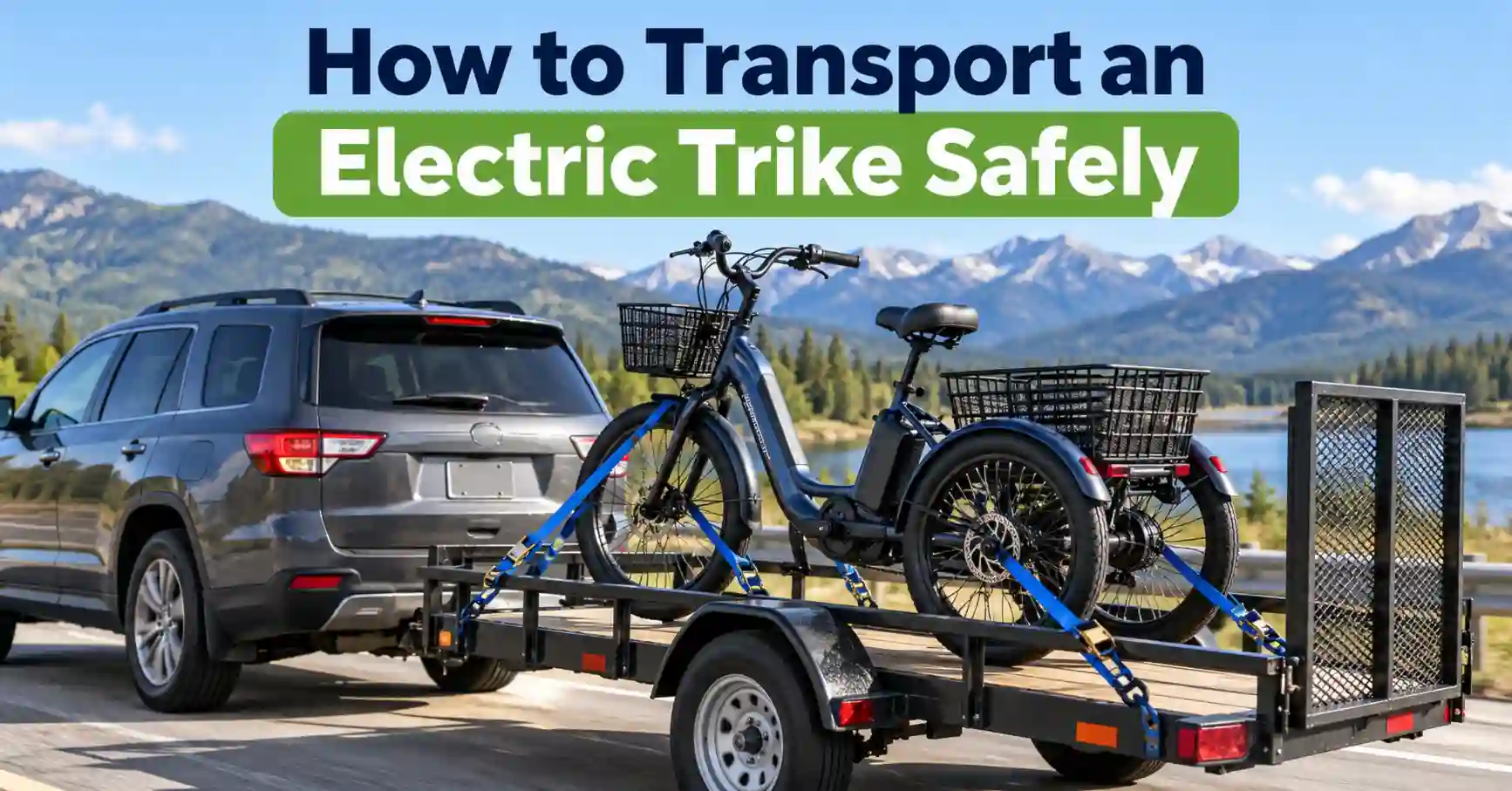
How to Transport an Electric Trike Safely: Car Racks, Trailers, and Loading Tips

Transporting an electric trike takes more planning than carrying a regular bicycle. Electric trikes are often wider and heavier, and their three-wheel layouts don’t fit most conventional bicycle racks. That can be challenging if you want to take your trike on vacation, travel in an RV, or drive to a new place to ride. It’s especially important for riders who have trouble lifting heavy equipment.
You can transport an electric trike safely using a compatible three-wheel carrier, utility trailer, pickup truck, or sufficiently large vehicle cargo area. The right method depends on the trike’s actual transport weight, dimensions, wheel arrangement, and the vehicle’s limits. Before you purchase transportation equipment, confirm all of those details rather than relying on a heavy-duty e-bike rack’s advertised capacity alone.
If you’re still choosing a trike, see my best electric tricycles guide and best electric trikes for heavy riders. Transportation and storage deserve consideration alongside riding comfort, stability, and range.
Can You Transport an Electric Trike on a Regular Bike Rack?
Most conventional two-wheel bicycle racks are unsuitable for adult electric trikes. Even if the rack has a high weight rating, its trays and clamps may not support the third wheel, the distance between paired wheels, or the trike’s frame.
- All three wheels need correctly positioned, approved support.
- Rear or front track width may exceed the rack’s design.
- Baskets, backrests, and unusual tubing can interfere with frame clamps.
- Installed tires may be wider than the wheel holders.
- The trike’s weight may exceed the per-trike rating even when the rack’s combined bicycle rating looks adequate.
- The loaded trike may obstruct lights or create side and rear clearance problems.
Delta Trikes vs. Tadpole Trikes
Delta trikes have one wheel at the front and two at the rear, as with many upright electric tricycles. Tadpole trikes have two front wheels and one rear wheel, a common recumbent configuration. A carrier must support the actual wheel arrangement; having room for three wheels is not enough if trays, ramps, and restraints do not line up.
My separate guide to loading a heavy e-bike onto a bike rack covers techniques for compatible two-wheel racks, but that guidance does not establish trike-carrier compatibility.
Best Ways to Transport an Electric Trike
The best arrangement depends on how often you travel, your vehicle, your trike’s size, and how much loading effort you can safely manage.
| Method | Suitable vehicles | Advantages | Limitations and safety checks |
| Purpose-built trike hitch carrier | Approved cars, SUVs, trucks, or specified RVs | No trailer; some offer ramps | Verify three-wheel fit, payload, rack weight, hitch, and vehicle approval |
| Utility trailer | Vehicles approved to tow the trailer | Potentially lower loading platform and more space | Confirm towing, ramp, tire, light, tie-down and trailer requirements |
| Inside SUV or minivan | Vehicles with sufficient opening and cargo room | Protection from road spray | Check lift weight, hatch size, cargo restraints, and occupant safety |
| Pickup truck bed | Trucks with adequate usable bed and payload | Accommodates some larger trikes | Confirm ramp and tailgate ratings, tie-downs, and overhang |
| Mobility-equipment carrier | Specifically approved vehicle and carrier combination | Some offer assisted loading | Manufacturer must explicitly approve trike and restraint arrangement |
1. Purpose-Built Hitch-Mounted Trike Carriers
A trike-specific carrier can work well for frequent transport without towing a trailer. These carriers use dedicated three-wheel supports, adjustable platforms, or manufacturer-approved trike adapters. However, even a carrier marketed for electric trikes can be too small or too lightly rated for your model.
Let’s Go Aero TriQuad: Check the Exact Version
The standard Let’s Go Aero TriQuad is marketed for trikes and similar cycles. Its published specifications include an 80 lb maximum motorized-vehicle payload, up to a 67-inch wheelbase, adjustable track width up to 36 inches, tire width up to 4.5 inches, and a 2-inch receiver. Its listed carrier weight is 80 lb. Manufacturer RV approvals apply only to specified configurations and applications.
That 80 lb payload does not accommodate a trike weighing more than 80 lb in its transport configuration. For example, it should not be assumed to fit a Mooncool TK2 at its published 90.4 lb net weight.
TriQuad HD 2.0 warning: Let’s Go Aero’s HD product description advertises a 150 lb payload, while a published specification table also lists a contradictory 75 lb motorized-vehicle limit. Do not rely on the higher figure until Let’s Go Aero confirms the allowable capacity in writing for the exact carrier version, trike, and vehicle.
🎬 Video: See How an Electric Trike Carrier Works
Wondering how a three-wheel electric trike carrier works? This video from Let’s Go Aero demonstrates the TriQuad carrier, including its wheel supports, loading ramps, and other features designed for transporting trikes.
It’s a helpful way to see how a purpose-built trike carrier differs from a regular bicycle rack.
Keep in mind: This video demonstrates one specific carrier. Always confirm that the carrier supports your electric trike’s weight, dimensions, and wheel configuration, and that it’s approved for your vehicle.
Hollywood Racks Sport Rider With Trike Adapter
Hollywood Racks’ current Sport Rider for E-Bikes with Trike Adapter Kit, model HR1500-TRK, lists a 90 lb trike limit, 60-inch maximum wheelbase, 36-inch maximum track width, and a 2-inch Class III receiver. Its published limits also include an 80 lb additional bicycle and a 170 lb combined load. The trike adapter is for the specified Sport Rider base rack, not any bicycle rack.
Hollywood Racks expressly prohibits this model on RVs, trailers, fifth wheels, and towed vehicles, and prohibits hitch extenders and bicycle covers. Check the current model instructions before ordering.
Important TK2 example: Mooncool publishes a TK2 net weight of 90.4 lb, which is 0.4 lb above Hollywood’s 90 lb trike rating. It cannot be considered compatible at that listed weight. Manufacturer-permitted battery removal may reduce the transport weight, but does not by itself establish approved fit, loading, or vehicle compatibility. Never round down a weight to meet a limit.
2. Utility Trailers
A small utility trailer can be practical for heavy or wide electric trikes because a compatible low platform and properly rated ramps may reduce lifting. Verify trailer payload capacity, usable deck dimensions, ramps that support every wheel, approved tie-down points, and the trailer manufacturer’s required load distribution. Your vehicle must be approved to tow the loaded trailer, including its applicable towing and tongue-weight restrictions. Inspect the coupler, safety chains, tires, lights, and brakes where required; follow local registration and road-equipment rules.
3. Inside an SUV or Minivan
A folding electric trike may fit inside a larger vehicle, but the cargo opening is often more restrictive than the interior dimensions. Check the door or hatch opening, folded size, loading height, and the weight you must lift or roll. Use appropriate vehicle cargo anchor points and restraints; a loose trike can become dangerous during hard braking or a crash. If you cannot establish a safe restraint arrangement, choose another transportation method.
4. Pickup Truck Bed
A pickup may accommodate some full-size trikes. Check usable bed dimensions, payload capacity, tie-down points, tailgate load restrictions, and the manufacturer’s approved loading arrangement. Three-wheel ramp geometry matters: don’t improvise with two narrow ramps while leaving the third wheel unsupported. If the trike extends past the bed, check the applicable projection, marking, and lighting rules.
5. Specialized Mobility-Equipment Carriers
Wheelchair or mobility-scooter carriers may look similar to trike carriers, but a high weight rating isn’t proof of compatibility. Only use one if its manufacturer confirms that the particular trike, wheel layout, ramp, restraint method, and vehicle installation are expressly supported.
How Much Does an Electric Trike Weigh?
Trike weights vary by frame, motor, battery, wheels, baskets, and accessories, so there is no single reliable weight range to use for transportation decisions. Look up what the manufacturer includes in its published net weight and determine the actual weight of the trike as you intend to carry it.
For example, Mooncool lists the TK2 at 90.4 lb net weight and advertises a 450 lb maximum load capacity. These are entirely different figures: the 450 lb figure is its riding load capacity, not the trike’s weight or the carrying capacity required of a car rack.
If the manufacturer permits battery or accessory removal, it may make loading easier. Confirm the actual battery-removed weight rather than guessing, and secure the separate battery and accessories in the vehicle as instructed.
How to Measure Your Electric Trike Before Choosing a Carrier
Measure the trike in its exact transport configuration. Record overall length and width, wheelbase, distance between paired wheels (track width), installed tire width, overall height, actual weight, and folded dimensions where applicable. Measure the vehicle’s cargo opening, not merely its interior cargo-space advertisement.
Wheelbase normally refers to front-to-rear axle spacing; track-width conventions can vary. The rack manufacturer may specify wheel-center spacing or outside tire width. Use its measurement method.
Electric Trike Carrier Compatibility Worksheet
| Check | Your trike / vehicle | Carrier requirement / limit |
| Actual transport weight | _____ lb | _____ lb |
| Overall length and width | _____ / _____ in | _____ / _____ in |
| Wheelbase | _____ in | _____ in |
| Paired-wheel track width | _____ in | _____ in |
| Tire width | _____ in | _____ in |
| Wheel arrangement | Delta / Tadpole | Explicit approval: _____ |
| Carrier empty weight | Not applicable | _____ lb |
| Receiver and vehicle limit | _____ / _____ lb | Required receiver: _____ |
| Ramps support all wheels? | Yes / No | Approved: _____ |
| RV / trailer use | Vehicle type: _____ | Approved: _____ |
| Loading assistance | Needed: Yes / No | Available: Yes / No |
Do not buy the carrier until every relevant size, weight, ramp, attachment, and vehicle restriction has been resolved.
Understanding Hitch Weight and Vehicle Limits
A carrier can fit your trike and still be unsuitable for your vehicle. Check the carrier’s per-trike payload, carrier empty weight, vehicle manufacturer’s permitted accessory/tongue loads, hitch rating, and any rear-axle or gross vehicle limits. The lowest applicable limit controls.
Carrier Weight Counts Too
For illustration, an 80 lb rack carrying a 90 lb trike creates a combined static assembly weight of 170 lb. That is not a declaration that a particular hitch can safely carry it. Because the load extends behind the receiver, leverage and road forces matter. Do not calculate safety from hitch class or receiver opening alone.
Hitch Extenders and Adapters
Extensions may increase leverage or reduce approved capacity. Some trike-carrier manufacturers ban them outright. Do not use one without approval from all relevant manufacturers.
When to Consult a Specialist
Consult the vehicle maker, carrier manufacturer, or qualified hitch specialist when the vehicle manual is unclear, the trike is heavy, an adapter is proposed, or an RV/towed arrangement is involved. The correct answer may be to use a trailer rather than a receiver-mounted rack.
How to Load an Electric Trike Onto a Carrier or Trailer Safely
- Choose firm, level ground. Park away from traffic and secure the vehicle or trailer as instructed.
- Inspect equipment. Check hitch engagement, fasteners, ramp surfaces, wheel supports, and straps.
- Install compatible ramps. Confirm rating, attachment, slope, and alignment for all three wheels.
- Remove loose cargo. Empty baskets and detach accessories when permitted.
- Turn off the trike. Follow battery, parking-brake, and transport-preparation instructions.
- Arrange enough help. Never attempt to control more weight than you safely can.
- Guide the trike into position. Keep each wheel on its approved path and avoid pinch or tipping zones.
- Position all wheels. Seat each wheel in its proper support area.
- Secure the load. Use the manufacturer-approved wheel restraints, frame attachment points, straps, and locking mechanisms.
- Check before driving. Verify no movement, stowed ramps, locked carrier components, clear lighting and plate, and adequate vehicle clearance.
Never ride or use the motor to power a trike up a ramp unless both the trike and loading-equipment manufacturers expressly approve it. The parking brake alone cannot secure a trike for highway travel.
What If You Can’t Lift or Push a Heavy Trike?
A ramp doesn’t remove all physical effort. A rider may still need to steer, push, hold, or lift a heavy trike. If that is difficult, investigate an approved low-deck trailer, purpose-built assisted loader, or professional help. Avoid makeshift lifts or unapproved powered loading.
New to Riding an Electric Trike?
If you’re planning to take your electric trike on trips, it’s also worth getting comfortable with how it handles before exploring unfamiliar roads or trails. Electric trikes steer and turn differently from regular bicycles, and understanding those differences can help you ride with more confidence.
Read My Guide: How to Ride an Electric Trike for Beginners →
How to Secure an Electric Trike So It Doesn’t Move
Follow the carrier or trailer manufacturer’s restraint instructions. Use suitable, rated wheel restraints, tie-downs, and approved frame points to prevent rolling, tipping, shifting, and bouncing. Check strap paths for rubbing, pinching, or damage to brake hoses, wiring, fenders, displays, spokes, and baskets.
A theft lock is not a transport restraint. Cable locks and locking hitch pins may deter theft but do not replace the load-bearing attachment system. Inspect restraint tension before departure and recheck at the intervals prescribed by the manufacturer.
Can You Transport a Folding Electric Trike Inside a Car?
Sometimes. Folding helps reduce dimensions, but doesn’t guarantee easy lifting or safe vehicle fit. Check both the available interior space and the opening through which the folded trike must pass. Protect exposed displays, hinges, cables, and other vulnerable components, then restrain the load against movement.
Mooncool TK2 Example
| Manufacturer specification | TK2 |
| Net weight | 90.4 lb |
| Overall length | 66 in |
| Overall width | 29 in |
| Wheelbase | 36 in |
| Folded dimensions | 39.4 × 28.7 × 26.8 in |
| Tires | 20 × 3.0 in |
| Folding design | Yes |
These are Mooncool’s published figures, not measurements from personal transport testing. They do not establish whether the TK2 fits any particular SUV, minivan, trunk, or carrier. The 90.4 lb net weight also means folding it does not automatically make it easy to lift. Follow Mooncool’s folding, battery, and securing instructions, then compare the measurements to your actual vehicle.
Want to Learn More About the Mooncool TK2? I’ve also written a hands-on review of the Mooncool TK2, covering its comfort, handling, features, and what I liked about riding it. If you’re considering this folding electric trike, my review can help you decide whether it’s a good fit for your needs.
Read My Mooncool TK2 Hands-On Review →
For a related two-wheel example, see whether a folding e-bike fits inside a car trunk.
Transporting an Electric Trike With an RV or Camper
RV owners need to check more than a carrier’s basic weight capacity. Rear overhang, hitch design, axle loads, vibration, and clearance can change which setups are approved. A rack rated for a passenger car is not necessarily safe behind a motorhome or travel trailer.
Get specific approval for a motorhome, travel trailer, fifth wheel, camper van, or flat-towed vehicle, as applicable. For instance, Let’s Go Aero lists specified TriQuad RV applications, while Hollywood Racks prohibits the HR1500-TRK on RVs and trailers. Even an RV-approved rack still requires proper trike fit, hitch and vehicle capacity, and the correct locked travel configuration.
Protecting Your Electric Trike During Transportation
Battery Handling
Follow the trike manufacturer’s transport instructions. If removal is allowed or recommended, store the battery securely where it cannot move, overheat, short against metal objects, or be crushed. Do not leave it loose inside the vehicle.
Road Spray, Salt, and Vibration
An exposed trike can collect spray, debris, and corrosive road salt. Inspect connectors, brakes, and fasteners after the trip, then clean and dry the trike according to its manual. For more on seasonal conditions, see transporting an e-bike on a car rack in winter.
Be Careful With Covers
A cover can act like a sail at highway speeds and place additional stress on the carrier and hitch. Use only covers explicitly permitted for the exact carrier and vehicle configuration. If a manufacturer prohibits them, do not use one even if the packaging says “transport cover.”
Common Electric Trike Transportation Mistakes
- Using an ordinary two-wheel rack without specific trike approval.
- Assuming a carrier fits both delta and tadpole wheel arrangements.
- Confusing trike load capacity with the trike’s own weight.
- Ignoring the carrier’s weight when checking vehicle and hitch limits.
- Overlooking track width, wheelbase, tire width, or loading clearance.
- Using ramps that leave a wheel unsupported.
- Attempting to lift or push a trike beyond your abilities.
- Using a parking brake or security cable as the sole restraint.
- Strapping to electrical cables, brake components, or fragile accessories.
- Leaving loose cargo or obstructing lights and license plates.
- Assuming a car-approved carrier is RV-approved.
- Assuming every folded trike fits in an SUV.
- Installing an unapproved cover or hitch extender.
Electric Trike Transportation Checklist
- ☐ Exact three-wheel carrier configuration is approved.
- ☐ Actual transport weight meets the individual trike limit.
- ☐ Wheelbase, paired-wheel spacing, tires, and overall dimensions fit.
- ☐ Vehicle, hitch, rear axle, trailer, and carrier limits are met.
- ☐ Ramps are approved, rated, aligned, and secured.
- ☐ Battery and loose accessories are prepared as instructed.
- ☐ Wheel supports, approved frame restraints, and straps are fastened.
- ☐ Theft locks are separate from load restraints.
- ☐ Ramps and moving carrier parts are locked in travel position.
- ☐ Required lights and license plates remain visible.
- ☐ Rear and side clearances and overhang are checked.
- ☐ Reinspection stops are planned as instructed.
Frequently Asked Questions
Can an electric trike fit on a hitch-mounted bike rack?
Yes, but only on a rack or approved adapter explicitly compatible with the particular trike’s wheel arrangement, dimensions, weight, and vehicle installation.
Can you put an electric tricycle in an SUV?
Possibly. Measure the cargo opening and usable interior space, assess loading weight, and arrange suitable restraints.
Do folding electric trikes fit in car trunks?
Some may fit in large cargo areas, but folded dimensions alone cannot establish fit through a conventional trunk opening.
Can you transport an electric trike in a pickup truck?
Yes, if the bed and payload limits permit it and appropriate loading ramps and cargo restraints are used.
Should you remove the battery before transporting an electric trike?
Follow the manufacturer. Removal may reduce loading weight, but the battery must be protected and securely stored.
Can you carry an electric trike behind an RV?
Only with a carrier expressly approved for your type of RV and an installation that meets all vehicle, hitch, and trike requirements.
What type of trailer can carry an electric trike?
A suitable utility trailer with adequate payload, compatible ramps, approved tie-downs, proper load distribution, and legally required road equipment may work.
How do you transport a heavy electric trike without lifting it?
Consider a properly rated low-deck trailer, approved assisted-loading system, or professional assistance rather than attempting an unsafe lift.
My Take
I think transportation deserves more attention before buying an electric trike. It’s easy to focus on stability, comfort, range, and cargo capacity, especially when a two-wheel bicycle is difficult to ride. But what happens when you want to take that trike to a trail or on vacation?
A folding frame doesn’t guarantee a lightweight trike, and a heavy-duty bicycle rack doesn’t automatically support three wheels. For some riders, a purpose-built carrier is the most convenient option. Others may find that a low utility trailer, pickup, or larger vehicle works better.
My advice is to plan transportation before purchasing the trike. Check measurements, obtain manufacturer compatibility confirmation, and be realistic about the physical effort required. The best arrangement is one that works safely for your trike, vehicle, and abilities.
🔎 Why You Can Trust This Guide
Electric Bike Explorer publishes practical, independent, research-based guidance. This article uses manufacturers’ published trike dimensions and carrier restrictions together with official cargo-securement advice. It does not claim hands-on testing of carriers or personal experience transporting the Mooncool TK2. Where published carrier specifications conflict, that uncertainty is identified instead of treating an unconfirmed capacity as reliable. To learn more about our research standards, review process, and how we evaluate electric bikes, visit How Electric Bike Explorer Picks and Ranks E-Bikes.
Sources and Further Reading
- Mooncool TK2 – official specifications
- Let’s Go Aero – standard TriQuad
- Let’s Go Aero – TriQuad HD 2.0
- Hollywood Racks – Sport Rider with Trike Adapter Kit
- NHTSA – Secure Your Load

Kristina is not just an enthusiast but a true authority on electric bikes. Nestled in the coastal beauty of Virginia, Kristina has found the perfect backdrop for her passion for electric biking. As a dedicated wife and homeschooling mom, her life revolves around family, faith, and the thrill of adventure.
Originally hailing from Ohio, Kristina's journey with electric bikes began as a curiosity and quickly evolved into a deep expertise. Her blog is a testament to her love for electric biking, combining her fascination for eco-friendly transportation with her coastal lifestyle.
When she's not cruising the beach on her electric bike, you'll find Kristina indulging in her other loves: long walks along the shore, getting lost in a good book, and cherishing moments with her loved ones. With a heart as big as her love for animals, especially cats, Kristina brings a unique perspective to the electric bike world, grounded in her strong faith in God and her dedication to a sustainable lifestyle.
Through her blog, Kristina shares her extensive knowledge of electric bikes, offering valuable insights, tips, and recommendations to fellow enthusiasts. Whether you're a seasoned rider or a newcomer to the electric bike scene, Kristina's blog is your go-to source for all things electric biking, fueled by her passion, expertise, and the scenic beauty of coastal Virginia.


