Best E-Bikes for Touring and Bikepacking in 2026
Last Updated on September 11, 2026 by Kristina
📚 Research-based buying guide: I have not personally tested every bike in this guide. These recommendations are based on current manufacturer specifications, safety documentation, warranty and return policies, independent testing, service information, and available rider feedback.
Touring and bikepacking place very different demands on an e-bike than a normal commute. Battery capacity matters, but so do charging speed, cargo limits, bike weight, tire clearance, replacement parts, dealer support, and whether the bike can actually carry the gear you need without compromising handling.
If you are still deciding what kind of e-bike fits your riding, start with my E-Bike Buying Guide. If your trips are more gravel-focused than luggage-focused, compare these picks with my Best Gravel E-Bikes guide. For trip planning, the E-Bike Range Calculator can help you estimate how terrain, rider weight, cargo, assist level, and weather may affect your usable range.
Prices and specifications checked September 11, 2026. Prices, configurations, colors, components, and availability can change. Confirm the exact current model and specification before purchasing.
Quick Picks: Best E-Bikes for Touring and Bikepacking
- Best Overall for Lightweight Touring and Gravel: Trek Checkpoint+ SL 5
- Best for Rough-Gravel Bikepacking: Ridley E-Kanzo Adventure Apex XPLR
- Best Road/Gravel Touring Crossover: Specialized Turbo Creo 2 Comp E5
- Best Traditional Trekking E-Bike: Giant Explore E+
- Best Step-Through Touring Option: Cannondale Tesoro X 2 StepThru
- Best Heavy Adventure and Cargo Touring Bike: Tern Orox S12
👉 Short on time?
See today’s e-bike deals and limited-time discounts, then compare top picks below.
Touring and Bikepacking E-Bike Comparison
| Bike | Type | Motor | Battery | Weight | Cargo / Rack | Charging / Extra Battery | Best For |
|---|---|---|---|---|---|---|---|
| Trek Checkpoint+ SL 5 | Electric gravel | TQ HPR60, 60 Nm | 360 Wh | 30.45 lb listed for a 2026 Large | Fork triple mounts and bikepacking-friendly frame; verify rear-rack setup before purchase | TQ system; confirm supplied charger and any extender compatibility for the exact build | Fast, light mixed-surface touring |
| Ridley E-Kanzo Adventure Apex XPLR | Rough-gravel / bikepacking | Bosch Performance Line CX, up to 100 Nm | 600 Wh | Not clearly published for the complete current build I verified | Fork cargo mounts: up to 4 kg per fork leg; 9 kg total with a lowrider. No conventional bolt-on rear rack | Bosch system; verify exact charger and PowerMore compatibility with dealer | Rough gravel, forest roads, bikepacking bags |
| Specialized Turbo Creo 2 Comp E5 | Road / gravel crossover | Specialized SL 1.2, 50 Nm | 320 Wh | 33 lb 5.3 oz in size 56 | Frame includes fender and rack mounts | Custom 48V charger; 160 Wh SL Range Extender available for compatible Creo 2 setups | Pavement-heavy tours with gravel sections |
| Giant Explore E+ | Trekking / adventure | Current U.S. Explore E+ family pages vary by generation; Giant’s newer range page lists SyncDrive Sport2 at 75 Nm | 625 Wh on the newer range page; upgrade path to 800 Wh | Verify the exact U.S. model | MIK HD rear rack rated to 27 kg; trailer mount; 156 kg total weight capacity | 250 Wh EnergyPak Plus extender compatibility on the newer range page; Giant also states fast partial charging | Dealer-supported road, gravel, and trekking use |
| Cannondale Tesoro X 2 StepThru | E-touring / trekking | Bosch Performance Line Sport, 28 mph | 625 Wh removable PowerTube | Verify current size-specific weight | Tubus rear rack rated to 25 kg | Bosch 4A charger | Comfortable road and mixed-surface touring |
| Tern Orox S12 | Adventure cargo | Bosch Performance Line CX, up to 85 Nm | 725 Wh; dual-battery ready for up to 1,450 Wh | 81.8 lb in size M | Atlas X rack rated to 220 lb; 463 lb max gross vehicle weight on pavement | Bosch 4A charger; optional dual-battery setup | Heavy cargo, remote travel, rough conditions |
The table deliberately separates light electric gravel bikes from heavier touring and adventure bikes. A 30 lb drop-bar e-bike and an 82 lb cargo-capable adventure bike may both work for multi-day travel, but they solve very different problems.
How I Chose These Touring and Bikepacking E-Bikes
I gave the most weight to the factors that can make or break a multi-day trip: battery capacity, realistic charging logistics, cargo mounting, bike weight, braking, tire clearance, serviceability, replacement parts, current model status, and how clearly the manufacturer documents its limits.
I also separated manufacturer range claims from what can actually be planned with confidence. Advertised range is not a guarantee. Hills, cold weather, headwinds, rider weight, cargo, tire pressure, surface, speed, and assist level can change energy use dramatically. Before planning a remote route, use the E-Bike Battery Size Calculator and Charging Time Calculator to build a larger safety margin.
🔎 Why You Can Trust This Guide
I compare official specifications, safety information, independent testing, support policies, and real-world rider feedback. Affiliate relationships do not determine which products I recommend or how they are ranked. You can read more about how Electric Bike Explorer reviews and ranks e-bikes.
Who This Guide Is For – and Who It Is Not For
This guide is for riders planning multi-day road tours, rail-trail trips, gravel overnights, forest-road bikepacking, camping trips, or long mixed-surface rides where battery planning and luggage capacity matter.
It is not a list of the biggest motors or longest advertised ranges. If your route is mainly technical singletrack, jumps, rock gardens, or downhill riding, an electric mountain bike may be a better tool. If you need to carry children or very heavy everyday cargo, a dedicated cargo e-bike may also make more sense than a lightweight bikepacking setup.
1. Trek Checkpoint+ SL 5 – Best Overall for Lightweight Touring and Gravel

The Trek Checkpoint+ SL 5 is the bike I would start with for riders who want an e-bike that still feels close to a normal gravel bike. Trek currently lists the Checkpoint+ SL 5 at $5,599.99 in the U.S. The 2026 build uses a TQ HPR60 drive unit with 60 Nm of torque and a 360 Wh battery.
A 2026 Trek-owned pre-owned specification page lists a Large at 30.45 lb, which is very light for an e-bike. The frame and fork are designed around gravel use, and the fork has triple rack mounts that are useful for bottle cages or light bikepacking cargo.
Why It Works for Touring
- Low bike weight makes it easier to handle when the motor is off or when you need to lift the bike.
- Drop-bar gravel geometry suits riders covering long distances on pavement and unpaved roads.
- TQ’s compact mid-drive system provides meaningful climbing support without turning the bike into a heavy utility platform.
- Fork mounts create practical options for distributing lighter cargo.
Main Tradeoffs
The 360 Wh battery is relatively small compared with full-size trekking bikes. That is not automatically a problem because the bike is lighter and the TQ system is designed around efficient assistance, but remote routes require more careful energy planning. I would also confirm Trek’s approved rear-rack options before building a pannier-heavy setup rather than assuming every gravel-frame mount is intended for a loaded touring rack.
Best for: Riders who want a light, fast e-gravel bike for credit-card touring, gravel overnights, rail trails, and mixed-surface trips where carrying less gear matters more than maximum battery size.
2. Ridley E-Kanzo Adventure Apex XPLR – Best for Rough-Gravel Bikepacking
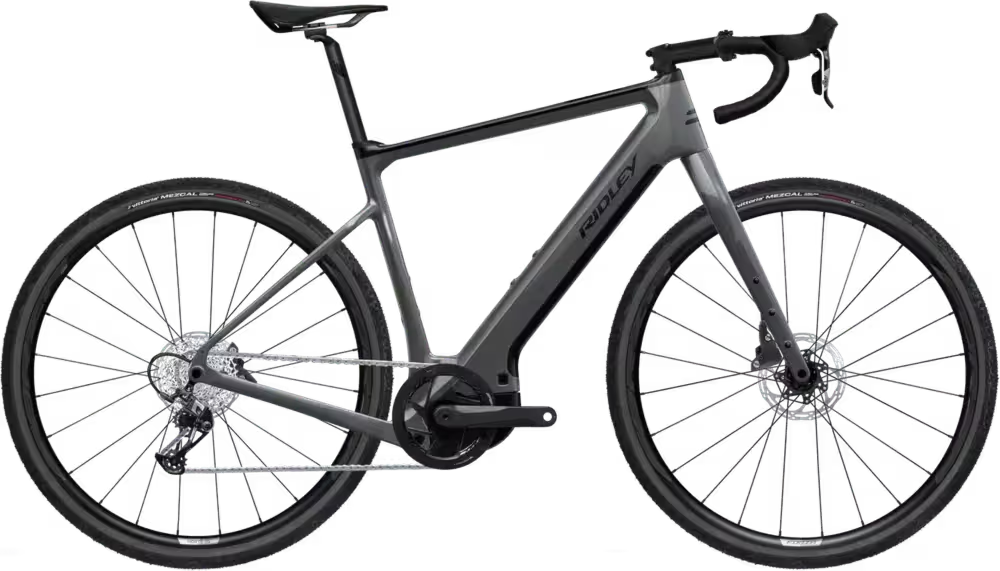
The Ridley E-Kanzo Adventure is much more aggressive than a typical road-oriented e-gravel bike. Ridley pairs its carbon adventure platform with a Bosch Performance Line CX drive unit. The current product page lists up to 100 Nm of torque and a 600 Wh integrated PowerTube battery.
The bike also accepts tires up to 2.1 in., which gives it substantially more rough-surface capability than a narrow-tire all-road bike. Ridley specifically highlights the fork mounting points for bikepacking cargo.
Cargo Limits Matter Here
Ridley publishes unusually useful cargo guidance. The fork mounting points are rated for up to 4 kg on each fork leg when using cargo cages. With a lowrider carrier, Ridley lists a 9 kg maximum total load.
The major limitation is at the rear. Ridley states that the E-Kanzo Adventure was not developed for a conventional bolt-on rear rack. The company instead suggests a saddlebag or a Tailfin-style rack system. That makes this a true bikepacking-oriented choice rather than a traditional four-pannier touring bike.
Main Tradeoffs
- No conventional bolt-on rear rack.
- U.S. dealer availability and pricing can be less straightforward than with larger domestic dealer networks.
- The more powerful Bosch system and rough-terrain setup may be more bike than a mostly paved tourist needs.
Best for: Riders using frame bags, seat packs, fork cages, and soft luggage on rough gravel roads, forest roads, and mixed off-road routes.
3. Specialized Turbo Creo 2 Comp E5 – Best Road/Gravel Touring Crossover
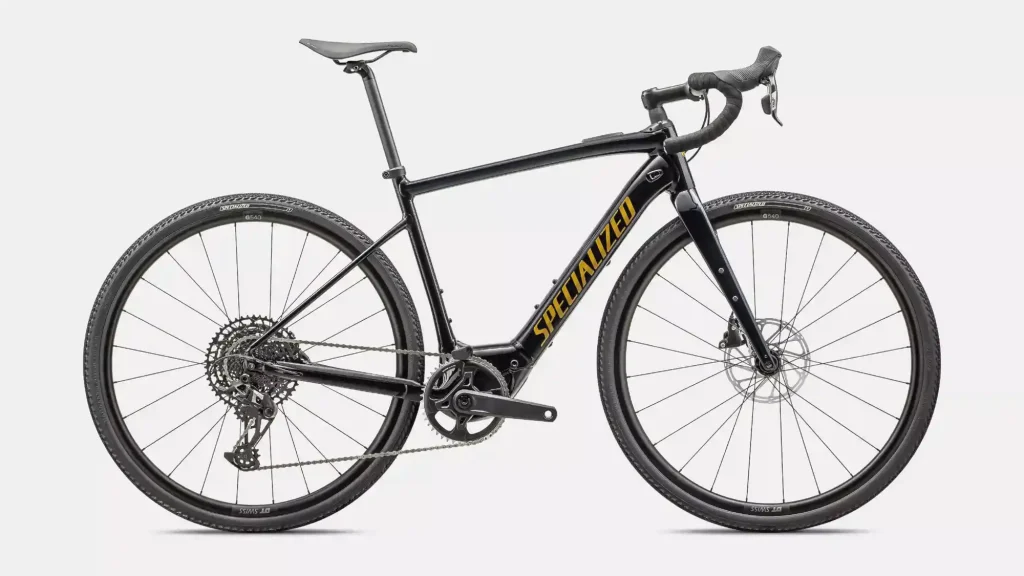
The Turbo Creo 2 Comp E5 is a strong choice for riders who spend most of their time on pavement but want enough tire clearance and stability for gravel. Specialized’s current product page lists the E5 build with its SL 1.2 motor, 50 Nm of torque, a 320 Wh integrated battery, and a listed weight of 33 lb 5.3 oz in size 56.
The aluminum frame includes fender and rack mounts, which gives this bike more traditional touring flexibility than many lightweight electric gravel bikes. Specialized also lists applicable UL 2849 and/or UL 2271 certification language for the e-system and battery on the current product page.
Charging and Range Extension
The Creo 2 uses a custom 48V Specialized charger. Specialized also offers a 160 Wh SL Range Extender for compatible systems. For multi-day travel, that extender can be more useful than carrying a much larger battery every day, but you should verify compatibility with the exact Creo 2 configuration before buying accessories.
Specialized’s pricing can vary by current SKU, size, and sale listing. The current product-detail page I verified lists the Turbo Creo 2 Comp E5 at $5,099.99, while Specialized’s broader Creo category has also shown discounted E5 listings. Confirm the exact model, color, size, and final checkout price rather than relying on an older sale figure.
Main Tradeoffs
- The 320 Wh main battery requires more charging discipline on long, mountainous days.
- It is built for efficient road and gravel travel, not heavy expedition cargo.
- A range extender adds cost and occupies bottle-cage space.
Best for: Riders who want a natural-feeling road/gravel e-bike for hotel-to-hotel touring, supported tours, fast mixed-surface rides, and lighter bikepacking.
Want to compare another version? Read my Specialized Turbo Creo 2 Comp review for a closer look at the carbon-frame model.
4. Giant Explore E+ – Best Traditional Trekking E-Bike
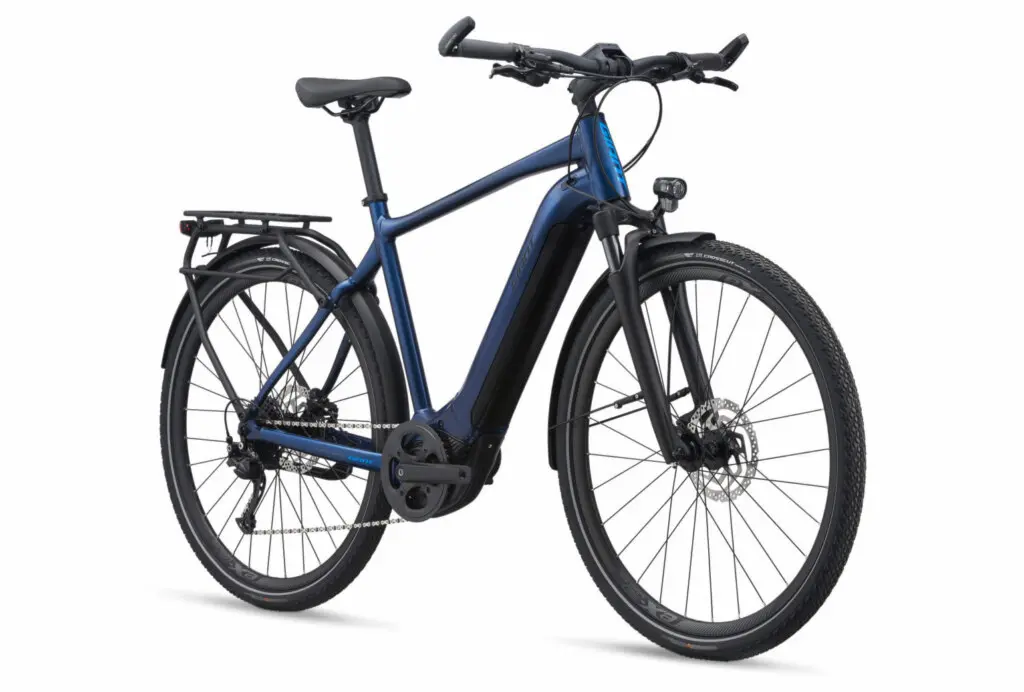
The Giant Explore E+ belongs in this guide because Giant still actively positions the current U.S. Explore E+ family for trekking, commuting, gravel, dirt, and longer adventures. It also has a large dealer network, which can matter on a tour when a proprietary electrical component needs diagnosis.
There is one important specification caveat: Giant’s current U.S. pages show Explore E+ material from more than one generation. Giant’s newer Explore E+ range page lists a SyncDrive Sport2 motor with 75 Nm of torque and a 625 Wh EnergyPak battery, with an upgrade path to 800 Wh. Another U.S. Explore page describes a 60 Nm configuration. Because of that, I would verify the exact model code and generation on the bike you are buying rather than combining family-level specifications.
Cargo and Battery Advantages
On the newer Explore E+ range page, Giant lists a MIK HD rear rack with a 27 kg maximum load, a 156 kg maximum total weight, and a trailer mount at the rear dropout. Giant also lists compatibility with a 250 Wh EnergyPak Plus range extender and describes a maximum possible battery capacity of up to 1,050 Wh when paired with the 800 Wh main battery.
Giant’s U.S. Explore information also describes fast partial charging, with the battery reaching about 80 percent in roughly 2.2 hours on the configuration discussed there. For touring, partial-charge speed can matter more than the theoretical zero-to-full time because lunch stops and short charging windows are common.
Main Tradeoffs
- Exact motor, battery, charger, and weight need to be confirmed for the specific U.S. SKU because Giant’s family pages span more than one generation.
- It is heavier and more utility-oriented than a lightweight gravel e-bike.
- The upright trekking format is less aerodynamic for riders chasing high average speeds.
Best for: Riders who want a conventional trekking setup with a real rear rack, fenders, dealer support, larger battery options, and the ability to pull a trailer.
5. Cannondale Tesoro X 2 StepThru – Best Step-Through Touring Option
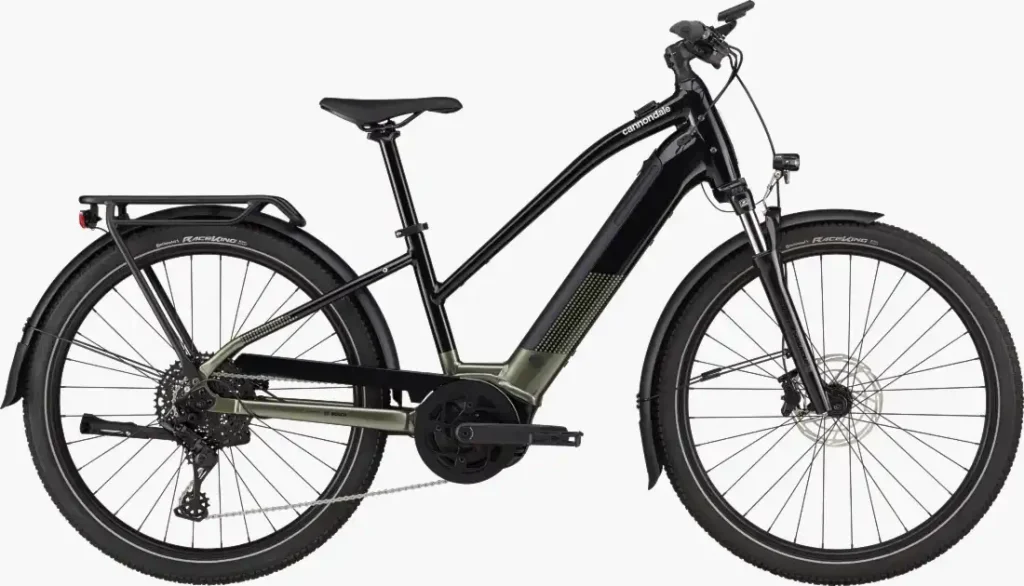
The Cannondale Tesoro X 2 StepThru is one of the more straightforward choices here for riders who want comfort, a removable battery, and a factory-equipped touring setup. Cannondale lists a Bosch Performance Line Sport drive unit with assistance up to 28 mph, a removable 625 Wh PowerTube battery, and a Bosch 4A charger.
It also comes with full-coverage fenders, integrated lights, and a Tubus rear rack rated to 25 kg. Cannondale lists UL 2849 certification for the electrical system.
Why It Works for Touring
- Step-through frame makes getting on and off easier when carrying luggage.
- 625 Wh removable battery can be charged away from the bike when practical.
- 25 kg rear-rack rating supports normal pannier touring better than many gravel bikes.
- Bosch’s 4A charger is useful when charging windows are limited.
- Cannondale and Bosch both have established dealer/service networks.
Main Tradeoffs
The Tesoro X 2 StepThru is a Class 3-style 28 mph configuration in the U.S., so it may not be allowed on every trail or shared-use path where a 20 mph Class 1 e-bike is permitted. If much of your trip uses protected trails, check the applicable rules before choosing it specifically for that route.
Best for: Riders who prioritize easy mounting, practical racks and fenders, removable-battery convenience, and paved-to-light-gravel touring.
6. Tern Orox S12 – Best Heavy Adventure and Cargo Touring Bike
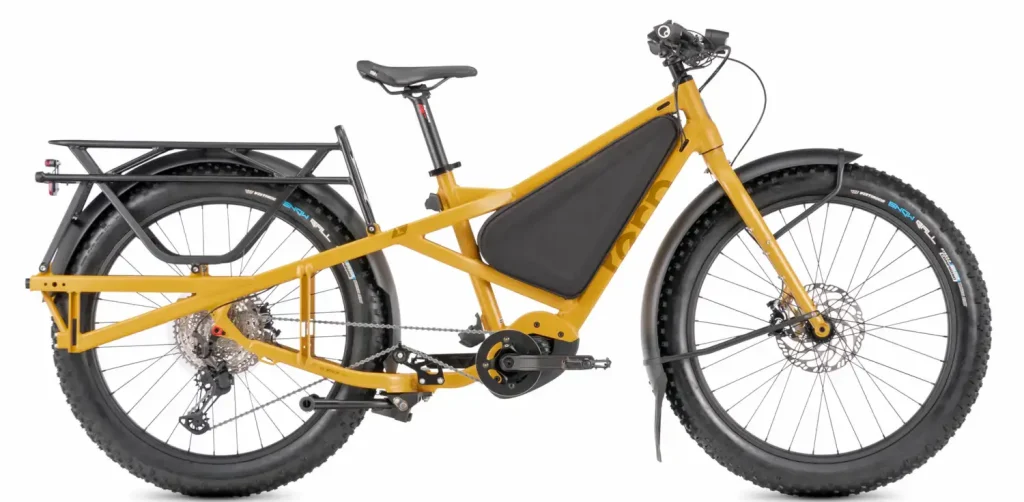
The Tern Orox S12 is in a completely different class from the lightweight gravel bikes above. It is an adventure cargo e-bike designed for difficult terrain, very heavy loads, remote travel, and riders who would rather carry more than travel light.
Tern currently lists the Orox S12 at $4,999 sale price. It uses a Bosch Performance Line CX motor with up to 85 Nm of torque, a 725 Wh battery, and a Bosch 4A charger. The bike is dual-battery ready, allowing up to 1,450 Wh with two 725 Wh batteries.
Cargo Capacity
The Atlas X rear rack is rated to 100 kg, or 220 lb. Tern lists a maximum gross vehicle weight of 210 kg, or 463 lb, on pavement and a lower off-road limit. The S12 itself weighs 81.8 lb in size M.
This is not a bike I would choose if I expected to carry it up hotel stairs or lift it onto a conventional car rack. It is, however, one of the strongest options in this guide for hauling camping equipment, food, water, cold-weather gear, or trailer cargo.
Main Tradeoffs
- Very heavy compared with conventional touring or gravel bikes.
- Large tires and cargo capability reduce efficiency compared with a lightweight drop-bar setup.
- Transporting the bike by car, train, or stairs can be difficult.
- The U.S. motor configuration assists to 20 mph rather than 28 mph.
Best for: Remote adventures, very heavy camping loads, winter travel, rough roads, and riders who value cargo capacity and dual-battery range over low bike weight.
How to Choose an E-Bike for Touring or Bikepacking
Start With the Route, Not the Motor
A 100 Nm motor can sound appealing, but route surface, trail rules, climbing, and luggage style matter more. A light 30 to 35 lb gravel e-bike may be easier to live with on a mostly paved tour, while a 70 to 80 lb adventure bike can be the better choice when carrying large amounts of food, water, or camping gear.
Calculate Watt-Hours Before You Plan Daily Mileage
Battery capacity is best compared in watt-hours. If battery terminology is confusing, my guide to e-bike battery capacity explains Ah and Wh in plain English.
Do not plan your route around a manufacturer’s maximum range claim. Use conservative assumptions, leave a reserve, and account for loaded weight, elevation, temperature, wind, road surface, and higher assist use late in the day.
Charging Speed Matters on Multi-Day Trips
A large battery is useful only if your route gives you enough time to recharge it. A 4A charger can be valuable on a lunch stop, while a slower charger may require overnight access. Before leaving, confirm the charger input voltage if you are traveling internationally and never substitute an unapproved charger.
Check the Actual Cargo Rating
Mounting bosses do not automatically mean unlimited cargo capacity. Ridley’s published fork limits are a good example. Tern publishes a very high rack rating, while Giant and Cannondale publish more conventional touring-rack limits. Stay within the limits for the rack, frame, wheels, tires, and the bike’s total gross weight.
Think About Service Before You Need It
Touring exposes weak points: brake pads wear faster under load, tires get cut, chains stretch, bolts loosen, and electrical problems can stop the assist completely. Dealer-supported systems from Bosch, Giant, Trek/TQ, Specialized, and Cannondale can offer advantages, but support still varies by town. Check dealer coverage along longer routes and ask whether shops actually service your drive system.
Check E-Bike Class and Trail Access
A 28 mph e-bike may be excellent on the road but restricted on some paths and trails. Before planning a trip around a specific bike, check my State-by-State E-Bike Law Guide and confirm the rules of the actual park, trail system, land manager, or city where you plan to ride.
Common Touring and Bikepacking Mistakes
- Planning around advertised maximum range: Build a reserve instead of assuming ideal-condition mileage.
- Ignoring charger speed: A large battery can still be inconvenient if it cannot recover enough energy during your available stops.
- Overloading fork or rack mounts: Use the manufacturer’s load limits, not visual guesswork.
- Buying a Class 3 bike for a Class 1 route: Check trail access before the purchase.
- Carrying too much: Extra cargo reduces range and changes handling and braking.
- Skipping a service plan: Know where you can get brake, tire, drivetrain, motor, and battery help along the route.
- Assuming every battery is easily removable: Hotel and campsite charging can be much easier with a removable battery.
Packing, Setup, and Charging Tips
Keep Heavy Items Low and Centered
Put dense gear such as tools, food, water, locks, and cooking equipment low and near the middle of the bike whenever possible. Balance panniers left to right and test the fully loaded bike before the trip.
Carry the Right Spares
At minimum, consider tire repair supplies, a spare tube even if you run tubeless, a pump, tire levers, a multi-tool, chain quick-link, spare rack bolts, zip ties, and brake pads appropriate for your bike. Do not attempt to open or repair a lithium-ion battery pack on the road.
Protect Your Charging Plan
Confirm charging permission at lodging or campgrounds before relying on it. Keep the charger dry, inspect cables and connectors, and avoid charging a damaged, unusually hot, swollen, wet, or impacted battery.
Touring or Bikepacking? Don’t Forget the Right Gear
A good accessory setup can make a big difference on longer rides. Before heading out, consider:
- Panniers or bikepacking bags – for clothing, food, tools, and overnight gear.
- Compact repair kit – including tire levers, patches, a multi-tool, and a chain quick-link.
- Mini pump – or a compact inflator that works with your tire valves.
- Spare tube or tubeless repair plugs – even if you normally run tubeless tires.
- Quality e-bike lock – especially for restaurant, store, campground, and overnight stops.
- Front and rear lights – useful for low light, bad weather, and unexpected late finishes.
- Phone or GPS mount – for navigation without constantly stopping to check directions.
- Portable power bank – helpful for keeping your phone, GPS, and other small electronics charged.
- Range extender or second battery – when your specific e-bike supports one and your route requires additional range.
See my Best E-Bike Accessories guide for more touring, safety, security, and comfort gear.
FAQs
What battery size is best for e-bike touring?
There is no single ideal size. A light 320 to 360 Wh gravel e-bike can work well for supported or efficient touring, while loaded trekking and adventure bikes often benefit from 600 Wh or more. Terrain, cargo, assist level, charger access, and rider effort matter as much as the number on the battery.
Is a range extender better than a larger main battery?
It depends on the trip. An extender lets you carry extra energy only when needed, but it adds cost and may use a bottle-cage position. A larger main battery is simpler but adds weight on every ride.
Are fat-tire e-bikes good for bikepacking?
They can be useful on sand, snow, loose surfaces, and very rough roads, especially when carrying heavy loads. The tradeoffs are weight, rolling resistance, transportation difficulty, and higher energy use compared with a lighter gravel setup.
Can I charge an e-bike at a campground?
Sometimes, but do not assume every outlet is available or approved for guest charging. Ask the campground, lodging provider, or host in advance and use only the correct manufacturer-approved charger.
Which of these bikes is easiest to carry upstairs?
The Trek Checkpoint+ SL 5 is the lightest of the verified weights in this group at about 30.45 lb for the listed 2026 Large. The Specialized Turbo Creo 2 Comp E5 is also relatively manageable at 33 lb 5.3 oz in size 56. The Tern Orox S12 is much harder to lift at 81.8 lb.
My Take
For most riders who want a genuine bicycle feel and plan to travel light, the Trek Checkpoint+ SL 5 is my best overall choice. It is exceptionally light for an e-bike, the TQ system provides useful assistance without dominating the ride, and the gravel platform makes sense for long mixed-surface days.
If the route is rougher and you are packing with soft luggage, the Ridley E-Kanzo Adventure is the more capable bikepacking tool. Just remember that Ridley specifically does not design it around a conventional rear rack.
For road-heavy touring, the Specialized Turbo Creo 2 Comp E5 is a strong crossover. For traditional rack-and-pannier trekking, I would look closely at the Giant Explore E+ or Cannondale Tesoro X 2 StepThru. The Giant offers especially interesting battery and cargo options, but verify the exact generation because Giant’s current U.S. family pages show more than one configuration.
If carrying capacity is the priority and low weight is not, the Tern Orox S12 is the standout. Its dual-battery capability and 220 lb rear-rack rating put it in a different category from the lightweight gravel bikes.
Before buying any of these bikes, confirm the exact current price, frame size, battery configuration, charger, cargo limits, replacement-battery availability, local dealer support, and the e-bike rules for the roads and trails you plan to use.
Disclosure: This article may contain affiliate links. If you purchase through one of these links, I may earn a commission at no extra cost to you. As an Amazon Associate, I earn from qualifying purchases. Affiliate relationships do not determine my ratings, rankings, or conclusions.
Disclosure: As an Amazon Associate, I earn from qualifying purchases. This comes at no extra cost to you and helps support the content on this site.
External Sources
- Trek Checkpoint+ current U.S. lineup
- Ridley E-Kanzo Adventure Apex XPLR official product page
- Specialized Turbo Creo 2 Comp E5 official product page
- Giant Explore E+ Series U.S. page
- Giant Explore E+ adventure overview
- Cannondale Tesoro X 2 StepThru official product page
- Tern Orox S12 official product page

Kristina is not just an enthusiast but a true authority on electric bikes. Nestled in the coastal beauty of Virginia, Kristina has found the perfect backdrop for her passion for electric biking. As a dedicated wife and homeschooling mom, her life revolves around family, faith, and the thrill of adventure.
Originally hailing from Ohio, Kristina's journey with electric bikes began as a curiosity and quickly evolved into a deep expertise. Her blog is a testament to her love for electric biking, combining her fascination for eco-friendly transportation with her coastal lifestyle.
When she's not cruising the beach on her electric bike, you'll find Kristina indulging in her other loves: long walks along the shore, getting lost in a good book, and cherishing moments with her loved ones. With a heart as big as her love for animals, especially cats, Kristina brings a unique perspective to the electric bike world, grounded in her strong faith in God and her dedication to a sustainable lifestyle.
Through her blog, Kristina shares her extensive knowledge of electric bikes, offering valuable insights, tips, and recommendations to fellow enthusiasts. Whether you're a seasoned rider or a newcomer to the electric bike scene, Kristina's blog is your go-to source for all things electric biking, fueled by her passion, expertise, and the scenic beauty of coastal Virginia.