Why Is My E-Bike Battery Rattling? Causes, Fixes, and When to Stop Riding
Last Updated on September 18, 2026 by Kristina
A removable e-bike battery should normally sit securely in its mount while you ride. A tiny amount of movement can vary by battery and frame design, but noticeable rattling, clicking, rocking, or shifting deserves a closer look – especially if the noise is new or getting worse.
The cause may be as simple as a battery that is not fully seated or accessible mounting hardware that has loosened. It can also come from wear in the latch, rails, cradle, retention pieces, alignment, or the battery housing itself.
If you are not sure the sound is actually coming from the battery, my e-bike clicking-noise troubleshooting guide can help you rule out pedals, spokes, racks, fenders, drivetrain parts, and other common sources. You can also start with the E-Bike Troubleshooting and Maintenance Guide if the bike has other symptoms.
Quick Answer: Why Is My E-Bike Battery Rattling?
An e-bike battery can rattle because it is not fully seated, the battery-mount hardware has loosened, the locking latch has developed play, the battery or rail is misaligned, a manufacturer-installed pad or retention part is worn or missing, the battery cradle is loose, or the mounting surfaces have worn with use.
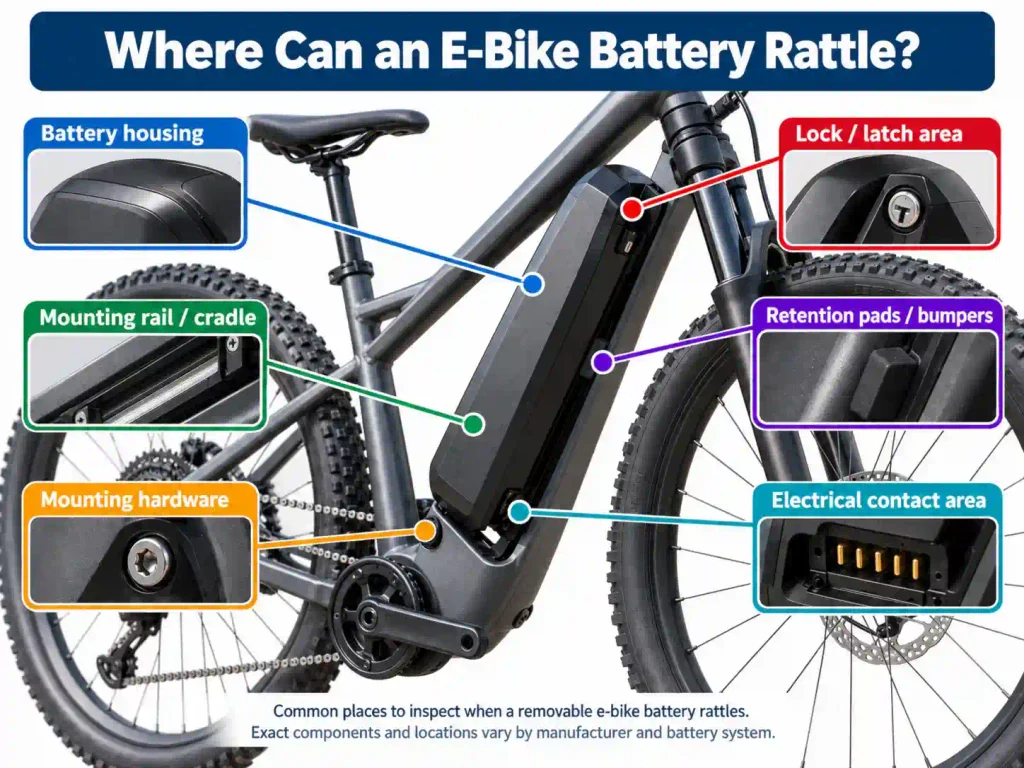
Start with the bike powered off. Confirm that the battery is installed in the correct position and fully locked. Then inspect the mount, rails, latch, accessible hardware, battery housing, and electrical contact area for movement, wear, cracking, melted plastic, bent contacts, or other damage.
Do not add homemade foam, tape, wedges, glue, bent metal, or other improvised shims unless the bike or battery manufacturer specifically approves that repair for your model.
Safety First
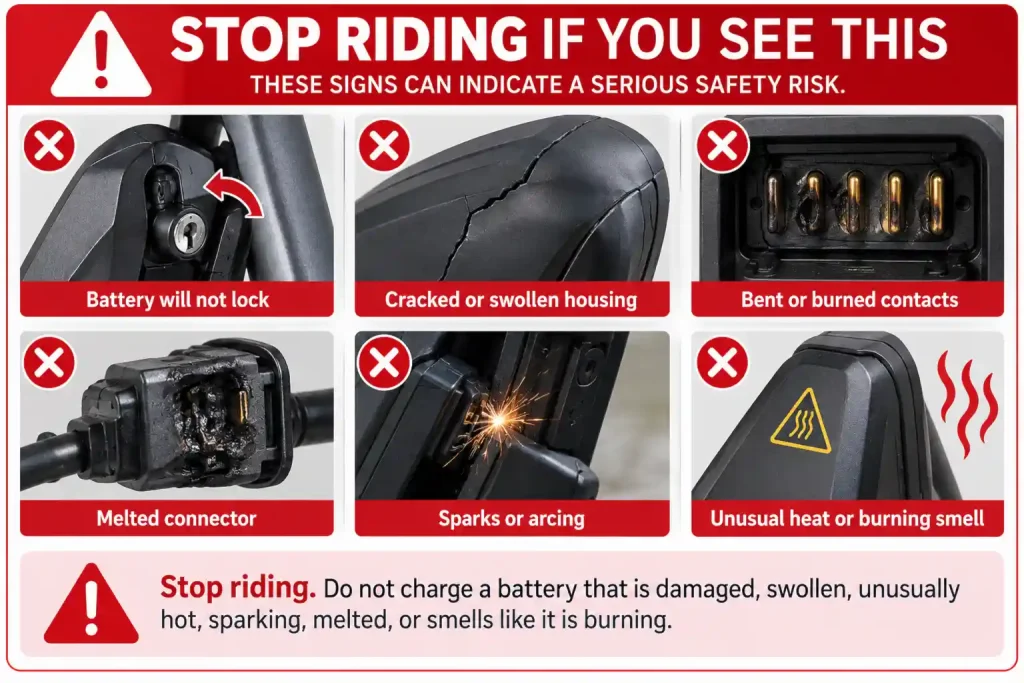
Stop riding and do not continue charging the battery if you find swelling, unusual heat, smoke, leaking, sparking, arcing, melted plastic, a burning or strong chemical smell, badly damaged electrical contacts, serious impact damage, or a cracked battery housing. Do not open, drill, rebuild, or modify a lithium-ion battery pack.
🔧 How This Guide Was Researched
This guide is based on manufacturer battery and mounting instructions, established lithium-ion battery safety guidance, component service documentation, and practical troubleshooting principles. I separate ordinary owner checks from repairs or adjustments that require model-specific instructions or professional service.
You can learn more about the standards used across the site in Electric Bike Explorer’s research, review, and editorial process.
E-Bike Battery Rattle Symptoms at a Glance
| What you notice | Possible cause | First safe check |
|---|---|---|
| Battery rocks side to side | Play in a rail, guide, pad, latch, or retention part | Confirm seating and inspect visible retention areas |
| Whole mount moves with the battery | Loose cradle, rail, or mounting hardware | Check whether the mount moves relative to the frame |
| Battery clicks when gently pushed | Latch, lock, or retention play | Confirm the battery fully engages and locks |
| Rattle mainly happens over bumps | Mount play, worn retention parts, or a nearby loose component | Check the battery, rack, fender, lock, cables, and accessories while stationary |
| Display cuts out when the battery moves | Possible intermittent electrical contact | Stop riding and inspect the mount and visible contact area for damage |
| Battery will not sit flush | Debris, misalignment, damage, incorrect installation, or incompatible battery | Remove and inspect it – do not force it |
| Battery unexpectedly unlatches | Failed, damaged, or improperly engaged retention system | Stop riding |
5-Minute Battery Rattle Check
- Power the bike off and disconnect the charger.
- Confirm the battery is fully seated. Reinstall it according to the owner’s manual if needed.
- Confirm the lock or retention mechanism engages. Do not ride with an unlocked battery.
- Gently test for movement while the bike is stationary. Do not use excessive force.
- Watch what moves. Determine whether the battery moves inside the mount or the whole cradle or rail moves on the frame.
- Inspect visible rails, latch areas, housing, contacts, pads, bumpers, and accessible hardware.
- Stop if you find substantial movement, structural damage, sparking, melting, swelling, unusual heat, or a battery that will not lock securely.
Is It Normal for an E-Bike Battery to Rattle?
There is no universal amount of acceptable battery movement for every e-bike. Battery fit and allowable play depend on the manufacturer and mounting design.
That does not mean a noticeable rattle should automatically be considered normal. Some manufacturers specifically include battery-security or anti-rattle checks in their installation and inspection procedures. If the movement is new, increasing, visible over bumps, affecting the lock, or accompanied by electrical symptoms, it deserves inspection.
I would pay particular attention when:
- The noise is new.
- The battery moves more than it used to.
- The rattle is getting worse.
- The battery shifts visibly over bumps.
- The lock no longer feels positive.
- You can reproduce the noise by gently moving the installed battery.
- The bike also flickers, resets, cuts power, or shows changing battery readings.
If your bike manufacturer specifies how the battery should be retained or checked, follow that guidance rather than applying a rule from a different battery system.
Battery Mount Design Matters
External downtube batteries, semi-integrated and fully integrated batteries, rear-rack batteries, and batteries used on folding e-bikes can use very different rails, latches, cradles, locks, bumpers, alignment pieces, and electrical interfaces.
That is why a fix shown for another e-bike online may not apply to yours. A spacer, latch adjustment, rail position, or bumper that is correct for one system could interfere with retention or electrical contact on another. Use the service instructions and replacement parts intended for your specific bike and battery system.
Common Reasons an E-Bike Battery Rattles
1. The Battery Is Not Fully Seated
This is the first thing I would check.
A removable battery can sometimes look installed even though it has not completely engaged with its rail, cradle, lower stop, upper latch, or secondary retention mechanism. Dirt or an awkward installation angle can also prevent it from reaching its intended position.
Turn the bike off and reinstall the battery according to the owner’s manual. Make sure it reaches its normal seated position and that the lock or retention mechanism fully engages. Never force a battery that does not slide or drop into place normally.
2. Loose Battery-Mount or Rail Hardware
The battery may be secure relative to its rail while the rail or mounting plate itself is moving against the frame.
Road vibration, rough trails, transport, repeated battery removal, or previous service can reveal hardware that is no longer properly secured.
Inspect only fasteners that are intended to be owner-accessible. If the manufacturer publishes a torque specification, use that specification and the correct tool. Do not guess at torque, especially on plastic mounting components, threaded inserts, or integrated battery hardware.
3. Play in the Locking Latch or Retention Mechanism
The lock does more than discourage theft on many removable battery systems. It may also form part of the mechanism that holds the battery in its riding position.
A worn latch, worn catch, loose lock assembly, damaged spring, deformed retention part, or incorrect adjustment can allow the battery to move.
Some systems provide a manufacturer-designed adjustment procedure. Others require a replacement component or dealer service. Do not bend the latch, file parts, force the lock cylinder, or improvise an adjustment without model-specific instructions.
4. Battery or Mount Misalignment
An upper and lower battery mount must line up correctly for the battery to fit as designed.
Misalignment can develop after frame service, component replacement, a crash, shipping damage, improperly installed mount hardware, or previous adjustment.
Some integrated battery systems use alignment pieces and model-specific hardware during installation. That is a good reason not to loosen multiple battery-mount components and start moving them around unless your manufacturer’s procedure specifically tells you to do so.
5. Worn Rails, Guides, Pads, Bushings, or Retention Pieces
Battery mounts are not all built the same. Depending on the bike, the assembly may contain rails, guides, rubber retention pieces, bumpers, mounting plugs, bushings, stops, or other replaceable parts that keep the battery aligned and limit unwanted movement.
These parts can wear, compress, loosen, tear, or go missing over time.
Use the manufacturer-specified replacement part where available. Some battery systems intentionally use factory pads, bumpers, or rubber retention pieces, so cushioning itself is not necessarily wrong. The problem is substituting an improvised material, thickness, or placement that the manufacturer did not approve.
6. A Loose Battery Cradle or Mounting Plate
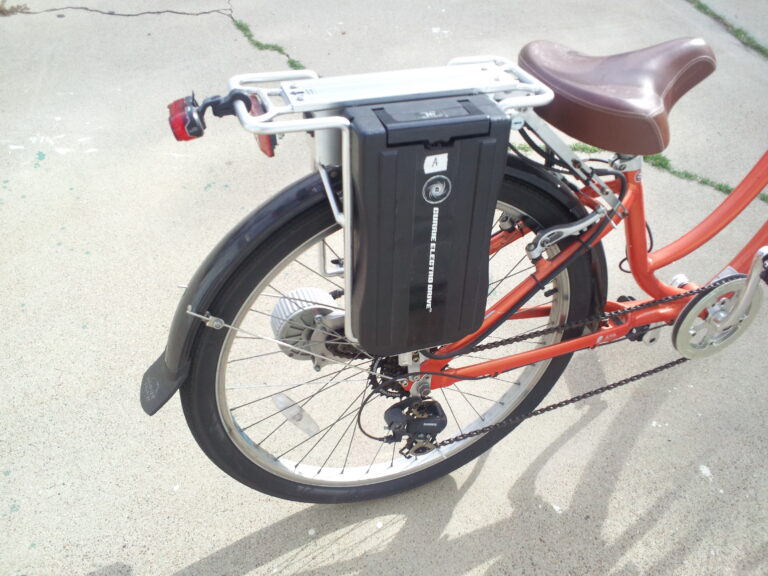
Rear-rack batteries and some externally mounted downtube batteries sit in a separate cradle or base plate.
If the whole cradle moves when you gently move the battery, the problem may be between the cradle and bike rather than between the battery and cradle.
Check the appropriate mounting hardware according to the bike manufacturer’s instructions.
7. Battery Housing Damage
A cracked battery shell, broken mounting feature, damaged end cap, or distorted housing can prevent the battery from fitting the mount correctly.
This is different from an ordinary loose bolt. The battery enclosure is part of a lithium-ion battery assembly and should not be drilled, glued, opened, bent, or rebuilt at home.
If the housing itself is damaged, stop using the battery and contact the manufacturer or a qualified service provider.
8. Connector Movement or Poor Seating
The mechanical mount and electrical connection are often closely related. If excessive battery movement allows the electrical contacts to move relative to one another, intermittent electrical symptoms can sometimes occur.
Inspect the visible contact area with the bike powered off. Look for dirt, obvious corrosion, bent contacts, darkened areas, melted plastic, cracking, or anything that appears overheated.
Do not probe battery terminals with metal objects or attempt to bend electrical contacts back into place unless the manufacturer specifically identifies that as an approved service procedure.
9. Wear From Repeated Vibration
Repeated riding over potholes, gravel, rough trails, washboard roads, or other high-vibration surfaces can reveal or contribute to looseness and wear in a mounting system. Transporting an e-bike regularly on a vehicle rack can also expose the bike to vibration.
If you ride in rough conditions, include the battery mount in your routine inspection rather than waiting for a small change in fit to become a larger problem.
10. The Wrong or Incompatible Battery
A replacement battery that looks similar is not automatically compatible with your bike.
Battery voltage, communication electronics, connector design, mounting geometry, retention hardware, charger compatibility, and system requirements can all matter.
Use the correct battery specified or approved for your bike. The U.S. Consumer Product Safety Commission also advises consumers to use replacement battery packs that have been tested and approved to work safely with the device and confirmed as suitable by the device manufacturer.
How to Find Where the Rattle Is Coming From
- Turn the bike completely off. Disconnect the charger. Remove the key if your manufacturer’s instructions call for it.
- Check whether the battery is fully seated. Compare its position with the owner’s manual or with how it normally sits in the bike.
- Confirm the battery is locked. A battery that does not securely enter its riding position should not be ridden.
- Gently check for movement. With the bike stationary and supported, use your hand to determine whether the battery rocks in the mount. Do not use excessive force.
- Determine what is actually moving. Watch whether the battery moves inside the mount, the mount moves on the frame, or another component is making the noise.
- Inspect the rails and retention areas. Look for shiny wear marks, scuffed plastic, damaged guides, cracked rails, missing pads, damaged bumpers, or loose hardware.
- Inspect the battery housing and contact area. Look for cracking, deformation, damage, bent contacts, melting, discoloration, or signs of overheating.
- Rule out nearby parts. Check the rear rack, fenders, kickstand, lock, bottle cage, cables, frame covers, folding latch, and accessories. A nearby loose component can sound surprisingly similar to a battery rattle.
If electrical problems are also present, use my step-by-step guide to finding loose electrical connections on an e-bike.
Safe Fixes for a Loose or Rattling E-Bike Battery
Reseat the Battery Correctly
Remove and reinstall the battery using the procedure in your owner’s manual. Make sure dirt, grit, or an incorrectly positioned cover is not preventing full engagement.
If the battery needs excessive force to install, stop. Forcing it can damage the latch, rails, housing, or electrical contacts.
Tighten Owner-Accessible Mounting Hardware to the Correct Specification
If you find loose accessible hardware and your manufacturer provides a torque specification, tighten it to that specification with the correct tool.
Do not assume every bolt on an e-bike should simply be made as tight as possible. Over-tightening can damage plastic parts, threads, inserts, brackets, or the frame, while under-tightening can allow the assembly to move.
Replace Approved Worn Retention Parts
If an original bumper, pad, rubber retention piece, guide, or mounting plug is damaged or missing, replace it with the correct manufacturer-approved part when available.
This is different from stuffing generic material around the battery until the noise stops.
Use a Manufacturer-Approved Latch Adjustment
If your manufacturer publishes an adjustment procedure for the latch, battery bracket, lock, or cradle, follow that procedure exactly.
If the procedure requires proprietary alignment tools, removal of integrated components, electrical work, or disassembly beyond normal owner maintenance, I would have a qualified shop perform it.
Replace Damaged Rails, Locks, Cradles, or Mounts
A visibly cracked rail, damaged lock assembly, deformed latch, broken cradle, or badly worn mounting component usually needs replacement rather than an improvised repair.
Contact the bike manufacturer, drive-system manufacturer, authorized dealer, or qualified e-bike shop for the correct part.
🔧 Helpful Tools for Checking a Rattling E-Bike Battery
You usually do not need specialized electrical equipment to investigate a battery rattle. A few basic tools can make the external inspection easier and help you work more carefully.
1/4-Inch Bicycle Torque Wrench, 2-20 Nm
Useful for tightening accessible battery-mount, rail, or cradle fasteners to the bike manufacturer’s specified torque. Choose a calibrated model with common hex and Torx-compatible bits, and never guess at the torque setting.
Park Tool SBS-1.3 Socket and Bit Set
Includes common bicycle hex and Torx-compatible bits for manufacturer-approved battery-mount hardware.
Bright Inspection Flashlight
Helps you inspect rails, latch areas, mounting hardware, wear marks, and visible battery contacts without probing the electrical connection.
Important: These tools are for external inspection and manufacturer-approved maintenance. Do not open the battery pack, probe battery terminals with metal tools, bend electrical contacts, or loosen mounting components unless your bike’s service instructions support the procedure.
Before You Modify Anything, Check Manufacturer Support
If the battery or mount is still under warranty – or the looseness appeared unexpectedly – check the manufacturer’s current manual, support page, recalls, safety notices, and service information before changing the mount.
There may be a model-specific inspection, adjustment procedure, updated component, replacement latch, rail, bumper, bracket, or dealer repair. Do not alter the mount first and investigate later.
What Not to Do
- Do not ride with a battery that is not locked into its riding position.
- Do not force a battery into or out of its mount.
- Do not drill the battery enclosure or mounting features.
- Do not open or rebuild a lithium-ion battery pack.
- Do not bend battery contacts or latch parts without an approved service procedure.
- Do not pack foam, tape, cardboard, rubber, glue, or other improvised material around the battery where it can interfere with contacts, drainage, cooling, removal, or the locking mechanism.
- Do not continue riding if the battery is shifting substantially or threatening to unlatch.
- Do not ignore melted connectors, arcing, sparks, burning smells, swelling, unusual heat, discoloration, or cracking.
- Do not substitute a battery simply because its voltage or outside dimensions appear similar.
When to Stop Riding
Stop riding and have the system inspected if you notice any of the following:
- The battery unexpectedly unlatches.
- The battery shifts significantly while riding.
- The battery will not securely lock into place.
- The battery housing is cracked, distorted, swollen, or otherwise seriously damaged.
- A battery rail, bracket, cradle, latch, or retention component is cracked or broken.
- Electrical contacts are bent, loose, badly corroded, burned, or damaged.
- You see sparking or arcing.
- A connector or surrounding plastic looks melted.
- You smell burning or a strong unusual chemical odor.
- The battery becomes unusually hot.
- You see discoloration that suggests overheating.
- The bike begins losing power when the battery moves.
If there is smoke, fire, severe overheating, or another immediate battery emergency, move away from the hazard and contact emergency services when appropriate.
When to Contact the Manufacturer or an E-Bike Shop
Contact the manufacturer, dealer, or a qualified e-bike technician when the fix involves more than straightforward owner maintenance.
Professional or manufacturer support is especially appropriate when:
- The latch or lock mechanism needs adjustment or replacement.
- The battery mount requires alignment.
- A rail, cradle, bracket, or docking assembly is damaged.
- An OEM bumper, spacer, retention rubber, guide, or mounting plug is missing.
- The lock cylinder or ejector mechanism is damaged.
- The electrical connector has shifted or appears damaged.
- You do not have the correct torque specifications.
- The battery itself is cracked or damaged.
- The battery or mount is still under warranty.
- The correct repair requires special manufacturer tools or service instructions.
For broader battery symptoms, the E-Bike Battery Guide covers charging, care, range, lifespan, safety, and related troubleshooting.
Can a Loose Battery Cause an E-Bike to Cut Out?
It can – but rattling by itself does not prove that your electrical connection is failing.
If the battery moves enough for its electrical connection to become intermittent, the bike may briefly lose power. Possible symptoms include a flickering display, motor assistance cutting out, changing battery readings, an error code, or the entire bike switching off.
A useful clue is whether the electrical symptom happens over bumps or at the same time the battery physically moves. However, cutouts can also come from battery voltage sag, wiring, the controller, sensors, overheating, the battery management system, or another problem.
If sudden power loss is the main symptom, follow my guide to an e-bike that cuts out while riding rather than assuming the rattle is the whole problem.
If the battery only seems to power the bike when it is pressed or held in a certain position, see E-Bike Battery Charges but Has No Power. If your battery display also jumps up and down, see why an e-bike battery percentage can fluctuate while riding.
How to Prevent Battery Mount Rattles
- Install the battery carefully and make sure it reaches its fully seated position every time.
- Lock the battery according to the manufacturer’s instructions before riding.
- Keep the battery rails, mount, and contact area clean and free from grit.
- Periodically inspect owner-accessible battery-mount hardware.
- Follow the manufacturer’s torque specifications rather than guessing.
- Inspect the battery mount after rough trail riding, pothole impacts, a crash, or long-distance vehicle transport.
- Do not force a battery that has become difficult to install.
- Look for wear marks, loose pieces, damaged bumpers, or changes in fit during routine maintenance.
My e-bike maintenance checklist can help you work battery-security, fastener, wiring, brake, and other safety checks into a regular routine.
FAQs About a Rattling E-Bike Battery
Is it normal for an e-bike battery to move slightly?
Allowable fit and play depend on the battery system, so there is no universal amount that applies to every e-bike. Do not assume noticeable rattling is normal. If movement is new, increasing, visible over bumps, or affecting the lock or electrical connection, inspect it and follow the manufacturer’s guidance.
Can a loose e-bike battery damage the connector?
Potentially. Repeated movement between the battery and its mount can increase mechanical wear. If that movement also affects the electrical contact area, inspect for discoloration, deformation, burning, melting, or other damage. Stop riding if you find serious contact damage.
Can a rattling battery make my e-bike shut off?
It can if movement causes an intermittent electrical connection, but a rattle alone does not prove that is what is happening. Power loss can have several electrical and battery-related causes.
Can I put foam or tape around an e-bike battery to stop rattling?
Do not add improvised foam, tape, glue, wedges, or other material unless the manufacturer specifically approves the method and location for your battery system. Some mounts intentionally use purpose-designed factory bumpers, pads, or rubber retention pieces. Replace those with the correct parts rather than guessing at material, thickness, or placement.
Why does my e-bike battery only rattle over bumps?
Impacts can expose play that is difficult to notice on smooth pavement. The movement could come from the battery in its rail, a latch, mounting plate, worn retention part, or even a nearby rack, fender, lock, cable, or accessory. Check the bike while stationary instead of repeatedly riding over bumps to reproduce the problem.
Should I ride if my e-bike battery will not lock securely?
No. A removable battery that is designed to lock into its riding position should be securely retained before you ride. If it will not lock, determine why or have the bike inspected.
Can an e-bike battery mount wear out?
Yes. Rails, guides, locks, bumpers, retention pieces, mounting plugs, hardware, and related components can wear or become damaged. The repair depends on the battery system, so use the manufacturer’s specified replacement parts and procedures.
Disclosure: As an Amazon Associate, I earn from qualifying purchases. This comes at no extra cost to you and helps support the content on this site.
Related E-Bike Troubleshooting Resources
- E-Bike Troubleshooting and Maintenance Guide
- E-Bike Battery Health and Lifespan Checker
- How to Find Loose Electrical Connections on an E-Bike
- E-Bike Cuts Out While Riding
Sources and Safety References
- Shimano Lithium-Ion Battery User’s Manual
- Trek 2023 Carbon Rail Service Manual – RIB Battery and Docking Assembly
- U.S. Consumer Product Safety Commission Micromobility Safety Information

Kristina is not just an enthusiast but a true authority on electric bikes. Nestled in the coastal beauty of Virginia, Kristina has found the perfect backdrop for her passion for electric biking. As a dedicated wife and homeschooling mom, her life revolves around family, faith, and the thrill of adventure.
Originally hailing from Ohio, Kristina's journey with electric bikes began as a curiosity and quickly evolved into a deep expertise. Her blog is a testament to her love for electric biking, combining her fascination for eco-friendly transportation with her coastal lifestyle.
When she's not cruising the beach on her electric bike, you'll find Kristina indulging in her other loves: long walks along the shore, getting lost in a good book, and cherishing moments with her loved ones. With a heart as big as her love for animals, especially cats, Kristina brings a unique perspective to the electric bike world, grounded in her strong faith in God and her dedication to a sustainable lifestyle.
Through her blog, Kristina shares her extensive knowledge of electric bikes, offering valuable insights, tips, and recommendations to fellow enthusiasts. Whether you're a seasoned rider or a newcomer to the electric bike scene, Kristina's blog is your go-to source for all things electric biking, fueled by her passion, expertise, and the scenic beauty of coastal Virginia.