How Long Does It Take to Charge an E-Bike? Real Daily Use Guide
Last Updated on June 8, 2026 by Kristina
If you’re planning to ride an e-bike every day, one of the most common questions is how long charging actually takes – and whether it will fit into your routine.
Before we break it down, it helps to understand how e-bike batteries, range, and charging all work together. If you’re unsure what battery you actually need, start here: How to choose the right e-bike battery for your riding needs
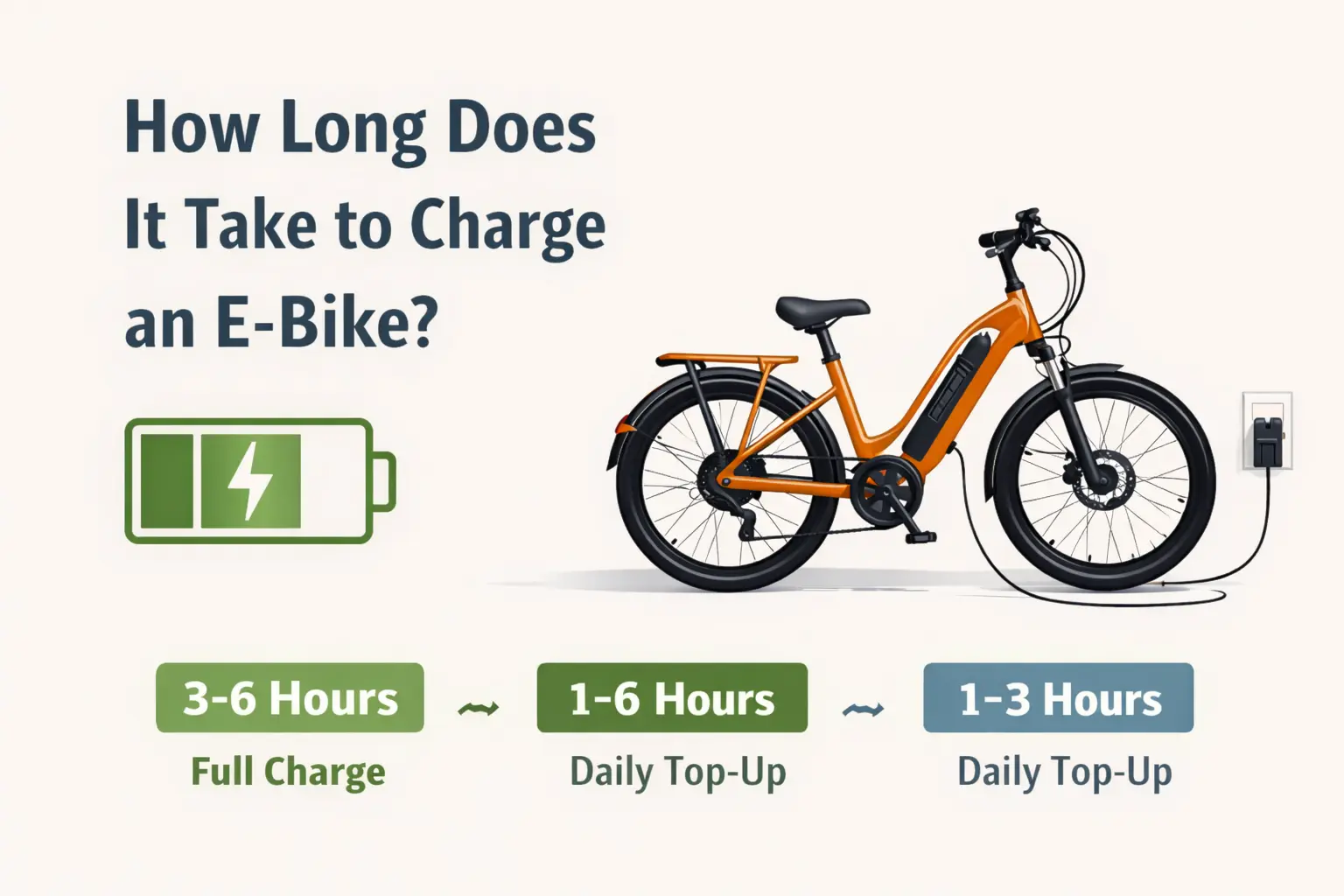
Most e-bikes take between 3 to 6 hours to fully charge, but for daily use, many riders only need 1 to 3 hours of top-up charging.
You can also estimate your real-world distance using this: Use the E-Bike Range Calculator
Short answer:
Most e-bikes take 3 to 6 hours to fully charge, depending on battery size and charger type. For daily use, many riders only need 1 to 3 hours of top-up charging.
What Actually Determines Charging Time?
Charging time depends on three core factors working together:
1. Battery Size (Watt-Hours)
- 300–400Wh → ~2 to 4 hours
- 500–700Wh → ~3 to 6 hours
- 750Wh+ → ~5 to 7+ hours
Bigger battery = longer charge time, but fewer charging sessions overall
📖 Read Next
How to Choose the Best eBike Battery for Your Commute (With Top Picks)
Understanding E-Bike Battery Capacity: Amp Hours (Ah) Explained
5 Signs It’s Time to Replace Your E-Bike Battery
The Ultimate Guide to Electric Bike Chargers: Types, Features, and Recommendations
Why Your E-Bike Battery Loses Charge Overnight — and How to Fix It
How Long Do E-Bike Batteries Last?
E-Bike Battery Charging Mistakes
E-Bike Battery Health Checker
2. Charger Output (Amps)
- 2A charger → slower, battery-friendly
- 3A charger → standard
- 4A–5A charger → faster charging
A higher amp charger reduces charge time, but should always match manufacturer specs.
3. How Much Battery You Used
For daily riders, this is the biggest factor.
- Light ride → quick top-up
- Long ride → longer recharge
Try this charging time calculator:
Use the tool below to estimate how long your e-bike battery will take to recharge based on battery size, charger amps, and how much battery you used.
E-Bike Charging Time Calculator
Estimate how long it will take to charge your e-bike battery based on your setup and daily usage, then see what battery size may fit your riding best.
This tool provides general estimates only and is not a substitute for manufacturer guidelines. Charging times and battery needs can vary based on real-world conditions. Always use manufacturer-approved chargers and follow safe charging practices. Improper charging or low-quality batteries can increase the risk of battery damage or fire.
A Simple Way to Estimate Your Charging Time
If you want a rough estimate, you can use this:
Charging Time (hours) = Battery Wh ÷ (Charger Voltage × Amps)
Example:
- 500Wh battery
- 48V 2A charger
≈ 4 to 5 hours
For a more accurate estimate based on your riding style: Use the E-Bike Battery Size Calculator
Real-World Charging Times for Daily Use
Here’s what most riders actually experience:
| Daily Ride Distance | Battery Used | Recharge Time |
|---|---|---|
| 5–10 miles | 20–30% | 1–2 hours |
| 10–20 miles | 30–50% | 1.5–3 hours |
| 20–40 miles | 50–80% | 3–5 hours |
Most commuters don’t need full overnight charging every day.
🎬 Watch: How E-Bike Charging Works in Real Life
If you prefer a quick visual breakdown, this video explains how long e-bike batteries take to charge, what affects charging time, and what to expect for daily use.
Best Charging Routine for Daily Riders
After Each Ride (Best Practice)
- Plug in when you get home
- Charge to ~80%–90%
- Takes about 1–3 hours
Overnight Charging (When Needed)
- Fine occasionally
- Not necessary every day
Avoid This:
- Running battery to 0% regularly
- Leaving at 100% for long periods
If you’re unsure how usage affects battery health: Read How long e-bike batteries actually last
How to Charge Faster (Safely)
If charging time feels too long, there are a few safe ways to speed things up – but it’s important to balance speed with battery health.
The goal isn’t just faster charging, it’s faster charging without shortening your battery’s lifespan.
Use a Higher Amp Charger (If Approved by the Manufacturer)
One of the easiest ways to reduce charging time is using a higher amp charger.
- 2A charger → slower, gentler charging
- 3A charger → standard
- 4A–5A charger → faster charging (if supported)
A higher amp charger can reduce charging time by 30% to 50%, especially on mid-size batteries.
However, always make sure:
- The charger is compatible with your battery system
- It’s from the manufacturer or a trusted source
- Voltage matches your battery (36V, 48V, 52V, etc.)
⚠️ Using the wrong charger can damage your battery or create safety risks.
Charge Indoors at Moderate Temperatures
Temperature has a bigger impact on charging than most riders realize.
- Cold environments → slower charging and reduced efficiency
- Hot environments → increased battery wear and potential safety risks
For best results:
- Charge indoors when possible
- Ideal temperature range: 50°F to 77°F (10°C to 25°C)
- Avoid garages or sheds that get very hot or cold
Charging in stable conditions helps your battery charge faster and more efficiently.
Let the Battery Cool Before Charging After a Ride
After a long ride, especially in warm weather or with high assist levels, your battery may be warm.
Plugging it in immediately can:
- Slow down charging efficiency
- Increase long-term battery wear
Instead:
- Wait about 20 to 30 minutes before charging
- Let the battery return to normal temperature
This small habit can improve both charging speed and battery lifespan over time.
Avoid Charging to 100% Every Time
Charging to 100% takes longer than stopping at 80–90%.
That’s because:
- The final portion of charging slows down (called “taper charging”)
- The battery protects itself as it nears full capacity
For daily use:
- Charge to 80–90% for faster turnaround
- Only go to 100% when you need maximum range
This reduces both charging time and long-term battery wear.
Keep Your Charging Setup Clean and Efficient
Small details can affect charging performance more than expected:
- Use a clean, undamaged charging port
- Avoid extension cords when possible
- Plug directly into a wall outlet
- Keep connectors dry and free of debris
A stable connection ensures your charger delivers full power efficiently.
Key Takeaway
Faster charging isn’t just about speed – it’s about smart charging habits.
The best approach is:
- Use the right charger
- Charge in the right conditions
- Avoid unnecessary full charges
That way, you’re not just saving time – you’re protecting your battery investment.
Fast Charging vs Battery Lifespan (What You Should Know)
Many riders assume faster charging is always better – but there’s a tradeoff between charging speed and long-term battery health.
The key is understanding when fast charging helps and when it can slowly wear your battery down over time.
⚡ Fast Charging (Higher Amp Chargers)
Pros:
- Reduces charging time by 30% to 50%
- Great for daily riders with limited time
- Useful for quick top-ups between rides
Cons:
- Generates more heat during charging
- Can slightly increase long-term battery wear
- Not all batteries are designed for high amp charging
Slower Charging (Standard Chargers)
Pros:
- Lower heat = better for battery longevity
- More stable charging cycle
- Ideal for overnight or routine charging
Cons:
- Longer charging times
- Less convenient if you need quick turnaround
Side-by-Side Comparison
| Feature | Fast Charging (4A–5A) | Standard Charging (2A–3A) |
|---|---|---|
| Charging Speed | Faster | Moderate |
| Heat Generation | Higher | Lower |
| Battery Wear Over Time | Slightly higher | Lower |
| Best Use Case | Quick daily top-ups | Regular charging routine |
| Long-Term Battery Health | Moderate | Best |
What Most Riders Should Do
For daily use, the best approach is a hybrid strategy:
- Use standard charging for most days
- Use fast charging occasionally when you need it
This gives you:
✔ Convenience when needed
✔ Better long-term battery health
✔ More flexibility in your routine
When Fast Charging Makes Sense
Fast charging is helpful if:
- You ride multiple times per day
- You need a quick turnaround between rides
- You commute and need a fast recharge at work or home
When to Stick With Standard Charging
Standard charging is better if:
- You charge overnight
- You want to maximize battery lifespan
- You don’t need immediate turnaround
Battery Safety (Important for Daily Riders)
Charging safety is often overlooked but critical.
- Always use the original charger
- Avoid charging near flammable materials
- Don’t charge damaged batteries
According to the U.S. Consumer Product Safety Commission, improper charging and low-quality batteries are a leading cause of e-bike battery fires.
For safety certification standards, see UL Solutions guidelines on UL 2849 systems.
Daily Charging vs Range Planning
Charging only feels inconvenient when your battery doesn’t match your riding habits.
For most riders, charging time isn’t the real issue – it’s range planning.
If your battery is properly matched to your daily distance, charging becomes simple:
- You ride
- You plug in
- You’re ready again in a couple of hours
But when your battery is too small for your routine, everything feels harder:
- You’re constantly checking battery levels
- You feel like you need to charge after every ride
- Charging time starts to feel like a limitation
When Charging Feels Like a Problem (But Isn’t)
If you’re experiencing any of these, it’s usually a range mismatch:
- You’re dropping below 20% on most rides
- You need to fully recharge every single day
- You feel range anxiety even on short trips
- You’re avoiding longer rides to “save battery”
In these cases, the real issue isn’t how fast your bike charges – it’s that your battery is being pushed too close to its limits.
What Proper Range Matching Looks Like
A well-matched e-bike setup should leave you with a buffer after every ride.
For daily use:
- Ideal battery usage per ride: 30% to 60%
- Remaining charge: 40% to 70%
- Recharge time: typically 1 to 3 hours
This gives you:
✔ Faster top-up charging
✔ Less stress about battery levels
✔ Longer battery lifespan
Bigger Battery vs Faster Charging (Which Matters More?)
Many riders assume faster charging is the solution – but in most cases:
- A larger battery reduces how often you need to charge
- A faster charger only reduces how long each session takes
In real-world use, less frequent charging is more valuable than slightly faster charging
When You Should Consider a Larger Battery
You may want to upgrade your battery size (or choose a different bike) if:
- Your commute is over 15–20 miles round trip
- You ride in hilly areas or use high assist levels
- You frequently end rides below 20% battery
- You want to reduce how often you need to charge
If your rides are pushing your limits, it may not be a charging problem – it may be a battery size issue.
➡ See: Best commuter e-bikes for real-world range
Is Charging an E-Bike Expensive?
Not at all.
- Full charge: about $0.10 to $0.25
- Monthly cost: about $3 to $10
Compare that to gas costs here: Use the E-Bike Savings Calculator
Which Setup Is Best for You?
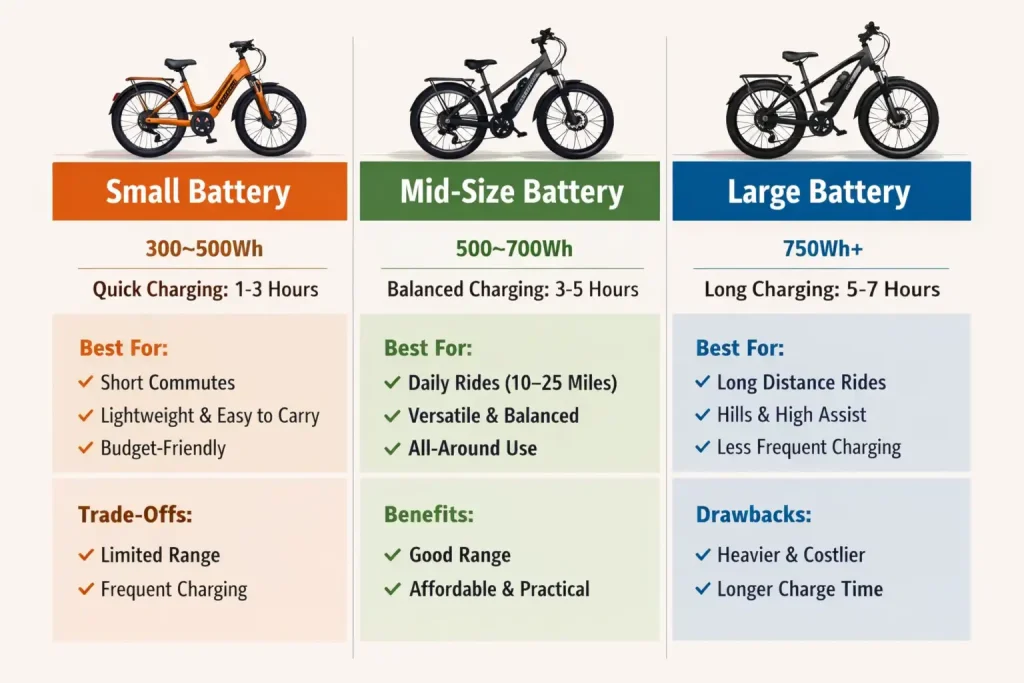
500–700Wh battery with a standard charger – balanced and practical
This is the sweet spot for the majority of riders.
- Supports 10–30 mile daily riding comfortably
- Charging time is reasonable (3–6 hours full, 1–3 hours top-up)
- Works well for commuting, errands, and mixed terrain
- Gives a good balance between range, weight, and cost
✔ Ideal if you want a “set it and forget it” setup that just works every day
Best for Short Commutes
Smaller battery (300–500Wh) – faster charging, lighter, simpler
Smaller batteries are often overlooked, but they’re a great choice for the right rider.
Best for:
- Short rides (5–15 miles per day)
- Flat terrain and moderate assist levels
- Riders who prioritize a lighter, easier-to-handle bike
Advantages:
- Faster charging (2–4 hours full, often 1–2 hours daily top-up)
- Lighter bike weight (easier to carry, store, and maneuver)
- Lower upfront cost
Tradeoffs:
- Less range buffer (you may need to charge more often)
- Not ideal for hills or longer rides
- Can feel limiting if your riding needs increase over time
✔ Best if your rides are predictable and relatively short
Best for Long-Distance Riders
Larger battery (750Wh+) – fewer charging sessions, more flexibility
Larger batteries are ideal for riders who want range confidence and flexibility.
Best for:
- Long commutes (20–40+ miles)
- Hilly terrain or higher assist levels
- Riders who don’t want to worry about charging daily
Advantages:
- More range per charge (less “range anxiety”)
- Fewer charging sessions per week
- Better performance under heavy load or challenging terrain
Tradeoffs:
- Longer charging time (5–7+ hours full charge)
- Heavier bike
- Higher upfront cost
✔ Best if you value convenience (less frequent charging) over charging speed
Quick Decision Guide
If you’re unsure, use this:
- Ride under 10–15 miles daily → Smaller battery is enough
- Ride 10–25 miles daily → Mid-size battery is ideal
- Ride 25+ miles or want flexibility → Go with a larger battery
How We Evaluate Charging Time
We base these estimates on:
- Real-world rider usage patterns
- Common battery sizes across brands like Aventon, Lectric, and Ride1Up
- Standard home outlet charging setups
We focus on real usage – not ideal lab conditions
FAQs
Yes – this is actually the best approach for consistent riders.
Occasionally yes, but avoid doing it daily.
About 1 to 2.5 hours, depending on charger speed.
Not if the charger is manufacturer-approved, but slower charging can extend lifespan slightly.
Most e-bikes take 3 to 6 hours to fully charge, depending on battery size and charger speed. Larger batteries (750Wh+) can take 5 to 7+ hours, while smaller batteries may charge in 2 to 4 hours.
Yes – and it’s actually better for battery health. Charging to 80–90% for daily use reduces wear and helps extend the lifespan of your battery.
Most daily riders charge after each ride or every 1–2 days. If your battery is properly sized for your riding, you’ll usually only need 1–3 hours of top-up charging.
Occasional overnight charging is fine, but doing it every day can keep the battery at 100% too long, which may reduce lifespan over time. It’s better to unplug once it’s fully charged when possible.
Yes. Charging slows down as the battery approaches 90–100%. This is normal and helps protect the battery from damage.
Yes, but only if it’s compatible with your battery system. A higher amp charger (like 4A or 5A) can reduce charging time significantly, but using the wrong charger can damage your battery.
Final Thoughts
For daily use, e-bike charging is simple and predictable.
Most riders aren’t waiting all day – they’re just topping off for a couple of hours.
Once your battery size matches your routine, charging becomes something you barely think about.
Want to make charging even easier?
👉 Explore all tools here: E-Bike Tools Hub – calculators, estimators, and smart tools
Not sure where to go next?
Some riders are brand new. Others are fixing a problem or thinking about a new bike. Choose what fits you.
Learn & Get Comfortable
Understand how e-bikes work and what to expect when riding.
Improve Your Current Ride
If your bike isn’t performing how you want, learn what affects speed, range, and power.
Compare Better Bikes
Looking for something that fits your riding style? Start here.
- Best Electric Bikes for Beginners
- Recommended Commuter Ebikes
- Most Comfortable City E-Bikes
- Best Fat Tire Ebikes
- Top Folding Ebikes
- Best Step Through Ebikes
- Top Cargo Electric Bikes
- Best Lightweight Ebikes
- Best Long Range Ebikes
- Top Moped Style E-Bikes
- E-bike Reviews
🛒 Ready to Buy?
Top picks and current availability from trusted brands.
👉 Still deciding?
Take our E-Bike Recommendation Quiz to get matched with the right riding style in under two minute

Kristina is not just an enthusiast but a true authority on electric bikes. Nestled in the coastal beauty of Virginia, Kristina has found the perfect backdrop for her passion for electric biking. As a dedicated wife and homeschooling mom, her life revolves around family, faith, and the thrill of adventure.
Originally hailing from Ohio, Kristina's journey with electric bikes began as a curiosity and quickly evolved into a deep expertise. Her blog is a testament to her love for electric biking, combining her fascination for eco-friendly transportation with her coastal lifestyle.
When she's not cruising the beach on her electric bike, you'll find Kristina indulging in her other loves: long walks along the shore, getting lost in a good book, and cherishing moments with her loved ones. With a heart as big as her love for animals, especially cats, Kristina brings a unique perspective to the electric bike world, grounded in her strong faith in God and her dedication to a sustainable lifestyle.
Through her blog, Kristina shares her extensive knowledge of electric bikes, offering valuable insights, tips, and recommendations to fellow enthusiasts. Whether you're a seasoned rider or a newcomer to the electric bike scene, Kristina's blog is your go-to source for all things electric biking, fueled by her passion, expertise, and the scenic beauty of coastal Virginia.