Park City, Utah E-Bike Singletrack Rules: Why Most E-MTBs Aren’t Allowed Unless You’re 65+
Last Updated on July 4, 2026 by Kristina
Park City, Utah is known for world-class mountain biking, beautiful singletrack, and a huge trail network that draws riders from all over the country. But there is one rule that surprises a lot of electric bike riders: most e-bikes are not allowed on Park City singletrack trails.
According to Canadian Cycling Magazine, Park City’s trail network remains mostly closed to e-MTBs, even though the area is extremely bike-friendly overall. The major exception is for riders who are 65 or older or riders with a mobility disability who qualify for Park City’s Class 1 e-bike Courtesy Tag Program.
This is another reminder that e-bike trail access is not always simple. Even if your electric bike is legal under state law, local trail managers, cities, parks, resorts, and land agencies can still set their own rules.
If you are planning to ride somewhere new, I always recommend checking local e-bike rules first. You can also use the our Trail Access Checker to help understand how trail access can vary by location.
Are E-Bikes Allowed on Park City Singletrack?
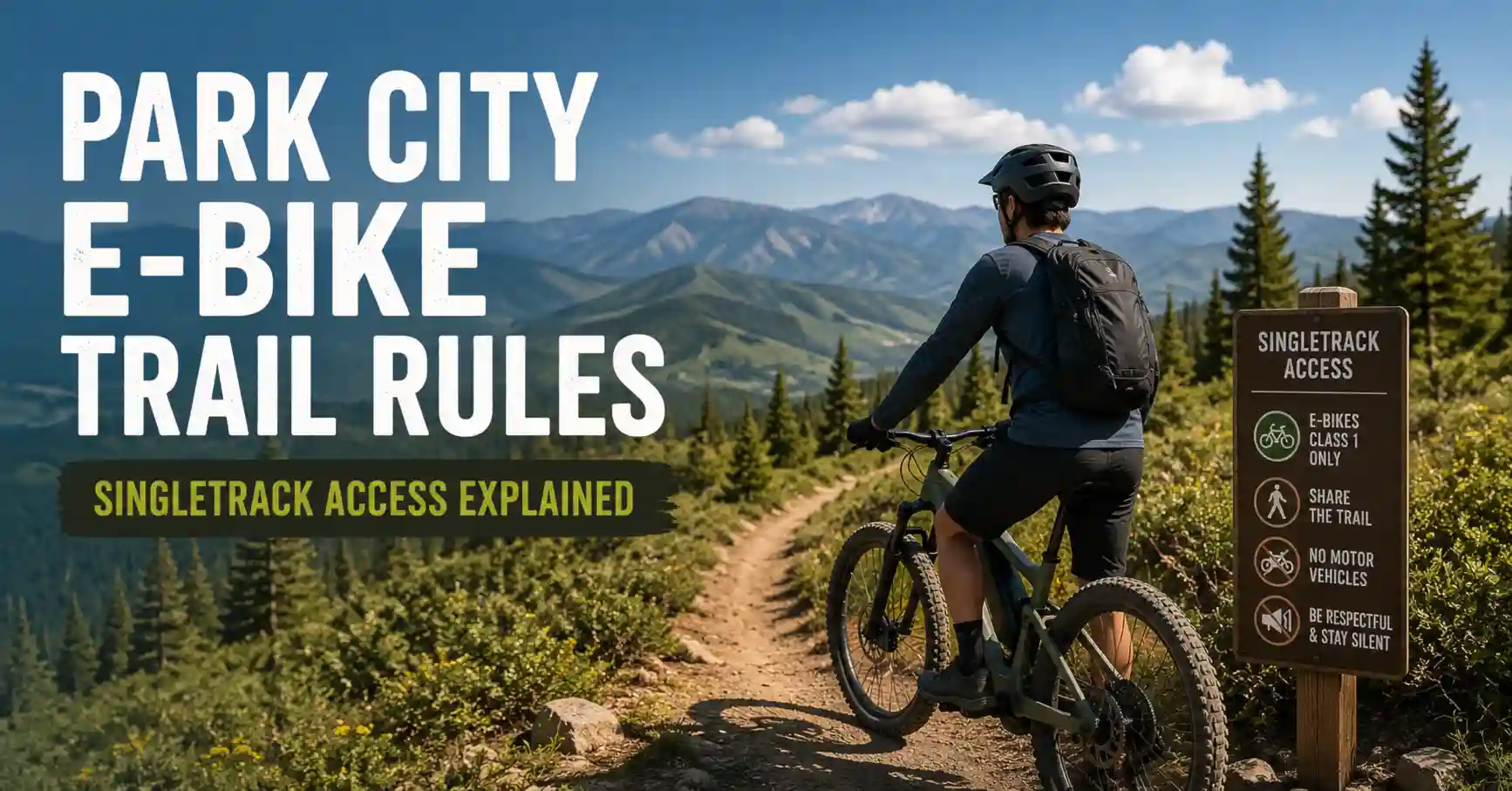
For most riders, Park City singletrack is mostly closed to e-bikes. However, there are limited Class 1 e-bike routes, including Clark Ranch and the Connector to Deer Valley East. Outside of approved routes, Class 1 e-bike access on Park City singletrack is generally limited to riders 65 or older or riders with a mobility disability through the city’s Courtesy Tag Program.
Park City also allows electric-assisted bicycles on paved multi-use pathways and soft-surface trails wider than five feet, but riders still need to watch for posted speed limits and local signs.
So the simple answer is this: Park City is not a total e-bike ban, but most singletrack is not open to regular e-bike use.
Why This Park City E-Bike Rule Is Getting Attention
The Park City e-bike rule is getting attention because it feels unusual at first glance.
Park City is not a place that ignores cycling. It has spent years building and maintaining a major trail system. The city is known for outdoor recreation, mountain biking, hiking, tourism, and bike-friendly infrastructure. So when riders hear that e-bikes are mostly banned from singletrack, it naturally raises questions.
The issue is not that Park City is anti-bike. The issue is how the community wants its singletrack trails to be used.
Park City’s trails are not only used by mountain bikers. They are also used by hikers, runners, dog walkers, tourists, families, and local residents. That creates a shared-use environment where speed, trail crowding, rider experience, and user conflict all matter.
What Kind of E-Bikes Are Allowed?
Park City’s Courtesy Tag exception is specifically for Class 1 e-bikes, but Park City also lists a few approved Class 1 e-bike routes where qualifying for the Courtesy Tag Program is not the main issue.
A Class 1 e-bike is pedal-assist only and stops providing motor assistance when the bicycle reaches 20 mph. It does not use throttle-only power. Utah also recognizes Class 2 and Class 3 electric-assisted bicycles. Class 2 e-bikes may use motor power to propel the bike and stop assisting at 20 mph, while Class 3 e-bikes are pedal-assist bikes that stop assisting at 28 mph and must have a speedometer.
That matters because a lot of riders use the word “e-bike” loosely. A legal Class 1 electric mountain bike is very different from a high-powered electric motorcycle, modified e-bike, or unclassified electric vehicle.
Park City’s rules make that distinction clear. The city says any unclassified “e-bike” or electric motorcycle is strictly prohibited on Park City and Summit County trails and pathways.
Watch: Utah’s New Rules for High-Powered E-Bikes and E-Motorcycles
🎥 Before getting into Park City’s Courtesy Tag Program, it helps to understand the bigger Utah e-bike conversation. This video, New Utah law tightens rules on high-powered e-bikes, e-motorcycles, is a good companion to this post because it shows why the difference between a regular electric bike and a high-powered electric motorcycle matters.
Utah is trying to draw a clearer line between legal electric bicycles and more powerful electric motorcycles or out-of-class electric vehicles. That matters for trail access because Park City’s rules are mainly focused on Class 1 e-bikes, not high-powered electric dirt bikes, Surron-style bikes, or modified e-bikes that fall outside normal e-bike classifications.
This is where a lot of confusion happens. A Class 1 e-bike is pedal-assist only and stops helping at 20 mph, while faster or more powerful electric vehicles may be treated differently under Utah law and local trail rules. So before riding any trail, it is important to check not only whether “e-bikes” are allowed, but what type of e-bike is allowed.
How Park City’s Courtesy Tag Program Works
Park City offers an E-Bike Courtesy Tag Program for qualified riders. The program is free, but riders need to apply and show proof of eligibility.
According to Park City, courtesy tags are for:
- Riders 65 years or older
- Riders with a mobility disability
- Class 1 e-bikes only
The tag is non-transferable, registered to a specific bike and serial number, and should be mounted on the handlebars so it is easy to see. Park City says applicants should allow up to 14 days for processing.
This is an interesting approach because it gives access to people who may benefit most from pedal assist, without fully opening the entire singletrack network to every e-bike rider.
Why Are Most E-Bikes Restricted on Park City Singletrack?
There are a few big reasons behind the Park City e-bike singletrack restriction.
1. Shared Trail Use
Park City trails are not only for mountain bikers. They are shared by hikers, runners, walkers, and dog owners.
Canadian Cycling Magazine reported that community preference is one reason behind the restriction, noting that hikers, runners, and dog walkers all share the same trail system.
Mountain Trails Foundation also says Park City Municipal Code prohibits e-bikes on singletrack, with exceptions for e-MTB riders 65 years and older and riders with a mobility disability. The organization notes that the exemption applies to trails in Park City proper, zip code 84060.
That is important because trail access can change quickly once you cross into another jurisdiction.
2. Speed Concerns
Speed is one of the biggest concerns with electric mountain bikes on shared trails.
Even Class 1 e-bikes can climb faster than many traditional mountain bikes. On a narrow trail with limited sightlines, that can make hikers, runners, and other riders feel less comfortable.
Canadian Cycling Magazine reported that uphill speed is one of the concerns mentioned by Mountain Trails Foundation’s executive director. The concern is not only downhill riding, but also how quickly e-MTBs can move uphill compared with regular mountain bikes.
That does not mean every e-bike rider is unsafe, but it does change the flow of a busy shared trail.
3. Rider Experience
Another concern is that e-bikes can help newer riders get farther into the backcountry than they might be ready for.
Going uphill with pedal assist can feel easy. Coming back down technical singletrack is another story.
A beginner rider may rent an electric mountain bike, climb deep into the trail system, and then realize the descent requires more bike handling skill than expected. Canadian Cycling Magazine also noted this concern, especially with tourists and newer riders who may not realize how remote some Park City trails become.
That can create safety issues for the rider and for others on the trail.
4. Community Preference
This rule also reflects local trail culture.
Some areas are opening more trails to Class 1 e-MTBs. Other areas are moving slowly or keeping restrictions in place. Park City appears to be taking a more cautious approach based on community feedback and local trail use patterns.
Whether that changes in the future is hard to know, but for now, the rule is clear: most riders cannot take an e-bike onto Park City singletrack unless they are on an approved Class 1 e-bike route or qualify for the Courtesy Tag Program.
Are There Any Legal Places to Ride an E-Bike in Park City?
Yes. This is not a total Park City e-bike ban.
Class 1 e-bikes are allowed on paved pathways and soft-surface trails wider than five feet. Park City also lists recommended Class 1 e-bike trails and routes, including Clark Ranch Trails and the Connector to Deer Valley East e-bike route.
Clark Ranch is listed as Class 1 only and includes beginner and intermediate trail options. Park City describes it as more than five miles of directional trails ridden counterclockwise, with several difficulty options.
The Connector to Deer Valley East is also listed as Class 1 only. Park City describes it as a designated Class 1 e-bike route that climbs about 3.5 miles on singletrack to access Wasatch County’s e-bike-friendly trail system. The city also warns riders not to continue beyond the Deer Valley Silver Lake base area because e-bikes are not allowed there.
So if you are visiting Park City with an e-bike, you are not completely out of options. You just need to be very careful about where you ride.
Important Note About Nearby Trail Systems
This is one of the most important details for e-bike riders to understand: Park City proper, Snyderville Basin, Deer Valley, Wasatch County, and other nearby trail systems may have different rules.
Mountain Trails Foundation says the 65+ and mobility disability exemption applies to trails in Park City proper, zip code 84060. It also says Snyderville Basin trails, zip code 84098, are operated by Basin Recreation, have different regulations, and do not allow e-bikes on natural surface trails under that same exemption.
That means you should never assume one Park City-area rule applies everywhere nearby.
Before riding, check the official trail map, posted trailhead signs, city rules, resort rules, and the trail manager responsible for that specific area.
Why This Matters for E-Bike Riders Everywhere
The Park City e-bike rule is a good example of why electric bike riders should never assume trail access.
A bike can be legal on the road and still be restricted on a trail.
This happens across the country. One city might allow Class 1 e-bikes on natural-surface trails. Another city might ban all e-bikes from singletrack. A state park might have one rule, while a nearby county trail has another.
This is why I always tell riders to check:
- The state e-bike law
- The city or county rule
- The park or trail manager’s rule
- Resort-specific rules
- Posted signs at the trailhead
- Whether the rule applies to Class 1, Class 2, or Class 3 e-bikes
- Whether electric motorcycles or modified bikes are treated differently
This also matters for people shopping for a new electric mountain bike. Before buying an e-MTB, it is worth asking where you realistically plan to ride it. If your local singletrack does not allow e-bikes, you may be better off with a commuter e-bike, fat tire e-bike for legal multi-use paths, or a regular mountain bike for restricted trail systems.
What Riders Should Do Before Riding Singletrack With an E-Bike
Before taking an electric mountain bike onto any singletrack trail, I would check the rules first.
Do not rely only on what another rider says online. Trail access rules can change, and nearby trail systems can have different regulations.
Here are a few simple steps:
- Look up the official city, county, park, resort, or trail manager rules
- Check whether Class 1 e-bikes are treated differently than Class 2 or Class 3
- Look for posted trailhead signs
- Avoid riding modified or unclassified electric bikes on trails
- Yield to hikers and uphill riders
- Slow down when passing
- Use a bell when appropriate
- Stay off trails when they are wet or muddy
- Respect closures even if you disagree with them
This is not just about avoiding a ticket. It is about protecting future e-bike access.
When riders ignore local rules, it gives trail managers more reasons to keep restrictions in place or add new ones.
My Take
I understand why a lot of e-bike riders feel frustrated by rules like this. A legal Class 1 electric mountain bike is still a bicycle in many ways. It has pedals, it requires rider input, and for older riders or people with mobility challenges, pedal assist can be the difference between enjoying the trails and being left out.
So I do like that Park City created an exception for riders 65 and older and riders with mobility disabilities. That part makes sense to me. E-bikes can help people keep riding longer, stay active, and enjoy outdoor spaces they may not be able to access on a regular bike.
At the same time, I also understand why Park City is being cautious. Singletrack is different from a paved bike path. Narrow trails, blind corners, mixed users, tourists, and faster uphill speeds can create tension fast.
Where I think the bigger conversation needs to happen is around responsible Class 1 access. Not every e-bike is the same. A pedal-assist Class 1 e-MTB is not the same thing as a high-powered electric motorcycle. If communities want to protect trails, I think they need clear rules, better education, and better enforcement of the difference between legal e-bikes and out-of-class electric vehicles.
I also think Park City’s approach shows how complicated e-bike access has become. There are paved pathways where Class 1 e-bikes are allowed, approved Class 1 routes like Clark Ranch and the Deer Valley East connector, a courtesy tag program for certain riders, and nearby areas with different rules. That is a lot for an average rider to figure out.
For now, Park City’s rule is a reminder that e-bike riders have to do their homework before heading to the trail. Just because an e-bike is legal in one place does not mean it is allowed everywhere.
And honestly, if we want more trail access in the future, the best thing e-bike riders can do is ride respectfully, follow posted rules, slow down around others, and show trail managers that responsible e-bike use can fit into shared outdoor spaces.
For more news on electric bikes click here
External Sources
Canadian Cycling Magazine: Why e-bikes are banned from this city’s famous singletrack
Park City, Utah: E-Bikes in Park City
Mountain Trails Foundation: Trail Guidelines and Etiquette
Utah Driver License Division: Electric-Assisted Bicycle Rules

Kristina is not just an enthusiast but a true authority on electric bikes. Nestled in the coastal beauty of Virginia, Kristina has found the perfect backdrop for her passion for electric biking. As a dedicated wife and homeschooling mom, her life revolves around family, faith, and the thrill of adventure.
Originally hailing from Ohio, Kristina's journey with electric bikes began as a curiosity and quickly evolved into a deep expertise. Her blog is a testament to her love for electric biking, combining her fascination for eco-friendly transportation with her coastal lifestyle.
When she's not cruising the beach on her electric bike, you'll find Kristina indulging in her other loves: long walks along the shore, getting lost in a good book, and cherishing moments with her loved ones. With a heart as big as her love for animals, especially cats, Kristina brings a unique perspective to the electric bike world, grounded in her strong faith in God and her dedication to a sustainable lifestyle.
Through her blog, Kristina shares her extensive knowledge of electric bikes, offering valuable insights, tips, and recommendations to fellow enthusiasts. Whether you're a seasoned rider or a newcomer to the electric bike scene, Kristina's blog is your go-to source for all things electric biking, fueled by her passion, expertise, and the scenic beauty of coastal Virginia.