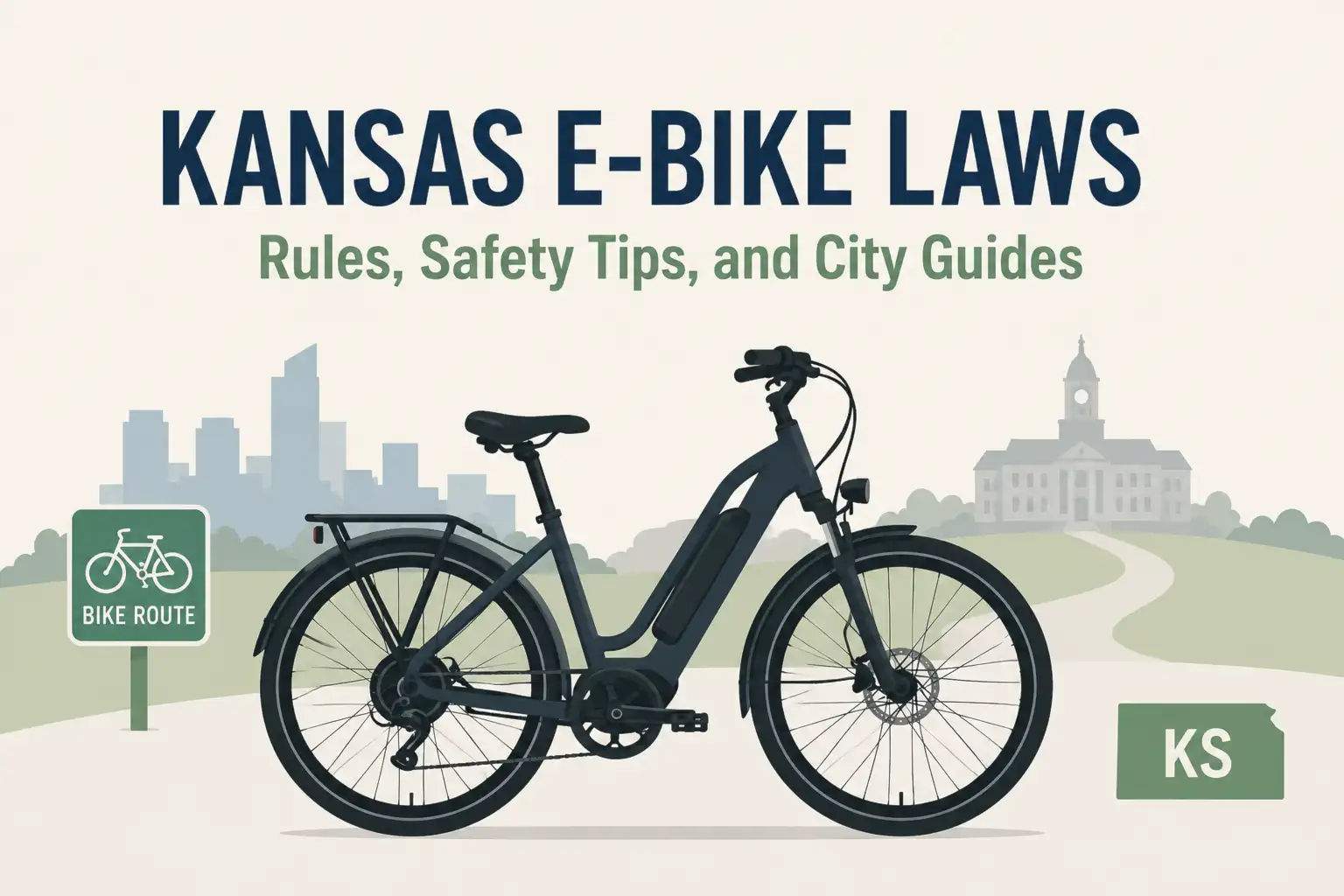
Kansas E-Bike Laws: State Electric Bike Guide for Riders
Last Updated on July 9, 2026 by Kristina
If you ride an electric bike in Kansas, the good news is that Kansas has a clear statewide e-bike law. Kansas uses the common three-class e-bike system, and a legal electric-assisted bicycle is generally treated like a bicycle instead of a motor vehicle. That means most riders do not need a driver’s license, title, registration, license plate, or vehicle insurance for a qualifying electric-assisted bicycle.
But there is one important catch. Kansas state e-bike law gives cities, counties, park agencies, and trail managers room to create local rules for streets, sidewalks, bike paths, multi-use trails, natural surface trails, parks, schools, and certain public areas.
So before riding in Wichita, Overland Park, Olathe, Lawrence, Topeka, Lenexa, Leawood, Manhattan, or Johnson County parks, it is worth checking both the Kansas state law and the local rule.
For more help comparing Kansas with other states, see my State-by-State E-Bike Laws Guide. You can also use my E-Bike Trail Access Checker before riding a new trail or visit my Start Here page if you are new to e-bikes and want help with choosing, setting up, and riding your first electric bike safely.
Kansas E-Bike Laws at a Glance
Kansas defines an electric-assisted bicycle as a bicycle with two or three wheels, a saddle, fully operative pedals, and an electric motor of less than 750 watts that fits into one of the three e-bike classes.
| Kansas E-Bike Rule | What It Means |
|---|---|
| E-bike classification | Kansas uses Class 1, Class 2, and Class 3 e-bike categories |
| Motor limit | Less than 750 watts |
| Pedals required | Yes, the bike must have fully operative pedals |
| Driver’s license required? | No, not for a qualifying electric-assisted bicycle |
| Registration required? | No |
| Vehicle insurance required? | No |
| License plate required? | No |
| Class 3 age rule | You must be at least 16 to operate a Class 3 e-bike |
| Helmets statewide | Kansas state law does not appear to set one statewide e-bike helmet requirement, but cities and schools may require helmets |
| Where e-bikes can ride | Generally where bicycles are allowed, unless a city, county, park, trail agency, or campus restricts them |
| Local rules matter? | Yes. Kansas law allows local restrictions |
🔍 Why You Can Trust Electric Bike Explorer
Electric Bike Explorer is dedicated to providing honest, well-researched, and easy-to-understand information for e-bike riders. Whenever possible, I personally test the e-bikes, accessories, and products I review. When I can’t test something directly, I rely on careful research, manufacturer specifications, real-world rider feedback, official sources, and trusted industry information.
For law guides, I review state statutes, local ordinances, transportation agencies, park rules, and official government resources whenever possible. For e-bike news, I review the original reporting along with available town documents, meeting agendas, proposed ordinances, police statements, government notices, and other primary sources. I also make a clear distinction between a proposal, an approved rule, and a law that has already taken effect.
For troubleshooting and safety guides, I focus on practical explanations, common rider experiences, manufacturer guidance, and safe maintenance practices.
My goal is to help you make informed decisions, understand the rules where you ride, solve common e-bike problems, and get the most out of your electric bike safely.
Want to know how I score bikes and research my guides? Read my full review and ranking process
Kansas E-Bike Classes Explained
Kansas recognizes three classes of electric-assisted bicycles.
| E-Bike Class | How the Motor Works | Motor Assistance Stops At | Common Use |
|---|---|---|---|
| Class 1 e-bike | Pedal assist only | 20 mph | Bike paths, commuting, casual riding |
| Class 2 e-bike | Throttle can move the bike without pedaling | 20 mph | Commuting, errands, riders who want throttle help |
| Class 3 e-bike | Pedal assist only | 28 mph | Faster road riding and commuting |
A Class 1 e-bike provides motor assistance only when you are pedaling and stops helping at 20 mph.
A Class 2 e-bike can use the motor to propel the bike without pedaling, but the motor assistance stops at 20 mph.
A Class 3 e-bike provides pedal assist only and stops helping at 28 mph.
Rider tip: if you are riding around town, near schools, through neighborhoods, or on shared paths, a Class 1 or Class 2 e-bike is usually the easiest to understand legally. Class 3 e-bikes are useful for commuting, but they come with more local restrictions, especially for younger riders.
Are E-Bikes Considered Motor Vehicles in Kansas?
No. A legal electric-assisted bicycle is not considered a motor vehicle in the same way as a car, motorcycle, moped, or high-powered e-moto. Kansas law says an electric-assisted bicycle rider does not need vehicle liability insurance, a driver’s license, registration, a certificate of title, or a license plate.
That is a big difference between a legal e-bike and something closer to an electric motorcycle, moped, or e-moto.
This matters because some powerful electric bikes sold online may look like e-bikes, but if they do not fit Kansas’s e-bike definition, they may not be treated the same way under the law.
Related helpful guide: E-Bike vs E-Moto: What’s the Difference?
Kansas Class 3 E-Bike Age Rule
Kansas has a specific age rule for Class 3 electric-assisted bicycles. A person under 16 years old may not operate a Class 3 e-bike. However, a person under 16 may ride as a passenger on a Class 3 e-bike if the e-bike is designed to carry passengers.
This is one of the most important Kansas e-bike laws for parents. A teen may be able to ride a Class 1 or Class 2 e-bike depending on local rules, but Class 3 is different because it can assist up to 28 mph.
If you are buying an e-bike for a teen, I would check these three things first:
- The class label on the bike
- The assisted top speed
- The city, school, and trail rules where they will actually ride
Related Helpful Guide: Best E-Bikes for Teens: What Parents Should Know
Kansas E-Bike Labeling and Modifications
Kansas law requires manufacturers and distributors to place a permanent label on electric-assisted bicycles sold after January 1, 2023. The label must show the classification number, top assisted speed, and motor wattage.
Kansas law also says a person may not tamper with or modify an e-bike in a way that changes the motor-powered speed capability or motor engagement unless the classification label is replaced after the modification.
In plain English, if someone unlocks an e-bike, changes the controller, adds a throttle, removes a speed limiter, or modifies the motor so the bike no longer matches its label, that can create legal problems.
I would not rely only on what a seller says in a product listing. Look for the e-bike class label and compare it with the real motor wattage and assisted speed.
Where Can You Ride an E-Bike in Kansas?
Kansas law generally allows an electric-assisted bicycle to be ridden where bicycles are allowed, including streets, highways, roadways, bicycle lanes, bicycle or multi-use paths, trails, and trail networks.
However, this is not a free pass for every sidewalk, trail, park, or natural surface path. Kansas law also allows cities, counties, municipalities, and state agencies to restrict or prohibit e-bikes or certain classes of e-bikes on streets, sidewalks, paths, trails, and trail networks.
That is why Kansas e-bike trail access can feel confusing. The state law gives the general rule, but the local trail manager may set the final rule.
Related Helpful Guide: E-Bike Trail Access Checker
Kansas E-Bike Rules for Roads and Bike Lanes
On roads, Kansas e-bike riders generally have the rights and duties of bicycle riders. The Kansas Legislative Research Department explains that bicycle and e-bike riders must follow the rules of the road, obey traffic signs and signals, yield when required, signal turns, and use required lights at night.
Kansas also has a three-foot passing rule for drivers passing a bicycle traveling the same direction.
For e-bike riders, I would keep this simple:
Ride with traffic.
Use bike lanes where available.
Signal turns.
Use a front white light and rear red light or reflector at night.
Do not ride faster than conditions allow.
Watch for city-specific rules in downtown areas, school zones, parks, and shared paths.
Kansas E-Bike Equipment Rules
Kansas bicycle equipment rules matter because e-bikes are generally treated like bicycles. Kansas law requires a bicycle used between sunset and sunrise to have a front white lamp visible from at least 500 feet and a rear red reflector, rear red light, or red/amber light worn by the rider visible from the rear.
Bicycles also need a brake capable of making the braked wheels skid on dry, level, clean pavement.
Kansas e-bike law also says an electric-assisted bicycle must comply with the equipment and manufacturing requirements adopted by the U.S. Consumer Product Safety Commission in 16 C.F.R. Part 1512.
Safety tip: Even if you only ride during the day, I still recommend a bright front light, rear light, bell, mirror, and helmet. Kansas roads and shared paths can change quickly, and being visible is one of the simplest ways to lower risk.
Related helpful links:
Best E-Bike Helmets
E-Bike Battery Safety Guide
Are Helmets Required for E-Bikes in Kansas?
Kansas state law does not appear to have one statewide helmet requirement for every e-bike rider. However, local cities can create stricter rules, and several Johnson County communities have added helmet requirements for minors.
For example, Overland Park’s current city guidance says helmets are required on e-bikes and e-scooters for riders under age 18. Leawood passed an ordinance requiring helmets for minors under 18 when operating electric-assisted or motorized bicycles, scooters, skateboards, mopeds, and similar devices in public areas. Olathe also updated its rules to require riders under 18 to wear helmets when riding e-bikes and similar devices.
My recommendation is simple: wear a helmet on every e-bike ride, even when it is not required. For kids and teens, I would treat a helmet as non-negotiable.
Kansas E-Bike Sidewalk Laws
Kansas state law does not give one simple statewide answer for every sidewalk. Kansas allows local rules, and cities can restrict bicycle, e-scooter, or e-bike operation on sidewalks and sidewalk areas.
This is where riders need to be careful. A sidewalk ride that may be allowed in one part of Kansas may be restricted in a downtown district, entertainment district, shopping area, school zone, or city park.
For example, Wichita allows bicycle riding on sidewalks except in the Central Business District unless the sidewalk is designated for bicycle use. Riders must yield to pedestrians and give an audible signal before passing.
Lawrence says bicycle riders 15 or younger must wear a helmet and that bicycle riding is not allowed on downtown sidewalks and parking lots.
Topeka has local downtown and NOTO-area restrictions for bicycles, electric-assisted scooters, skates, skateboards, roller blades, and similar devices. Since Kansas generally treats a legal e-bike like a bicycle, e-bike riders should be careful in these same sidewalk and public-area zones unless the city gives different guidance.
Sidewalk safety reminder: if you are on a sidewalk with pedestrians nearby, slow way down, yield, use a bell or voice before passing, and get off the bike if the area feels crowded.
Kansas E-Bike Trail and Park Rules
Kansas generally allows e-bikes where bicycles are allowed, but parks and trail managers can make their own rules. That means trail access can depend on the trail surface, the managing agency, and the e-bike class.
The Kansas Legislative Research Department notes that within state parks, e-bikes that cease to provide assistance at 20 mph may be used on trails approved for bicycle use. That wording is important because it does not mean every e-bike is automatically allowed on every Kansas state park trail.
In practical terms, that points more toward 20 mph assist bikes, such as Class 1 and Class 2 e-bikes, but riders should still check the specific Kansas Department of Wildlife and Parks trail or posted rules before riding.
Johnson County Park & Recreation District is more specific. JCPRD allows Class 1 and Class 3 e-bikes on shared-use paved trails. JCPRD says Class 1 and Class 3 e-bikes must have fully operable pedals and a motor under 750 watts. JCPRD also says Class 1 and Class 3 e-bikes only are allowed and no other motorized conveyances are allowed.
This is a good example of why the Kansas e-bike law guide needs local sections. State law gives one baseline, but local trail rules may allow one class and not another.
Kansas City and Local E-Bike Rules Comparison Chart
This chart is meant as a quick starting point. Local ordinances can change, so always check the current city code or posted signs before riding.
| Kansas City / Area | E-Bike Rule Notes | Helmet / Age Notes | Sidewalk / Trail Notes |
|---|---|---|---|
| Wichita | State e-bike rules generally apply, but Wichita has local bicycle and scooter rules | No citywide e-bike helmet rule found in the sources I checked | Bicycle riding is allowed on sidewalks except in the Central Business District unless designated for bicycle use; riders must yield and signal before passing pedestrians |
| Overland Park | Overland Park follows the Kansas three-class system and has updated local guidance for e-bikes and e-scooters | Helmets are required on e-bikes and e-scooters for riders under 18; Class 3 follows the 16+ rule | Riders should check current city guidance and posted signs because local rules have changed recently |
| Olathe | Olathe updated its rules to align with the Kansas three-class e-bike system | Riders under 18 must wear a helmet; under 16 may not operate Class 3 e-bikes | Local materials reference sidewalk speed limits, road rules, and rider responsibilities |
| Lawrence | State e-bike rules apply, plus local bicycle sidewalk rules | Bicyclists 15 or younger are required to wear a helmet | No bicycle riding on downtown sidewalks and parking lots |
| Topeka | State e-bike rules apply, but Topeka has local restrictions for bicycles and similar devices in certain downtown / NOTO areas | The source I checked focused more on prohibited sidewalk and public areas | E-bike riders should be careful in restricted downtown and NOTO sidewalk/public-area zones unless the city gives different guidance |
| Lenexa | Lenexa lists Class 1 and Class 3 e-bikes in its local e-wheel rules | Lenexa lists 15+ as the recommended age for Class 1 and Class 3 e-bikes | Class 1 and Class 3 e-bikes are listed for sidewalks, trails, streets, and parks, with a 20 mph max speed in the city chart |
| Leawood | Legal e-bikes are allowed where bicycles are allowed, but e-motos are treated much more strictly | Helmets are required for minors under 18 on electric-assisted or motorized bicycles and similar devices | Leawood says e-bikes may be ridden where bicycles are allowed, including streets, bike lanes, multi-use paths, trails, or trail networks; e-motos are illegal unless properly titled, registered, insured, and licensed |
| Manhattan | Manhattan has detailed micromobility rules that include electric-assisted bicycles in some ordinance language | Check both city and Kansas State University rules | Bicycle and micromobility devices are restricted on certain Aggieville and Downtown sidewalks/plazas and city parking areas |
| Johnson County Parks | JCPRD has its own e-bike trail rules | Helmets are recommended by JCPRD | Class 1 and Class 3 e-bikes are allowed on JCPRD shared-use paved trails; Class 2 throttle e-bikes are not listed as allowed |
Wichita E-Bike Laws
Wichita riders should start with Kansas state e-bike law, but also pay attention to local sidewalk and downtown rules.
Wichita says bicycles may be ridden on sidewalks except in the Central Business District unless the sidewalk is designated for bicycle use. Riders on sidewalks must yield to pedestrians and give an audible signal before passing.
Local rider tip: ride an e-bike like a bicycle, stay alert downtown, and do not assume every sidewalk is okay just because another part of the city allows sidewalk riding.
Overland Park E-Bike Laws
Overland Park follows the Kansas three-class e-bike system, but riders should pay close attention because e-bike and e-scooter rules have been updated recently.
Overland Park’s current city guidance says helmets are required on e-bikes and e-scooters for riders under age 18. The city also reminds parents to help kids start slow, use speed governors when available, and make sure young riders know the rules before riding.
Class 3 e-bikes still follow the Kansas 16+ age rule. E-bikes should also be properly labeled, and tampering with the motor-powered speed capability or motor engagement can create legal issues.
Local update note: because the rules changed recently, riders should be careful with older summaries online. Look for the current Overland Park city guidance, follow posted signs, and remember that Class 3 e-bikes are not for riders under 16.
Olathe E-Bike Laws
Olathe has also updated its e-bike rules. Olathe’s city materials said the revisions were designed to align with the Kansas three-class system, add e-bike and micromobility rules, and require helmets for riders under 18.
Local reporting also summarized the Olathe rules as requiring riders under 18 to wear helmets and prohibiting riders under 16 from operating Class 3 e-bikes.
Parent note: this is one of the Kansas cities where teen e-bike rules matter most. Check the e-bike class before buying, make sure your child has a helmet, and do not assume a fast Class 3 e-bike is okay for a middle school rider.
🎥 Video note: This local news video explains Olathe’s updated rules for e-bikes and electric scooters, especially for families, teen riders, and anyone riding near schools or neighborhoods.
Lawrence E-Bike Laws
Lawrence follows Kansas e-bike law, but it also has local bicycle safety rules that matter for e-bike riders.
The City of Lawrence says bicyclists 15 years or younger are required to ride with a helmet. Lawrence also says it is unlawful to ride a bicycle on downtown sidewalks and parking lots.
Downtown rider note: if you are near downtown, campus, or busy pedestrian areas, treat the sidewalk rules seriously. Lawrence is a college town with a lot of people walking, biking, driving, and using scooters.
Topeka E-Bike Laws
Topeka has specific prohibited sidewalk and public area rules for bicycles, electric-assisted scooters, skates, skateboards, roller blades, and similar devices.
Because Kansas generally treats legal electric-assisted bicycles like bicycles, I would not assume an e-bike is okay in restricted bicycle areas unless the city gives different guidance.
Topeka Ordinance 20360 lists restricted areas that include parts of Kansas Avenue, NOTO-area streets, public parking facilities, Redbud Park, and Breezeway Park. It also says riders on public sidewalks must yield to pedestrians and give an audible signal before passing.
Downtown safety reminder: Do not ride through crowded downtown or NOTO sidewalk areas unless you are sure bikes are allowed there. When in doubt, dismount and walk.
Lenexa E-Bike Laws
Lenexa has a helpful e-wheel safety page. It lists Class 1 and Class 3 e-bikes with a recommended age of 15+, says they may be used on sidewalks, trails, streets, and parks, and lists a 20 mph maximum speed. Lenexa also notes that e-bikes are not allowed on highways without a valid driver’s license.
Local rule reminder: this is one of the clearer city pages for parents and riders. Still, I would check posted signs around parks and trails because local trail access can change.
Leawood E-Bike Laws
Leawood has a local helmet rule for minors. The city says it passed an ordinance requiring helmets for all minors under 18 operating an electric-assisted or motorized bicycle, scooter, skateboard, moped, or similar device. The rule applies on streets, trails, sidewalks, and other public areas within Leawood.
Leawood also makes a strong distinction between legal e-bikes and e-motos. The city says e-motos are illegal unless the device is titled, registered, insured, and the rider has a driver’s license with a Class M endorsement.
E-moto warning: if the bike looks like a small motorcycle, has no meaningful pedals, or goes well beyond Kansas e-bike limits, do not assume it is a legal e-bike.
Manhattan and Kansas State Area E-Bike Notes
Manhattan has detailed micromobility rules around Downtown and Aggieville. Some ordinance language defines micromobility devices to include electric-assisted bicycles, electric-assisted scooters, motorized skateboards, electric one-wheel boards, hoverboards, and similar devices.
Manhattan ordinance materials say no person shall ride or operate any bicycle, micromobility device, skateboard, roller skates, roller blades, or similar device on certain Aggieville and Downtown sidewalks or plazas, or in city parking lots and garages. Outside those restricted areas, riders must yield to pedestrians, give an audible signal before passing, and travel at a reasonable and prudent speed, not over 15 mph.
Kansas State University also has campus micromobility rules. K-State says bicycles parked on campus must display a free K-State bicycle permit.
Campus note: check both city rules and campus parking rules. A ride that is legal on a city street may still create a campus citation if you park or ride in the wrong place.
Kansas E-Bike Rules for Schools and Universities
School and campus rules can be stricter than state law. Kansas state law tells you whether an e-bike is generally legal, but schools can still control where students ride, park, store, or charge electric bikes.
University of Kansas
The University of Kansas says bicycles and e-scooters must park at designated bike racks and may not be chained to railings, light poles, meters, or similar objects. Bikes and e-scooters not parked at designated bike racks may be removed.
Kansas State University
Kansas State University says all bicycles parked on campus must display a K-State bicycle permit. Parking Services issues the permits for free. Riders are responsible for bicycle parking violations and moving violations.
Wichita State University
Wichita State has an e-bikes and scooters safety page with safety resources related to lithium-ion battery powered e-mobility devices. Wichita State housing materials also list lithium-ion battery powered scooters or other means of transportation as not permitted in housing packing guidance.
Johnson County Community College
Johnson County Community College says electric scooters and electric bicycles are considered motor vehicles for campus policy purposes, and operators must comply with all parking and traffic regulations. JCCC also says electric scooters and electric bicycles must be placed in designated bicycle racks.
Blue Valley Schools and Student E-Vehicles
Some Kansas school districts have started addressing student e-vehicles more directly. Local reporting has said Blue Valley requires students who ride certain motorized devices to school to have a permit and power them off when they get to campus.
Because district policies can change, parents should check the current school handbook, district transportation rules, and campus-specific parking rules before sending a student to school on an e-bike.
Olathe Schools and Teen Riders
Olathe city materials noted that students were part of local discussions around e-bike and micromobility rules. This matters because e-bike laws for teens are not only about state law. They can also involve city rules, helmet requirements, school communication, and campus riding or parking limits.
Parent note: before a student rides an e-bike to school, parents should check the school district handbook, city code, campus parking rules, helmet rules, and whether the school allows e-bikes on property at all.
Kansas E-Bike Rules for Parents
If you are a parent buying an e-bike for a child or teenager in Kansas, I would not start with speed or price. I would start with legality and control.
Here is what I would check first:
The e-bike class label.
Whether it is Class 1, Class 2, or Class 3.
Whether the motor is under 750 watts.
Whether the bike has working pedals.
Whether the city requires helmets for minors.
Whether the school allows e-bikes on campus.
Whether the bike is really an e-bike or closer to an e-moto.
Whether the rider can safely handle the weight and speed.
A 28 mph Class 3 e-bike can feel exciting, but it is not the same thing as a regular bicycle. For most younger riders, I would lean toward a lower-speed model, strong brakes, a visible headlight and taillight, and a properly fitted helmet.
Helpful related links:
Best E-Bikes for Beginners
Best Step-Through E-Bikes
E-Bike Helmet Guide
Are E-Motos Legal as E-Bikes in Kansas?
No. An e-moto is not automatically legal just because a seller calls it an e-bike.
Kansas e-bike law requires a qualifying electric-assisted bicycle to have pedals, fit into one of the three classes, and use a motor under 750 watts. If the vehicle goes much faster, has motorcycle-style power, lacks functional pedals, or does not match the Class 1, Class 2, or Class 3 system, it may fall outside the Kansas e-bike law.
This is becoming a major issue in Johnson County and the Kansas City metro area. BikeWalkKC has warned that many concerns are really about e-motos being marketed as e-bikes, not ordinary legal e-bikes.
E-moto warning: If a bike is advertised as 35 mph, 40 mph, 50 mph, “off-road only,” or “no license needed” but does not clearly meet Kansas e-bike law, be careful. It may not be legal on roads, sidewalks, bike paths, parks, school property, or public roads as an e-bike.
Kansas E-Bike Battery Safety Reminder
Kansas law focuses on where and how you can ride, but battery safety matters too. The U.S. Consumer Product Safety Commission recommends following the manufacturer’s charging instructions, using only the charger provided or recommended by the manufacturer, unplugging the device when charging is complete, and never charging e-bikes or other micromobility products while sleeping or away from home.
I always recommend buying from a reputable brand, avoiding mystery replacement batteries, and never charging an e-bike in a hallway, bedroom, exit path, or near anything flammable.
Helpful related links:
E-Bike Battery Safety Guide
How to Tell if an E-Bike Is UL Certified
E-Bike Battery Not Holding Charge
Recommended Gear for Riding in Kansas
Whether you’re commuting through Wichita, riding around Overland Park or Olathe, or exploring Kansas roads, parks, and shared-use trails, having the right gear can make your ride safer and more enjoyable. Here are a few accessories I recommend for most Kansas e-bike riders.
- Helmet – Protect your head with a properly fitted, CPSC-certified bicycle helmet, even if you’re not legally required to wear one.
- Front & Rear Bike Lights – Improve your visibility during early morning rides, evening commutes, and low-light conditions.
- Phone Mount – A sturdy handlebar phone mount can make it easier to follow maps, check your route, or use trail apps without having to stop and dig through a bag.
- Rear View Mirror – A handlebar or helmet-mounted mirror can help you keep an eye on traffic behind you, which is especially helpful when riding on roads, bike lanes, or narrow shoulders.
- Panniers or Rear Rack Bags – Panniers and bike bags are useful for carrying groceries, work items, jackets, tools, chargers, or extra layers without wearing a heavy backpack.
- Small Handlebar or Frame Bag – A compact bag gives you quick access to smaller items like keys, wallet, snacks, sunglasses, tire levers, or a portable charger.
- Heavy-Duty Bike Lock – Help protect your investment when stopping at stores, trailheads, or other public places.
- Mini Tire Pump & Flat Repair Kit – Be prepared for unexpected flats, especially if you’re riding longer distances.
- Compact Multi-Tool – Quickly tighten loose bolts or make minor adjustments while you’re away from home.
- High-Visibility Reflective Gear – Reflective vests, ankle bands, or jackets can help drivers see you sooner, especially at dawn, dusk, or in poor weather.
Nearby State Law Guides
Traveling outside Kansas? Laws change quickly.Check other states:
Arkansas e-bike laws
Georgia e-bike laws
North Carolina e-bike laws
South Carolina e-bike laws
👉 Compare all states in the state-by-state e-bike law guide
Want to See More Electric Bike Explorer in Google Search?
Add Electric Bike Explorer as a preferred source to see more of our e-bike law guides, safety updates, reviews, buying guides, and troubleshooting posts when they are relevant to your searches.
FAQs
Maybe. Kansas state law does not ban students from riding legal e-bikes to school, but school districts can set their own rules for permits, parking, walking the bike on campus, and whether e-bikes can be charged or stored on school property. Parents should check the school handbook, city code, and district rules before letting a student ride an e-bike to school.
Yes. Kansas gives cities, counties, municipalities, and state agencies room to regulate or restrict e-bikes or certain e-bike classes on streets, sidewalks, paths, trails, and trail networks. That is why a ride may be legal under state law but still restricted by a city, park, school, or trail manager.
Not on JCPRD shared-use paved trails based on current JCPRD guidance. Johnson County Park & Recreation District allows Class 1 and Class 3 e-bikes on shared-use paved trails, but Class 2 throttle e-bikes are not listed as allowed.
Be careful. Kansas law says a person may not tamper with or modify an e-bike in a way that changes its motor-powered speed capability or motor engagement unless the classification label is replaced after the modification. A modified e-bike may no longer match its legal class.
Not automatically. Kansas law allows local authorities and state agencies to regulate e-bike use on certain trails and trail networks, including areas where nonmotorized or natural surface trail rules may apply. Before riding an e-bike on a natural surface trail, check the trail manager’s posted rules.
Not always. A campus can have its own parking, charging, storage, and riding rules. KU requires bicycles and e-scooters to park at designated bike racks. K-State requires parked bicycles to display a free K-State bicycle permit. JCCC treats electric bicycles and electric scooters as motor vehicles for campus policy purposes.
A 1,000-watt electric bike would not fit Kansas’s electric-assisted bicycle definition if the motor is 1,000 watts, because Kansas defines a qualifying electric-assisted bicycle as having an electric motor of less than 750 watts. It may be treated differently from a legal e-bike, especially on roads, trails, sidewalks, parks, and school property.
No. Kansas law says a person under 16 may not operate a Class 3 electric-assisted bicycle. A person under 16 may ride as a passenger on a Class 3 e-bike only if the bike is designed to carry passengers.
No, not for a qualifying electric-assisted bicycle. Kansas law says vehicle liability insurance is not required for the operation of an electric-assisted bicycle. However, you may still want to check your homeowners, renters, or separate e-bike insurance coverage for theft, damage, or liability protection.
Parents should check the e-bike class, motor wattage, top assisted speed, city helmet rules, school rules, trail restrictions, and whether the bike is really a legal e-bike or more like an e-moto. For teen riders, I would be especially careful with Class 3 e-bikes and anything advertised above Kansas’s legal e-bike limits.
No. A legal Kansas e-bike must fit the electric-assisted bicycle definition, including working pedals, less than 750 watts, and one of the three e-bike classes. A faster or more powerful e-moto may be treated differently and may not be legal on sidewalks, trails, parks, school property, or public roads as an e-bike.
My Take on Kansas E-Bike Laws
Kansas is fairly e-bike friendly because it uses the three-class system and generally treats legal e-bikes like bicycles. I like that Kansas does not require a driver’s license, registration, title, insurance, or license plate for qualifying electric-assisted bicycles.
But Kansas is also a state where local rules really matter. Wichita, Lawrence, Topeka, Olathe, Overland Park, Lenexa, Leawood, Manhattan, Johnson County parks, and college campuses may all have different rules for sidewalks, trails, minors, helmets, parking, and school property.
The biggest takeaway is this: do not only ask, “Is my e-bike legal in Kansas?” Ask, “Is my e-bike legal where I plan to ride it?”
For most riders, a properly labeled Class 1 or Class 2 e-bike under 750 watts will be the easiest to manage. For Class 3 e-bikes, teen riders, school commuting, and shared trails, I would be extra careful.
External Sources
Kansas Office of Revisor of Statutes – K.S.A. 8-1489 Electric-Assisted Bicycle Definitions
https://ksrevisor.gov/statutes/chapters/ch08/008_014_0089.html
Kansas Legislature – K.S.A. 8-1592b Electric-Assisted Bicycles
https://www.kslegislature.gov/b2025_26/laws/008_000_0000_chapter/008_015_0000_article/008_015_0092b_section/008_015_0092b_k/
Kansas Legislative Research Department – Kansas Laws on Bicycle, E-Bike, and Scooter Operation
https://klrd.gov/2026/01/13/kansas-laws-on-bicycle-e-bike-and-scooter-operation/
City of Wichita Bicycle FAQ
https://www.wichita.gov/FAQ.aspx?QID=322
City of Lawrence – Information for Bicyclists
https://lawrenceks.gov/share-the-road/bicyclists/
City of Topeka Ordinance 20360
https://files.topeka.gov/community/ordinances/2022/Ordinance20360.pdf
City of Lenexa – E-Wheel Safety & Rules
https://www.lenexa.com/City-Services/Streets-Transportation-Traffic/E-wheel-Safety-Rules
City of Leawood – E-Bike and Scooter Safety
https://www.leawood.org/570/E-Bike-and-Scooter-Safety
City of Overland Park – Scooters and Bikes
https://www.opkansas.gov/scooters-and-bikes
Olathe City Council E-Bike Ordinance Materials
https://olatheks.legistar.com/LegislationDetail.aspx?GUID=970DB10F-B9BA-492B-BE21-AC9BE410FA98&ID=7982660&Options=&Search=
Johnson County Park & Recreation District – E-Bikes in the Parks
https://jcprd.com/1285/E-Bikes-in-the-Parks
City of Manhattan – E-Scooters and Micromobility Rules
https://www.manhattanks.gov/3735/E-Scooters
Manhattan Ordinance Document
https://www.manhattanks.gov/DocumentCenter/View/59748/7449-Amend-C3C4-DistrictEscooters-100119
Kansas State University Micromobility Rules
https://www.k-state.edu/parking/services/micromobility/
University of Kansas Bicycle Parking Regulations
https://parking.ku.edu/regulations/parking-regs-bicycle-parking
Johnson County Community College Parking and Personal Transportation Policy
https://www.jccc.edu/about/leadership-governance/policies/safety-and-security/campus-security-and-control/parking.html
Wichita State University E-Bikes and Scooters Safety Page
https://www.wichita.edu/services/environmental_health_and_safety/ebikes_scooters.php
Wichita State University Housing Packing List
https://www.wichita.edu/student_life/housing/packinglist.php
BikeWalkKC – Confusing E-Bike Legislation Doesn’t Make Anyone Safer
https://bikewalkkc.org/blog/2026/05/06/confusing-e-bike-legislation-doesnt-make-anyone-safer/
U.S. Consumer Product Safety Commission – Micromobility Safety
https://www.cpsc.gov/Safety-Education/Safety-Education-Centers/Micromobility-Information-Center

Kristina is not just an enthusiast but a true authority on electric bikes. Nestled in the coastal beauty of Virginia, Kristina has found the perfect backdrop for her passion for electric biking. As a dedicated wife and homeschooling mom, her life revolves around family, faith, and the thrill of adventure.
Originally hailing from Ohio, Kristina's journey with electric bikes began as a curiosity and quickly evolved into a deep expertise. Her blog is a testament to her love for electric biking, combining her fascination for eco-friendly transportation with her coastal lifestyle.
When she's not cruising the beach on her electric bike, you'll find Kristina indulging in her other loves: long walks along the shore, getting lost in a good book, and cherishing moments with her loved ones. With a heart as big as her love for animals, especially cats, Kristina brings a unique perspective to the electric bike world, grounded in her strong faith in God and her dedication to a sustainable lifestyle.
Through her blog, Kristina shares her extensive knowledge of electric bikes, offering valuable insights, tips, and recommendations to fellow enthusiasts. Whether you're a seasoned rider or a newcomer to the electric bike scene, Kristina's blog is your go-to source for all things electric biking, fueled by her passion, expertise, and the scenic beauty of coastal Virginia.