Why Is My E-Bike Jerking or Surging? Causes, Fixes, and When to Stop Riding
Last Updated on September 14, 2026 by Kristina
An e-bike that jerks, surges, or suddenly delivers a burst of motor power can be unsettling, especially if the bike used to feel smooth. Sometimes the explanation is fairly simple, such as the way a cadence-based pedal-assist system engages. Other times, inconsistent assistance can point to a pedal-assist sensor, speed sensor, brake cutoff, battery connection, throttle, controller, wiring, or mechanical drivetrain problem.
The biggest clue is when the jerking happens. A bike that gives a strong push when pedal assist first engages is a different troubleshooting problem from one that cuts in and out over bumps, surges on hills, loses power after braking, or behaves unpredictably with the throttle.
In this guide, I will help you narrow down those symptoms safely, beginning with the simplest checks before moving into electrical problems that may require professional service. If your bike is having several symptoms at once, start with my E-Bike Troubleshooting and Maintenance Guide. You can also use the free E-Bike Tools Hub for battery, controller, error-code, and troubleshooting tools.
Why Is My E-Bike Jerking or Surging?
Common possibilities include abrupt cadence-sensor pedal-assist engagement, a dirty or misaligned pedal-assist sensor, a speed-sensor problem, an incorrectly behaving brake cutoff, a loose battery or electrical connection, battery power-delivery problems under load, throttle trouble, moisture-related electrical issues, a controller fault, or a mechanical drivetrain problem that feels like motor surging.
The safest first step is usually not replacing a part. Pay attention to exactly when the problem happens, whether the display changes, whether it affects pedal assist or throttle, and whether it began after a bump, hill, brake application, transport, rain, repair, or crash.
🔎 Why You Can Trust This Guide
I use manufacturer instructions, established safety guidance, technical references, and common rider-reported symptoms to help identify likely e-bike problems and the safest checks to try first. I separate simple owner checks from advanced electrical diagnosis and avoid treating one symptom as proof that a specific part has failed. You can read more about how Electric Bike Explorer researches and verifies its information, including troubleshooting guides, e-bike reviews, buying guides, safety information, and e-bike laws.
Like Electric Bike Explorer?
Add Electric Bike Explorer as a Preferred Source on Google to make it easier to see more of our e-bike news, guides, reviews, and troubleshooting content in Google Search.
Fast Diagnostic Shortcut
If it has always given a noticeable push when PAS starts: compare lower assist levels and consider normal cadence-sensor behavior before assuming something has failed.
If it recently started surging: move pedal-assist sensors, speed sensors, battery seating, brake cutoffs, wiring, and error codes higher on the list.
If it happens over bumps: check battery seating and owner-accessible electrical connections first.
If it happens mainly on hills, under hard acceleration, or at low battery: investigate battery and power delivery, but do not assume the battery itself is bad.
If the speedometer drops to 0: investigate the speed sensor and magnet.
If it happens only with the throttle: concentrate on the throttle and its wiring before blaming the motor.
If it also happens with motor assist turned off: look closely at the mechanical drivetrain, wheel, crank, or axle.
If the bike accelerates without your input: stop riding.
Safety First
Stop using or charging the e-bike if you notice smoke, unusual heat, swelling, leaking, a strong chemical or burning odor, damaged wiring, sparks, or a battery that has been submerged or seriously impacted.
Also stop riding if the bike accelerates without your input, the throttle sticks, motor assistance continues after you have stopped pedaling or released the throttle, or the jerking is strong enough to affect steering or balance.
Do not open a lithium-ion battery pack, bypass battery protection, defeat a brake cutoff, probe damaged live wiring, or use an incompatible charger. Contact the manufacturer, a qualified e-bike technician, or emergency services when appropriate.
Before You Start, Ask Yourself These 5 Questions
- Has the bike always behaved this way, or is the surging new?
- Does it happen with pedal assist, throttle, or both?
- Does the display flicker, restart, show an error, or suddenly display 0 mph?
- Does it happen mainly over bumps, on hills, at low battery, or in high assist?
- Did it begin after rain, washing, transportation, a fall, repair, or adjustment?
Those five details often narrow the search faster than replacing parts or randomly disconnecting components.
Why Is My E-Bike Jerking or Surging?
Answer these five questions to narrow down the most likely area to check. This tool cannot confirm that a specific part has failed, but it can help you decide what to inspect next.
This symptom checker is for general troubleshooting only. Electrical and mechanical symptoms can overlap, and a symptom alone cannot confirm that a specific component has failed. If you cannot identify the cause safely, have the e-bike inspected by a qualified technician.
What Causes an E-Bike to Jerk or Surge?
The symptom checker above can help point you toward the most likely area to investigate, but several e-bike problems can create similar symptoms. Start with the section that best matches what your bike is doing rather than replacing parts based on the symptom alone.
Some causes are relatively simple, such as normal cadence-based pedal-assist engagement or a sensor that has moved out of alignment. Others involve the battery, wiring, brake cutoff, throttle, controller, motor, or drivetrain.
If your bike is experiencing several electrical symptoms at once, my E-Bike Troubleshooting and Maintenance Guide can help you look at the larger system.
1. Normal Cadence-Sensor Engagement Can Feel Like Surging
Not every strong burst of assistance means something is broken. Some e-bikes with cadence-based pedal assist can deliver power fairly abruptly once the system detects that the pedals are turning.
This can feel like a push or surge, especially in a higher assist level. It may be most noticeable when starting from a stop, pedaling slowly through a turn, or restarting after coasting.
A few clues suggest you may be feeling normal system behavior rather than a new fault:
- The bike has behaved this way since it was new.
- The surge happens mainly when pedal assist first engages.
- Lower assist levels feel smoother.
- Throttle operation is normal, if the bike has a throttle.
- The display does not flicker or restart.
- There are no unusual noises or error codes.
Try a lower assist level and use an easier gear so your pedaling cadence is more consistent.
However, if the bike used to deliver smooth assistance and has recently started jerking, do not automatically dismiss it as normal cadence-sensor behavior.
If pedal assist itself feels inconsistent, see my 5 Common Pedal Assist Problems and How to Fix Them.
2. Check the Pedal-Assist Sensor
A dirty, loose, damaged, or misaligned pedal-assist sensor can cause the controller to receive an inconsistent rider-input signal.
Depending on the e-bike, the system may use a cadence sensor or a torque sensor. Some cadence-sensor systems use a magnet ring near the crank. If the sensor or magnet ring moves out of position, assistance may become delayed, intermittent, or unusually abrupt.
Symptoms can include:
- Motor assistance repeatedly turning on and off while pedaling
- Delayed assistance followed by a sudden burst
- Assistance working during some pedal rotations but not others
- Jerking that occurs with PAS but not with the throttle
Turn the bike off before inspecting the crank area. Look for obvious dirt, a shifted magnet ring if your system uses one, damaged wiring, or a connector that appears loose.
Do not start changing sensor spacing unless you know the correct position for your particular bike. Designs and adjustment requirements vary between systems.
If your main symptom is a delay before the motor starts helping, see Why Is My E-Bike Pedal Assist Delayed? Causes, Fixes, and What to Check First.
3. Check the Speed Sensor and Magnet
A speed-sensor problem can sometimes be mistaken for a motor or controller problem.
E-bike speed-sensing designs vary. Bosch, for example, documents systems that can use different speed-sensor and magnet arrangements depending on the drive system. You can see one manufacturer example on the Bosch eBike Systems Performance Line Speed page.
If the magnet moves, the sensor is damaged, or its connection becomes intermittent, the system may receive incorrect or missing speed information.
One especially useful clue is the speedometer.
If your display suddenly shows 0 mph while you are clearly moving, investigate the speed-sensing system before replacing expensive components.
Depending on the design of your bike, look for:
- A magnet that has rotated or moved out of alignment
- Excessive distance between the magnet and sensor on systems that use this arrangement
- A missing magnet
- Damage to the sensor
- Loose or damaged wiring
- A problem that began after wheel removal, brake work, transportation, repair, or a crash
If your display is powered but repeatedly shows zero speed, my E-Bike Display Turns On but Speedometer Shows Zero: Causes and Fixes guide goes deeper into this specific symptom.
Do not assume every 0 mph reading proves the sensor itself has failed. Wiring, configuration, controller, motor-cable, or communication problems may cause similar symptoms depending on the system.
🎥 Watch: This video explains why some e-bikes can lurch forward or deliver pedal assist too abruptly, and what may be causing that overly sensitive or surging feeling.
4. Inspect the Brake Cutoff Sensors
Brake cutoff sensors are designed to tell the e-bike system to stop providing motor power when the brakes are applied.
Ride1Up, for example, provides manufacturer troubleshooting instructions for brake-sensor problems that can interfere with motor operation. You can see that example in Ride1Up’s brake sensor troubleshooting documentation.
If a cutoff sensor sticks, becomes misaligned, or sends an intermittent signal, assistance may repeatedly cut out and return. To the rider, that can feel like jerking or surging.
Pay particular attention if:
- The problem starts after using the brakes.
- A brake lever does not return completely.
- Lightly moving one brake lever unexpectedly changes the symptom.
- The motor repeatedly cuts in and out after braking.
- The problem began after brake adjustment or lever replacement.
Do not permanently disconnect a brake safety sensor just to make the bike run.
I have a complete walkthrough for this problem in E-Bike Brake Cutoff Sensor Stuck? Causes, Fixes, and When to Stop Riding.
5. Make Sure the Battery Is Seated Securely
A battery does not have to fall completely out of the bike to create a problem.
If the electrical connection between the battery and bike momentarily loses contact while riding, power may disappear and return almost immediately. That can feel like motor surging, bucking, or jerking.
This possibility moves higher on the list when:
- The problem occurs over bumps.
- The display flickers or restarts.
- The entire electrical system briefly loses power.
- The battery has recently been removed.
- The problem began after transporting the bike.
- The battery seems to move in its mount.
Turn the bike off and inspect the way the battery sits in its cradle or frame mount. It should latch and lock according to the bike manufacturer’s instructions.
Look at accessible battery contacts for obvious dirt, corrosion, discoloration, physical damage, or signs of overheating.
Do not insert metal objects into battery terminals or attempt to open the battery pack.
If bumps seem to trigger the problem, continue with my step-by-step guide to finding loose electrical connections on an e-bike.
6. Battery Voltage Sag Can Cause Problems Under Load
If the bike behaves normally on flat ground but jerks, loses power, or shuts off during steep climbs or hard acceleration, the battery and overall power-delivery system deserve closer attention.
An e-bike generally places greater demand on its electrical system when the motor is working hard. Battery voltage can temporarily drop under heavier load.
A more noticeable drop may occur when the battery is:
- At a low state of charge
- Cold
- Aging
- Under unusually heavy demand
- Experiencing an internal cell or connection problem
Depending on the system and the condition causing the problem, battery-management protection may also interrupt power.
That does not automatically mean the battery needs replacing. A loose connection, controller issue, excessive motor load, temperature problem, or another electrical fault can produce similar symptoms.
If hills are the main trigger, read E-Bike Shuts Off Going Uphill? Causes, Fixes & Troubleshooting.
If the battery indicator also drops and then rises again, see Why Does My E-Bike Battery Percentage Jump Up and Down?.
7. Check for Loose Electrical Connections
A connector that is only slightly loose can create an intermittent problem.
Road vibration, bumps, steering movement, transportation, maintenance, or repeated battery removal can expose an already marginal connection.
Possible symptoms include:
- Random surging
- Motor cutouts
- Display resets
- Problems over rough pavement
- Assistance returning when the bike moves or vibrates
- Intermittent error codes
With the bike powered off, inspect only owner-accessible connectors.
Look for connections that are:
- Partially separated
- Crooked
- Wet
- Dirty
- Corroded
- Pinched
- Showing damaged insulation
- Showing signs of overheating
Do not pull hard on wires, probe powered connectors, or force connectors together.
If you find melted plastic, blackening, severe corrosion, exposed conductors, or obvious heat damage, stop riding until the problem has been inspected.
For a more detailed inspection process, use How to Find Loose Electrical Connections on an E-Bike.
If the entire bike actually loses power while riding, also see E-Bike Cuts Out While Riding? Fixes for Battery, Motor & Wiring.
8. Throttle Problems Can Cause Sudden or Inconsistent Power
If the bike rides normally using pedal assist but jerks or surges only when you use the throttle, the throttle circuit becomes an important place to investigate before assuming the motor itself is bad.
Possible areas include:
- The throttle mechanism
- Throttle wiring
- A loose throttle connector
- Moisture or physical damage
- Controller input
- Bike settings or riding mode
The throttle should move smoothly and return normally when released.
If it sticks, physically binds, or causes unexpected acceleration, stop riding the bike.
A throttle-related symptom does not necessarily mean you need a new controller. Start with the simpler owner-accessible checks and the manufacturer instructions for your particular bike.
See E-Bike Throttle Not Working? Here’s How to Fix It for more throttle-specific troubleshooting.
9. Controller Problems Can Cause Erratic Assistance
The controller is a central part of the e-bike’s electrical system. It helps manage power delivery and responds to information from other components in the system.
A controller problem can therefore produce symptoms that overlap with many other failures.
Possible clues can include:
- Jerking with both PAS and throttle
- Random power interruptions
- Problems that appear when the system is under heavier load
- Multiple electrical symptoms occurring together
- Error codes
- No obvious problem with battery seating or accessible external wiring
However, these symptoms are not proof that the controller is bad.
Battery problems, motor wiring, sensors, connectors, displays, and other components can create similar behavior.
That is why I recommend checking the easier causes before buying a replacement controller.
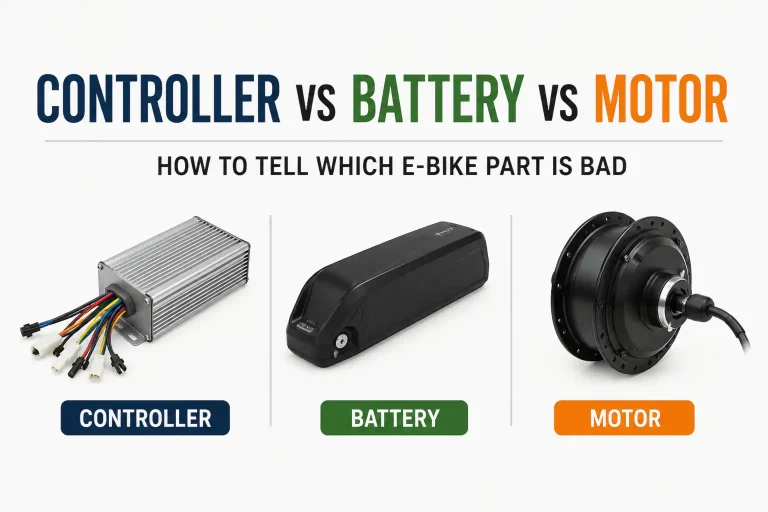
My Controller vs Battery vs Motor: How to Tell Which E-Bike Part Is Bad guide can help narrow down which part of the electrical system deserves further testing.
10. Moisture Can Cause Intermittent Electrical Problems
If the jerking started shortly after riding in heavy rain, washing the bike, crossing deep water, or transporting it in wet conditions, moisture becomes an important clue.
Water or moisture can contribute to problems at damaged or poorly sealed connectors, sensors, displays, throttles, wiring, or other electrical components.
If you suspect moisture:
- Turn the bike off.
- Remove the battery only if it is designed for normal owner removal and the manufacturer’s instructions allow it.
- Do not charge a wet or potentially water-damaged battery.
- Allow the bike to dry in a safe location.
- Inspect owner-accessible connections for visible moisture, corrosion, or damage.
If the jerking began after a wet ride or washing, start with my wet-weather electrical troubleshooting guide.
A battery that has been submerged, seriously damaged, unusually hot, swollen, leaking, smoking, sparking, or giving off a strong chemical or burning odor should be treated as a potentially serious battery-safety problem.
For additional lithium-ion battery and charging safety guidance, see the U.S. Consumer Product Safety Commission’s Micromobility Information Center.
11. The Problem May Be Mechanical Rather Than Electrical
Sometimes what feels like the motor surging is actually the drivetrain slipping or another mechanical component moving unexpectedly.
Potential mechanical causes can include:
- A worn chain
- Chain skipping
- Cassette or freewheel problems
- Derailleur adjustment problems
- Loose crank components
- Wheel or axle problems
- Brake rubbing
- Internal motor or hub problems
One useful clue is whether the bike still jerks when motor assistance is completely turned off.
If the sensation remains with assistance off, a mechanical problem moves much higher on the list.
Also listen carefully.
Grinding, clunking, scraping, popping, or repeated slipping noises deserve investigation before you continue riding.
For motor-specific noises, see E-Bike Motor Makes Grinding Noise: Causes, Fixes & When to Stop Riding.
A Good Troubleshooting Order
Jerking can have many possible causes, so replacing components randomly can quickly become expensive.
I would work through the problem in roughly this order:
- Identify exactly when it happens. PAS, throttle, braking, bumps, hills, low battery, or all the time?
- Check the display. Look for restarts, 0 mph readings, battery-indicator changes, and error codes.
- Try a lower assist level. This can help distinguish abrupt PAS behavior from a new fault.
- Check the brakes. Make sure the levers return normally and the motor cutoff is not behaving unexpectedly.
- Check battery seating.
- Inspect owner-accessible connectors and visible wiring.
- Inspect PAS and speed-sensor areas where applicable.
- Consider whether rain, washing, transportation, a crash, or a recent repair preceded the problem.
- Check the mechanical drivetrain.
- Move to component testing only after simpler causes have been considered.
If your display is showing an error, use my E-Bike Error Code Finder before assuming a specific component needs replacing.
You can also browse my E-Bike Tools Hub for additional battery, controller, error-code, and troubleshooting tools.
Helpful Tools & Accessories for Troubleshooting Your E-Bike
Before replacing expensive parts, I recommend having a few basic tools on hand. They’re inexpensive, useful for routine maintenance, and can make diagnosing common e-bike problems much easier.
- Digital Multimeter – Helps check basic voltage at the battery or charger, but it does not prove the battery is healthy under load. Only use one if you know how to avoid shorting the terminals.
- Portable Bike Pump – Keeps your tires properly inflated, reducing strain on the motor when climbing hills.
- Digital Tire Pressure Gauge – Lets you verify your tire pressure for better efficiency and hill-climbing performance.
- Hex Key (Allen Wrench) Set – Useful for tightening loose components, battery mounts, and accessories.
- Bike Repair Multi-Tool – A compact tool for making quick adjustments at home or on the trail.
- Electrical Contact Cleaner – Helps clean battery terminals and electrical connectors if dirt or corrosion is causing poor contact.
- Dielectric Grease – Can help protect some connector seals from moisture, but use it sparingly and only where appropriate. Do not pack random electrical plugs or battery terminals with grease.
- Head Lamp or Small Flashlight – Helps you inspect battery contacts, wiring plugs, and connector pins more clearly.
- Zip Ties – Good for securing loose wires after you confirm everything is working correctly.
- Bike Repair Stand – Can hold your e-bike steady while you inspect the pedal sensor, wiring, and crank area.
➡️ View all recommended e-bike accessories
Still Stuck After Trying These Steps?
Some electrical issues aren’t obvious and can take time to track down – especially with controllers, wiring harnesses, or battery systems.
👉 Get help from a verified e-bike expert and pinpoint the issue faster
Before You Replace the Battery, Controller, or Motor
Jerking alone is not enough to prove that an expensive electrical component has failed.
For example, a bike that cuts out on a hill could have a battery problem, but it could also have a loose connection, controller problem, electrical-load issue, temperature-related problem, or battery-protection event.
Similarly, PAS surging does not automatically prove that the controller or pedal sensor is faulty.
Before replacing a major component, try to establish whether the problem affects:
- PAS only
- Throttle only
- Both PAS and throttle
- The display and entire electrical system
- Only high-load riding
- Mechanical operation even when assistance is off
That pattern is often more useful than the symptom “the bike jerks” by itself.
If you are trying to separate major-component symptoms, compare them with my battery vs controller vs motor troubleshooting guide before buying replacement parts.
When Should You Stop Riding?
Some jerking problems are frustrating but not immediately dangerous. Others can make the bike unpredictable.
Stop riding and investigate the problem before using the bike again if:
- The bike accelerates without your input.
- The throttle sticks.
- Assistance continues abnormally after you stop pedaling or release the throttle.
- The bike jerks strongly enough to affect balance or steering.
- A wheel, crank, or axle appears loose.
- You hear severe grinding, clunking, scraping, or repeated drivetrain slipping.
- The display or electrical system repeatedly shuts off during riding.
- Wiring is visibly damaged.
- A connector is melted, burned, or unusually hot.
- You smell burning or a strong chemical odor.
- You see smoke or sparks.
- The battery is swollen, leaking, seriously damaged, or unusually hot.
Do not keep riding simply to “see if it gets worse” when the bike is accelerating unpredictably or showing signs of serious electrical, mechanical, or battery damage.
For lithium-ion battery and charging safety, see the CPSC Micromobility Information Center.
When to Take the E-Bike to a Technician
Owner-level troubleshooting is useful for checking battery seating, obvious sensor problems, brake-lever behavior, error codes, and owner-accessible connectors.
Professional diagnosis becomes more appropriate when:
- No obvious cause can be found.
- The problem keeps returning.
- The bike surges unpredictably.
- Testing would require opening the battery or controller.
- Internal motor or sensor testing is needed.
- Wiring inside the frame may be damaged.
- The motor itself is making abnormal noises.
- A component or connector shows heat damage.
- The bike has been involved in a serious crash or water exposure.
If the bike is still under warranty, contact the manufacturer before opening electrical components or replacing parts. Check the warranty terms for your particular bike before performing repairs that go beyond normal owner maintenance.
Related E-Bike Troubleshooting Guides
If you are still narrowing down the cause, these are some of the most relevant guides to try next:
- E-Bike Brake Cutoff Sensor Stuck? Causes, Fixes, and When to Stop Riding
- E-Bike Shuts Off Going Uphill? Causes, Fixes & Troubleshooting
- How to Find Loose Electrical Connections on an E-Bike
- Controller vs Battery vs Motor: How to Tell Which E-Bike Part Is Bad
- E-Bike Motor Makes Grinding Noise: Causes, Fixes & When to Stop Riding
- Why Is My E-Bike Pedal Assist Delayed? Causes, Fixes, and What to Check First
- 5 Common Pedal Assist Problems and How to Fix Them
- E-Bike Display Turns On but Speedometer Shows Zero: Causes and Fixes
- Why Does My E-Bike Battery Percentage Jump Up and Down?
- E-Bike Cuts Out While Riding? Fixes for Battery, Motor & Wiring
- E-Bike Throttle Not Working? Here’s How to Fix It
- E-Bike Troubleshooting and Maintenance Guide
You can also visit the E-Bike Tools Hub for additional interactive troubleshooting resources.
Frequently Asked Questions
Why does my e-bike jerk when I start pedaling?
If it has always done this, you may be feeling the way its pedal-assist system engages. Some cadence-based systems can provide a noticeable increase in assistance once pedal movement is detected.
If the behavior is new, unusually strong, or inconsistent, check the PAS sensor, magnet ring if equipped, sensor wiring, brake cutoff system, and accessible electrical connections.
For PAS-specific symptoms, see my pedal-assist troubleshooting guide.
Why does my e-bike surge while riding at a steady speed?
Surging at a steady pace can be related to inconsistent PAS input, a speed-sensor problem, brake cutoff behavior, electrical connections, controller input, or another intermittent signal.
Look for patterns such as bumps, braking, changes in pedal cadence, display changes, or certain assist levels.
If the display speed also drops to zero or becomes erratic, see what to check when an e-bike speedometer shows zero.
Why does my e-bike jerk when going uphill?
Hills place more demand on the electrical system. Battery voltage sag, a low or aging battery, a battery-protection event, loose connection, controller problem, motor load, or a temperature-related issue may become more noticeable during a climb.
If the entire bike shuts off on hills, use my uphill shutdown troubleshooting guide.
Can a loose battery make an e-bike jerk?
It can. If the electrical connection at the battery briefly loses contact during vibration or bumps, motor power may disappear and return.
Check that the battery is fully seated and locked according to the manufacturer’s instructions, and inspect owner-accessible contacts for obvious damage, discoloration, or heat.
If the symptom happens mainly over bumps, see How to Find Loose Electrical Connections on an E-Bike.
Can a bad controller cause surging?
It can, but surging by itself does not prove that the controller is faulty.
PAS sensors, brake sensors, throttles, batteries, wiring, connectors, speed-sensing problems, and motor-related issues can produce overlapping symptoms. Check the simpler possibilities first.
Use my Controller vs Battery vs Motor guide if you are having trouble narrowing down the electrical system.
Why does my e-bike jerk only when I use the throttle?
That pattern makes the throttle, throttle wiring, connector, settings, or controller throttle input more relevant.
If pedal assist works normally, start with my E-Bike Throttle Not Working troubleshooting guide before assuming the battery or motor has failed.
Why does my e-bike jerk after I use the brakes?
If motor assistance cuts out and returns unexpectedly after braking, inspect the brake levers and brake cutoff system.
Make sure each lever returns completely to its normal resting position. If lightly moving a lever changes the problem when you are not intentionally braking, continue with my brake cutoff sensor troubleshooting guide.
Why does my e-bike jerk over bumps?
A symptom triggered by bumps can point toward battery seating or an intermittent electrical connection, although mechanical problems are also possible.
Check the battery mount and owner-accessible connectors with the bike powered off. If the display flickers or resets at the same time, an electrical connection becomes especially important to investigate.
See my loose electrical connection guide for a more systematic inspection process.
Is it safe to ride an e-bike that is surging?
It depends on how severe and predictable the symptom is.
A mild, familiar burst when pedal assist engages is very different from unexpected acceleration or violent jerking. Stop riding if assistance occurs without your input, the throttle sticks, the bike becomes difficult to control, or you notice serious electrical, mechanical, or battery-safety warning signs.
My Take
Jerking and surging are good examples of why e-bike troubleshooting should start with the pattern of the symptom rather than immediately replacing parts.
If the bike has always delivered a noticeable push when cadence-based pedal assist starts, it may simply be the way that particular system delivers assistance. A new or worsening problem is different.
Pay attention to whether the jerking happens with PAS, throttle, braking, bumps, hills, low battery, or both PAS and throttle. Also watch the display and listen for mechanical noise.
Those clues can quickly move you toward the PAS system, speed sensor, brake cutoff, battery connection, throttle, wiring, battery power delivery, controller, or drivetrain without guessing.
And if the bike begins accelerating without your input or the jerking affects your ability to control it, treat that as a stop-riding problem, not something to troubleshoot while continuing your ride.
Disclosure: As an Amazon Associate, I earn from qualifying purchases. This comes at no extra cost to you and helps support the content on this site.
External Sources
I used manufacturer documentation and government safety information to help verify the technical and safety guidance in this article:
- Bosch eBike Systems – Performance Line Speed – Speed-sensor and magnet configurations used with Bosch e-bike systems.
- Ride1Up – Brake Sensor Issues – Manufacturer information about brake cutoff sensors, motor cutoff behavior, and brake-sensor troubleshooting.
- U.S. Consumer Product Safety Commission – Micromobility Information Center – Federal safety information for e-bikes, lithium-ion batteries, charging, recalls, and other micromobility products.

Kristina is not just an enthusiast but a true authority on electric bikes. Nestled in the coastal beauty of Virginia, Kristina has found the perfect backdrop for her passion for electric biking. As a dedicated wife and homeschooling mom, her life revolves around family, faith, and the thrill of adventure.
Originally hailing from Ohio, Kristina's journey with electric bikes began as a curiosity and quickly evolved into a deep expertise. Her blog is a testament to her love for electric biking, combining her fascination for eco-friendly transportation with her coastal lifestyle.
When she's not cruising the beach on her electric bike, you'll find Kristina indulging in her other loves: long walks along the shore, getting lost in a good book, and cherishing moments with her loved ones. With a heart as big as her love for animals, especially cats, Kristina brings a unique perspective to the electric bike world, grounded in her strong faith in God and her dedication to a sustainable lifestyle.
Through her blog, Kristina shares her extensive knowledge of electric bikes, offering valuable insights, tips, and recommendations to fellow enthusiasts. Whether you're a seasoned rider or a newcomer to the electric bike scene, Kristina's blog is your go-to source for all things electric biking, fueled by her passion, expertise, and the scenic beauty of coastal Virginia.