Massachusetts Bill Could Require Registration and Insurance for Some High-Speed E-Bikes
Massachusetts is moving closer to a major overhaul of its e-bike and micromobility laws – and riders across the state are paying close attention.
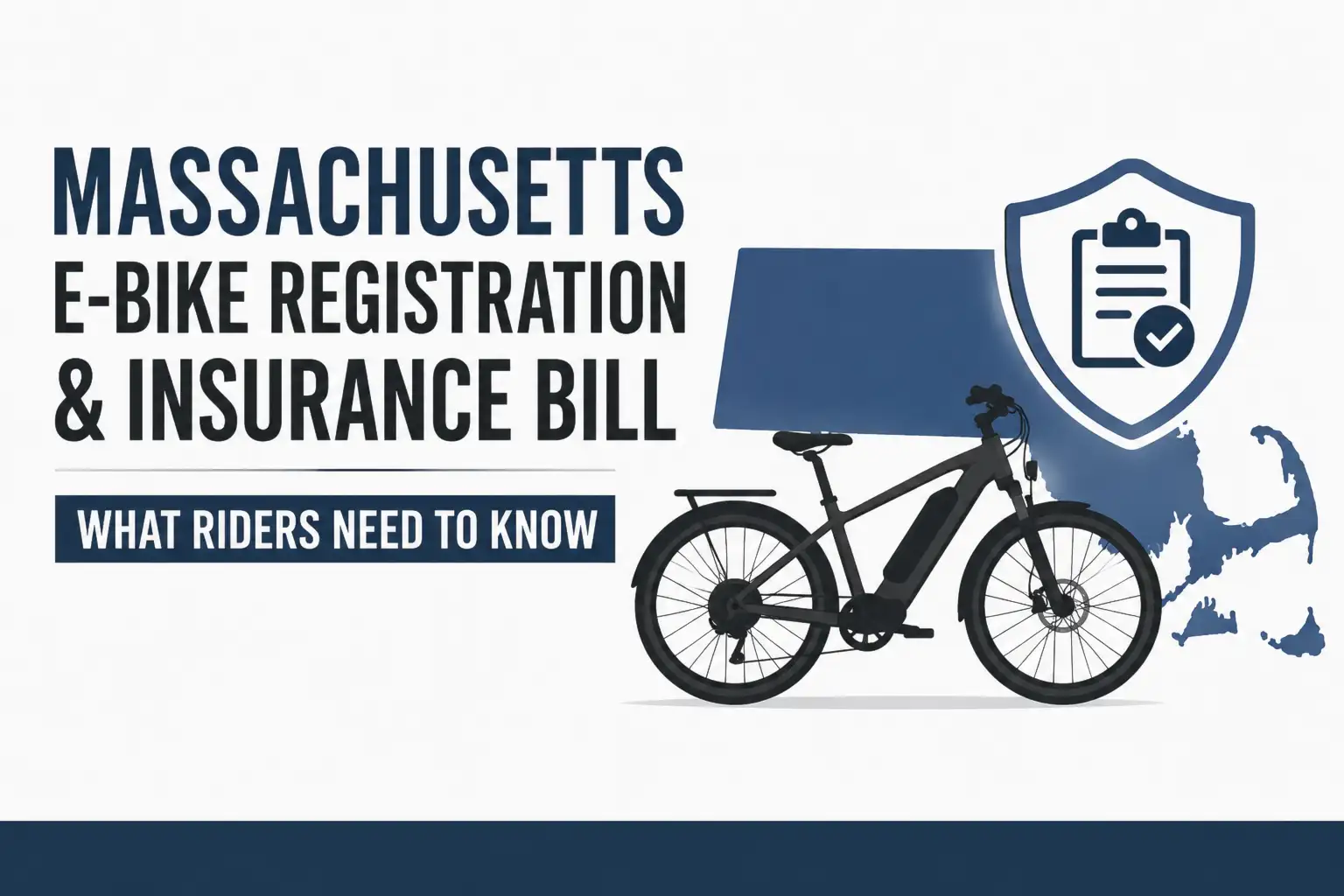
Governor Maura Healey has filed legislation called the “Ride Safe Act” (S.3077), which would create a new speed-based system for regulating e-bikes, scooters, mopeds, and other micromobility devices.
The biggest headline grabbing attention right now is the possibility of:
- annual registration
- license plates or identification decals
- liability insurance requirements
- restrictions on bike lane access
But one important detail needs clarification:
The proposal does not appear to treat standard low-speed Class 1 and Class 2 e-bikes the same as high-speed e-mopeds or electric motorcycles.
Based on the bill language, ordinary 20 mph Class 1 and Class 2 commuter e-bikes would largely continue being treated similarly to bicycles.
Why Massachusetts Is Updating E-Bike Laws
State officials say current Massachusetts law has become outdated as e-bikes and micromobility devices have rapidly evolved.
According to the Healey administration, lawmakers are trying to address:
- rising crash concerns
- reckless riding complaints
- confusion around current classifications
- conflicts between riders and pedestrians
- increasingly fast electric vehicles using bicycle infrastructure
The proposed legislation would create clearer statewide rules based primarily on speed tiers instead of older category labels.
How This Compares to Current Massachusetts E-Bike Law
Right now, Massachusetts still uses a mix of older “motorized bicycle” and moped-style definitions that can create confusion around:
- where you can legally ride
- whether registration is required
- how enforcement works
- what counts as an e-bike vs a moped
👉 For a full breakdown of the current rules, see my
Massachusetts E-Bike Laws Guide →
👉 I also recently covered the proposed speed-tier framework here:
Massachusetts Proposes New E-Bike & Scooter Laws With Speed-Based Tiers →
👉 Want to compare Massachusetts to other states?
See my complete State-by-State E-Bike Laws Guide →
👉 Not sure about sidewalk riding rules?
See my full E-Bikes on Sidewalks Guide →
🎬 Quick video breakdown of the proposed Massachusetts e-bike law changes, including registration, insurance, and new speed-tier rules:
What the New Massachusetts Proposal Would Do
The proposed Ride Safe Act creates four speed-based categories.
Speed Tier 0 (0–20 mph)
This category includes most standard commuter e-bikes and lower-speed Class 1 and Class 2 e-bikes.
These devices would generally continue being treated similarly to bicycles.
Helmet requirements would apply for riders under 16.
Speed Tier 1 (20–30 mph)
This category includes faster Class 3-style e-bikes and some moped-like devices.
The proposal includes:
- expanded helmet requirements
- restrictions on sidewalk riding
- additional operational rules
These bikes may still retain some bicycle infrastructure access depending on local regulations and final bill revisions.
Speed Tier 2 (30–40 mph)
This is where the proposal becomes significantly stricter.
These higher-speed vehicles would fall into categories where Massachusetts could require:
- registration
- license plates or identification decals
- liability insurance
- additional operating requirements
The proposal gives regulators authority to develop more detailed enforcement and registration systems over time.
These devices would increasingly be treated more like mopeds or motorcycles than bicycles.
Speed Tier 3 (40+ mph)
These vehicles would essentially be treated as motorcycles and excluded from bicycle infrastructure.
Registration and Insurance Requirements Explained
One reason this proposal has generated so much debate is because early headlines suggested “all e-bikes” would require insurance and registration.
But after reviewing both the bill discussions and state release, the proposal appears more targeted toward higher-speed motorized bicycles and e-moped-style devices rather than ordinary 20 mph commuter e-bikes.
The proposal creates a framework that could allow:
- annual registration
- identification stickers or license-style markings
- proof of liability insurance
- stricter operating requirements for higher-speed devices
The legislation also establishes a working group that could recommend additional rules and implementation details before full rollout.
If passed, portions of the legislation would reportedly begin implementation in 2028.
The Proposal Also Focuses on Battery Safety
Another major part of the Ride Safe Act involves electrical and battery safety standards.
The proposal would require certain micromobility devices to meet recognized UL safety certifications, including standards tied to:
- e-bike electrical systems
- lithium-ion batteries
- powered scooters and similar devices
Battery fires and unsafe aftermarket battery systems have become a growing concern nationwide, especially in dense urban areas.
If passed, Massachusetts could become one of the stricter states when it comes to e-bike battery safety compliance.
Bike Lane and Path Restrictions
The legislation would also restrict certain higher-speed devices from:
- bike lanes
- off-street bike paths
- shared-use recreational trails
That’s becoming a growing national trend as states try separating traditional bicycles from faster electric motorcycles and modified e-bikes.
Helmet Rules Would Expand
The proposal would require:
- helmets for riders under 16 on lower-speed e-bikes
- helmets for all riders using certain higher-speed tiers
Helmet laws are becoming increasingly common as states react to rising injury concerns involving faster electric bikes and scooters.
Modified and High-Speed E-Bikes Could Face the Biggest Changes
One important takeaway from this proposal:
Modified e-bikes may be regulated based on actual speed capability – not just their original factory classification.
That means:
- speed unlocks
- controller modifications
- dual-motor conversions
- aftermarket tuning
…could potentially push a bike into a higher regulatory category.
This is something more states are beginning to focus on as extremely fast “e-bike” style vehicles become more common.
Riders Are Already Debating the Proposal
Reaction online has been mixed.
Some riders support stricter rules for high-speed electric motorcycles using bike lanes and pedestrian areas.
Others worry the proposal could eventually:
- expand into lower-speed commuter bikes
- increase costs for riders
- reduce affordable transportation options
- create overregulation
One thing I noticed while reviewing community reactions is that many riders actually support separating true e-bikes from 40+ mph electric motorcycles – they just don’t want ordinary commuter e-bikes caught in the same regulations.
Essential E-Bike Gear (Quick Picks)
Before you choose your e-bike, these are the accessories most riders end up needing for safety and everyday use:
- Bike Lock – protect your investment
- Helmet – essential for safety
- Lights – ride safely in low visibility
- Storage (bags/racks) – carry gear easily
- Rearview Mirror – improve awareness in traffic
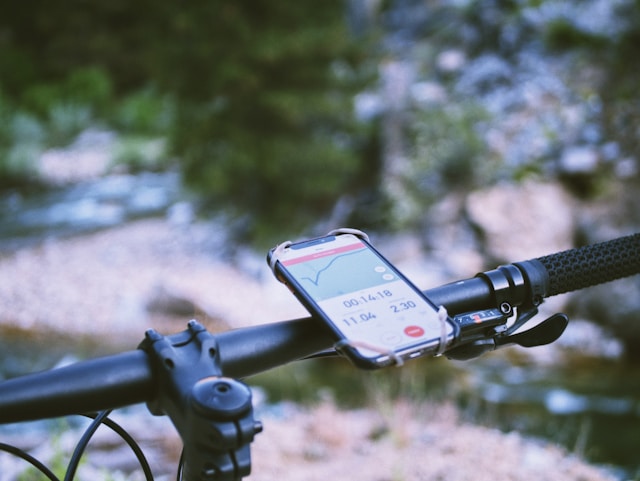
- Phone Mount – use navigation and track rides safely
- Tire Repair Kit – be prepared for unexpected flats on the road or trail.
- Portable Bike Pump – keep your tires properly inflated for the best ride quality and range.
My Take
Personally, I think Massachusetts is trying to solve a real problem – but this is a very delicate balancing act.
I completely understand why states are becoming concerned about extremely fast electric motorcycles riding in bike lanes and crowded shared-use paths. A 45 mph electric dirt bike operating beside pedestrians is not the same thing as a normal commuter e-bike.
At the same time, I think lawmakers need to be very careful not to overregulate standard low-speed e-bikes that many people rely on for:
- commuting
- affordable transportation
- replacing short car trips
- mobility access
One thing I’ve consistently noticed covering e-bike laws is that the biggest issues usually involve:
- illegal modifications
- reckless riding
- speed-unlocked bikes
- electric dirt bikes operating illegally
- lack of enforcement of existing rules
—not ordinary pedal-assist commuters.
Personally, I think the smartest long-term approach is probably:
- keep standard low-speed e-bikes accessible
- separate true high-speed e-motos from bicycles
- improve enforcement against reckless riding
- create clearer rules riders can actually understand
Right now, there’s still a lot of confusion around the proposal because some headlines made it sound like every e-bike in Massachusetts would suddenly need insurance and registration.
After reviewing the proposal more closely, that does not appear to be the case.
Still, this is definitely one of the most important e-bike law developments happening in the U.S. right now because other states may eventually follow a similar speed-tier model.
For more news on electric bikes click here
External Sources
- https://www.mass.gov/news/governor-healey-files-ride-safe-act-to-strengthen-public-safety-regulate-e-bikes-mopeds-and-scooters
- https://malegislature.gov/Bills/194/S3077

Kristina is not just an enthusiast but a true authority on electric bikes. Nestled in the coastal beauty of Virginia, Kristina has found the perfect backdrop for her passion for electric biking. As a dedicated wife and homeschooling mom, her life revolves around family, faith, and the thrill of adventure.
Originally hailing from Ohio, Kristina's journey with electric bikes began as a curiosity and quickly evolved into a deep expertise. Her blog is a testament to her love for electric biking, combining her fascination for eco-friendly transportation with her coastal lifestyle.
When she's not cruising the beach on her electric bike, you'll find Kristina indulging in her other loves: long walks along the shore, getting lost in a good book, and cherishing moments with her loved ones. With a heart as big as her love for animals, especially cats, Kristina brings a unique perspective to the electric bike world, grounded in her strong faith in God and her dedication to a sustainable lifestyle.
Through her blog, Kristina shares her extensive knowledge of electric bikes, offering valuable insights, tips, and recommendations to fellow enthusiasts. Whether you're a seasoned rider or a newcomer to the electric bike scene, Kristina's blog is your go-to source for all things electric biking, fueled by her passion, expertise, and the scenic beauty of coastal Virginia.