Can Police Pull Over E-Bike Riders? What Riders Need to Know About E-Bike Traffic Stops
Last Updated on June 1, 2026 by Kristina
Electric bikes are becoming more common across the United States, and so are questions about e-bike laws, enforcement, and police interactions. One of the biggest questions riders ask is:
Can police pull over an e-bike rider?
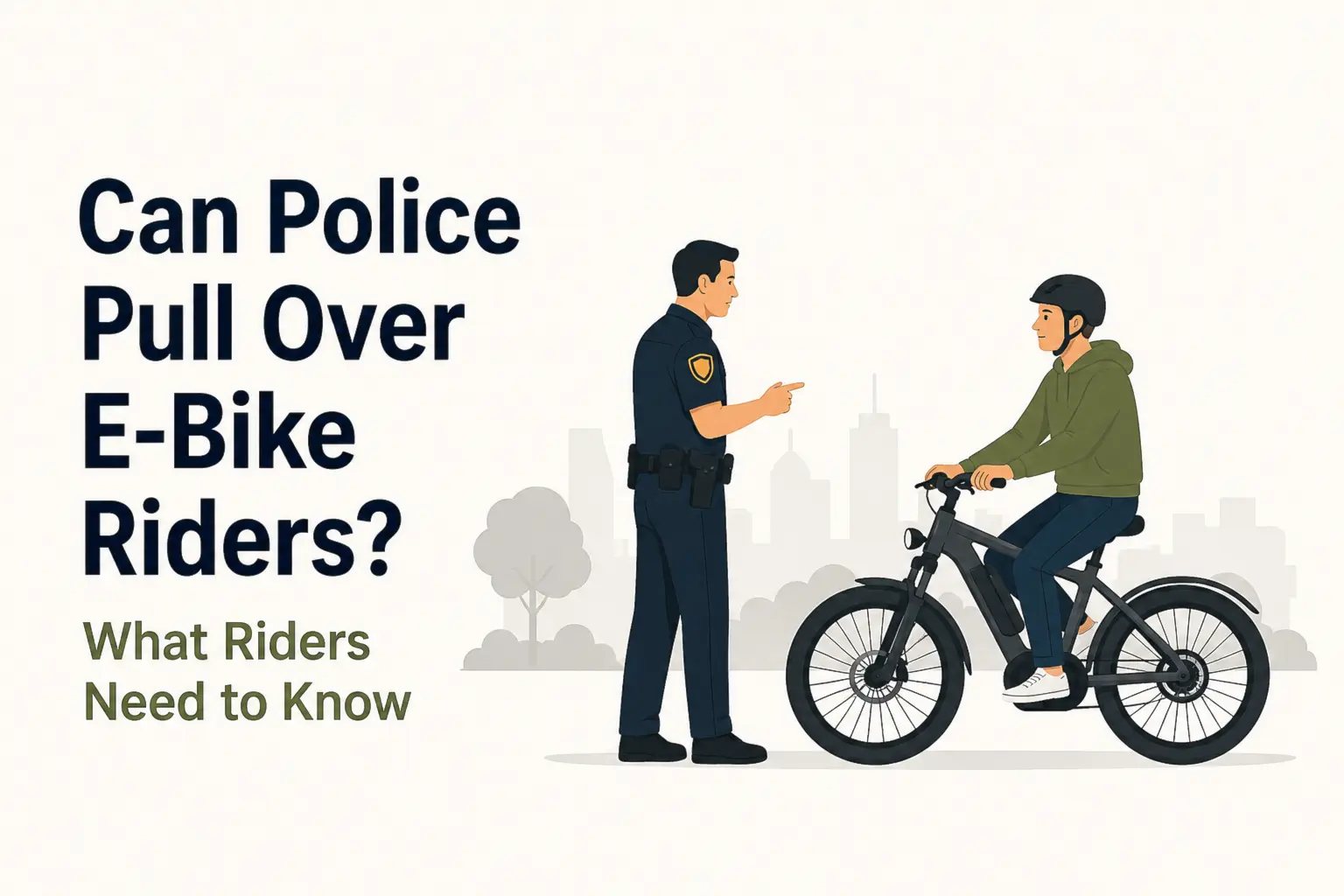
The short answer is yes. In many situations, police officers can legally stop e-bike riders for traffic violations, unsafe riding, illegal modifications, reckless behavior, or violations of local e-bike laws.
As e-bike use continues to grow, law enforcement agencies in some cities are increasing enforcement efforts, especially around high-speed riding, sidewalk use, modified bikes, and electric motorcycles being disguised as e-bikes.
According to PeopleForBikes, most U.S. states now use a three-class e-bike system that helps define where and how electric bikes can legally operate.
If you are new to riding, start with:
- 👉 E-Bike Buying Guide
- 👉 State-by-State E-Bike Laws Guide
- 👉 E-Bike Classes Explained
- 👉 Maintenance & Troubleshooting Guide
Who This Guide Is For (and Who It’s Not)
This guide is for:
- New e-bike riders
- Commuters using e-bikes on roads or bike paths
- Riders confused about local e-bike enforcement
- Parents buying e-bikes for teenagers
- Riders worried about police stops or tickets
- Anyone riding Class 2 or Class 3 e-bikes
This guide is NOT for:
- Riders using illegal electric motorcycles off-road
- Legal advice for criminal cases
- State-specific legal representation
What Police Usually Look For With E-Bikes
Most police officers are not looking to stop ordinary riders commuting responsibly.
Enforcement usually focuses on:
- Excessive speed
- Unsafe sidewalk riding
- Reckless behavior around pedestrians
- Illegal modified e-bikes
- Missing lights during night riding
- Riders ignoring traffic laws
- Groups riding dangerously in public areas
- Electric motorcycles being marketed as e-bikes
In many cities, complaints from pedestrians and residents are what lead to increased enforcement.
Can Police Pull Over an E-Bike Rider?
Yes. In most states, police officers can stop e-bike riders for many of the same reasons they stop regular bicyclists or drivers.
That can include:
- Speeding
- Running stop signs
- Riding recklessly
- Illegal sidewalk riding
- Riding in prohibited areas
- Riding a modified e-bike
- Riding an unclassified high-speed electric bike
- Dangerous riding near pedestrians
- Riding under the influence
In many areas, e-bike riders are expected to follow standard traffic laws when operating on roads and shared-use paths.
Police do not need a special “e-bike law” to stop a rider if the behavior appears unsafe or violates local traffic regulations.
Quick Comparison: Can Police Stop You?
| Situation | Can Police Stop You? |
|---|---|
| Running a stop sign | Yes |
| Riding too fast on a trail | Yes |
| Illegal sidewalk riding | Yes |
| Riding a modified e-bike | Yes |
| Reckless riding | Yes |
| Riding under the influence | Yes |
| Riding legally and responsibly | Usually not a problem |
Why Police Are Paying More Attention to E-Bikes
Across the U.S., cities have reported:
- Faster e-bike speeds on crowded trails
- More complaints from pedestrians
- Teens riding modified bikes
- Illegal throttle modifications
- Electric motorcycles being sold as “e-bikes”
- Unsafe riding in beach towns, boardwalks, and parks
Some cities have started targeted enforcement campaigns around:
- Boardwalks
- Shared-use paths
- Downtown sidewalks
- Tourist areas
- School zones
- Public parks
We recently covered enforcement crackdowns in places like:
- Virginia Beach
- Parker, Colorado
- California coastal areas
- New York City
These enforcement efforts often focus less on ordinary commuters and more on dangerous or illegal riding behavior.
Common Reasons Police Pull Over E-Bike Riders
Riding Too Fast
Many riders do not realize their e-bike may exceed local speed limits on trails or shared-use paths.
Even legal Class 3 e-bikes can create problems if riders travel too fast around pedestrians.
Some local bike paths have speed limits of:
- 10 mph
- 15 mph
- 20 mph
Police may stop riders who:
- Weave through crowds
- Ignore pedestrians
- Ride aggressively
- Pass unsafely
Riding on Sidewalks Where E-Bikes Are Prohibited
This is one of the most common enforcement issues.
Many cities:
- Ban Class 3 e-bikes on sidewalks
- Restrict throttle e-bikes
- Limit all bicycles downtown
- Restrict riding near tourist areas
Some riders assume statewide rules override city rules, but local ordinances often matter.
That is why it is important to check:
- State laws
- City rules
- Park rules
- Trail regulations
👉 Related: Sidewalk E-Bike Laws Guide
Riding an Illegal or Modified E-Bike
Police are increasingly targeting bikes that:
- Exceed legal speed limits
- Have removed speed limiters
- Use oversized motors
- Operate more like electric dirt bikes or mopeds
A bike marketed online as an “e-bike” may not legally qualify as one in your state.
In many states:
- Legal Class 1 and Class 2 e-bikes max out at 20 mph
- Legal Class 3 e-bikes max out at 28 mph pedal assist
- Higher-speed bikes may require registration, insurance, or licensing
Some riders get stopped because officers suspect the bike is actually:
- An electric motorcycle
- An unregistered moped
- An illegal off-road vehicle
Warning About Modified E-Bikes
Removing speed limiters or unlocking higher speeds may legally change your bike from an e-bike into a motor vehicle in some states.
That can affect:
- registration,
- insurance,
- licensing,
- and where the bike can legally operate.
What Can Make an E-Bike Illegal?
This is becoming one of the biggest enforcement issues in the U.S.
An e-bike may become illegal if it:
- Has a removed speed limiter
- Exceeds Class 3 speed limits
- Uses unauthorized modifications
- Has an oversized motor beyond local legal limits
- Functions more like a motorcycle than a bicycle
- Is marketed deceptively online
Many riders are surprised to learn that some imported “e-bikes” may legally qualify as:
- Mopeds
- Motor-driven cycles
- Off-road motorcycles
instead of standard electric bicycles.
That distinction can affect:
- Registration requirements
- Licensing
- Insurance
- Where you can legally ride
Reckless Riding
Police may stop riders for:
- Swerving through traffic
- Riding against traffic
- Ignoring stop signs
- Running red lights
- Carrying passengers unsafely
- Riding one-handed in traffic
- Using phones while riding dangerously
Even if your e-bike itself is legal, unsafe riding behavior can still lead to tickets.
Riding Under the Influence
In many states, DUI laws can apply to bicycles and e-bikes.
That means riding an e-bike while intoxicated could potentially result in:
- Citations
- Arrests
- DUI charges
State laws vary significantly on this issue.
Can Police Check Your E-Bike Speed?
Yes, in some situations police may investigate whether an e-bike is exceeding legal speed limits.
Officers may:
- Estimate speed visually
- Use radar in targeted enforcement areas
- Observe unsafe riding behavior
- Check the bike’s display settings
- Inspect class stickers or motor labels
This is becoming more common in:
- Tourist areas
- Beach towns
- Boardwalks
- Shared-use trails
- Downtown pedestrian zones
Even if your bike is technically legal, riding dangerously fast around pedestrians can still lead to a stop.
What Happens If Your E-Bike Exceeds 28 MPH?
In many states, a legal Class 3 e-bike is limited to:
- 28 mph pedal assist
- 750W motor maximum (in many jurisdictions)
Once a bike exceeds those limits, it may legally stop being considered an e-bike.
Instead, it could potentially be classified as:
- A moped
- A motor-driven cycle
- An electric motorcycle
That can trigger requirements such as:
- Registration
- Insurance
- Licensing
- VIN requirements
- Restricted riding locations
This is one of the biggest reasons police are increasingly checking modified high-speed bikes.
The U.S. Consumer Product Safety Commission (CPSC) defines low-speed electric bicycles differently from higher-speed motor vehicles, which is one reason modified bikes can create legal confusion.
Can Police Stop You on Bike Trails or Greenways?
Yes, in many situations police or park enforcement officers can stop riders on:
- Rail trails
- Greenways
- Shared-use paths
- Boardwalks
- Park systems
- Beach paths
This often happens when riders:
- Exceed posted speed limits
- Ride recklessly near pedestrians
- Use prohibited e-bike classes
- Ride modified bikes
- Ignore local trail rules
Some trails allow:
- Class 1 only
Others allow:
- Class 1 and Class 2
And some ban all motorized vehicles entirely.
That is why trail access rules can vary dramatically by location.
How to Tell If Your E-Bike Is Street Legal
Many riders are surprised to learn their bike may not legally qualify as an e-bike in some areas.
Quick E-Bike Legality Checklist
✅ Proper class sticker
✅ Legal speed limit
✅ Legal motor wattage
✅ Required lights/reflectors
✅ No illegal modifications
Your E-Bike Class
Make sure the bike is properly labeled as:
- Class 1
- Class 2
- Class 3
Top Assisted Speed
Most legal e-bikes are limited to:
- 20 mph (Class 1 & 2)
- 28 mph (Class 3)
Motor Power
Many states follow the 750W standard for legal e-bikes.
Throttle Rules
Some trails and cities restrict throttle-operated bikes.
Required Equipment
Depending on your location, legal requirements may include:
- Front/rear lights
- Reflectors
- Helmets
- Bells
- Age restrictions
Modifications
Removing speed limiters or changing controller settings may make the bike illegal for public road use.
👉 Related: E-Bike Classes Explained
Common E-Bike Law Myths
- “Police Can’t Pull Over Bicycles”
False. Police can stop bicyclists and e-bike riders for traffic violations. - “If It Has Pedals, It’s Automatically Legal”
False. Some electric motorcycles include pedals but still exceed legal e-bike definitions. - “All Trails Allow E-Bikes”
False. Trail rules vary widely by city, county, park system, and state. - “Throttle E-Bikes Are Legal Everywhere”
False. Some areas restrict or ban throttle-equipped bikes. - “Police Only Care About Dirt Bikes”
False. Enforcement can also apply to speeding, reckless riding, sidewalk riding, and modified commuter e-bikes.
Real-World E-Bike Enforcement Scenarios
Scenario 1: Fast Boardwalk Riding
You ride 28 mph through a crowded beach boardwalk.
Could police stop you?
→ Very likely.
Scenario 2: Legal Commuting
You ride a properly classified Class 2 e-bike responsibly on city streets.
Could police stop you?
→ Usually unlikely unless another violation occurs.
Scenario 3: Modified High-Speed Bike
Your e-bike has an unlocked 40 mph mode and removed limiter.
Could police stop you?
→ Very possible.
Scenario 4: Illegal Sidewalk Riding
You ride quickly through crowded downtown sidewalks where bikes are prohibited.
Could police stop you?
→ Very likely.
States and Cities Seeing Increased E-Bike Enforcement
Some areas around the U.S. have seen more aggressive e-bike enforcement due to growing complaints and safety concerns.
Examples include:
- New York City
- California beach communities
- Virginia Beach boardwalk areas
- Colorado towns addressing high-speed e-motos
- Tourist-heavy coastal cities
We have also covered changing e-bike laws and enforcement in:
👉 Related: State-by-State E-Bike Laws Guide
Local Laws Matter More Than Many Riders Realize
One of the biggest sources of confusion is that state law is only part of the equation.
Many cities, counties, trails, and park systems create their own rules regarding:
- Sidewalk riding
- Trail access
- Boardwalk riding
- Speed limits
- Class restrictions
- Helmet rules
That means a bike that is legal in one city may face restrictions in another nearby area.
This is especially common in:
- Tourist towns
- Coastal communities
- Downtown business districts
- Public parks
- Shared-use trails
The National Conference of State Legislatures (NCSL) notes that state and local governments may regulate where e-bikes are allowed, including trails, sidewalks, and shared-use paths.
Can Police Confiscate an E-Bike?
In some situations, yes.
Police may impound or confiscate an e-bike if:
- It is illegally modified
- It is being operated unlawfully
- It is connected to criminal activity
- It is considered an unregistered motor vehicle
- The rider refuses lawful orders
This is more common with:
- High-speed electric dirt bikes
- Unregistered electric motorcycles
- Modified throttle bikes
- Illegal street riding
It is far less common for ordinary commuter e-bike riders following traffic laws.
What Happens During an E-Bike Traffic Stop?
Most e-bike stops are similar to bicycle traffic stops.
An officer may:
- Ask you to stop safely
- Ask basic questions
- Check the bike class label
- Ask for identification
- Explain the violation
- Issue a warning or citation
In some states or situations, officers may inspect:
- Motor wattage labels
- Speed settings
- VIN or serial numbers
- Modifications
Know Your Rights During an E-Bike Stop
If you are stopped while riding:
- Stay calm and respectful
- Avoid arguing roadside
- Follow lawful instructions
- Ask politely why you were stopped
- Keep your hands visible
- Do not resist or flee
- Take note of the citation information if needed
If you believe a ticket was issued incorrectly, it is usually better to address it later through the proper legal process rather than escalating the situation during the stop.
Do You Need ID While Riding an E-Bike?
This depends on local laws and the situation.
In many places:
- Riders are not required to carry a driver’s license for legal e-bikes
- Police may still request identification during a lawful stop
If the bike exceeds legal e-bike definitions, licensing requirements may change.
Can Police Stop Teen Riders?
Yes.
Many enforcement efforts specifically target:
- Underage riders
- Groups riding recklessly
- Modified bikes near schools
- High-speed riding in neighborhoods
Parents should understand:
- Age restrictions
- Helmet laws
- Class 3 limitations
- Local sidewalk rules
👉 Related: E-Bike Classes Explained
Parents Should Know About E-Bike Enforcement
Many recent enforcement efforts across the U.S. have focused on:
- Teen riders
- Modified bikes
- High-speed riding
- Unsafe group riding
Parents should verify:
- Local age laws
- Helmet requirements
- Whether the bike is truly street legal
- Speed capabilities
- Local sidewalk and trail rules
Many online bikes marketed to teenagers may actually exceed legal e-bike definitions.
How to Avoid Problems With Police on an E-Bike
Follow Local E-Bike Laws
Do not assume every city follows the same rules.
Know Your E-Bike Class
Check whether your bike is:
- Class 1
- Class 2
- Class 3
And verify the bike still meets legal specifications.
Avoid Illegal Modifications
Removing speed limiters can change how your bike is legally classified.
Slow Down Around Pedestrians
Many complaints that lead to enforcement involve unsafe speeds near walkers.
Use Proper Safety Gear
While not always legally required, helmets and lights improve visibility and reduce negative attention.
👉 Related: Best E-Bike Accessories
Ride Predictably
Following traffic rules dramatically reduces the chance of being stopped.
Are Police Targeting Regular E-Bike Riders?
Usually, enforcement efforts focus on:
- Dangerous riding
- Illegal bikes
- Reckless teenagers
- Modified high-speed bikes
- Crowded tourist areas
Most ordinary commuters riding responsibly are unlikely to experience major issues.
However, as e-bike popularity grows, riders should expect:
- Increased enforcement
- More local regulations
- More scrutiny of high-speed bikes
- Greater focus on safety
Why This Confuses So Many Riders
Part of the confusion comes from inconsistent rules.
Some states:
- Fully embrace e-bikes
- Allow broad trail access
- Treat e-bikes similarly to bicycles
Other areas:
- Restrict throttle bikes
- Ban Class 3 access
- Require local permits
- Increase enforcement
Online marketing also creates confusion because some companies advertise bikes as “street legal” even when they may not qualify under local e-bike definitions.
That is one reason understanding your state’s laws matters so much.
Our Take on E-Bike Enforcement
Most riders support reasonable safety enforcement.
The biggest problem is not usually ordinary commuters riding responsibly. The biggest issue is often:
- Illegal high-speed bikes
- Reckless riding
- Unsafe sidewalk use
- Riders treating crowded paths like racetracks
Unfortunately, when that behavior increases, it can affect all e-bike riders through stricter rules and public backlash.
Responsible riding helps protect long-term trail access and public acceptance of e-bikes.
FAQs
Yes. Police can stop e-bike riders for unsafe speed or violating local speed limits.
Yes. Riders can receive citations for traffic violations, reckless riding, or local ordinance violations.
In most states, yes. E-bike riders generally must follow bicycle and traffic laws.
In some situations, yes. Officers may inspect speed capability, labels, or modifications.
Yes. Police or park enforcement can stop riders violating trail rules or local regulations.
In some states, yes. Helmet laws vary by state, age, and e-bike class.
Sometimes. Apartment complexes, shopping centers, HOAs, and private developments may enforce their own riding rules or involve local police if riding becomes dangerous.
Usually yes for legal Class 1, 2, and 3 e-bikes, but laws vary by state and bike type.
👉 See related: Do you need a license for an e-bike?
Often no. Many cities prohibit Class 3 e-bikes on sidewalks.
Final Thoughts
So, can police pull over e-bike riders?
Absolutely.
Just like bicycles, scooters, motorcycles, and cars, e-bike riders are expected to follow traffic laws and local regulations.
The good news is that most responsible riders who:
- follow local laws,
- ride respectfully,
- avoid illegal modifications,
- and slow down around pedestrians
will likely avoid major problems.
As e-bike laws continue evolving across the country, understanding your local regulations is becoming more important than ever.
Not sure where to go next?
Some riders are brand new. Others are fixing a problem or thinking about a new bike. Choose what fits you.
Learn & Get Comfortable
Understand how e-bikes work and what to expect when riding.
Improve Your Current Ride
If your bike isn’t performing how you want, learn what affects speed, range, and power.
Compare Better Bikes
Looking for something that fits your riding style? Start here.
- Best Electric Bikes for Beginners
- Recommended Commuter Ebikes
- Most Comfortable City E-Bikes
- Best Fat Tire Ebikes
- Top Folding Ebikes
- Best Step Through Ebikes
- Top Cargo Electric Bikes
- Best Lightweight Ebikes
- Best Long Range Ebikes
- Top Moped Style E-Bikes
- E-bike Reviews
🛒 Ready to Buy?
Top picks and current availability from trusted brands.
👉 Still deciding?
Take our E-Bike Recommendation Quiz to get matched with the right riding style in under two minute
External Sources
- PeopleForBikes – Electric Bike Laws & Three-Class System
- National Conference of State Legislatures (NCSL) – State Electric Bicycle Laws
- U.S. Consumer Product Safety Commission (CPSC) – Bicycle Requirements
- National Park Service – E-Bike Policy Information

Kristina is not just an enthusiast but a true authority on electric bikes. Nestled in the coastal beauty of Virginia, Kristina has found the perfect backdrop for her passion for electric biking. As a dedicated wife and homeschooling mom, her life revolves around family, faith, and the thrill of adventure.
Originally hailing from Ohio, Kristina's journey with electric bikes began as a curiosity and quickly evolved into a deep expertise. Her blog is a testament to her love for electric biking, combining her fascination for eco-friendly transportation with her coastal lifestyle.
When she's not cruising the beach on her electric bike, you'll find Kristina indulging in her other loves: long walks along the shore, getting lost in a good book, and cherishing moments with her loved ones. With a heart as big as her love for animals, especially cats, Kristina brings a unique perspective to the electric bike world, grounded in her strong faith in God and her dedication to a sustainable lifestyle.
Through her blog, Kristina shares her extensive knowledge of electric bikes, offering valuable insights, tips, and recommendations to fellow enthusiasts. Whether you're a seasoned rider or a newcomer to the electric bike scene, Kristina's blog is your go-to source for all things electric biking, fueled by her passion, expertise, and the scenic beauty of coastal Virginia.