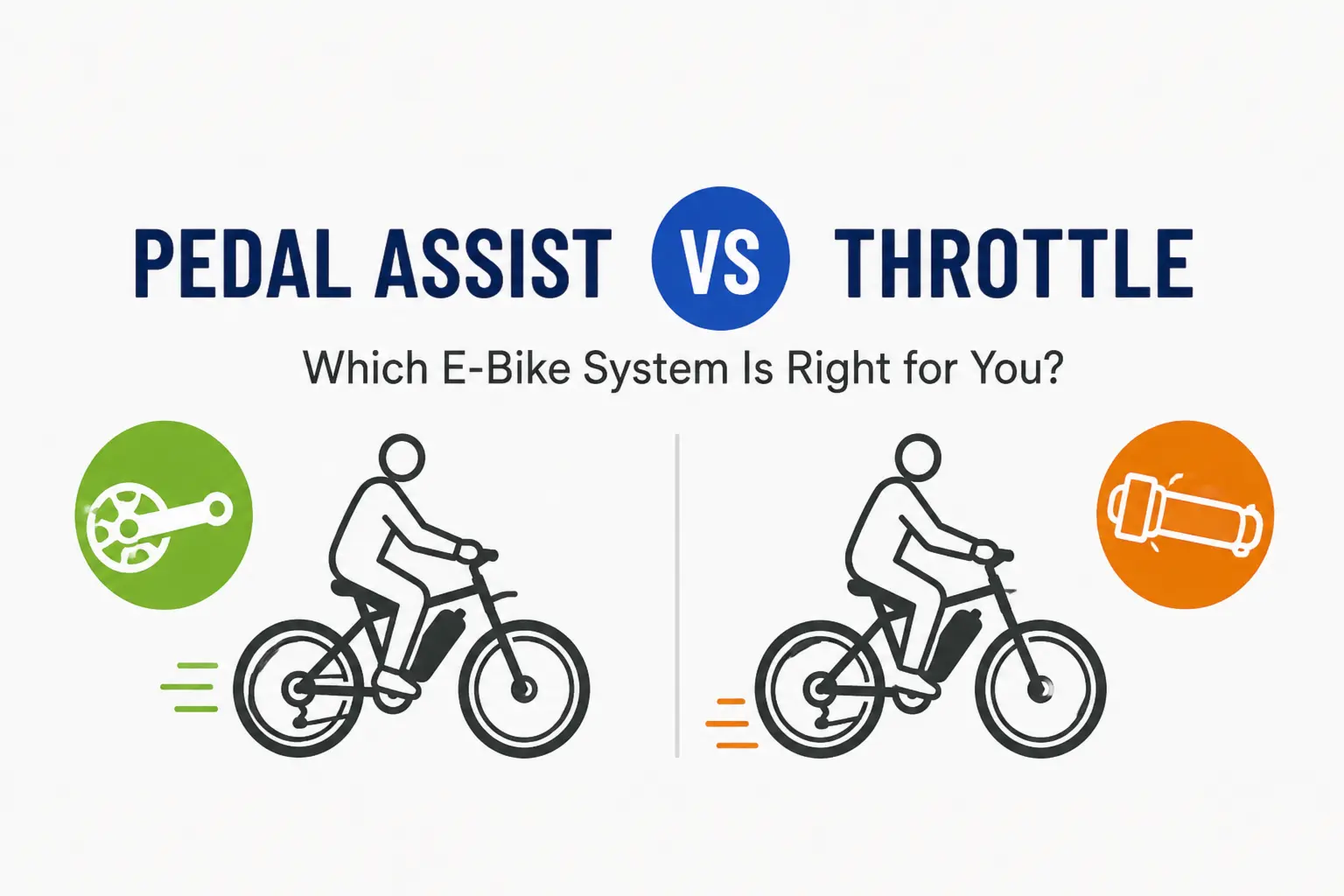
Pedal Assist vs Throttle: Which E-Bike System Is Better for You?
Last Updated on May 22, 2026 by Kristina
Last updated: May 2026
If you’re shopping for an e-bike, one of the biggest decisions you’ll run into is whether you want pedal assist, a throttle, or a bike that gives you both.
For many first-time riders, this can feel confusing because the terms sound similar but create very different riding experiences.
Some riders think a throttle turns an e-bike into a motorcycle. Others assume pedal assist barely helps at all.
Neither is really true.
The system you choose can affect:
- How natural the bike feels
- How much exercise you get
- Battery range
- Hill climbing ability
- Starting from traffic lights
- Local class regulations
- Overall riding comfort
This guide focuses on real-world riding situations so you can decide which system actually fits your riding style.
→ New to e-bikes? Start with our E-Bike Buying Guide
→ Want to understand classes first? Read Understanding Electric Bike Classes
How We Evaluate E-Bikes
This guide combines:
- Manufacturer specifications
- Real rider experiences
- Battery efficiency data
- E-bike class regulations
- Reported commuting and recreational riding experiences
- Safety guidance and industry recommendations
- Common rider questions and troubleshooting situations
Our goal is simple: help riders understand how these systems work in everyday riding rather than relying on marketing claims.
Who This Guide Is For (and Who It’s Not)
This guide is for:
- First-time e-bike buyers
- Daily commuters
- Recreational riders
- Seniors
- Riders comparing different models
- Anyone confused by pedal assist and throttle differences
This guide may not be for:
- Riders only comparing a specific bike brand
- Advanced riders already familiar with e-bike systems
Pedal Assist vs Throttle: Which Should You Choose?
If you just want a fast answer:
| Riding Goal | Usually Best Choice |
|---|---|
| Natural bicycle feel | Pedal assist |
| Starting from traffic lights | Throttle |
| Longer battery range | Pedal assist |
| Hills and heavy cargo | Both |
| Less effort while riding | Throttle |
| Exercise while riding | Pedal assist |
| Daily commuting | Both |
| Seniors or mobility limitations | Both |
For many riders, the ideal setup is actually an e-bike with both systems available.
Pedal assist can handle most riding efficiently while throttle becomes useful for:
• Starting from traffic lights
• Climbing hills
• Carrying cargo
• Fighting headwinds
• Giving your legs a break
Pedal Assist vs Throttle Comparison Chart
| Feature | Pedal Assist | Throttle |
|---|---|---|
| Requires pedaling | Yes | No |
| Feels like normal cycling | Yes | No |
| Battery efficiency | Usually better | Usually lower |
| Exercise benefit | Higher | Lower |
| Starting from stops | Moderate | Excellent |
| Hill assistance | Good | Very good |
| Long-range riding | Better | Lower |
| Rider effort | Moderate | Low |
| Natural ride feel | High | Lower |
Which Should You Choose?
Do you want exercise while riding?
→ Yes
→ Mostly commuting or recreational riding?
→ Pedal assist
↓
→ No
Do you want help starting from traffic lights or hills?
→ Yes
→ Throttle + Pedal Assist
↓
→ No
Do you ride long distances often?
→ Yes
→ Pedal assist
↓
→ No
→ Throttle or both
Many riders eventually discover that having both systems gives the most flexibility because you can ride naturally most of the time while still keeping throttle available when needed.
Recommended Setup by Rider Type
| Rider Type | Recommended Setup |
|---|---|
| Daily commuter | Pedal assist + throttle |
| Beginner rider | Pedal assist + throttle |
| Fitness rider | Pedal assist |
| Senior rider | Pedal assist + throttle |
| Cargo rider | Pedal assist + throttle |
| Long-distance rider | Pedal assist |
| Casual neighborhood rider | Either |
Many riders use pedal assist for most of their riding while using throttle selectively for starts, hills, cargo, or when tired.
→ Looking for beginner-friendly options? Read Best Electric Bikes for Beginners
→ Planning daily transportation? Read Top Commuter E-Bikes
Find Your Recommended E-Bike Setup
Not sure whether pedal assist, throttle, or both makes sense for your riding style? Answer a few quick questions below to see which setup may fit you best.
Find Your Recommended E-Bike Setup
Answer a few quick questions to see whether pedal assist, throttle, or both may fit your riding style best.
Recommendation Disclaimer: Results are estimates based on common riding patterns and preferences. Actual comfort and performance can vary by bike design, motor type, terrain, battery size, and riding conditions. Test rides are always recommended when possible.
Quick Reality Check
Many riders assume they will use throttle constantly.
In reality, many owners discover that they:
• Use pedal assist for most riding
• Use throttle for traffic lights
• Use throttle for steep hills
• Use throttle when carrying cargo
• Use throttle when tired near the end of rides
For many riders, the question is not necessarily pedal assist or throttle.
It often becomes how much of each you use.
What Is Pedal Assist?
Pedal assist (often called PAS) means the motor helps you while you pedal.
You still pedal normally, but sensors on the bike detect your movement and tell the motor to add assistance.
Think of it like riding with a steady tailwind helping push you forward.
The bike does not move on its own when you stop pedaling.
Most e-bikes include multiple assist levels that let you decide how much help you want.
Typical Pedal Assist Levels
| Assist Level | Typical Use |
|---|---|
| Eco | Maximum battery range |
| Low | Flat casual riding |
| Medium | Daily commuting |
| High | Hills and stronger headwinds |
| Turbo | Maximum power |
The exact names and power levels vary by manufacturer, but the idea is usually the same: more assistance means less effort from you, but it also generally uses more battery power.
→ Want to learn more? Read How E-Bike Pedal Assist Works
What Is a Throttle?
A throttle allows the motor to power the bike without pedaling.
Depending on the bike, it may use:
• Thumb throttle
• Twist throttle
• Trigger throttle
Think of it like pressing a gas pedal.
You activate the throttle and the motor provides power even if your feet are not moving.
Some bikes include:
- Full-speed throttles
- Limited-speed throttles
- Throttle plus pedal assist combinations
- Adjustable settings
Actual throttle behavior can vary by bike manufacturer and local regulations.
→ Related Content: What is a throttle on an ebike?
Does Motor Type Affect Pedal Assist?
Yes.
Not all pedal assist systems feel exactly the same.
The motor and sensor combination can dramatically change how an e-bike rides.
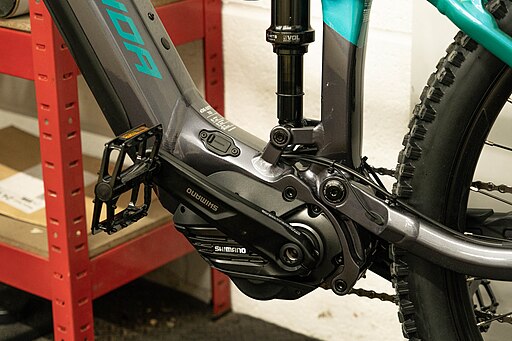
Hub Motor E-Bikes
- Usually more affordable
- Common on commuter and budget bikes
- Often paired with cadence sensors
- Can feel more like a push from behind
Mid-Drive E-Bikes
- Usually smoother feeling
- Better hill climbing performance
- Often paired with torque sensors
- Feels more like traditional cycling
Some newer hub motor bikes now use torque sensors as well, creating a smoother ride feel than older designs.
→ Related Content: Hub Motor vs Mid-Drive E-Bikes
→ Related Content: Throttle-Controlled E-Bikes with Torque Sensors: A Buyer’s Guide
Cadence Sensor vs Torque Sensor
Many new riders confuse pedal assist with sensor type.
The sensor itself changes how the assistance feels.
| Feature | Cadence Sensor | Torque Sensor |
|---|---|---|
| Feel | More on/off feeling | More natural |
| Cost | Usually lower | Usually higher |
| Exercise feel | Moderate | Better |
| Responsiveness | Lower | Higher |
Cadence sensors
Cadence sensors primarily detect whether you are pedaling.
The bike then applies preset motor assistance.
Many riders describe this feeling as:
“Pedal a little and the motor kicks in.”
Torque sensors
Torque sensors measure how hard you’re pushing the pedals.
If you pedal lightly:
→ Light assistance
If you pedal harder:
→ More assistance
Many riders feel torque sensors create a more natural cycling experience.
→ Read Cadence Sensor vs Torque Sensor: What’s the Difference?
Real Riding Scenarios: Pedal Assist vs Throttle
Seeing how these systems work in everyday situations often makes the choice easier.
Scenario 1: Daily commuting
You ride 8 miles to work with traffic lights and moderate hills.
Pedal assist only
- Better battery efficiency
- More natural ride feel
Throttle + pedal assist
- Easier starts at intersections
- Less effort after work
Best fit: Pedal assist + throttle
Scenario 2: Weekend fitness rides
You want exercise but don’t want hills ruining the ride.
Pedal assist
- Lets you stay active
- Helps on difficult sections
Best fit: Pedal assist
Scenario 3: Carrying groceries or cargo
You stop frequently and carry additional weight.
Throttle + pedal assist
- Easier starts
- Less strain
- Helpful on hills
Best fit: Pedal assist + throttle
Scenario 4: Knee pain or mobility concerns
You occasionally need help getting moving.
Throttle + pedal assist
- Less strain during starts
- Flexible assistance levels
Best fit: Pedal assist + throttle
🎬 See pedal assist and throttle in real-world riding situations below
Common Beginner Mistakes
- New riders commonly run into a few issues:
- Riding in maximum assist mode all the time
- Holding throttle continuously and wondering why battery range drops
- Forgetting assist levels affect battery life
- Assuming every Class 3 bike includes a throttle
- Confusing cadence sensors with torque sensors
- Expecting every pedal assist system to feel identical
Many riders are surprised how much changing a single assist level can change the entire riding experience.
How Battery Range Changes
Throttle and pedal assist can affect battery usage differently, but there is no fixed rule because actual range depends heavily on:
• Rider weight
• Hills
• Wind resistance
• Tire pressure
• Cargo weight
• Assist level
• Motor efficiency
• Temperature
• Riding speed
In general:
- Lower pedal assist levels often produce the longest range
- Heavy throttle use often uses battery power faster
- Rider input can dramatically increase total range
Approximate example on the same e-bike:
| Riding Style | Approximate Range* |
|---|---|
| Mostly Eco pedal assist | 40–70 miles |
| Mixed riding | 25–55 miles |
| Frequent heavy throttle use | 15–40 miles |
Actual results vary widely by bike and riding conditions.
Estimated Battery Use Per Mile
Approximate energy consumption:
| Riding Style | Estimated Energy Use |
|---|---|
| Eco pedal assist | 10–15 Wh/mile |
| Moderate pedal assist | 15–20 Wh/mile |
| Mixed riding | 20–25 Wh/mile |
| Heavy throttle use | 25–35+ Wh/mile |
Heavy throttle riding does not automatically destroy range, but asking the motor to do more work without much rider effort typically increases battery usage.
→ Try our E-Bike Range Calculator
→ Learn more in our E-Bike Battery Guide
Battery quality also matters. Many manufacturers now use batteries tested to safety standards developed by UL Solutions. Looking for UL-certified battery systems can provide additional peace of mind when shopping.
Safety Notes
• Throttle acceleration can surprise first-time riders
• Practice starts in an empty parking lot
• Start with lower assist levels while learning
• Wet roads reduce traction
• Keep both hands on handlebars when accelerating
• Learn how your bike responds before riding in traffic
• Understand local laws before riding
The Consumer Product Safety Commission (CPSC) also recommends using properly fitted helmets and following safe riding practices with electric bicycles.
Why Some Riders Think Their Throttle Is Broken
Many new riders think something is wrong when a throttle suddenly stops working.
Sometimes it actually is a problem.
Sometimes it is normal bike behavior.
| Possible Cause | What To Check |
|---|---|
| Brake sensor activated | Check brake levers |
| Low battery | Recharge battery |
| PAS-only mode enabled | Review display settings |
| Speed limitation reached | Check bike class restrictions |
| Loose connector | Inspect wiring |
| Controller issue | Inspect controller |
→ Related Content: How to Tell If Your E-Bike Controller Is Bad
→ Related Content: 5 Common Pedal Assist Problems and Fixes
How E-Bike Classes Affect Throttle Use
Many new riders are surprised to learn that throttle availability often depends on e-bike class and local regulations.
| Class | Pedal Assist | Throttle |
|---|---|---|
| Class 1 | Yes | No |
| Class 2 | Yes | Yes |
| Class 3 | Yes | Depends on manufacturer and local laws |
According to PeopleForBikes, many states use a three-class e-bike system, but local regulations for trails, sidewalks, and riding areas can still vary.
→ Related Content: State-by-State E-Bike Laws Guide
Common Myths
Myth: Throttle means no exercise
Not necessarily.
Many riders only use throttle occasionally for hills, starts, or breaks.
Myth: Pedal assist barely helps
Modern pedal assist systems can provide significant assistance, especially at higher levels.
Myth: Throttle always destroys battery range
Not automatically.
Moderate use typically has less impact than many riders expect.
Continuous high-speed riding and steep hills usually have a larger effect.
Myth: Every pedal assist bike feels the same
Different motors, sensors, tuning, and bike designs can create very different riding experiences.
Myth: Pedal assist means the bike does all the work
Pedal assist still requires rider input.
The motor simply adds assistance while you pedal. How much work you do often depends on the assist level you choose.
Myth: More assist automatically means a better ride
Not always.
Higher assist levels can reduce battery range and sometimes feel less natural depending on the bike. Many riders find medium settings provide the best balance between power and efficiency.
Myth: You need a throttle to climb hills
Not necessarily.
Many mid-drive and torque-sensor bikes can climb hills extremely well using pedal assist alone.
→ Related Content: Best E-bikes for Hills
Test Ride Checklist
If possible, try these things before buying:
☐ Start from a complete stop
☐ Test multiple assist levels
☐ Try throttle acceleration carefully
☐ Ride up a hill if available
☐ Notice whether pedal assist feels smooth or abrupt
☐ Test comfort and riding position
☐ Pay attention to how natural the bike feels
FAQs
Neither is automatically safer. Riders often need a short adjustment period with throttle systems because acceleration can feel stronger than expected.
Many commuter and recreational e-bikes include both, although some models only include pedal assist.
Sometimes, but compatibility depends on the controller, motor system, and local regulations.
Pedal assist usually feels more like traditional cycling.
Many beginners prefer having both because they can gradually learn what they like.
Usually yes, but many bikes reduce power output as battery levels become very low. Some bikes may limit performance to help protect the battery.
Usually yes.
Many e-bikes allow you to simply avoid using the throttle, while some displays also let you disable it through settings.
Yes.
Most e-bikes can still be pedaled like a regular bicycle, although they often feel heavier because of the motor and battery.
Final Thoughts
Pedal assist vs throttle is not really about choosing which one is universally better.
It is about choosing what fits how you ride.
If you want a natural cycling feel and maximum battery efficiency, pedal assist is often the better fit.
If you want effortless starts, occasional breaks, or extra help on hills, throttle can be extremely useful.
For many everyday riders, commuters, and beginners, having both systems available often provides the most flexibility and confidence.
Not sure where to go next?
Some riders are brand new. Others are fixing a problem or thinking about a new bike. Choose what fits you.
Learn & Get Comfortable
Understand how e-bikes work and what to expect when riding.
Improve Your Current Ride
If your bike isn’t performing how you want, learn what affects speed, range, and power.
Compare Better Bikes
Looking for something that fits your riding style? Start here.
- Best Electric Bikes for Beginners
- Recommended Commuter Ebikes
- Most Comfortable City E-Bikes
- Best Fat Tire Ebikes
- Top Folding Ebikes
- Best Step Through Ebikes
- Top Cargo Electric Bikes
- Best Lightweight Ebikes
- Best Long Range Ebikes
- Top Moped Style E-Bikes
- E-bike Reviews
🛒 Ready to Buy?
Top picks and current availability from trusted brands.
👉 Still deciding?
Take our E-Bike Recommendation Quiz to get matched with the right riding style in under two minute
External Sources
• PeopleForBikes E-Bike
• Consumer Product Safety Commission
• UL Solutions Battery Safety Standards

Kristina is not just an enthusiast but a true authority on electric bikes. Nestled in the coastal beauty of Virginia, Kristina has found the perfect backdrop for her passion for electric biking. As a dedicated wife and homeschooling mom, her life revolves around family, faith, and the thrill of adventure.
Originally hailing from Ohio, Kristina's journey with electric bikes began as a curiosity and quickly evolved into a deep expertise. Her blog is a testament to her love for electric biking, combining her fascination for eco-friendly transportation with her coastal lifestyle.
When she's not cruising the beach on her electric bike, you'll find Kristina indulging in her other loves: long walks along the shore, getting lost in a good book, and cherishing moments with her loved ones. With a heart as big as her love for animals, especially cats, Kristina brings a unique perspective to the electric bike world, grounded in her strong faith in God and her dedication to a sustainable lifestyle.
Through her blog, Kristina shares her extensive knowledge of electric bikes, offering valuable insights, tips, and recommendations to fellow enthusiasts. Whether you're a seasoned rider or a newcomer to the electric bike scene, Kristina's blog is your go-to source for all things electric biking, fueled by her passion, expertise, and the scenic beauty of coastal Virginia.