Washington Clarifies E-Bike vs. Electric Motorcycle Rules Starting June 11
Washington riders may soon need to take a closer look at what they’re riding.
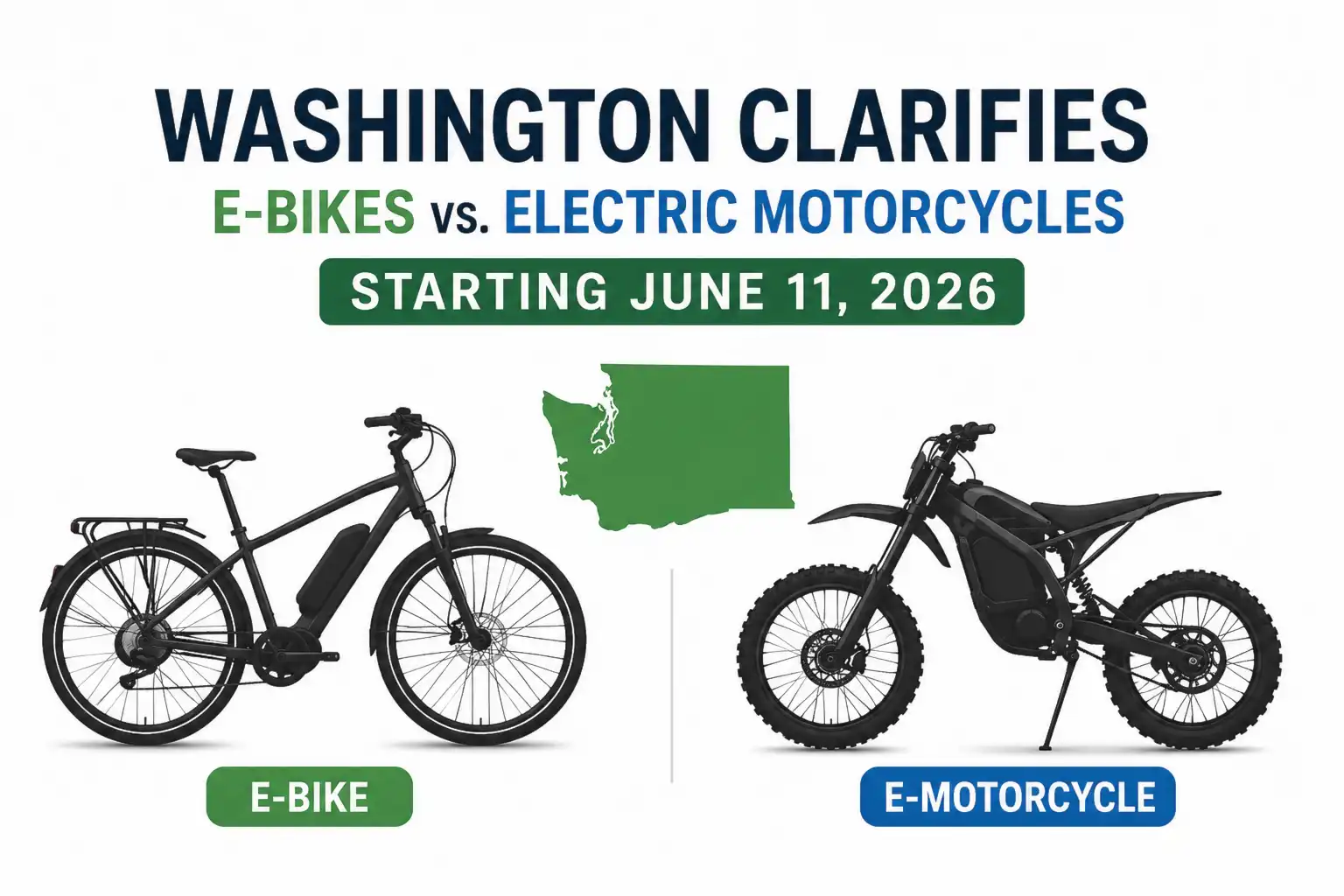
A new Washington law taking effect June 11, 2026, creates a clearer legal distinction between electric bicycles and electric motorcycles. While most traditional Class 1, Class 2, and Class 3 e-bikes will remain unaffected, some high-powered e-motos and motorcycle-style electric vehicles could now fall under different regulations.
If you ride in Washington, understanding where your bike fits could help you avoid confusion as the new rules take effect.
If you’re unsure how Washington classifies electric bikes, be sure to check out our Washington E-Bike Laws Guide for a complete breakdown of the state’s current regulations.
Quick Answer
Washington’s new law does not ban e-bikes and does not change the state’s existing Class 1, Class 2, and Class 3 e-bike system. Instead, it creates a clearer distinction between legal e-bikes and higher-powered electric motorcycles that have increasingly been marketed as e-bikes.
For most riders using factory-built e-bikes from major manufacturers, little or nothing will change.
Why Washington Is Making This Change
Over the last several years, lawmakers across the country have struggled with a growing gray area in the electric vehicle market.
Many high-powered electric motorcycles resemble bicycles and are often sold online alongside traditional e-bikes. Some can reach speeds far beyond what most people associate with an electric bicycle while still being ridden on bike paths, trails, and other cycling infrastructure.
Washington lawmakers say the goal is to improve clarity for riders, law enforcement, and local governments while preserving the existing three-class e-bike framework.
The legislation was largely driven by concerns over high-speed e-motos being operated in places intended for bicycles, pedestrians, and lower-speed electric bikes.
What Counts as an E-Bike in Washington?
Washington continues to recognize the familiar three-class e-bike system:
| Class | Description | Maximum Assisted Speed |
|---|---|---|
| Class 1 | Pedal assist only | 20 mph |
| Class 2 | Throttle allowed | 20 mph |
| Class 3 | Pedal assist only | 28 mph |
New to e-bike classifications? Check out my guide explaining the three classes of e-bikes and how they affect where you can ride.
Most mainstream e-bikes sold by major manufacturers continue to fit within these classifications.
Riders comparing regulations nationwide can also visit our State-by-State E-Bike Laws Guide.
What the New Law Changes
Rather than changing the definition of existing Class 1, 2, or 3 e-bikes, Washington’s law creates a clearer distinction between traditional e-bikes and electric motorcycles.
Vehicles that exceed traditional e-bike performance standards or more closely resemble motorcycles may now be classified differently under state law.
The change is intended to reduce confusion surrounding high-powered electric vehicles that operate outside the scope of typical bicycle regulations.
Will My E-Bike Be Affected?
For most riders, probably not.
Here’s a simple breakdown:
| Type of Vehicle | Likely Impact |
|---|---|
| Class 1 e-bike | No change |
| Class 2 e-bike | No change |
| Class 3 e-bike | No change |
| Factory legal 750W e-bike | No change |
| Sur Ron-style e-moto | May be affected |
| Talaria-style e-moto | May be affected |
| Modified unlocked e-bike | May be affected |
| Electric motorcycle marketed as an e-bike | Likely affected |
For riders using mainstream e-bikes from brands such as Aventon, Lectric, Velotric, Ride1Up, Trek, Specialized, Cannondale, Rad Power Bikes, and similar manufacturers, day-to-day riding should remain largely unchanged.
The biggest impact is expected to fall on higher-powered vehicles that blur the line between bicycles and motorcycles.
Why E-Motos Are Receiving More Attention
Electric motorcycles have become increasingly popular over the last few years.
Unlike traditional e-bikes, many of these vehicles:
- Have significantly higher power outputs
- Reach higher top speeds
- Use motorcycle-style frames
- Operate more like dirt bikes than bicycles
- Are frequently used on bike infrastructure
Lawmakers have repeatedly pointed to these vehicles as the primary reason for creating a clearer legal distinction.
Supporters argue that separating electric motorcycles from e-bikes helps protect access to bike lanes, shared-use trails, and cycling infrastructure.
Trail access can vary by location, so riders may also want to use our E-Bike Trail Access Checker to verify local access rules.
Could Riders Need Registration or Licensing?
Potentially, yes.
Depending on how a vehicle is classified under Washington law, some riders could become subject to requirements that typically apply to motorcycles or other motor vehicles.
These requirements may include:
- Vehicle registration
- Driver licensing
- Motorcycle endorsements
- Insurance requirements
- Additional equipment standards
Specific requirements will depend on how the vehicle is classified under state regulations.
What Washington Riders Should Do Now
Before June 11, riders should:
- Verify their bike’s motor rating.
- Confirm their bike has fully functional pedals.
- Review manufacturer specifications.
- Understand whether their vehicle fits within traditional e-bike classifications.
- Avoid modifying factory speed restrictions without understanding the legal implications.
Riders should also review local sidewalk regulations, as some cities impose additional restrictions on where e-bikes may be operated. You can learn more in our guide on riding e-bikes on sidewalks.
Related E-Bike Law Resources
If you’re researching e-bike regulations, these guides may also help:
- Washington E-Bike Laws Guide
- State-by-State E-Bike Laws Guide
- What Are the Three Classes of E-Bikes?
- Can You Ride an E-Bike on Sidewalks?
- E-Bike Trail Access Checker
My Take
I think this is one of the more measured approaches we’ve seen from lawmakers recently.
Washington is not banning e-bikes, eliminating the three-class system, or imposing new requirements on the vast majority of riders. Instead, lawmakers are attempting to address a growing issue where some electric motorcycles are being marketed and operated as if they were bicycles.
There is a meaningful difference between a Class 2 commuter e-bike used for transportation and a high-powered electric motorcycle capable of significantly higher speeds. As these vehicles become more common, it’s understandable that states are looking for ways to clarify where the line exists.
That said, the success of this law will ultimately depend on enforcement.
If officials focus on genuinely high-powered e-motos while leaving legal Class 1, Class 2, and Class 3 e-bike riders alone, the law could help preserve trail access and public support for e-bikes. If enforcement becomes overly broad, it could create confusion for riders who are already following the rules.
For now, most Washington e-bike owners are unlikely to notice any major changes. The riders most likely to be affected are those using e-motos, heavily modified bikes, or vehicles that already operate outside traditional e-bike definitions.
For more news on electric bikes click here

Kristina is not just an enthusiast but a true authority on electric bikes. Nestled in the coastal beauty of Virginia, Kristina has found the perfect backdrop for her passion for electric biking. As a dedicated wife and homeschooling mom, her life revolves around family, faith, and the thrill of adventure.
Originally hailing from Ohio, Kristina's journey with electric bikes began as a curiosity and quickly evolved into a deep expertise. Her blog is a testament to her love for electric biking, combining her fascination for eco-friendly transportation with her coastal lifestyle.
When she's not cruising the beach on her electric bike, you'll find Kristina indulging in her other loves: long walks along the shore, getting lost in a good book, and cherishing moments with her loved ones. With a heart as big as her love for animals, especially cats, Kristina brings a unique perspective to the electric bike world, grounded in her strong faith in God and her dedication to a sustainable lifestyle.
Through her blog, Kristina shares her extensive knowledge of electric bikes, offering valuable insights, tips, and recommendations to fellow enthusiasts. Whether you're a seasoned rider or a newcomer to the electric bike scene, Kristina's blog is your go-to source for all things electric biking, fueled by her passion, expertise, and the scenic beauty of coastal Virginia.