E-Bike Battery Only Charges to 80% or 90%? Why It Won’t Reach 100%
Last Updated on October 7, 2026 by Kristina
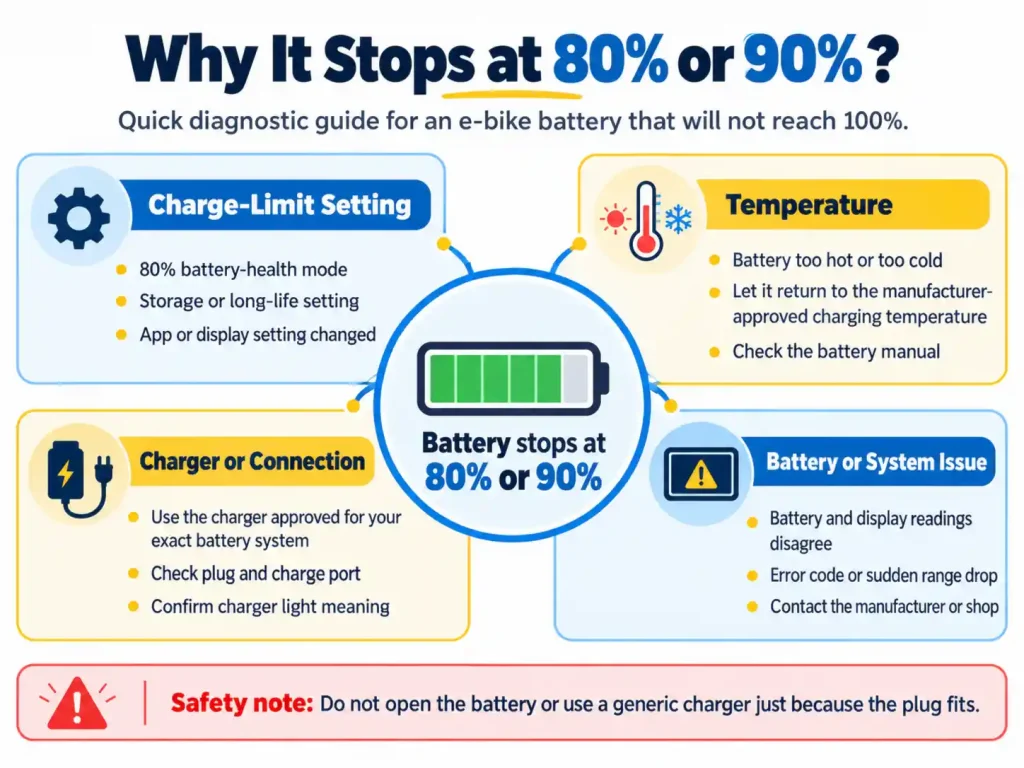
If your e-bike battery charges normally but stops at 80%, 90%, or another number below 100%, the battery is not necessarily failing. Some e-bike systems intentionally limit charging to protect long-term battery health, while other cases point to temperature limits, an inaccurate state-of-charge reading, charger or connection problems, or a battery that needs professional diagnosis.
The fastest way to narrow it down is to notice where the charge stops, whether it stops at the same percentage every time, and what changed before the problem started. If the battery does not charge at all, start with my complete e-bike charging troubleshooting guide. You can also use the E-Bike Won’t Charge Diagnostic Tool to work through battery, charger, and connection symptoms.
Quick Answer: Why an E-Bike Battery May Stop at 80% or 90%
The most common possibilities are an intentional charge-limit setting, charging outside the battery’s permitted temperature range, a display or app reading that does not match the battery’s actual state of charge, a charger or connector issue, or a battery-management problem that needs service.
If the battery stops at exactly 80% every time, check for a battery-health, storage, or charge-limit setting before assuming the battery is defective. Some manufacturers provide an 80% charging mode specifically to reduce the time a lithium-ion battery spends at a very high state of charge.
What Does Your Battery Do? Quick Diagnosis Table
| What you notice | What to check first | Why it matters |
|---|---|---|
| Stops at exactly 80% every time | App, display, or battery-health charge setting | A deliberate 80% limit is used on some e-bike systems. |
| Stops at 90% to 95%, but the number varies | Temperature, display accuracy, charger behavior, battery condition | A variable stopping point is less suggestive of a simple fixed charge limit. |
| Charger indicates completion early | Your charger manual, connector condition, approved charger compatibility | LED meanings vary by charger. A “full” indication is not interpreted the same way on every system. |
| Charges farther after the battery cools or warms | Manufacturer charging-temperature limits | Many systems pause or restrict charging when the pack is too hot or too cold. |
| Bike display says 80%, battery LEDs suggest something different | Display/app reading and manufacturer reset or calibration guidance | The percentage shown to the rider is an estimate, not a direct measurement of every cell. |
| Percentage jumps around during or after charging | State-of-charge estimation, voltage sag, battery health | See my guide to why e-bike battery percentage jumps up and down. |
| Battery also shuts down while plenty of charge remains | Battery health and professional diagnosis | A pack that shuts down under load may have a different problem than one that simply stops charging early. See why an e-bike battery can die at 50%. |
Safety First
Stop using or charging the battery if you notice smoke, swelling, unusual heat, leaking, sparks, damaged wiring, a strong chemical odor, a melted connector, or a battery that has been submerged or seriously impacted. Move away from the battery and contact the manufacturer, a qualified e-bike technician, or emergency services when appropriate.
Do not open a lithium-ion battery pack, bypass its battery-management system, short terminals, probe inside the pack, or try to “force” a full charge. Do not substitute a generic or so-called universal charger simply because the plug fits. The U.S. Consumer Product Safety Commission has warned that chargers that appear physically compatible can still be electrically incompatible and create a fire hazard. Use the charger supplied with the bike or a replacement specifically approved for your battery system.
A 5-Minute Troubleshooting Sequence
- Check for a charge-limit setting. Open the bike’s app or display settings and look for terms such as Charge Limit, Battery Health, Long Life, Storage Mode, or Maximum Charge.
- Let the battery return to a normal charging temperature. If it just came in from freezing weather, sat in a hot car, or finished a hard ride, allow it to reach the temperature range specified by the manufacturer before charging again.
- Confirm you are using the correct approved charger. Match the charger to the battery and bike documentation. Do not rely on connector shape alone.
- Compare indicators. If your removable battery has its own LED gauge, compare it with the bike display or app. Note any disagreement.
- Charge again under normal conditions. Record whether the charge stops at the exact same percentage each time.
- Check the manual or support page. Look up the charger-light pattern, error code, and any manufacturer-specific reset or calibration procedure.
- Stop DIY diagnosis if the behavior persists. Contact the manufacturer or a qualified e-bike shop rather than opening the battery.
1. Your E-Bike May Be Intentionally Limited to 80%
This is the first thing I would check when a battery repeatedly stops at the same round number, especially 80%.
Some e-bike manufacturers offer battery-preservation modes that intentionally avoid a full 100% charge during normal use. For example, FIT describes a Long Life mode that uses a reduced charge range, and Specialized documents an 80% Charge Limit on supported systems. Specialized also documents periodic full charging for calibration on systems using that feature.
That means an 80% ceiling can be completely normal on one bike and abnormal on another.
Check whether it is a limit or only an alert
Do not assume every “80%” feature physically stops charging. Some systems may provide a notification rather than a hard cutoff. Trek Central documentation, for example, describes charge alerts within its app features. The important question is whether your particular setting actually limits charging or simply tells you when the battery reaches a chosen percentage.
If you recently updated the bike’s app, firmware, display, or battery settings, check those settings before replacing hardware.
2. The Battery May Be Too Hot or Too Cold to Finish Charging
Lithium-ion batteries are normally charged only within a manufacturer-defined temperature range. A battery that is too hot after a hard ride or too cold after winter storage may refuse to begin charging, pause charging, or behave differently until it returns to an acceptable temperature.
The exact limits vary. For example, a Shimano STEPS battery user manual lists a charging temperature range of 0°C to 40°C for the system covered by that manual. That number should not be treated as universal. Your own battery manual is the authority for your bike.
If the pack feels unusually hot instead of merely warm, do not keep retrying the charger. Use my guide to why an e-bike battery gets hot and follow the stop-use warnings there.
3. The Display Percentage May Not Be the Same as the Battery’s True State of Charge
An e-bike’s percentage display is an estimate created from battery-management data, voltage, software, and the manufacturer’s state-of-charge algorithm. It is useful, but it is not the same as directly measuring how much energy remains in every cell.
If the battery’s own LEDs indicate something different from the bike display or app, record both readings. A temporary disagreement may point toward a state-of-charge estimation or display issue rather than proof that the battery physically cannot accept more charge.
Use only the reset or calibration procedure documented for your exact bike. Do not repeatedly drain a lithium-ion battery to empty or leave it charging indefinitely in an attempt to “recalibrate” it unless the manufacturer specifically instructs you to do so.
4. The Charger May Be Ending the Charge Early
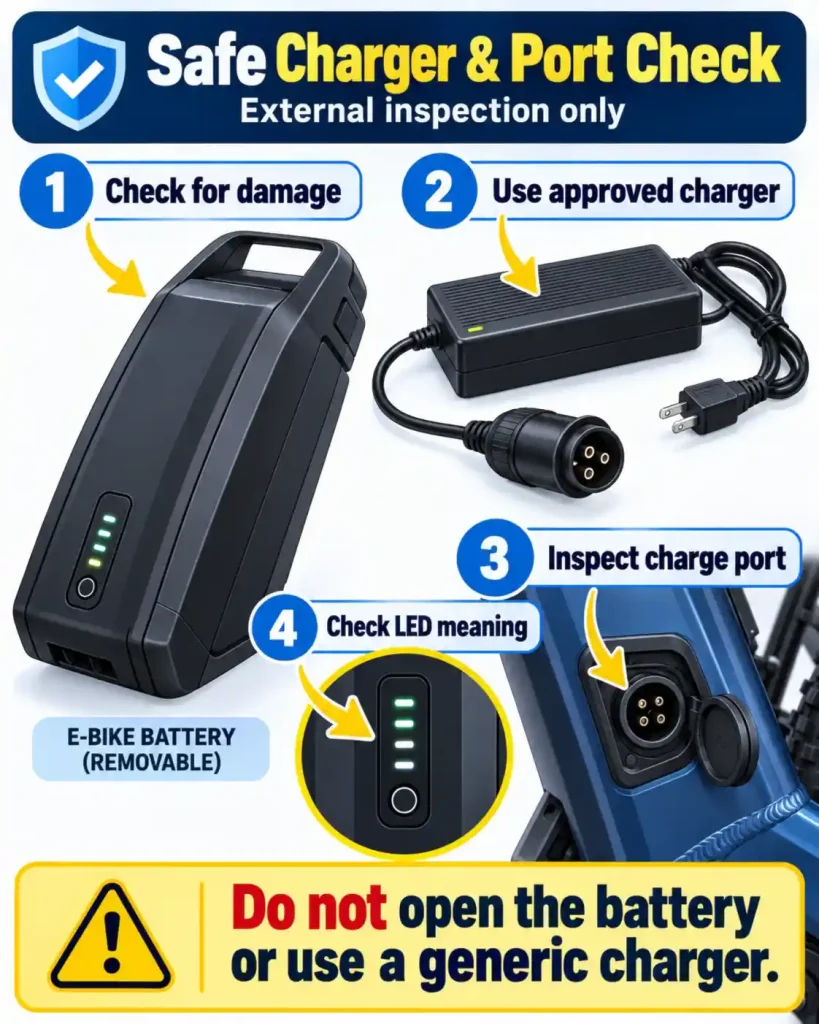
If the charger changes its status indication before the battery reaches the expected level, start with the charger manual. LED colors are not standardized across all e-bike chargers. Green, red, flashing, solid, and no-light conditions can mean different things on different systems.
Check:
- Whether the charger is the exact model approved for the battery.
- Whether its input cable is fully seated.
- Whether the charge connector is clean, dry, undamaged, and fully inserted.
- Whether the charger becomes unusually hot, smells abnormal, buzzes excessively, or shows an error pattern.
- Whether the manual says the displayed light pattern means charging complete, standby, fault, or another condition.
If you are comfortable making basic electrical measurements and the manufacturer allows it, my guide to testing an e-bike charger with a multimeter explains safer external checks. Do not open the charger or battery to test internal components.
5. The Charge Port or Battery Connection May Be Intermittent
A loose or damaged connection can interrupt charging before the battery reaches full. This is more likely if charging starts and stops when the connector moves, the charge port feels loose, or the problem began after the bike fell, the battery was removed roughly, or moisture reached the connection area.
With the bike powered off and disconnected from the charger, inspect only the externally visible connector and charge port. Look for bent pins, corrosion, dirt, moisture, melting, discoloration, or a connector that no longer seats normally.
Do not straighten damaged high-current contacts with metal tools while the battery is energized. If you see heat damage or a deformed connector, stop using the battery and charger until the system is inspected.
6. Cell Imbalance or Battery-Management Behavior Is Possible, but Do Not Try to Fix It Internally
E-bike battery packs contain groups of lithium-ion cells managed by a battery-management system, often called a BMS. Depending on the design, the BMS monitors voltage, temperature, current, and other conditions and may stop charging when it detects a problem.
Cell balancing can be part of normal battery-management behavior on some packs, particularly near the upper end of the charge cycle. But there is no universal rider procedure for “balancing” every e-bike battery. If the manufacturer provides a documented calibration or balancing procedure, follow that procedure exactly. Otherwise, do not open the pack or leave it charging for unusually long periods in an attempt to force cells into balance.
If the battery repeatedly stops well below its normal full level after charge-limit settings, temperature, connections, and the approved charger have been checked, the pack may need professional diagnosis.
7. Battery Age Can Matter, but 90% Does Not Automatically Mean the Battery Is Worn Out
Lithium-ion batteries lose usable capacity as they age and accumulate charge cycles. That can reduce range and make voltage behavior under load less predictable. But a display that stops at 90% is not, by itself, enough evidence to diagnose battery wear.
Look at the bigger pattern: Is range much lower than it used to be? Does the battery shut down under load? Does the percentage fall unusually fast? Has the pack been stored for long periods at high temperatures? Those clues are more useful than a single percentage reading.
For the broader aging picture, see how long e-bike batteries last and my guide to an e-bike battery that is not holding a charge.
What Changed Before the Problem Started?
This question can narrow the diagnosis quickly. Think back to the first time the battery stopped short of 100%.
- Did you install an app or firmware update?
- Did someone change battery-health or charge-limit settings?
- Did you switch to a different charger?
- Did the battery come out of winter storage?
- Was the battery unusually hot after a ride or very cold from a garage or vehicle?
- Was the battery dropped or was the bike involved in a crash?
- Did the bike or charge port get wet?
- Did the percentage display start behaving differently at the same time?
- Has range also dropped noticeably?
A sudden change after a software update or setting change points in a very different direction than a gradual decline accompanied by reduced range and shutdowns under load.
Charger Says Full but the Battery Shows 80% or 90%
This is one of the most useful symptoms to document. Do not assume either indicator is automatically correct.
First, check the charger manual to confirm what its light actually means. Then compare the percentage on the bike display, the manufacturer app, and the battery’s own indicator if it has one. If all rider-facing indicators consistently stop at the same round number, a charge-limit feature becomes more likely. If the readings disagree, the issue may involve state-of-charge estimation, communication, or the display rather than the battery physically reaching a fixed ceiling.
If the charger indicates completion unusually quickly and the bike’s range is also much lower than normal, contact the manufacturer with the charger model and battery details before buying replacement parts.
Should You Charge an E-Bike Battery to 100% Every Time?
There is no single rule that fits every e-bike battery.
Some manufacturers intentionally offer an 80% charge limit because spending less time at a very high state of charge can support long-term battery care. Other systems are designed around different charging behavior, calibration routines, or storage recommendations. Follow the instructions for your battery instead of applying a generic “always stop at 80%” rule to every e-bike.
If you need the bike’s maximum available range for a long ride, a full charge may be appropriate when the manufacturer permits it. If your bike has an official battery-health charging mode and your daily rides use only part of the battery, that mode may be useful. The key is to use the feature the battery maker actually designed.
🎬 Watch: Bosch eBike Battery Handling – Learn practical tips for charging, storing, transporting, and safely caring for your e-bike battery.
What Not to Do
- Do not open a lithium-ion battery pack.
- Do not bypass the BMS or protection circuitry.
- Do not use a charger just because the connector fits.
- Do not intentionally short or probe battery contacts.
- Do not keep charging a battery that is swelling, smoking, leaking, sparking, or becoming unusually hot.
- Do not leave a suspect battery charging unattended while you repeatedly test it.
- Do not repeatedly run the battery completely flat unless your manufacturer specifically directs you to do that as part of an approved procedure.
- Do not assume a green charger light means the same thing on every charger.
When to Call the Manufacturer or an E-Bike Shop
Stop home troubleshooting and get qualified help when:
- The battery has physical damage, swelling, leaking, unusual heat, odor, sparking, or water intrusion.
- The charge port or connector shows melting, discoloration, or burned contacts.
- The approved charger repeatedly reports an error.
- The battery consistently stops below its intended charge limit after normal temperature and settings have been confirmed.
- The bike shuts down under load even when the display reports substantial charge remaining.
- The manufacturer documentation calls for service or battery replacement.
- You cannot confirm that your charger is approved for the battery.
Information to have ready before you contact support
- Bike brand, model, and model year.
- Battery model and serial number.
- Charger model number.
- The percentage where charging stops.
- Whether it stops at the same percentage every time.
- The charger-light color or flashing pattern.
- Any error code in the display or app.
- Approximate room and battery temperature.
- Whether the battery charges differently on or off the bike, if both methods are supported.
- Anything that changed immediately before the problem started.
Good notes can save time and help support determine whether the problem is a setting, charger, connector, display, battery, or bike-side issue.
🔧 How This Guide Was Researched
This guide is based on manufacturer instructions, established safety guidance, technical references, and common rider experiences. Stop using or charging the bike if you notice smoke, swelling, unusual heat, damaged wiring, sparks, or a strong chemical odor.
I also cross-checked manufacturer documentation for charge-limit behavior and temperature restrictions, along with U.S. Consumer Product Safety Commission charger-safety guidance. When a procedure varies by battery system, I recommend following the instructions for the exact bike, battery, and charger rather than applying a universal rule.
Frequently Asked Questions
Why does my e-bike battery stop charging at exactly 80%?
Check for an official charge-limit, battery-health, storage, or long-life setting first. Several e-bike systems provide reduced maximum-charge modes. If your bike has no such feature, check temperature, the charger, connections, and manufacturer support guidance.
Why does my e-bike battery only charge to 90%?
A 90% reading is less obviously tied to a common fixed charge limit, so look at whether the number is consistent, whether the battery and display agree, whether charging conditions are within the manufacturer’s temperature limits, and whether the charger is the approved model. One reading alone is not enough to diagnose battery failure.
Why does the charger turn green before the battery reaches 100%?
Do not rely on color alone because charger indicators are manufacturer-specific. Check the charger manual to confirm what that light means, then compare the battery, display, and app readings. If the charger ends charging early and usable range is also abnormally low, contact the manufacturer.
Can cold weather stop an e-bike battery from charging fully?
Yes. E-bike batteries commonly have manufacturer-defined charging temperature limits, and charging may pause or be restricted outside those limits. Let the pack reach the approved charging temperature naturally and follow your battery manual.
Can I use another charger to see if mine is bad?
Only use a charger specifically approved for your battery system. Do not test with a generic charger merely because the connector fits. An electrically incompatible charger can damage the battery or create a fire hazard.
Should I leave the battery plugged in longer so the cells balance?
Only if your battery manufacturer specifically instructs you to do so. Cell balancing and charge-completion behavior vary by BMS design. Do not leave a suspect pack charging for an unusually long time in an attempt to force it to 100%.
Does stopping at 90% mean I need a new battery?
No. A 90% ceiling by itself does not prove the battery is worn out. Battery age is more convincing when it is accompanied by major range loss, abnormal shutdowns, charging errors, or other repeatable symptoms.
My Take
If an e-bike battery stops at exactly 80% every single time, I would check the app and battery-health settings before assuming anything has failed. That is one of the few symptoms where a round number can be a useful clue.
If it stops at different percentages, the charger reports an error, the readings disagree, or range has dropped substantially, the diagnosis becomes less clear. At that point I would document the behavior, verify temperature and the approved charger, and let the manufacturer or a qualified shop take over before anyone opens the battery.
The most important distinction is this: a battery that intentionally stops at 80% is not the same problem as a battery that cannot reach its intended full charge. Confirm what your system is designed to do first.
Related E-Bike Battery and Charging Guides
- Why Won’t My E-Bike Charge? Complete Troubleshooting Guide
- E-Bike Won’t Charge Diagnostic Tool
- How to Test an E-Bike Charger With a Multimeter Safely
- Why E-Bike Battery Percentage Jumps Up and Down
- Why an E-Bike Battery Dies at 50%
- E-Bike Not Holding Charge? Causes and Fixes
- How Long Do E-Bike Batteries Last?
- E-Bike Troubleshooting Guide
Sources
- U.S. Consumer Product Safety Commission – Universal charger fire-hazard warning
- FIT E-Bike System – Battery FAQ
- Specialized – App bike settings and Charge Limit documentation
- Trek – Trek Central FAQ
- Shimano STEPS – Battery and charging user manual
Prices, specifications, app features, charging behavior, and support policies can change. Confirm the current instructions for your exact bike, battery, and charger before troubleshooting or purchasing replacement parts.

Kristina is not just an enthusiast but a true authority on electric bikes. Nestled in the coastal beauty of Virginia, Kristina has found the perfect backdrop for her passion for electric biking. As a dedicated wife and homeschooling mom, her life revolves around family, faith, and the thrill of adventure.
Originally hailing from Ohio, Kristina's journey with electric bikes began as a curiosity and quickly evolved into a deep expertise. Her blog is a testament to her love for electric biking, combining her fascination for eco-friendly transportation with her coastal lifestyle.
When she's not cruising the beach on her electric bike, you'll find Kristina indulging in her other loves: long walks along the shore, getting lost in a good book, and cherishing moments with her loved ones. With a heart as big as her love for animals, especially cats, Kristina brings a unique perspective to the electric bike world, grounded in her strong faith in God and her dedication to a sustainable lifestyle.
Through her blog, Kristina shares her extensive knowledge of electric bikes, offering valuable insights, tips, and recommendations to fellow enthusiasts. Whether you're a seasoned rider or a newcomer to the electric bike scene, Kristina's blog is your go-to source for all things electric biking, fueled by her passion, expertise, and the scenic beauty of coastal Virginia.