Controller vs Battery vs Motor: How to Tell Which E-Bike Part Is Bad
Last Updated on September 14, 2026 by Kristina
When an e-bike suddenly stops working, cuts out under load, or powers on but will not move, it is easy to assume the worst. The problem might be the e-bike battery, the controller, or the motor, but it could also be something much simpler like a loose connector, stuck brake sensor, bad display connection, damaged wiring, or a battery that is not seated correctly.
I always like to start with the simple checks before replacing expensive parts. If you are still at the early troubleshooting stage, you may also want to read my full e-bike troubleshooting guide, my guide on why your e-bike cuts out while riding, and my post on e-bike battery not holding a charge. If the issue sounds more like a charging problem, my guide on why your e-bike won’t charge may be the better place to start.
In this guide, I’ll break down controller vs battery vs motor problems, how to tell which e-bike part is bad, what symptoms to look for, and when it is time to stop riding and contact the bike brand or a qualified e-bike repair shop.
Is It the E-Bike Controller, Battery, or Motor?
If your whole e-bike shuts off, start with the battery, charger, battery mount, and main power wiring.
If your display turns on but the motor will not run, check the brake cutoff sensors, throttle, pedal assist sensor, controller, and motor cable.
If your motor jerks, stutters, grinds, or shows hall sensor or phase wire errors, check the motor cable, controller, hall sensors, phase wires, and motor.
If your e-bike cuts out when accelerating or climbing hills, the battery, battery management system, controller, or wiring connection may be involved.
The key is to troubleshoot in the right order. Do not start by buying a new motor, battery, or controller until you have checked the charger, battery seating, battery terminals, display error codes, brake sensors, connectors, and visible wiring.
🔍 Why You Can Trust Electric Bike Explorer
Electric Bike Explorer is dedicated to providing honest, well-researched, and easy-to-understand information for e-bike riders. Whenever possible, I personally test the e-bikes, accessories, and products I review. When I can’t test something directly, I rely on careful research, manufacturer specifications, real-world rider feedback, official sources, and trusted industry information.
For law guides, I review state statutes, local ordinances, transportation agencies, park rules, and official government resources whenever possible. For e-bike news, I review the original reporting along with available town documents, meeting agendas, proposed ordinances, police statements, government notices, and other primary sources. I also make a clear distinction between a proposal, an approved rule, and a law that has already taken effect.
For troubleshooting and safety guides, I focus on practical explanations, common rider experiences, manufacturer guidance, and safe maintenance practices.
My goal is to help you make informed decisions, understand the rules where you ride, solve common e-bike problems, and get the most out of your electric bike safely.
Want to know how I score bikes and research my guides? Read my full review and ranking process
Before You Blame the Battery, Controller, or Motor
Before replacing any major part, check these first:
- Is the battery fully seated and locked into place?
- Are the battery terminals clean and dry?
- Is the charger plugged in correctly?
- Does the charger light behave normally?
- Is the display turning on normally?
- Is there an error code on the display?
- Are the brake levers stuck slightly pulled?
- Are the throttle and pedal assist sensor plugged in?
- Is the motor cable fully seated?
- Are any wires pinched near the handlebar, fork, frame, or rear axle?
- Did the problem start after rain, washing the bike, a crash, shipping, assembly, or rear wheel removal?
A stuck brake cutoff switch can make an e-bike act like the controller or motor is bad because the controller may be receiving a constant “stop motor output” signal. This is why I always recommend checking the simple things before ordering parts.
Need a full step-by-step troubleshooting guide?
Before replacing a battery, controller, or motor, start with my complete e-bike troubleshooting guide. It walks through the simple checks that can save you from buying the wrong part.
📖 Read Next
DIY Troubleshooting: E-Bike Motor Not Engaging
Which E-Bike Motor Is Easier to Maintain Long-Term? Hub vs Mid-Drive Guide
Top 10 E-Bike Maintenance Mistakes That Damage Your Motor
Electric Bike Maintenance for Beginners
Why Some E-Bikes Feel More Powerful (Even With the Same Watt Motor)
Motor Power Calculator – How Many Watts Does Your E-Bike Need?
E-Bike Battery Problem Symptoms
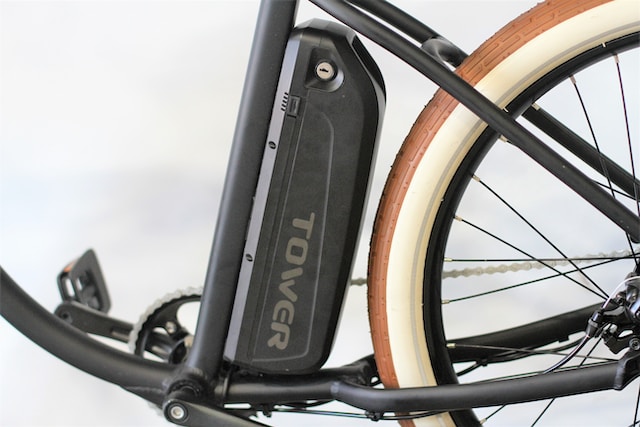
A bad e-bike battery or weak battery connection can cause several different symptoms.
Common signs of an e-bike battery problem include:
- The e-bike will not power on at all.
- The display turns on, then shuts off quickly.
- The bike cuts out when accelerating.
- The motor works on flat ground but shuts off on hills.
- The battery percentage drops suddenly.
- The battery will not charge.
- The charger light does not behave normally.
- The battery feels unusually hot.
- The battery case is swollen, cracked, wet inside, or smells burnt.
If the bike cuts out only when the motor asks for more power, I would suspect the battery before the motor. A weak battery may still show voltage when sitting still, but sag badly when the controller asks for current.
When the Battery Is More Likely the Bad Part
The battery becomes more suspicious when the whole bike loses power, not just the motor.
For example:
- The display shuts off completely.
- Lights cut out with the display.
- The bike turns back on after resting.
- The issue happens more often at low battery percentage.
- The bike shuts off under heavy load.
- The battery will not charge even with the correct charger.
- The battery has visible damage, water exposure, swelling, or heat issues.
Are only the lights failing? If the display and motor still work but the headlight, taillight, brake light, or turn signals do not, the problem may be limited to the lighting system rather than the battery, motor, or main power supply. Use my e-bike lights troubleshooting guide to narrow down the cause safely.
If the battery is damaged, gets unusually hot, stays hot after charging, or looks deformed, stop using it. Shimano’s e-bike FAQ says that if a battery is deformed or stays hot after being charged, that is not normal and the rider should contact the place of purchase or a distributor.
Battery cutting out or losing range?
If your bike powers on but dies under load, also read my guide on e-bike batteries not holding a charge and use my e-bike battery replacement cost calculator to estimate what a replacement may cost.
Do Not Open or Modify an E-Bike Battery
This is one area where I would not recommend DIY repair for most riders. Lithium-ion battery packs are not like replacing AA batteries in a remote. They have cells, wiring, welds, protection circuits, and a battery management system.
The CPSC warns riders not to use modified or reworked battery packs from unqualified people and recommends using replacement batteries that have been tested and approved for the device by the manufacturer.
UL 2849 is also important because it evaluates the e-bike electrical system combination, including the drive train, battery system, and charger system. That matters because the battery, charger, controller, and drive system are meant to work together safely, not as random mix-and-match parts.
E-Bike Controller Problem Symptoms
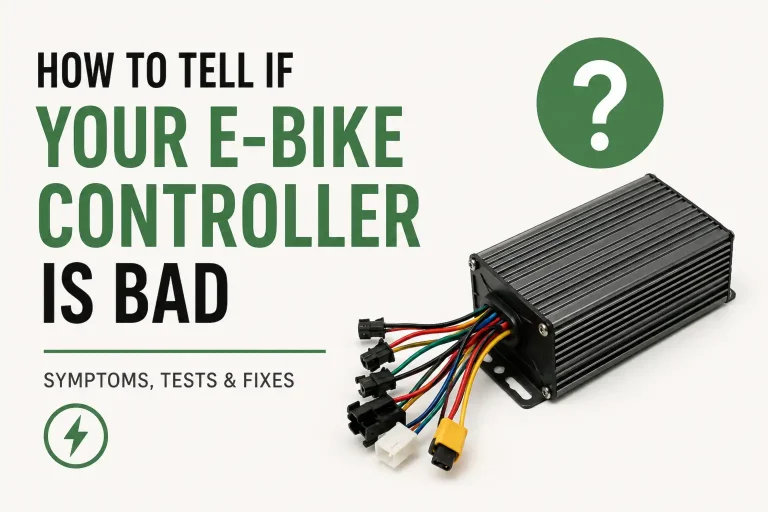
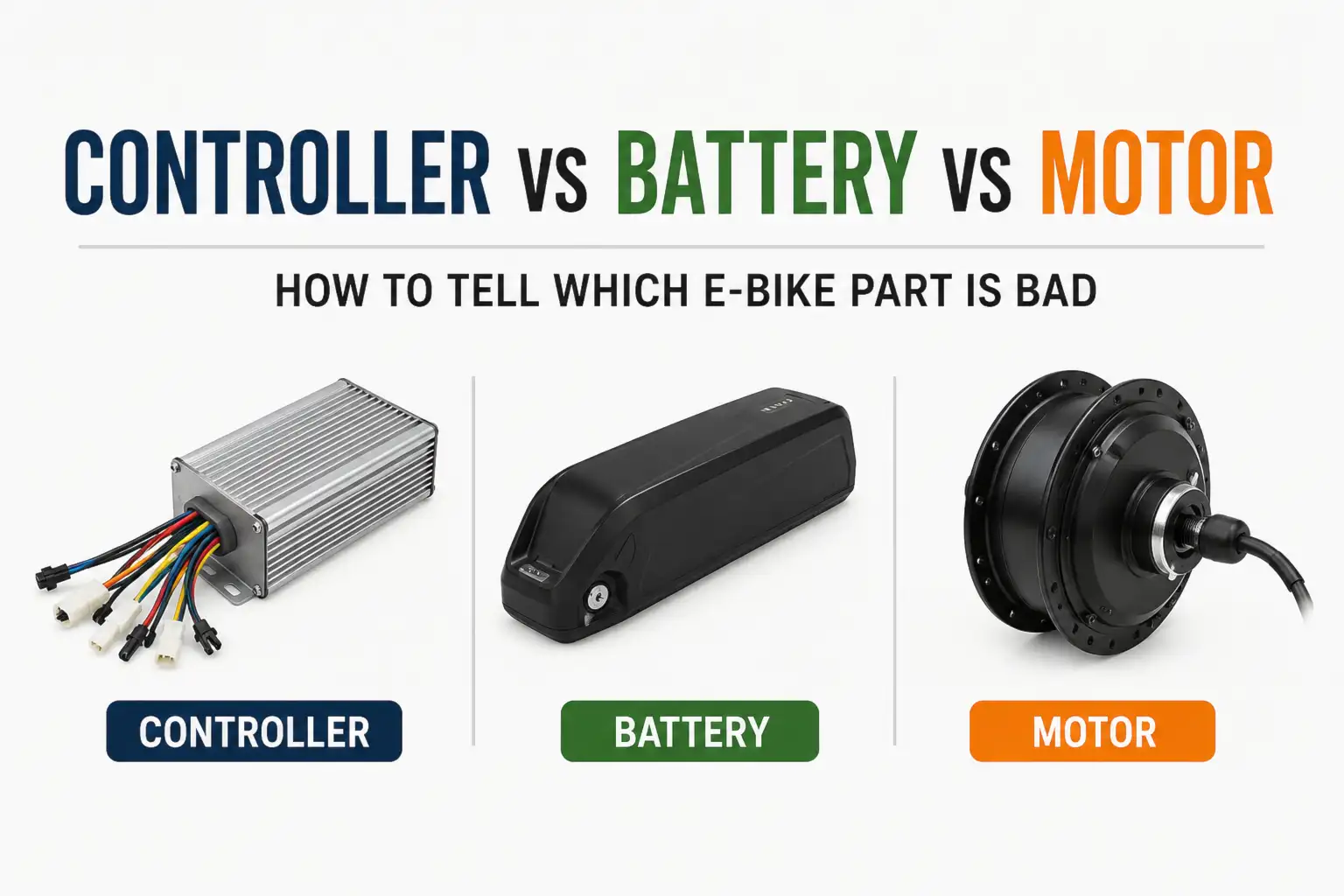
The controller is the electronic “middleman” between the battery, motor, throttle, pedal assist sensor, brake sensors, display, and wiring harness. If the battery is the fuel tank, the controller is the part deciding when and how power is sent to the motor.
Common signs of a bad e-bike controller include:
- The display turns on, but the motor does not respond.
- The throttle does nothing.
- Pedal assist does nothing.
- The motor cuts out during acceleration.
- The controller gets unusually hot.
- The bike shuts off after bumps or rough roads.
- You see a communication error, controller error, current sensor error, or throttle-related error.
- There is a burnt smell near the controller.
- The controller has water damage, corrosion, melted wiring, or discolored plugs.
A controller problem is more likely when the battery voltage is normal, power is reaching the controller, but the controller still does not provide proper output to the motor, throttle, or sensors.
When the Controller Is More Likely the Bad Part
The controller becomes more suspicious when:
- The battery is charged and tests normally.
- The display works.
- The battery connection is clean and secure.
- The brake sensors are not stuck.
- The motor cable is fully connected.
- The motor does not respond to throttle or pedal assist.
- The controller smells burnt or has visible heat damage.
- The bike worked before water exposure, then stopped.
- The problem is intermittent after bumps.
One important clue is whether the controller is sending the smaller sensor voltage needed by parts like the throttle and hall sensors. Many e-bike systems use a low-voltage reference from the controller for sensors. If that voltage is missing, the bike may power on but not respond properly.
Not sure if the controller is the problem?
Use my e-bike controller diagnostic tool to narrow down controller symptoms before ordering a replacement.
E-Bike Motor Problem Symptoms
The motor is usually one of the more durable parts of an e-bike, but it can still fail. In many cases, what looks like a bad motor is actually a bad motor cable, hall sensor issue, phase wire issue, controller issue, or damaged connector.
Common signs of an e-bike motor problem include:
- The motor jerks or stutters.
- The motor makes a grinding noise.
- The motor hums but does not turn.
- The wheel feels hard to turn.
- The motor runs rough under power.
- The bike shows a motor hall sensor error.
- The bike shows a motor phase wire error.
- The rear hub motor cable is damaged near the axle.
- The motor overheats or smells burnt.
- The motor works briefly, then stops.
If your main symptom is noise, also read my guide on e-bike motor grinding noise, because not every noise is an electrical failure. Sometimes it is a loose axle nut, brake rub, spoke issue, bearing problem, drivetrain problem, or fender rubbing the tire.
When the Motor Is More Likely the Bad Part
The motor becomes more suspicious when:
- The wheel jerks instead of spinning smoothly.
- The motor makes rough grinding sounds under power.
- The motor cable near the axle is cut, crushed, or twisted.
- The display shows a motor hall signal or motor phase error.
- The wheel feels abnormal when spun by hand.
- The motor overheats quickly under normal riding.
- The same battery and controller work with another matching motor.
A hard-to-turn hub motor wheel can sometimes point to a motor issue, but it can also point to a controller MOSFET or phase-wire short. That is why it is important not to assume the motor is ruined just because the wheel feels strange.
Grin Technologies, a respected e-bike systems company, has troubleshooting resources covering hall sensor testing, controller MOSFET testing, throttle testing, connector issues, and motor repair. This shows how closely controller, motor, sensor, and wiring problems can overlap.
Hearing a grinding noise from the motor?
If your main symptom is noise, read my full guide on why an e-bike motor makes a grinding noise before assuming the motor is ruined.
Controller vs Battery vs Motor Symptom Chart
| Symptom | Most Likely Area to Check First | What It Usually Means |
|---|---|---|
| Bike will not power on at all | Battery, battery mount, charger, display, main wiring | Power is not reaching the system |
| Display turns on but motor does nothing | Brake cutoff, controller, throttle, PAS sensor, motor cable | The system has power, but motor output may be blocked |
| Bike cuts out on hills or acceleration | Battery, BMS, controller, wiring | Voltage may be dropping under load |
| Motor jerks or stutters | Motor cable, hall sensors, controller, phase wires | Motor timing or communication may be off |
| Motor makes grinding noise | Motor, bearings, gears, brakes, drivetrain | Could be mechanical or internal motor wear |
| Controller gets very hot | Controller, motor load, wiring, settings | Controller may be overloaded or failing |
| Battery gets hot, swollen, or deformed | Battery | Stop using it and contact the seller or manufacturer |
| Error code for low voltage | Battery, charger, BMS, wiring | Battery voltage is too low or not being read correctly |
| Error code for brake | Brake cutoff sensor | Brake sensor may be stuck or misaligned |
| Error code for hall or phase wire | Motor cable, motor, controller | Motor signal or phase wiring issue |
| Communication error | Display, harness, controller connectors | Parts may not be talking to each other |
Quick Diagnostic Shortcut
Here is the easiest way I would narrow it down:
If the whole e-bike shuts off, start with the battery, charger, battery mount, and main power wiring.
If the display stays on but the motor will not run, check the brake cutoff sensors, throttle, pedal assist sensor, controller, and motor cable.
If the motor jerks, stutters, grinds, or throws hall/phase errors, check the motor cable, controller, hall sensors, phase wires, and motor.
If the problem started after a flat tire repair or rear wheel removal, check the motor cable first.
If the problem started after rain or washing the bike, check the battery contacts, display plug, controller area, and wiring connectors for moisture or corrosion.
Use my rain and washing troubleshooting guide to check moisture-related causes before concluding that one of these expensive components has failed.
If the battery is hot, swollen, leaking, smoking, or smells strange, stop using it immediately and contact the bike brand or seller.
The Best Troubleshooting Order
When I troubleshoot an e-bike, I like to use this order because it helps avoid replacing the wrong part.
Step 1: Check the Battery First
Start with the battery because everything depends on it.
Check:
- Is the battery charged?
- Is it fully clicked into place?
- Is it locked in the mount?
- Are the terminals dirty, burnt, loose, or corroded?
- Does the battery charge normally?
- Does the charger LED act normally?
- Does the bike shut off under load?
If you have a multimeter and know how to use it safely, you can check battery voltage. Be very careful not to short the battery terminals with the probes. If you are not comfortable doing this, skip it and contact the bike brand or a local e-bike shop.
A battery can sometimes show voltage with no load but still fail under load. That is why a bike may turn on in the garage but shut down when you ride uphill.
Step 2: Check the Display and Error Codes
Do not ignore error codes. They can save a lot of guessing.
Many e-bike systems use the display or app to show errors related to the battery, drive unit, speed sensor, controller, communication, or system lock. Shimano, for example, advises riders to check app-based errors or warnings, use the error/warning solution page, and contact the place of purchase or distributor if the issue continues.
Source: Shimano STEPS FAQ
https://bike.shimano.com/support-and-service/faq/STP0A.html
Error codes are helpful, but they are not always the final answer. A motor error can be caused by a damaged motor cable. A controller communication error can be caused by a loose harness plug. A battery error can be caused by a dirty terminal or bad connection.
Step 3: Check Brake Cutoff Sensors
This is one of the most overlooked e-bike problems.
Many e-bikes have brake sensors that cut motor power when you pull the brake lever. If one brake lever is stuck slightly pulled, or if the sensor is misaligned, the motor may not run even though the display turns on.
Try this:
- Make sure both brake levers fully return.
- Look for a brake icon on the display.
- Wiggle each lever gently.
- Check for a pinched or pulled brake sensor wire.
- Restart the bike after checking.
If the motor suddenly works after adjusting a brake lever or sensor, the controller and motor may be fine.
Step 4: Check the Motor Cable
On hub motor e-bikes, the motor cable is one of the most important things to inspect.
Look near the rear axle. That is where the cable can get pulled, crushed, twisted, or damaged. Also check the large motor plug. Many waterproof motor connectors need to be pushed together firmly until the arrows line up or the plug is fully seated.
A motor cable that looks connected but is not fully seated can cause:
- No motor power
- Jerking
- Error codes
- Intermittent cutouts
- Hall sensor errors
- Phase wire errors
If the problem started after assembly, shipping, a tire change, or rear wheel removal, the motor cable should be one of the first things you check.
Step 5: Check the Throttle and Pedal Assist Sensor
If your e-bike has throttle and pedal assist, test both.
Ask yourself:
- Does the throttle work but pedal assist does not?
- Does pedal assist work but throttle does not?
- Do both fail at the same time?
- Did the problem start after handlebar adjustment or cable movement?
- Is the PAS sensor or magnet ring near the crank dirty, loose, or misaligned?
If only the throttle fails, the controller and motor may still be okay. If both throttle and PAS fail, the issue may be the brake sensor, controller, display, wiring harness, or motor output.
Step 6: Check the Controller
After the battery, display, brake sensors, throttle, PAS sensor, and motor cable have been checked, then the controller becomes more suspect.
Look for:
- Burnt smell
- Melted wires
- Water inside the controller area
- Corrosion
- Loose plugs
- Controller case unusually hot
- Bike shutting off after bumps
- No throttle or PAS response even with a charged battery
If the controller is hidden inside the frame, do not start tearing into the bike unless you are comfortable and it will not affect your warranty. On newer e-bikes, especially models with integrated wiring, app pairing, brand-specific displays, or proprietary controllers, the safer choice may be to contact the manufacturer.
Step 7: Check the Motor Last
The motor is important, but I usually would not blame the motor first unless there are clear signs.
Motor problems are more likely when you have:
- Grinding from the hub or mid-drive
- Jerky movement under power
- Motor phase or hall sensor error codes
- Damaged motor cable
- Overheating from the motor area
- Rough wheel feel
- Visible axle cable damage
A mid-drive motor may also feel different than a hub motor problem because mid-drives send power through the chain, cassette, derailleur, and crank area. That means drivetrain issues can sometimes feel like motor problems.
E-bike shutting off while riding?
If your bike cuts out randomly, this may be a battery, controller, wiring, or brake sensor issue. Read my guide on why an e-bike cuts out while riding for more specific causes.
🎬 Helpful Video: E-Bike Not Working? Troubleshooting Steps
If you are more of a visual learner, this video walks through common e-bike troubleshooting steps and can help you see how different parts of the system work together. I would still start with the simple checks first, like the battery connection, display, brake sensors, motor cable, and loose wiring, before assuming the controller, battery, or motor needs to be replaced.
Easy Way to Think About It
Here is the simple version I use:
If the whole bike loses power, think battery, charger, battery mount, or main power connection.
If the bike powers on but the motor will not run, think brake sensor, controller, throttle, PAS sensor, motor cable, or motor.
If the motor runs rough, jerks, grinds, or throws hall/phase errors, think motor cable, motor sensors, controller, or motor internals.
If the problem started after rain, think connectors, controller, display, and battery mount.
If the problem started after a tire change, think motor cable seating or cable damage.
If the problem started after a crash, inspect wiring, brake sensors, display, throttle, and motor cable before replacing parts.
What About the BMS?
The BMS, or battery management system, is inside the battery pack. It helps manage charging, discharging, and protection. A BMS issue can make an e-bike act like it has a bad controller because the controller may not get steady power.
Possible BMS-related symptoms include:
- Bike shuts off suddenly.
- Battery will not charge.
- Battery shows charge but cuts off under load.
- Battery works after resting, then cuts out again.
- Battery stops output even though the display briefly powers on.
Most riders should not try to repair a BMS themselves. If the battery is under warranty, contact the e-bike brand first.
Can a Bad Controller Make the Motor Feel Bad?
Yes. A failing controller can make the motor jerk, stutter, cut out, or not run at all.
That is why motor symptoms do not always mean the motor itself is bad. The controller controls motor timing and power delivery. If the controller has a damaged MOSFET, poor sensor output, water damage, or a wiring fault, the motor may act rough even if the motor is still good.
Can a Bad Battery Make the Controller Look Bad?
Yes. A weak battery can make the controller seem like it is failing.
If the battery voltage drops too low under load, the controller may shut down to protect the system. That can feel like the controller is cutting out, but the real issue may be battery voltage sag, a weak cell group, BMS protection, or a poor battery connection.
That is why I like to check the battery before the controller.
When to Stop Riding Immediately
Stop riding and do not keep testing the bike if you notice:
- Battery swelling
- Battery leaking
- Battery stays hot after charging
- Burnt plastic smell
- Smoke
- Sparks
- Melted wires
- Controller smells burnt
- Motor cable is exposed or shorted
- Bike accelerates unexpectedly
- Motor assist is unpredictable
- Charger or battery behaves abnormally
Battery and electrical problems are not something to ignore. CPSC guidance recommends using the correct charger, avoiding unattended charging, avoiding modified or reworked packs, and using only approved replacement batteries.
Source: CPSC Micromobility Safety Center
https://www.cpsc.gov/Safety-Education/Safety-Education-Centers/Micromobility-Information-Center
What to Tell the E-Bike Brand or Repair Shop
If you contact the manufacturer or a local e-bike shop, give them clear information. This can help them diagnose the problem faster.
Tell them:
- Bike brand and model
- Battery voltage and amp-hour rating if known
- Mileage if shown on the display
- What happened right before the issue started
- Whether the bike powers on
- Whether the display shows an error code
- Whether throttle works
- Whether pedal assist works
- Whether the motor makes noise
- Whether the issue happens under load
- Whether the bike was recently wet, crashed, shipped, assembled, or repaired
- Photos of the battery terminals, motor cable, controller area, and display error
The more specific you are, the better. “My bike does not work” is hard to diagnose. “The display turns on, the battery is fully charged, there is no brake icon, but the motor does not respond to throttle or pedal assist after a rear flat repair” gives the company much more to work with.
Common Mistakes Riders Make When Troubleshooting
Replacing the Controller Too Soon
A controller can be bad, but it is not always the first part I would replace. A loose brake sensor, unplugged motor cable, weak battery, bad throttle, or dirty battery terminal can create similar symptoms.
Assuming the Motor Is Bad Because It Will Not Spin
If the motor does not spin, the motor may be fine. The controller may not be sending power, the brake cutoff may be active, the display may not be communicating, or the battery may be dropping out.
Ignoring the Battery Mount
Sometimes the battery itself is not bad, but the battery mount or terminal connection is loose, dirty, corroded, or damaged.
Washing the Bike Like a Motorcycle
E-bikes have electrical connectors, displays, controllers, and battery contacts. Heavy water pressure can push moisture where it does not belong. If the problem started after washing or riding in heavy rain, inspect connectors before buying parts.
Mixing Random Batteries, Chargers, and Controllers
This can be dangerous and expensive. Battery voltage, connector type, BMS limits, controller current, display compatibility, and communication protocols all matter. UL 2849 focuses on the e-bike electrical drive train, battery, and charger system combination, which is a good reminder that the system is meant to work together safely.
Helpful Tools & Accessories for Troubleshooting Your E-Bike
Before replacing expensive parts, I recommend having a few basic tools on hand. They’re inexpensive, useful for routine maintenance, and can make diagnosing common e-bike problems much easier.
- Digital Multimeter – Helps check basic voltage at the battery or charger, but it does not prove the battery is healthy under load. Only use one if you know how to avoid shorting the terminals.
- Portable Bike Pump – Keeps your tires properly inflated, reducing strain on the motor when climbing hills.
- Digital Tire Pressure Gauge – Lets you verify your tire pressure for better efficiency and hill-climbing performance.
- Hex Key (Allen Wrench) Set – Useful for tightening loose components, battery mounts, and accessories.
- Bike Repair Multi-Tool – A compact tool for making quick adjustments at home or on the trail.
- Electrical Contact Cleaner – Helps clean battery terminals and electrical connectors if dirt or corrosion is causing poor contact.
- Dielectric Grease – Can help protect some connector seals from moisture, but use it sparingly and only where appropriate. Do not pack random electrical plugs or battery terminals with grease.
- Head Lamp or Small Flashlight – Helps you inspect battery contacts, wiring plugs, and connector pins more clearly.
- Zip Ties – Good for securing loose wires after you confirm everything is working correctly.
- Bike Repair Stand – Can hold your e-bike steady while you inspect the pedal sensor, wiring, and crank area.
➡️ View all recommended e-bike accessories
Still Stuck After Trying These Steps?
Some electrical issues aren’t obvious and can take time to track down – especially with controllers, wiring harnesses, or battery systems.
👉 Get help from a verified e-bike expert and pinpoint the issue faster
FAQs
Yes. If the battery will not charge, the charger, charging port, battery terminals, wall outlet, or battery itself could be the issue. Before assuming the battery is bad, make sure the charger is fully plugged in, the charging port is clean and dry, and the battery terminals are not dirty or corroded.
If the display turns on but the motor will not run, the issue may be a stuck brake cutoff sensor, loose motor cable, throttle problem, pedal assist sensor issue, controller fault, or motor wiring problem. I would not assume the motor is bad until those smaller checks are done first.
Yes. A stuck or misaligned brake cutoff sensor can tell the controller to stop sending power to the motor. The display may still turn on normally, but the bike will not move. This is one of the first things I would check before replacing a controller.
If your e-bike cuts out while climbing hills or accelerating, the battery may be sagging under load, the BMS may be cutting power, the controller may be overloaded, or a connection may be loose. This is different from a bike that will not power on at all.
Yes. A loose, damaged, or partially seated hub motor cable can cause jerking, stuttering, hall sensor errors, phase wire errors, or no motor output. This is especially common after shipping, assembly, rear wheel removal, or a flat tire repair.
No. A grinding noise can come from the motor, but it can also come from brake rub, loose spokes, a loose axle nut, a damaged bearing, chain problems, derailleur issues, or something rubbing the tire. If the noise happens only under motor power, then the motor, controller, or motor cable becomes more suspicious.
It is possible. A failing controller may send power incorrectly or cause rough motor behavior. If the motor starts jerking, overheating, or making unusual electrical noises, stop riding and inspect the wiring, controller, and motor cable before continuing.
A weak battery usually causes cutouts or low-voltage problems, but mismatched batteries, wrong voltage batteries, damaged packs, or unsafe replacement batteries can create bigger electrical problems. I would only use the battery and charger recommended by the e-bike manufacturer.
No. Do not start by buying parts. Check the charger, battery seating, battery terminals, display error codes, brake sensors, throttle, pedal assist sensor, and motor cable first. Replacing parts without testing can get expensive fast.
Stop and contact the manufacturer if the battery is swollen, leaking, smoking, unusually hot, deformed, or smells strange. You should also contact support if the controller smells burnt, wires are melted, the motor cable is damaged, or the bike accelerates unpredictably.
My Take
When an e-bike has no power, cuts out, or refuses to move, I would not jump straight to “the motor is bad.” In many cases, the real problem is a battery connection, weak battery, stuck brake cutoff, loose motor plug, damaged wiring, controller issue, or charger problem.
My basic troubleshooting order is:
- Battery and charger
- Display and error codes
- Brake cutoff sensors
- Motor cable and connectors
- Throttle and pedal assist sensor
- Controller
- Motor
That order can save money and frustration. The battery supplies the power, the controller manages the power, and the motor uses the power. Once you understand what each part does, it becomes much easier to narrow down the problem.
If the battery shows any signs of swelling, heat, smoke, leaking, or damage, stop using it right away. If the controller smells burnt or the motor cable is damaged near the axle, do not keep riding and hoping it clears up. Electrical problems can get worse if ignored.
For most riders, the safest path is to check the simple things first, document the symptoms, take photos, and contact the e-bike brand before replacing expensive parts.
Disclosure: As an Amazon Associate, I earn from qualifying purchases. This comes at no extra cost to you and helps support the content on this site.
External Sources Used
- CPSC Micromobility Safety Center – battery charging, charger, replacement battery, and lithium-ion safety guidance.
https://www.cpsc.gov/Safety-Education/Safety-Education-Centers/Micromobility-Information-Center - UL Solutions – UL 2849 e-bike electrical system, battery system, charger system, and drive train certification information.
https://www.ul.com/services/e-bikes-certificationevaluating-and-testing-ul-2849 - Shimano STEPS FAQ – e-bike battery, charger, warning/error, drive unit, and system troubleshooting guidance.
https://bike.shimano.com/support-and-service/faq/STP0A.html - Grin Technologies – e-bike troubleshooting resources covering hall sensors, controller MOSFETs, throttle testing, connectors, and motor repair.
https://ebikes.ca/resources/getting-advanced/troubleshooting.html

Kristina is not just an enthusiast but a true authority on electric bikes. Nestled in the coastal beauty of Virginia, Kristina has found the perfect backdrop for her passion for electric biking. As a dedicated wife and homeschooling mom, her life revolves around family, faith, and the thrill of adventure.
Originally hailing from Ohio, Kristina's journey with electric bikes began as a curiosity and quickly evolved into a deep expertise. Her blog is a testament to her love for electric biking, combining her fascination for eco-friendly transportation with her coastal lifestyle.
When she's not cruising the beach on her electric bike, you'll find Kristina indulging in her other loves: long walks along the shore, getting lost in a good book, and cherishing moments with her loved ones. With a heart as big as her love for animals, especially cats, Kristina brings a unique perspective to the electric bike world, grounded in her strong faith in God and her dedication to a sustainable lifestyle.
Through her blog, Kristina shares her extensive knowledge of electric bikes, offering valuable insights, tips, and recommendations to fellow enthusiasts. Whether you're a seasoned rider or a newcomer to the electric bike scene, Kristina's blog is your go-to source for all things electric biking, fueled by her passion, expertise, and the scenic beauty of coastal Virginia.