Fernandina Beach, Florida Adopts New E-Bike Speed Limits: What Riders Need to Know
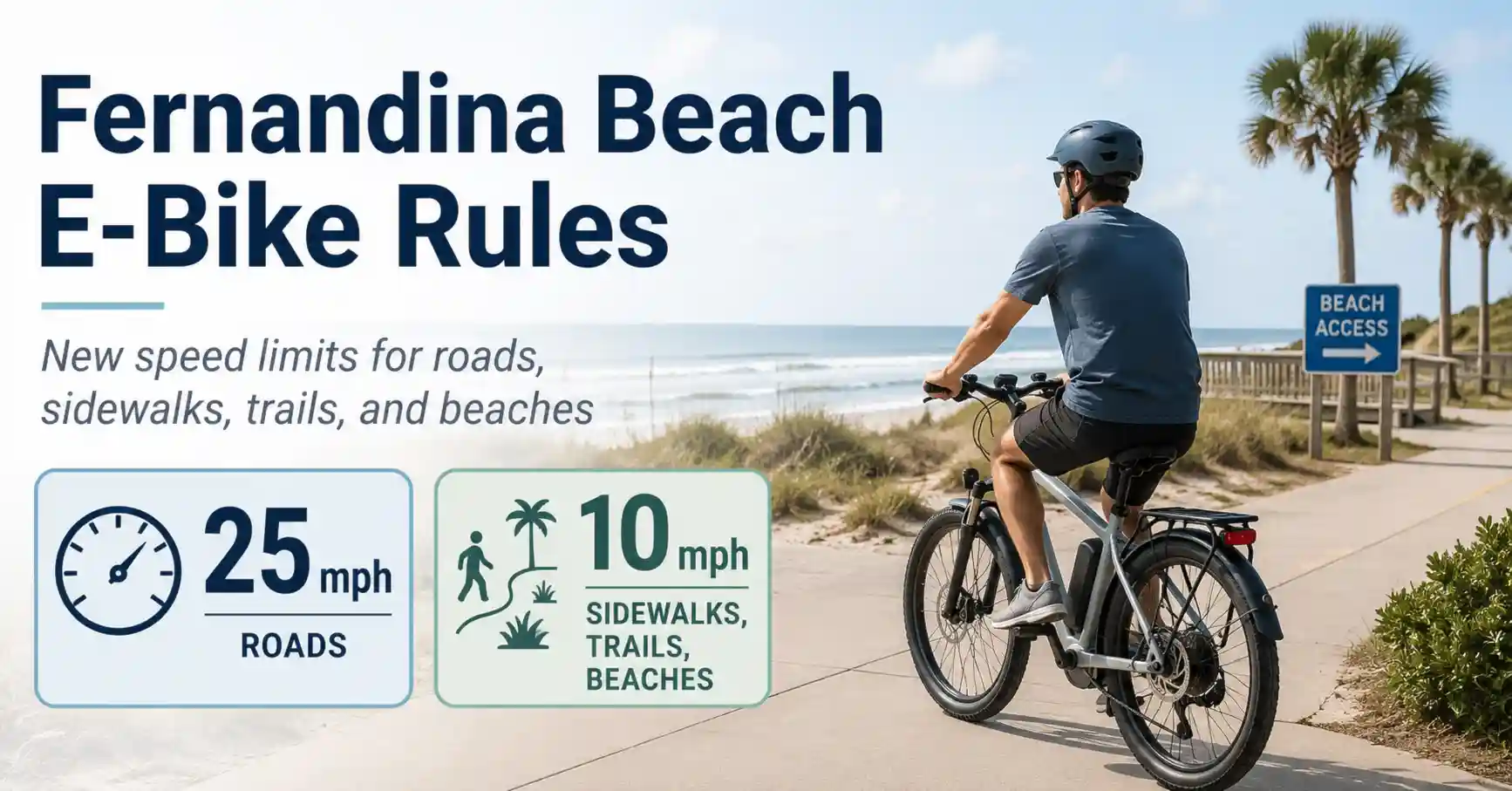
Fernandina Beach, Florida has adopted new e-bike rules that establish different speed limits for city roadways, sidewalks, multi-use paths, trails, beaches, and recreational parks.
The Fernandina Beach City Commission unanimously approved Ordinance 2026-08 during its final reading on July 7, 2026. The ordinance applies broadly to bicycles, electric bicycles, motorized scooters, mopeds, and certain other personal mobility devices.
For riders, the most important numbers are 25 mph on city roadways and 10 mph on sidewalks, trails, multi-use paths, and city-owned beaches.
These are local rules that apply in addition to Florida’s statewide requirements. Riders can review my complete Florida e-bike laws guide for information about legal e-bike classes, motor limits, helmet requirements, and where electric bikes may generally be ridden.
Traveling outside Florida? My state-by-state e-bike law guide explains how the rules compare across the country.
Fernandina Beach E-Bike Rules at a Glance
| Where you are riding | Maximum speed | Motor-use rule |
|---|---|---|
| Roadways within city jurisdiction | 25 mph | Motor assistance allowed within legal e-bike limits; lower posted limits must still be followed |
| Sidewalks | 10 mph | Human power only – no throttle or pedal assist |
| Unpaved portions of public rights-of-way | 10 mph | Human power only |
| Multi-use paths | 10 mph | Pedal assist allowed; riders should not assume throttle-only operation is permitted |
| City trail networks | 10 mph | Pedal assist allowed; posted restrictions still apply |
| City-owned beaches | 10 mph | Pedal assist allowed; other beach rules and signs still apply |
| City recreational parks and municipal golf course | Riding prohibited unless signs allow it | Follow posted signs |
Local reporting on the final ordinance confirms the 25 mph roadway maximum and 10 mph limits for sidewalks, trails, paths, and beaches. It also reports that sidewalks and unpaved public rights-of-way are restricted to human-powered operation.
Fernandina Beach E-Bikes Are Limited to 25 MPH on Roadways
Electric bikes and traditional bicycles may not exceed 25 mph on roadways under Fernandina Beach jurisdiction.
The original version of the proposed ordinance included a 20 mph roadway limit. Commissioners later increased it to 25 mph after local cyclists pointed out that experienced riders can exceed 20 mph on traditional bicycles without using a motor.
The City Commission’s final meeting recap confirms that Ordinance 2026-08 passed 5-0 with a 25 mph roadway limit. The Fernandina Beach Police Department also announced 25 mph as the adopted maximum for roadways within city jurisdiction.
However, the ordinance does not give riders permission to travel 25 mph on every street. A rider must still obey any lower posted speed limit and slow down when traffic, pedestrians, curves, weather, or road conditions make 25 mph unsafe.
🔍 Why You Can Trust Electric Bike Explorer
Electric Bike Explorer is dedicated to providing honest, well-researched, and easy-to-understand information for e-bike riders. Whenever possible, I personally test the e-bikes, accessories, and products I review. When I can’t test something directly, I rely on careful research, manufacturer specifications, real-world rider feedback, official sources, and trusted industry information.
For law guides, I review state statutes, local ordinances, transportation agencies, park rules, and official government resources whenever possible. For e-bike news, I review the original reporting along with available town documents, meeting agendas, proposed ordinances, police statements, government notices, and other primary sources. I also make a clear distinction between a proposal, an approved rule, and a law that has already taken effect.
For troubleshooting and safety guides, I focus on practical explanations, common rider experiences, manufacturer guidance, and safe maintenance practices.
My goal is to help you make informed decisions, understand the rules where you ride, solve common e-bike problems, and get the most out of your electric bike safely.
Want to know how I score bikes and research my guides? Read my full review and ranking process
Why Some Reports Still List a 20 MPH E-Bike Limit
Riders may come across news reports or earlier ordinance documents that list a 20 mph roadway limit.
That number came from an earlier proposal. The roadway limit was raised to 25 mph before final approval. Some coverage published after the final vote continued to reference the earlier 20 mph figure, but the final City Commission recap, Fernandina Observer report, and police announcement identify 25 mph as the adopted roadway maximum.
This is also why the earlier Ordinance Watch PDF should not be treated as the fully amended final ordinance. It contains language from an earlier stage of the approval process.
Electric Assistance Is Not Allowed on Fernandina Beach Sidewalks
One of the most important parts of the new Fernandina Beach e-bike ordinance involves sidewalk riding.
An e-bike may be ridden on a sidewalk at no more than 10 mph, but it must be propelled entirely by human power. That means the rider cannot use:
- A throttle
- Pedal assist
- Cruise control
- Any other form of motor assistance
Turning the pedal-assist setting down to Level 1 is not enough. The motor must not help propel the bicycle while it is being operated on a sidewalk. Local reporting says the same human-powered-only requirement applies to unpaved portions of public rights-of-way.
Riders must also yield to pedestrians and reduce their speed when sidewalks are crowded. The 10 mph number is a maximum, not a speed riders are expected to maintain around people walking, children, pets, or storefront entrances.
Sidewalk rules vary considerably between states and cities. My e-bike sidewalk laws guide explains why a bike that is legal on one sidewalk may be restricted only a few miles away.
Trails and Multi-Use Paths Have a 10 MPH Speed Limit
Fernandina Beach also established a 10 mph maximum speed for bicycles and e-bikes on city trail networks and multi-use paths.
Unlike sidewalks, local reporting on the final ordinance says riders may use pedal assistance on these paths and trails. However, the available reporting does not clearly authorize throttle-only riding, so riders should avoid assuming that a Class 2 throttle may be used without pedaling.
Posted signs can also create additional restrictions. A particular trail, park, environmental corridor, or protected area may have rules that are stricter than the citywide maximum.
Before visiting an unfamiliar trail, riders can use my e-bike trail access checker to see whether their e-bike class may be allowed. Trail managers and posted signs should always be treated as the final authority.
E-Bikes Are Limited to 10 MPH on City-Owned Beaches
Bicycles, e-bikes, and covered personal mobility devices are limited to 10 mph on city-owned beaches.
Local reports say pedal assistance may be used on the beach. Riders should still watch for signs, seasonal rules, environmental restrictions, and locations where bikes or motor assistance may be prohibited.
Ten mph can also be too fast when a beach is crowded. Riders may encounter:
- Children playing near access points
- Dogs and leashes
- People carrying chairs or umbrellas
- Soft or uneven sand
- Beach vehicles
- Limited visibility around dunes and entrances
A rider can still be stopped for careless operation even when traveling below the numerical speed limit if the speed is unsafe for the conditions.
E-Bikes Are Prohibited in City Parks Unless Signs Allow Them
The ordinance generally prohibits e-bikes and other covered motorized devices in Fernandina Beach recreational parks unless signs specifically allow their use.
The restriction includes the city’s municipal golf course. The golf course was specifically discussed during the ordinance process after officials received complaints about young riders performing wheelies, jumping bunkers, and damaging portions of the course.
Riders should check signs before entering any park. A paved path through a recreational area should not automatically be treated as an approved e-bike route.
Riders Must Obey Stop Signs and Other Traffic Laws
The new local rules do not replace ordinary traffic laws.
People operating bicycles and electric bicycles must still:
- Stop at stop signs and red lights
- Yield when required
- Follow traffic-control signs
- Ride in a predictable manner
- Yield to pedestrians
- Reduce speed when conditions require it
- Avoid carrying loads that interfere with safe operation
Fernandina Beach officials said complaints leading to the ordinance included riders speeding on sidewalks, performing wheelies, and rolling through stop signs.
These behavior-based rules matter just as much as the posted speed limits. Traveling at 9 mph through a tightly crowded sidewalk could still be unsafe even though it is technically below the 10 mph maximum.
How the Fernandina Beach Rules Fit With Florida E-Bike Law
Florida recognizes three classes of legal electric bicycles. A qualifying e-bike must have fully operable pedals, a seat or saddle, and an electric motor producing less than 750 watts:
- Class 1: Pedal assist that stops at 20 mph
- Class 2: Throttle-capable assistance that stops at 20 mph
- Class 3: Pedal assist that stops at 28 mph
These definitions are found in Florida Statute 316.003.
Florida generally gives legal e-bikes the same rights and duties as traditional bicycles. Qualifying e-bikes do not require a driver’s license, motor vehicle registration, title, license plate, or automobile insurance.
However, Florida Statute 316.20655 specifically allows local governments and land-managing agencies to regulate or prohibit e-bike use on:
- Streets and roadways
- Sidewalks
- Bicycle paths
- Multi-use paths
- Trail networks
- Beaches
- Dunes
That local authority is what allows Fernandina Beach to impose rules that are more specific than Florida’s general statewide law.
What the 25 MPH Limit Means for Class 3 E-Bikes
A Class 3 e-bike may provide pedal assistance up to 28 mph under Florida’s classification system. However, a rider in Fernandina Beach may not use that capability to exceed the city’s 25 mph roadway maximum.
The bike itself does not necessarily become illegal simply because it is capable of assisting up to 28 mph. The rider must control the bike and remain within the local speed limit.
Class 1 and Class 2 assistance already stops at 20 mph, although a rider could theoretically travel faster through human power or while going downhill. The city’s speed limits apply to the bike’s actual speed, not only the speed produced by its motor.
Violations Can Lead to a $50 Fine
Fernandina Beach police described an education-focused enforcement approach rather than beginning with immediate fines for every violation.
During the ordinance process, officials outlined a system that could include:
- A warning and documentation of the violation
- Contacting a parent or guardian when the rider is a juvenile
- A citation that may be resolved by completing an approved safety course within 30 days
- A $50 civil penalty for repeat or continued violations
The reported plan allows a rider facing an early citation to complete an approved safety course rather than pay the $50 penalty. Later violations can result in the fine. This is the Police Department’s announced enforcement approach, not a promise that every officer must issue a warning before taking other action when conduct is especially dangerous.
Why Fernandina Beach Adopted the New E-Bike Ordinance
The ordinance followed months of discussion about unsafe riding, particularly involving juvenile riders and high-powered electric vehicles being used around downtown, sidewalks, parks, and other public areas.
Fernandina Beach Police Chief Jeffry Tambasco told commissioners that the department recorded 188 complaints involving juvenile e-bike riders during 2025. Officials also discussed reports of riders speeding near pedestrians, ignoring stop signs, performing wheelies, and damaging the municipal golf course.
City leaders said the goal was to make expectations clearer, protect pedestrians and riders, and create rules that police could explain and enforce consistently.
What Fernandina Beach E-Bike Riders Should Remember
The easiest way to remember the new Fernandina Beach e-bike speed limits is:
- 25 mph maximum on city roadways
- 10 mph maximum on sidewalks, trails, multi-use paths, and city-owned beaches
- No motor assistance on sidewalks or unpaved public rights-of-way
- Pedal assist allowed on trails, multi-use paths, and beaches
- No riding in city parks or on the municipal golf course unless signs allow it
Riders should also obey any lower posted limit and watch for signs at parks, trail entrances, beach access points, and other managed public areas.
Recommended Gear for Riding in Fernandina Beach
Fernandina Beach’s new rules place extra emphasis on riding safely around pedestrians, shared paths, traffic, and beach access areas. A few simple accessories can make it easier to follow the rules and stay visible.
- Helmet – Protect your head with a properly fitted, CPSC-certified bicycle helmet, even if you’re not legally required to wear one.
- Front & Rear Bike Lights – Improve your visibility during early morning rides, evening commutes, and low-light conditions.
- Phone Mount – A sturdy handlebar phone mount can make it easier to follow maps, check your route, or use trail apps without having to stop and dig through a bag.
- Rear View Mirror – A handlebar or helmet-mounted mirror can help you keep an eye on traffic behind you, which is especially helpful when riding on roads, bike lanes, or narrow shoulders.
- Panniers or Rear Rack Bags – Panniers and bike bags are useful for carrying groceries, work items, jackets, tools, chargers, or extra layers without wearing a heavy backpack.
- Small Handlebar or Frame Bag – A compact bag gives you quick access to smaller items like keys, wallet, snacks, sunglasses, tire levers, or a portable charger.
- Heavy-Duty Bike Lock – Help protect your investment when stopping at stores, trailheads, or other public places.
- Mini Tire Pump & Flat Repair Kit – Be prepared for unexpected flats, especially if you’re riding longer distances.
- Compact Multi-Tool – Quickly tighten loose bolts or make minor adjustments while you’re away from home.
- High-Visibility Reflective Gear – Reflective vests, ankle bands, or jackets can help drivers see you sooner, especially at dawn, dusk, or in poor weather.
Want to See More Electric Bike Explorer in Google Search?
Add Electric Bike Explorer as a preferred source to see more of our e-bike law guides, safety updates, reviews, buying guides, and troubleshooting posts when they are relevant to your searches.
My Take
I think Fernandina Beach was right to establish clear rules rather than leaving residents, tourists, rental customers, and police officers guessing about where e-bikes can be ridden and how fast they can travel.
A 10 mph limit makes sense on crowded sidewalks, shared trails, and beach areas where riders are frequently passing pedestrians, children, and dogs. I also agree with requiring riders to turn off motor assistance on sidewalks. Even a low pedal-assist setting can cause an e-bike to accelerate more quickly than someone walking nearby expects.
Raising the roadway maximum from 20 to 25 mph was also a reasonable change. A blanket 20 mph limit would have applied to traditional cyclists who can exceed that speed without a motor. The 25 mph limit still requires faster Class 3 riders to slow down while giving cyclists enough flexibility to move safely with traffic.
The part that needs the most public education is the difference between pedal assist and throttle use. Saying that pedal assist is allowed on a trail or beach does not necessarily mean riders can hold down a throttle and travel without pedaling. The city should make that distinction clear on signs, rental paperwork, safety courses, and public information pages.
I also hope enforcement stays focused on the behavior creating the real danger: speeding around pedestrians, running stop signs, performing stunts in traffic, damaging public property, or riding high-powered electric motorcycles as though they are ordinary e-bikes.
Overall, Fernandina Beach has not banned e-bikes. It has created different rules for different riding environments. When those rules are explained clearly and enforced fairly, they can protect pedestrians without taking away e-bikes as a useful form of transportation and recreation.
For more news on electric bikes click here
Disclosure: As an Amazon Associate, I earn from qualifying purchases. This comes at no extra cost to you and helps support the content on this site.
External Sources
Fernandina Observer – How Fast Can You Ride an E-Bike in Fernandina Beach? New Rules Set the Limits
https://www.fernandinaobserver.org/stories/how-fast-can-you-ride-an-e-bike-in-fernandina-beach-new-rules-set-the-limits,112934
Nassau NewsLine – City Commission Final Approval Recap
https://nassaunewsline.net/city-commission-advances-stormwater-rate-hike-scales-back-parks-study/
Nassau NewsLine – Fernandina Beach Advances E-Bike Ordinance
https://nassaunewsline.net/fernandina-beach-advances-e-bike-ordinance-with-new-speed-limits-safety-education/
Florida Statute 316.003 – Electric Bicycle Definitions
https://www.leg.state.fl.us/STATUTES/index.cfm?App_mode=Display_Statute&URL=0300-0399%2F0316%2FSections%2F0316.003.html
Florida Statute 316.20655 – Electric Bicycle Regulations
https://www.leg.state.fl.us/statutes/index.cfm?App_mode=Display_Statute&URL=0300-0399%2F0316%2FSections%2F0316.20655.html

Kristina is not just an enthusiast but a true authority on electric bikes. Nestled in the coastal beauty of Virginia, Kristina has found the perfect backdrop for her passion for electric biking. As a dedicated wife and homeschooling mom, her life revolves around family, faith, and the thrill of adventure.
Originally hailing from Ohio, Kristina's journey with electric bikes began as a curiosity and quickly evolved into a deep expertise. Her blog is a testament to her love for electric biking, combining her fascination for eco-friendly transportation with her coastal lifestyle.
When she's not cruising the beach on her electric bike, you'll find Kristina indulging in her other loves: long walks along the shore, getting lost in a good book, and cherishing moments with her loved ones. With a heart as big as her love for animals, especially cats, Kristina brings a unique perspective to the electric bike world, grounded in her strong faith in God and her dedication to a sustainable lifestyle.
Through her blog, Kristina shares her extensive knowledge of electric bikes, offering valuable insights, tips, and recommendations to fellow enthusiasts. Whether you're a seasoned rider or a newcomer to the electric bike scene, Kristina's blog is your go-to source for all things electric biking, fueled by her passion, expertise, and the scenic beauty of coastal Virginia.