Are Belt Drive E-Bikes Worth It? Pros, Cons, Costs, and Who Should Buy One
Last Updated on June 23, 2026 by Kristina
If you’ve been shopping for an electric bike, you’ve probably noticed that some models use a belt drive instead of a traditional chain. Manufacturers often advertise belt drive e-bikes as quieter, cleaner, and lower maintenance, but they also tend to cost more.
That leaves many riders wondering: Are belt drive e-bikes actually worth it?
The short answer is yes for many riders, especially commuters, urban riders, and anyone who wants a low-maintenance e-bike. However, they are not necessarily the best choice for everyone.
In this guide, I’ll explain how belt drive e-bikes work, the advantages and disadvantages, how they compare to traditional chains, and whether the extra cost makes sense for your riding style.
If you’re still deciding between the two systems, be sure to read my Belt Drive vs Chain Drive Guide, where I compare maintenance, durability, repairability, and long-term ownership costs in greater detail.
Quick Answer: Are Belt Drive E-Bikes Worth It?
For most commuters and recreational riders, a belt drive e-bike is worth the extra cost if you prioritize low maintenance, quiet operation, and long-term durability.
A belt drive won’t make your e-bike significantly faster or more powerful, but it can reduce maintenance, eliminate chain grease, and provide a smoother riding experience.
However, traditional chain-driven e-bikes remain the better choice for riders on a tight budget, off-road riders who want the widest selection of replacement parts, and anyone who prefers simpler field repairs.
📌 Quick Verdict
⭐⭐⭐⭐½ (9/10)
Belt drive e-bikes aren’t necessary for every rider, but they are one of the most worthwhile upgrades available for commuters, city riders, and anyone who values low-maintenance ownership.
While they cost more upfront, many riders find the cleaner operation, quieter ride, and longer lifespan worth the investment.
Best For: Commuters, urban riders, seniors, recreational riders, low-maintenance ownership
Not Ideal For: Budget-focused buyers, riders who frequently perform their own repairs, riders seeking the lowest upfront cost
Why You Can Trust Electric Bike Explorer
Every e-bike recommendation and buying guide on Electric Bike Explorer is based on extensive research, manufacturer specifications, owner experiences, independent testing, and real-world riding feedback whenever available.
I regularly compare drivetrain systems, motors, batteries, and components across dozens of electric bikes each year. My goal isn’t to recommend the most expensive option. Instead, I focus on helping everyday riders understand what matters, what doesn’t, and where spending more money actually makes sense.
I also regularly update my buying guides as new models are released and older models are discontinued, helping ensure readers have access to current information rather than outdated recommendations.
If you’re new to electric bikes, I also recommend reading my Best Electric Bikes Guide and Best Commuter E-Bikes Guide for additional recommendations.
Belt Drive vs Chain Drive at a Glance
| Feature | Belt Drive E-Bike | Chain Drive E-Bike |
|---|---|---|
| Maintenance | Very Low | Moderate |
| Lubrication Required | No | Yes |
| Rust Resistance | Excellent | Moderate |
| Noise Level | Quiet | Moderate |
| Cleanliness | Excellent | Can Transfer Grease |
| Lifespan | Often 10,000+ Miles | Often 2,000-5,000 Miles |
| Replacement Parts | Less Common | Widely Available |
| Upfront Cost | Higher | Lower |
| Best For | Commuters, Urban Riders | Budget Buyers, Trail Riders |
What Is a Belt Drive E-Bike?
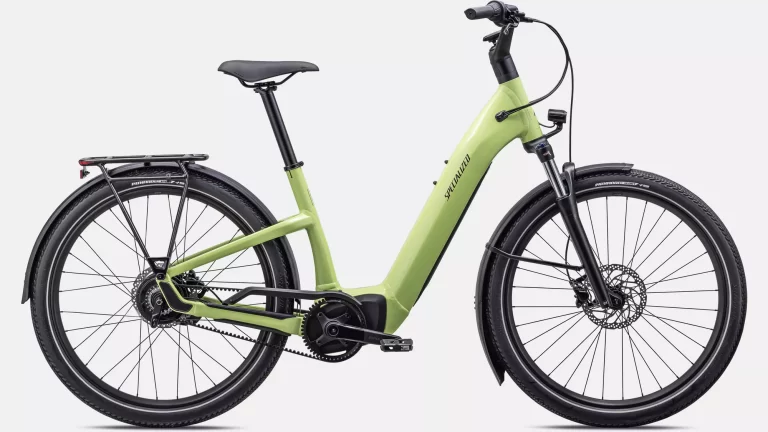
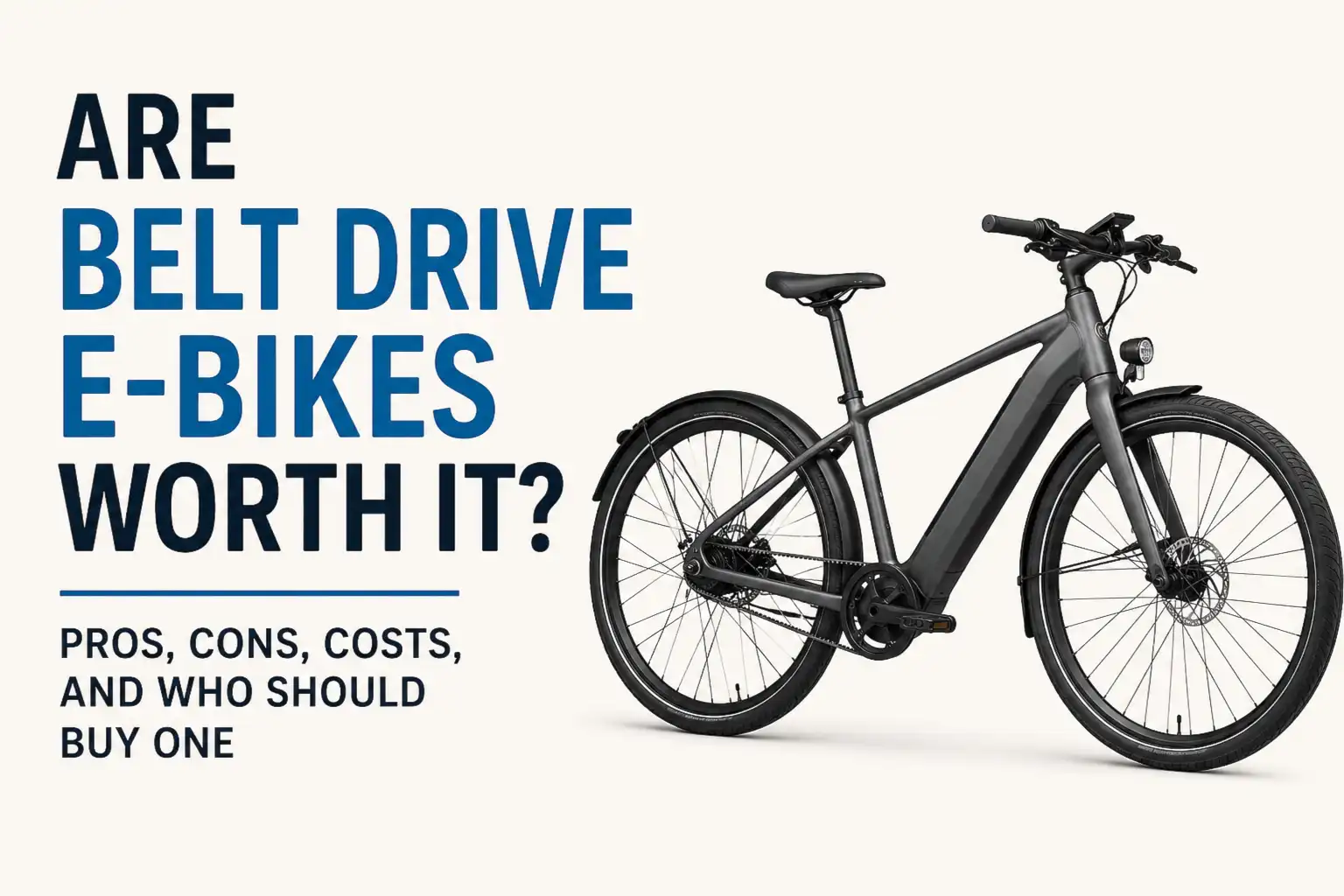
Instead of using a metal chain, a belt drive e-bike uses a reinforced carbon-fiber belt to transfer power from the pedals to the rear wheel.
Most belt drive systems use a Gates Carbon Drive belt, one of the most recognized belt drive systems in the cycling industry.
Unlike traditional chains:
- No lubrication is required
- No rust develops
- No greasy chain marks on clothing
- Fewer routine adjustments are needed
- Operation is usually quieter
Because there are no metal links rubbing together, belt drives often feel smoother and cleaner than traditional chain systems.
According to Gates Carbon Drive, belt systems are designed to provide quieter operation while requiring significantly less routine maintenance than traditional chain systems.
Why Can’t Every E-Bike Use a Belt Drive?
One of the biggest misconceptions about belt drive e-bikes is that any bike can be converted from a chain to a belt.
In reality, belt drives require a specially designed frame.
Unlike a chain, a belt cannot simply be separated and reconnected during installation. The frame must include a split or opening that allows the belt to pass through the rear triangle.
This specialized frame design is one reason many belt drive e-bikes cost more than comparable chain-driven models.
It also means converting a standard chain-drive e-bike to a belt drive is often impractical or impossible.
How Long Does a Belt Drive Last?
One of the biggest selling points of a belt drive e-bike is longevity.
Many e-bike chains need replacement somewhere between 2,000 and 5,000 miles, though actual lifespan depends heavily on riding conditions, rider power, weather exposure, and maintenance.
A quality carbon belt can often last significantly longer.
Many riders report getting 10,000 miles or more from a quality carbon belt system, although actual lifespan depends on riding conditions, alignment, weather exposure, and maintenance.
For commuters who ride daily, this can mean years of use before replacement becomes necessary.
Benefits of Belt Drive E-Bikes
Extremely Low Maintenance
This is the primary reason most riders choose a belt drive.
Traditional chains require:
- Cleaning
- Lubrication
- Rust prevention
- Adjustment
- Occasional replacement
A belt drive eliminates most of these tasks.
For busy commuters and casual riders, less maintenance can be a major advantage.
Cleaner Riding Experience
Nobody enjoys chain grease on pants, legs, hands, or vehicle interiors.
Since belt drives require no lubrication, they stay remarkably clean.
This makes them especially popular among:
- Commuters
- Office workers
- Apartment dwellers
- Recreational riders
Quiet Operation
Many riders are surprised by how quiet a belt drive system feels.
Without metal chain links engaging gears, belt drives generally produce less drivetrain noise.
Combined with a quiet mid-drive motor, the ride can feel exceptionally smooth and refined.
Excellent for Wet Weather
Rain, road salt, and moisture are common enemies of traditional bicycle chains.
Belt drives resist corrosion and require less attention after wet-weather riding.
For year-round commuters, this can be a significant benefit.
Organizations such as PeopleForBikes frequently highlight ease of ownership and reduced maintenance as factors that help encourage more people to choose bicycles and e-bikes for transportation.
How Much Maintenance Does a Belt Drive Actually Save?
For many riders, reduced maintenance is the single biggest reason to choose a belt drive e-bike.
Traditional chain-driven e-bikes typically require:
- Chain cleaning
- Chain lubrication
- Rust prevention
- Chain replacement
- Cassette replacement
A belt drive system eliminates many of these routine maintenance tasks.
You should still inspect the belt periodically and keep the drivetrain reasonably clean, but there is no lubricant to apply and no chain rust to worry about.
For commuters who ride several times per week, the convenience can be significant over the life of the bike.
That doesn’t mean chain-driven e-bikes are difficult to own. In fact, a properly maintained chain drivetrain can provide years of reliable service. If you’re riding a chain-driven e-bike, my E-Bike Chain Maintenance Guide walks through cleaning, lubrication, inspection, and replacement intervals to help keep your drivetrain running smoothly.
Regardless of which drivetrain you choose, every e-bike still requires periodic inspection and care. For maintenance schedules, battery care, brake adjustments, troubleshooting, and repair resources, visit my E-Bike Troubleshooting and Maintenance Hub.
If you’re new to e-bike maintenance, you may also find my E-Bike Maintenance Checklist helpful for staying on top of routine service tasks.
Why Many Belt Drive E-Bikes Use Internal Gear Hubs
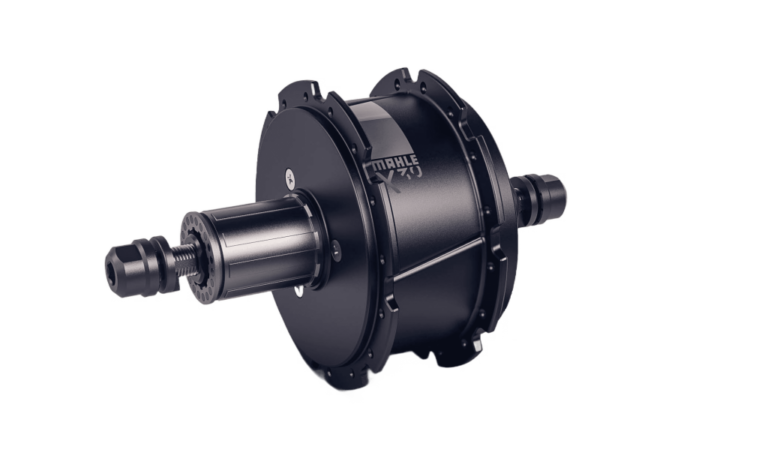
Many premium belt drive e-bikes pair the belt with an internal gear hub rather than a traditional derailleur system.
An internal gear hub contains the gearing inside a sealed rear hub, helping protect components from dirt, moisture, and weather.
Benefits often include:
- Lower maintenance
- Better weather protection
- Cleaner appearance
- Ability to shift while stopped on many systems
Popular internal gear hubs include:
- Shimano Nexus
- Shimano Alfine
- Enviolo
- Rohloff
Manufacturers such as Shimano and Enviolo have spent years refining internal gear hub systems specifically for commuters seeking lower maintenance and improved weather protection.
When combined with a belt drive, an internal gear hub creates one of the lowest-maintenance drivetrain setups available on an electric bike.
📖 Read Next
E-Bike Troubleshooting & Maintenance Guide
E-Bike Battery Guide: Types, Charging, Range, Lifespan, and Care
Understanding eBike Voltage: 36V vs 48V vs 52V — Which Is Right for You?
Top 10 E-Bike Maintenance Mistakes That Damage Your Motor (and How to Avoid Them)
E-Bike Software Updates: Why They Matter & How to Get Them
How to Build Your Own Ebike From Scratch
Drawbacks of Belt Drive E-Bikes
Higher Purchase Price
The biggest downside is cost.
Belt drive e-bikes often cost several hundred dollars more than comparable chain-driven models.
Part of this comes from:
- Premium drivetrain components
- Specialized frame designs
- Internal gear hubs
- Lower production volumes
For budget-conscious buyers, the price difference may be difficult to justify.
Fewer E-Bike Options Available
Most electric bikes still use chains.
While the number of belt drive models continues to grow, you’ll generally find fewer choices compared to traditional chain-driven e-bikes.
Repairs Can Be More Specialized
Although belt drives require less maintenance overall, replacement parts may not be as widely available as standard bicycle chains.
Some riders may need to order specific replacement components rather than purchasing them locally.
Potentially Higher Repair Costs
While repairs are less frequent, some belt drive components can cost more to replace than standard chain drivetrain parts.
This isn’t usually a major issue for most riders, but it’s worth considering when comparing long-term ownership costs.
Are Belt Drive E-Bikes Cheaper to Own Long-Term?
A belt drive e-bike usually costs more upfront, but ownership costs may be lower over time.
Traditional chain-driven e-bikes may require:
- Multiple chain replacements
- Lubricants and cleaning products
- Cassette replacements
- Additional drivetrain maintenance
A belt drive system can reduce many of these expenses.
While the savings may not completely offset the higher purchase price, many riders find the reduced maintenance and convenience worthwhile over several years of ownership.
For frequent commuters, the time saved on maintenance may be just as valuable as the money saved on replacement parts.
It’s also worth remembering that drivetrain costs are only one part of e-bike ownership. Battery replacement, tires, brake pads, and other wear items can affect long-term costs as well.
If you’re planning for long-term ownership, check out my E-Bike Battery Guide and Battery Replacement Cost Calculator to better understand future expenses.
Are Belt Drive E-Bikes Better Than Chain Drive E-Bikes?
The answer depends entirely on your priorities.
Belt Drive Is Usually Better If You:
- Commute regularly
- Ride in all weather conditions
- Want minimal maintenance
- Prefer quieter operation
- Value long-term durability
- Dislike chain grease
- Store your bike in an apartment or shared living space
Chain Drive Is Usually Better If You:
- Want the lowest purchase price
- Frequently ride off-road
- Perform your own repairs
- Need easy access to replacement parts
- Want the largest selection of e-bike models
- Enjoy upgrading drivetrain components
For many riders, neither system is objectively better. They’re simply designed for different priorities.
If you’re still comparing overall e-bike categories, my Best Electric Bikes Guide breaks down the top choices across commuter, cargo, folding, fat tire, and comfort categories.
What Types of E-Bikes Benefit Most From Belt Drives?
Not every type of electric bike benefits equally from a belt drive system.
Commuter E-Bikes
Daily riders often benefit the most from the reduced maintenance and cleaner operation.
When you’re riding to work several days per week, not having to constantly clean and lubricate a chain becomes a meaningful advantage.
For specific recommendations, see my Best Commuter E-Bikes Guide.
Urban and City E-Bikes
City riders appreciate the quieter ride, cleaner operation, and lower maintenance requirements.
If most of your riding involves bike paths, paved roads, errands, and transportation around town, a belt drive can be an excellent fit.
Cruiser E-Bikes
Many casual riders prefer the simplicity of a belt drive because there is less upkeep between rides.
If you mainly ride for enjoyment, a belt drive allows you to spend more time riding and less time performing maintenance.
E-Bikes for Seniors
Many seniors appreciate not having to regularly lubricate, clean, or adjust a chain.
If comfort and ease of ownership are priorities, my Best E-Bikes for Seniors Guide includes several models worth considering.
Lightweight Commuter E-Bikes
Many premium lightweight commuter e-bikes now incorporate belt drive systems because they complement the clean, minimalist design philosophy that appeals to urban riders.
Who Should Consider a Belt Drive E-Bike?
Daily Commuters
This is arguably the ideal belt drive customer.
Organizations such as PeopleForBikes and the League of American Bicyclists regularly highlight convenience and low-maintenance transportation options as important factors in encouraging more people to ride regularly.
When you’re riding to work several days per week, the reduced maintenance becomes noticeable very quickly.
Urban Riders
City riders often appreciate the cleaner operation and lower maintenance requirements.
If your rides involve bike paths, paved roads, and errands around town, a belt drive can be a great fit.
Seniors
Many seniors prefer e-bikes that require less routine maintenance.
If convenience is a top priority, a belt drive system may be worth the additional investment.
Recreational Riders
If you simply want to ride and enjoy your e-bike without constantly thinking about drivetrain maintenance, belt drives are appealing.
Riders in Wet Climates
If you regularly ride in rainy areas or near coastal environments where corrosion can be an issue, the rust-resistant nature of a belt drive can be particularly attractive.
Essential E-Bike Gear (Quick Picks)
If you’re investing in a low-maintenance commuter e-bike, don’t forget the accessories that improve safety and convenience.
I recommend considering:
- Bike Lock – protect your investment
- Helmet – essential for safety
- Lights – ride safely in low visibility
- Storage (bags/racks) – carry gear easily
- Rearview Mirror – improve awareness in traffic
- Phone Mount – use navigation and track rides safely
- Tire Repair Kit – be prepared for unexpected flats on the road or trail.
- Portable Bike Pump – keep your tires properly inflated for the best ride quality and range.
Who Should Skip a Belt Drive E-Bike?
Budget Buyers
If you’re shopping for the best value under a specific budget, a traditional chain drive often makes more financial sense.
The money saved can sometimes be invested in:
- A larger battery
- Better brakes
- Higher-quality suspension
- Additional accessories
Some Off-Road Riders
While there are excellent belt-drive mountain bikes available, many mountain bikers still prefer chain systems because replacement parts are easier to find and trail-side repairs are more familiar.
DIY Mechanics
If you enjoy performing your own drivetrain upgrades and modifications, you’ll generally find far more aftermarket options available for chain-driven systems.
When Is a Belt Drive Not Worth the Extra Money?
A belt drive e-bike may not be worth the additional cost if:
- You ride only occasionally
- You’re shopping on a strict budget
- You already perform your own bike maintenance
- You enjoy upgrading drivetrain components
- You prioritize maximum gear range over low maintenance
In many cases, a quality chain-driven e-bike will deliver a very similar riding experience for less money.
The extra cost of a belt drive is easiest to justify when you ride frequently and want to spend less time maintaining your bike.
Common Myths About Belt Drive E-Bikes
Myth: Belt Drives Are Faster
Not true.
The drivetrain itself doesn’t significantly increase top speed.
Motor power, controller settings, gearing, rider weight, and terrain have a much larger impact on performance.
Myth: Belt Drives Never Need Maintenance
While maintenance requirements are lower, belt drives still require occasional inspections and proper tension.
Myth: Belt Drives Last Forever
They last much longer than most chains, but eventually they will wear out and require replacement.
Myth: Belt Drives Are Only for Expensive Bikes
While belt drives are more common on premium e-bikes, there are now several affordable commuter-focused models available that use belt drive systems.
Myth: Belt Drives Can’t Handle High Power
Modern carbon belt systems are capable of handling the power output of many mid-drive and hub-drive electric bikes when properly designed and maintained.
Popular Belt Drive E-Bikes Worth Considering
If you’re interested in a low-maintenance drivetrain, these are several well-known belt drive e-bikes worth researching. Availability and specifications can change over time, so always verify current details before purchasing.
Priority Current
The Priority Current is one of the most recognized commuter-focused belt drive e-bikes on the market.
Key highlights include:
- Gates Carbon Drive belt system
- Mid-drive motor
- Available Enviolo continuously variable transmission (CVT)
- Commuter-focused geometry
- Integrated lights and fenders on many configurations
For riders who want a premium commuting experience with minimal maintenance, the Priority Current remains one of the strongest options available.
Gazelle Ultimate C380+
Gazelle has built a strong reputation for comfortable, commuter-oriented electric bikes, and the Ultimate C380+ is one of its flagship models.
Notable features include:
- Gates Carbon Drive belt
- Enviolo internal gear hub
- Bosch mid-drive motor
- Upright riding position
- Integrated commuter accessories
This is often considered one of the most refined commuter e-bikes available, though it comes with a premium price tag.
Specialized Turbo Vado IGH
The Turbo Vado IGH combines Specialized’s proven commuter platform with a low-maintenance drivetrain.
Highlights include:
- Internal gear hub
- Belt drive system
- Powerful mid-drive motor
- Excellent ride quality
- Strong dealer support network
For riders who value local bike shop support and premium components, the Turbo Vado IGH is worth considering.
Ride1Up Roadster V3 (Belt Drive Version)
The belt-drive version of the Ride1Up Roadster V3 is one of the more affordable ways to experience the benefits of a carbon belt drivetrain.
Highlights include:
- Lightweight commuter-focused design
- Carbon belt drive option
- Torque sensor
- Hydraulic disc brakes
- Natural riding feel
Depending on the configuration, the Roadster V3 weighs significantly less than many commuter e-bikes, making it attractive for apartment dwellers and riders who occasionally need to carry their bike.
Read my full review of the Ride1up Roadster V3
Canyon Commuter:ON
The Canyon Commuter:ON combines a modern urban design with premium commuter-focused components.
Features may include:
- Gates belt drive
- Integrated lighting
- Lightweight frame
- Urban-focused geometry
For riders seeking a sleek city e-bike with low-maintenance ownership, it’s another option worth researching.
Should You Buy One of These Bikes?
If your priorities include:
- Low maintenance
- Daily commuting
- Quiet operation
- Long-term durability
- Clean ownership
then a belt-drive e-bike may be worth the additional investment.
However, if your primary goal is maximizing value or staying within a strict budget, a quality chain-driven e-bike can still be an excellent choice.
Looking for a Low-Maintenance E-Bike?
If you’re interested in belt drives because you want a cleaner, quieter, and easier-to-own electric bike, these guides can help:
- Best Electric Bikes
- Best Commuter E-Bikes
- Most Comfortable City E-Bikes
- Best E-Bikes for Seniors
- Belt Drive vs Chain Drive Guide
The drivetrain matters, but comfort, motor performance, battery range, rider fit, and intended use are just as important when choosing the right e-bike.
FAQs
Yes.
Belt drives resist rust and generally require less maintenance after wet-weather riding than traditional chain systems.
This makes them especially appealing to year-round commuters and riders who live in rainy climates.
Yes.
While uncommon, belts can wear out, become damaged, or eventually require replacement after many thousands of miles.
However, they generally last much longer than traditional bicycle chains.
Usually not.
Most belt drive systems require a specially designed frame that allows the belt to be installed through the rear triangle.
Unless the frame was designed for a belt drive, conversion is often impractical.
Yes.
Climbing performance depends primarily on motor power, torque output, gearing, rider weight and terrain. A belt drive itself does not significantly affect hill-climbing ability.
Yes.
Many premium commuter and urban e-bikes pair belt drives with mid-drive motors.
This combination is especially common on higher-end commuter models.
It depends.
Many casual riders appreciate the cleaner operation and reduced maintenance.
However, riders who only use their e-bike occasionally may find a traditional chain system offers better value.
No.
One of the biggest benefits of a belt drive is that it does not require chain lubricant.
Many riders report getting 10,000 miles or more from a quality carbon belt system.
Actual lifespan depends on riding conditions, weather exposure, belt alignment and overall maintenance.
Generally, yes.
Many riders notice less drivetrain noise compared to traditional chain systems, particularly when paired with a quiet mid-drive motor.
Many riders describe belt drives as smoother and quieter than traditional chains. While the difference isn’t dramatic, the reduced drivetrain noise and lack of chain vibration can make the ride feel more refined.
My Take
After researching and comparing countless electric bikes, I believe belt drive e-bikes are worth the extra money for many riders, particularly commuters and urban riders.
The biggest advantage isn’t speed or performance. It’s convenience.
Not having to clean, lubricate, and constantly monitor a chain may sound like a small benefit, but over several years of ownership it can save time, reduce frustration, and provide a cleaner riding experience.
I also think many buyers underestimate how nice it is to simply hop on the bike and ride without worrying about chain maintenance, rust, or grease getting on clothing.
That said, I don’t think every rider needs a belt drive.
If you’re shopping on a tighter budget, enjoy maintaining your own bikes, or only ride occasionally, a traditional chain-driven e-bike remains an excellent choice.
For me, the riders who benefit most from a belt drive are daily commuters, urban riders, and anyone who values low-maintenance ownership. If that sounds like you, a belt drive e-bike is one of the few upgrades you’ll likely appreciate every time you ride.
Disclosure: As an Amazon Associate, I earn from qualifying purchases. This comes at no extra cost to you and helps support the content on this site.
External Resources
- Gates Carbon Drive
- Shimano Nexus
- Shimano Alfine
- Enviolo
- PeopleForBikes
- League of American Bicyclists

Kristina is not just an enthusiast but a true authority on electric bikes. Nestled in the coastal beauty of Virginia, Kristina has found the perfect backdrop for her passion for electric biking. As a dedicated wife and homeschooling mom, her life revolves around family, faith, and the thrill of adventure.
Originally hailing from Ohio, Kristina's journey with electric bikes began as a curiosity and quickly evolved into a deep expertise. Her blog is a testament to her love for electric biking, combining her fascination for eco-friendly transportation with her coastal lifestyle.
When she's not cruising the beach on her electric bike, you'll find Kristina indulging in her other loves: long walks along the shore, getting lost in a good book, and cherishing moments with her loved ones. With a heart as big as her love for animals, especially cats, Kristina brings a unique perspective to the electric bike world, grounded in her strong faith in God and her dedication to a sustainable lifestyle.
Through her blog, Kristina shares her extensive knowledge of electric bikes, offering valuable insights, tips, and recommendations to fellow enthusiasts. Whether you're a seasoned rider or a newcomer to the electric bike scene, Kristina's blog is your go-to source for all things electric biking, fueled by her passion, expertise, and the scenic beauty of coastal Virginia.