How Far Does It Take an E-Bike to Stop? Understanding E-Bike Stopping Distance
Last Updated on June 3, 2026 by Kristina
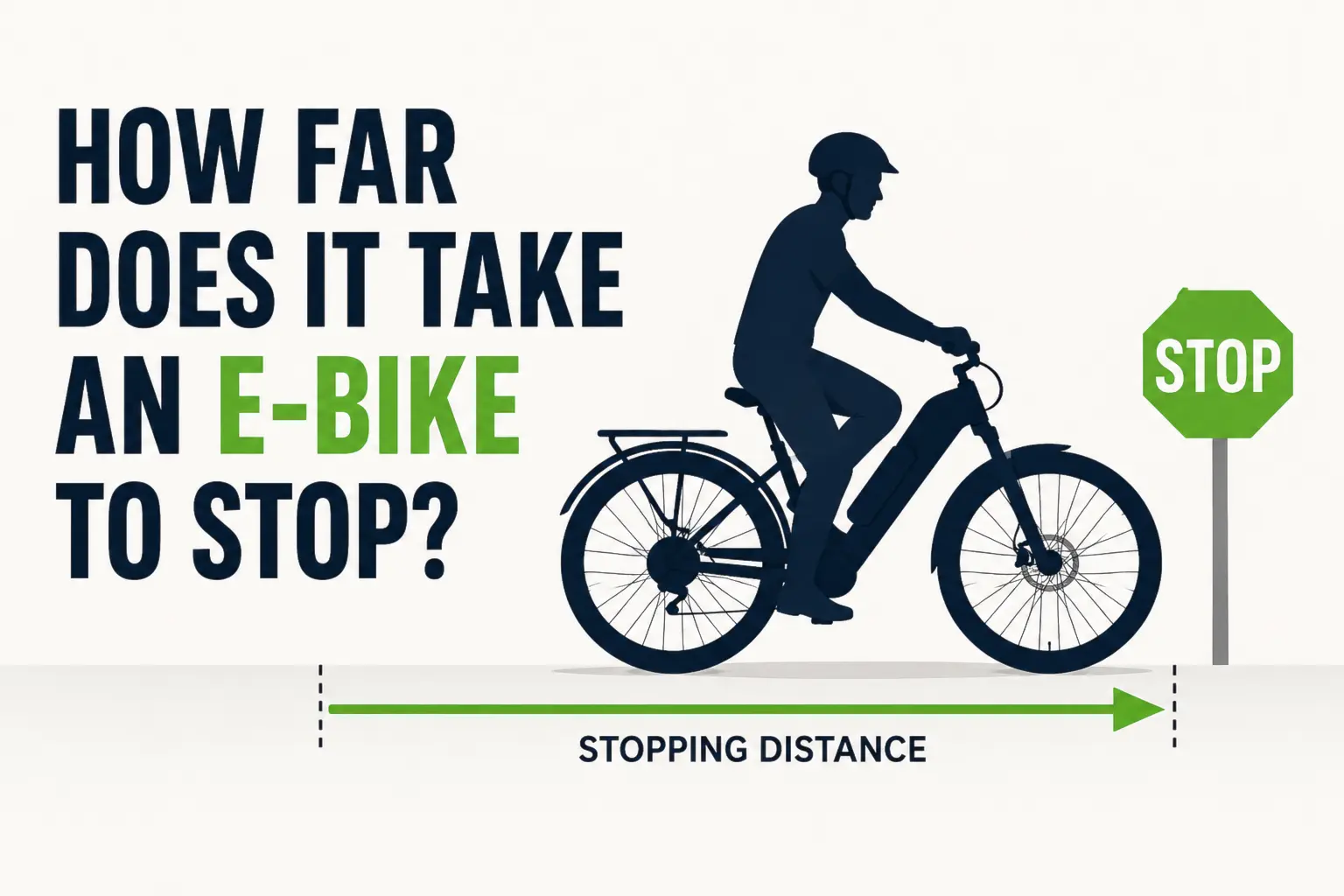
If you’ve ever wondered how far it takes an e-bike to stop, you’re asking one of the most important e-bike safety questions.
Many riders focus on motor power, speed, and range, but stopping distance is just as important. Whether you’re commuting, riding recreationally, or navigating busy bike paths, understanding e-bike braking distance can help you ride more safely and avoid accidents.
I’ve found that many new riders underestimate how much space they need to stop, especially when riding a faster Class 3 e-bike. That’s why understanding electric bike stopping distance is so important.
If you’re new to riding, I also recommend reading our E-Bike Buying Guide, Are E-Bikes Safe?, Why Are My E-Bike Brakes Weak?, and Can You Get an E-Bike Wet? guides for additional safety information.
How Far Does It Take an E-Bike to Stop?
The short answer is that most e-bikes require anywhere from about 10 feet to well over 100 feet to come to a complete stop, depending on speed, rider weight, braking system, road conditions, and reaction time.
Typical E-Bike Stopping Distance Estimates
| Speed | Estimated Total Stopping Distance |
|---|---|
| 10 mph | 10-20 feet |
| 15 mph | 20-35 feet |
| 20 mph | 30-60 feet |
| 28 mph | 60-120+ feet |
These figures include:
- Reaction distance
- Actual braking distance
Important: These are generalized real-world estimates, not guaranteed stopping distances. Actual stopping distance can vary significantly depending on rider reaction time, braking system, rider weight, tire traction, weather conditions, and road surface.
⚠️ E-Bike Safety Tip
At 20 mph, many riders travel nearly 30 feet before braking even begins due to reaction time alone.
At 28 mph, that number can exceed 40 feet.
Always leave more space than you think you’ll need, especially in traffic, on shared-use paths, around pedestrians, and during wet weather.
Why E-Bike Stopping Distance Matters
Stopping distance becomes increasingly important when:
- Riding in traffic
- Commuting to work
- Descending hills
- Riding on shared-use paths
- Carrying cargo
- Riding in wet conditions
- Operating a Class 3 e-bike
- Riding heavier fat tire e-bikes
I’ve personally noticed that riders often worry about going faster but rarely think about how quickly they can stop. In many situations, stopping ability matters more than acceleration.
What Makes Up Total E-Bike Stopping Distance?
Every stopping distance consists of two parts.
Reaction Distance
Reaction distance is the distance you travel before you even touch the brakes.
Most riders require approximately 0.75 to 1.5 seconds to recognize a hazard and begin braking.
At 20 mph, an e-bike travels roughly 29 feet per second.
That means you may travel 20 to 40 feet before braking even starts.
Braking Distance
Braking distance begins once the brakes are applied.
Braking distance depends on:
- Brake type
- Rider weight
- Bike weight
- Tire traction
- Road conditions
- Weather conditions
- Speed
Together, reaction distance and braking distance create your total stopping distance.
Why Faster E-Bikes Need More Room to Stop
Many riders assume a bike traveling 28 mph only needs slightly more stopping distance than one traveling 20 mph.
In reality, stopping distance increases dramatically as speed increases.
The reason is kinetic energy.
The amount of energy your brakes must dissipate increases exponentially as speed increases.
Because speed is squared in the kinetic energy equation, a relatively small increase in speed can lead to a much larger increase in stopping distance.
This is one reason many trail systems and local governments pay close attention to higher-speed electric bikes.
Real-World Example of E-Bike Braking Distance
Imagine you’re riding at 20 mph through a neighborhood.
A car suddenly backs out of a driveway.
Before your hands even reach the brakes, you may travel nearly 30 feet due to reaction time alone.
If braking requires another 20 to 30 feet, your total stopping distance could easily exceed 50 feet.
This is why maintaining a safe following distance is so important when riding an e-bike.
How Weather Affects E-Bike Stopping Distance
Wet pavement can significantly increase stopping distance.
Water reduces tire traction and can make emergency braking less effective.
Approximate Stopping Distance on Dry vs Wet Pavement
| Speed | Dry Pavement | Wet Pavement |
|---|---|---|
| 15 mph | 20-35 ft | 30-50 ft |
| 20 mph | 30-60 ft | 45-80 ft |
| 28 mph | 60-120+ ft | 90-150+ ft |
These are approximate ranges only and will vary based on braking systems, tires, rider weight, and surface conditions.
If you frequently ride in rain, see our guide on Can You Get an E-Bike Wet?
Factors That Affect E-Bike Stopping Distance
Brake Type
Not all e-bike brakes perform equally.
Hydraulic Disc Brakes
Benefits include:
- Strong stopping power
- Better modulation
- Better wet-weather performance
- Consistent braking
Mechanical Disc Brakes
Benefits include:
- Good stopping performance
- Easier maintenance
- Lower cost
Rim Brakes
Benefits include:
- Lightweight
- Inexpensive
However, rim brakes generally provide less stopping power than modern disc brakes and often perform worse in wet weather.
Many major e-bike manufacturers, including Aventon, Velotric, Trek, Specialized, and Cannondale, now equip higher-end models with hydraulic disc brakes because they generally provide stronger and more consistent braking performance than mechanical systems.
Rider and Bike Weight
Heavier bikes require more energy to stop.
This includes:
- Cargo e-bikes
- Fat tire e-bikes
- Hunting e-bikes
- Riders carrying gear or groceries
Many electric bikes weigh between 50 and 90 pounds before adding the rider.
Tire Traction
Your tires play a major role in braking performance.
Traction can be reduced by:
- Rain
- Gravel
- Sand
- Mud
- Wet leaves
- Ice
Even powerful brakes cannot stop effectively if your tires lose grip.
Hills and Descents
Downhill riding increases stopping distance because gravity continues pushing the bike forward even while braking.
This is why riders should reduce speed before entering steep descents.
Why Cargo E-Bikes Need More Stopping Distance
Cargo e-bikes are becoming increasingly popular for families, grocery runs, and business use.
A fully loaded cargo e-bike carrying children, groceries, or equipment may weigh more than twice as much as a traditional bicycle.
More weight creates more momentum, which generally increases stopping distance.
If you’re considering a cargo bike, be sure to leave additional space for braking and choose a model with quality hydraulic brakes.
Do Fat Tire E-Bikes Stop Faster?
Not necessarily.
Fat tires can improve traction on certain surfaces, but many fat tire e-bikes also weigh significantly more than standard commuter bikes.
In many cases, the added weight offsets some of the traction benefits.
Do E-Bikes Have ABS Brakes?
Some premium e-bikes now offer Anti-Lock Braking Systems (ABS).
ABS can help prevent wheel lockup during emergency braking and may help riders maintain control during panic stops.
ABS does not eliminate stopping distance, but it can improve stability and reduce the risk of losing control during hard braking.
While still uncommon, ABS technology is becoming more common on higher-end electric bikes.
Bosch has reported that anti-lock braking systems can help reduce wheel lockup and improve stability during emergency braking situations, particularly on loose or slippery surfaces.
Typical Stopping Distance by E-Bike Type
| E-Bike Type | Typical Stopping Distance Characteristics |
|---|---|
| Lightweight Commuter E-Bike | Generally shorter |
| Folding E-Bike | Generally shorter |
| Standard Hybrid E-Bike | Moderate |
| Fat Tire E-Bike | Moderate to longer |
| Cargo E-Bike | Longer |
| Hunting E-Bike | Longer |
| Moped-Style E-Bike | Longer |
For more information, see our guides on:
How to Reduce Your E-Bike Stopping Distance
Look Farther Ahead
The earlier you identify hazards, the more time you’ll have to react.
Maintain Your Brakes
Inspect regularly:
- Brake pads
- Rotors
- Brake cables
- Hydraulic systems
You may also find our Why Are My E-Bike Brakes Weak? guide helpful.
Slow Down in Poor Conditions
Reducing speed is one of the easiest ways to reduce stopping distance.
Use Both Brakes Properly
Most stopping power comes from the front brake.
Use both brakes smoothly and firmly for maximum control.
Maintain Proper Tire Pressure
Proper tire pressure helps maximize traction and braking performance.
How to Perform an Emergency Stop on an E-Bike
In an emergency situation:
- Keep your eyes focused ahead.
- Shift your weight slightly rearward.
- Apply both brakes smoothly and firmly.
- Avoid grabbing only the front brake.
- Maintain a straight line whenever possible.
- Stay calm and controlled.
Practicing emergency braking in a safe area can help improve your confidence and reaction time.
The League of American Bicyclists and other cycling safety organizations generally recommend practicing emergency braking in a safe, controlled environment so riders can better understand how their bike responds under hard braking.
Common E-Bike Stopping Distance Mistakes
Following Too Closely
Many riders underestimate how much room they need.
Riding Too Fast for Conditions
Wet roads, crowded trails, and steep hills all require additional stopping distance.
Ignoring Brake Maintenance
Worn brake pads reduce stopping performance and increase stopping distance.
Assuming E-Bike Brakes Work Like Car Brakes
Cars use four-wheel braking systems, larger tire contact patches, and often include ABS.
E-bikes require more rider skill and awareness.
🔎 How We Researched This Guide
This guide was created using bicycle braking principles, transportation safety resources, e-bike manufacturer recommendations, rider testing data, and established physics principles related to momentum, kinetic energy, and braking performance.
We reviewed bicycle safety guidance, braking performance research, and transportation safety resources to better understand how speed, rider weight, braking systems, tire traction, and weather conditions affect e-bike stopping distance.
Our goal is to provide practical, real-world information that helps riders make safer decisions while commuting, exercising, or enjoying recreational rides.
FAQs
A typical e-bike traveling at 20 mph may require approximately 30 to 60 feet to stop completely, depending on rider reaction time, braking system, rider weight, and road conditions.
In most situations, hydraulic disc brakes provide stronger and more consistent stopping performance, especially during wet-weather riding.
Not necessarily. Fat tires can improve traction on some surfaces, but the additional weight of many fat tire e-bikes may increase stopping distance.
Yes. Additional rider and cargo weight generally increase the amount of energy the brakes must dissipate, which can increase stopping distance.
Some premium electric bikes now offer ABS braking systems, although most consumer e-bikes still use hydraulic or mechanical disc brakes.
Final Thoughts
So, how far does it take an e-bike to stop?
The answer depends on many factors, but one thing is clear: stopping distance increases much faster than most riders expect.
Whether you’re riding a commuter e-bike, cargo bike, fat tire e-bike, or Class 3 electric bike, understanding braking distance can help you ride more safely and avoid accidents.
The safest riders aren’t necessarily the slowest riders.
They’re the riders who understand their stopping distance and always leave themselves enough room to react.
Not sure where to go next?
Some riders are brand new. Others are fixing a problem or thinking about a new bike. Choose what fits you.
Learn & Get Comfortable
Understand how e-bikes work and what to expect when riding.
Improve Your Current Ride
If your bike isn’t performing how you want, learn what affects speed, range, and power.
Compare Better Bikes
Looking for something that fits your riding style? Start here.
- Best Electric Bikes for Beginners
- Recommended Commuter Ebikes
- Most Comfortable City E-Bikes
- Best Fat Tire Ebikes
- Top Folding Ebikes
- Best Step Through Ebikes
- Top Cargo Electric Bikes
- Best Lightweight Ebikes
- Best Long Range Ebikes
- Top Moped Style E-Bikes
- E-bike Reviews
🛒 Ready to Buy?
Top picks and current availability from trusted brands.
👉 Still deciding?
Take our E-Bike Recommendation Quiz to get matched with the right riding style in under two minute
Sources
PeopleForBikes Bicycle Safety Resources
https://www.peopleforbikes.org
National Highway Traffic Safety Administration
https://www.nhtsa.gov
League of American Bicyclists Bicycle Safety Resources
https://bikeleague.org
U.S. Consumer Product Safety Commission Bicycle Safety Guidance
https://www.cpsc.gov

Kristina is not just an enthusiast but a true authority on electric bikes. Nestled in the coastal beauty of Virginia, Kristina has found the perfect backdrop for her passion for electric biking. As a dedicated wife and homeschooling mom, her life revolves around family, faith, and the thrill of adventure.
Originally hailing from Ohio, Kristina's journey with electric bikes began as a curiosity and quickly evolved into a deep expertise. Her blog is a testament to her love for electric biking, combining her fascination for eco-friendly transportation with her coastal lifestyle.
When she's not cruising the beach on her electric bike, you'll find Kristina indulging in her other loves: long walks along the shore, getting lost in a good book, and cherishing moments with her loved ones. With a heart as big as her love for animals, especially cats, Kristina brings a unique perspective to the electric bike world, grounded in her strong faith in God and her dedication to a sustainable lifestyle.
Through her blog, Kristina shares her extensive knowledge of electric bikes, offering valuable insights, tips, and recommendations to fellow enthusiasts. Whether you're a seasoned rider or a newcomer to the electric bike scene, Kristina's blog is your go-to source for all things electric biking, fueled by her passion, expertise, and the scenic beauty of coastal Virginia.